The Hamilton 992
Hamilton’s grade 992, a 16-size, 21-jewel pocket watch made at Lancaster, Pennsylvania, from 1903 to 1940: built to the rules the railroads set for their crews’ watches, and advertised by Hamilton as the most popular watch on American railroads for time inspection. The NAWCC Bulletin counts well over 600,000 made.
Made 1903 to 1940, at Lancaster, Pennsylvania, By Hamilton Watch Company, Now at Many survive in private hands; the National Air and Space Museum holds a 4992B navigation watch developed from it
Companies Hamilton
In the history America industrializes the watch
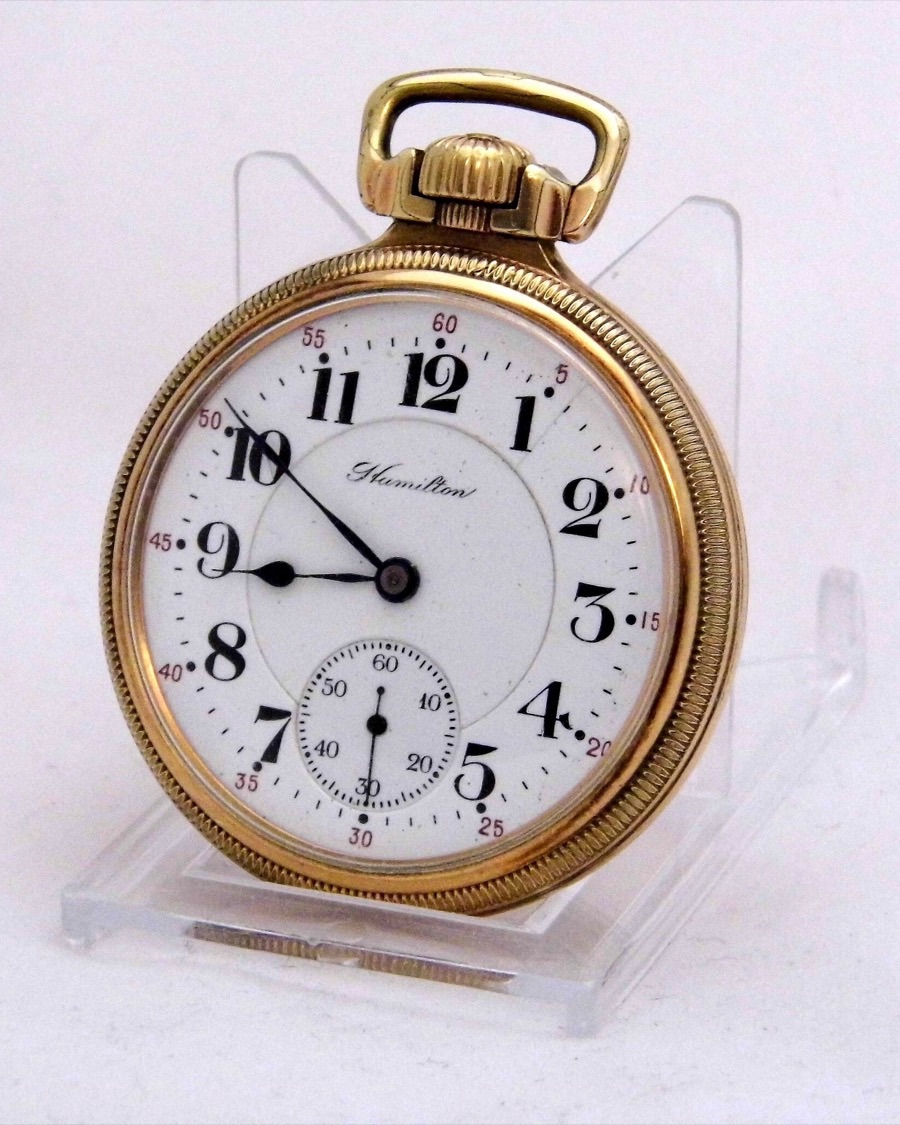
The watch
The NAWCC Bulletin records that as the market turned to smaller, thinner watches in the late 1890s, Hamilton’s superintendent Henry Cain designed bridge and three-quarter-plate 16-size movements; the best-selling was the 21-jewel grade 992, of which well over 600,000 were made between 1903 and 1940.1
Hamilton’s advertisement of May 1923 describes it as a 16-size, three-quarter-plate, 21-jewel movement adjusted to heat, cold, isochronism and five positions.4
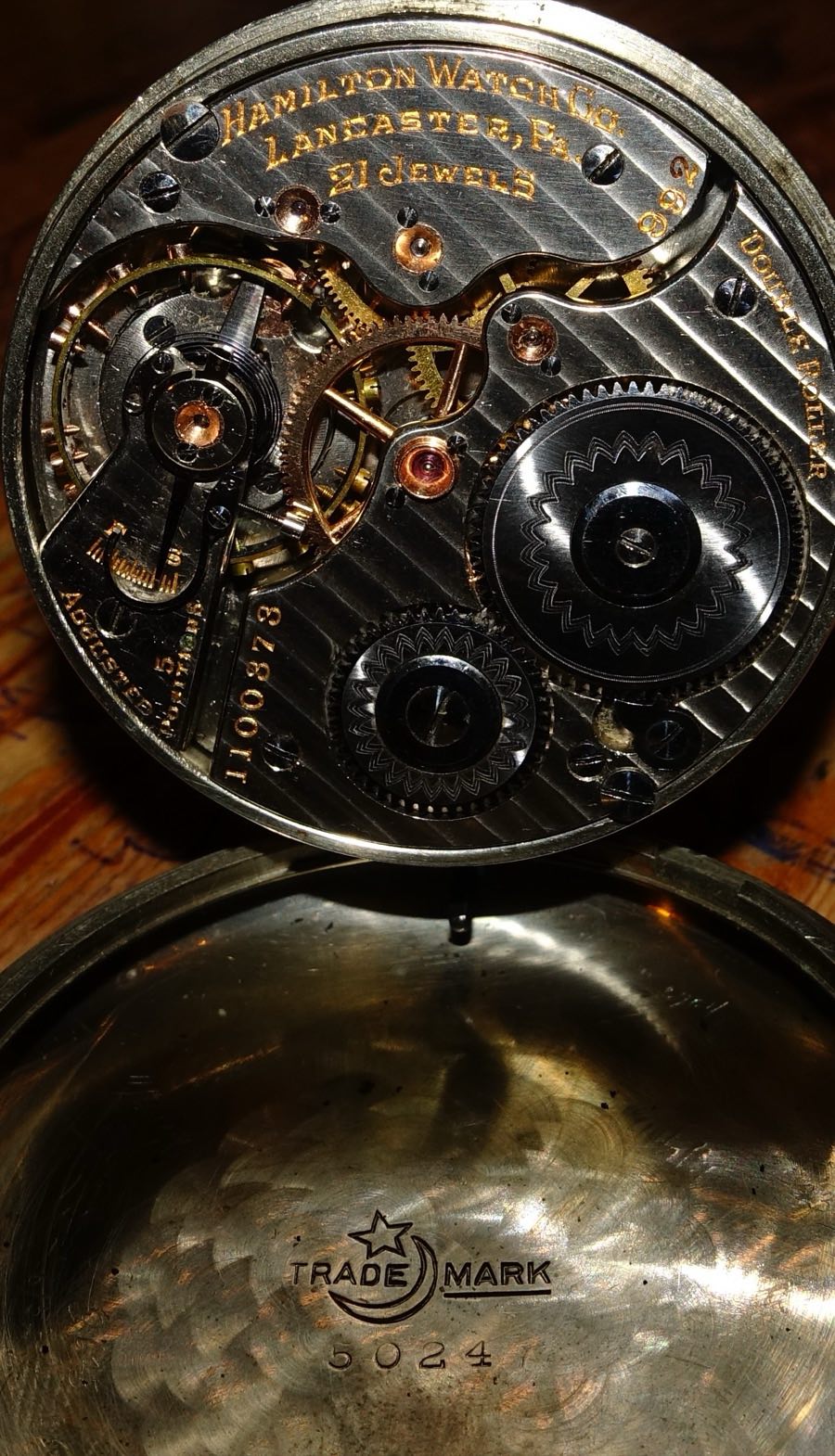
A surviving movement, photographed for Wikimedia Commons, is engraved Hamilton Watch Co., Lancaster, Pa., 21 Jewels, 992, Double Roller and Adjusted 5 Positions.6
What changed
Railroads set rules for the watches their crews carried, enforced by time inspectors such as Webb C. Ball after 1891; the story is told under railroad time.8, 9
Wikipedia’s account lists typical rules of the early twentieth century: 16 or 18 size, 17 jewels after 1895, adjustment to five positions and to temperature and isochronism, Arabic numerals after 1906, an open face with the crown at twelve, lever setting and a double-roller escapement after 1908, and no more than 30 seconds’ variation at a weekly check.9
The NAWCC Bulletin says Hamilton meant from the start to make only high-grade watches, aimed at the railroads’ need for watches that met established timekeeping standards.1
Hamilton sold the 992 on those rules: its advertisements say it would pass any official time inspection and perform more accurately than the standard set for time inspection on any railroad.2, 4
On the railroads
Hamilton’s advertisements in the Baltimore and Ohio’s staff magazine name the 940 and 992 as the most popular watches on American railroads for time inspection service in 1914–15, and the 992 alone in December 1921.2, 3
They sold it to the men who carried it: “the watch for railroad men”, an engineer of the Rock Island Lines beside a locomotive’s driving wheels, and a Rock Island conductor who says a 992 had timed his trains since 1910.3, 4
The NAWCC Bulletin records that General Pershing and the US Army Corps of Engineers chose the 992 for building rail lines in France in the First World War, and Admiral Byrd for his Antarctic expeditions.1
Since
In 1940 the 992B replaced it, and sold more than 525,000, the NAWCC Bulletin records; navigation watches such as the 4992B were developed from it for the Second World War.1
The National Air and Space Museum holds a Hamilton 4992B navigation watch.10
After the war Hamilton’s pocket watches were limited to a few models, among them the 992B; the watchmaker RGM says Hamilton stopped making the 992B in 1969.1, 11
Key dates
- 1892
The Hamilton Watch Company is founded at Lancaster.1, 12
- 1903
The NAWCC Bulletin dates the start of the 992’s production to 1903.1
- 1908
Railroad rules call for lever setting and a double-roller escapement.8, 9
- 1914
Hamilton’s advertisements name the 940 and 992 as the most popular watches on American railroads for time inspection.2
- 1921
Hamilton’s advertisements name the 992 alone as the most popular watch for time inspection.3
- 1940
The NAWCC Bulletin records the 992B replacing the 992.1
Where the Hamilton 992 leads
- Made by, CompanyHamilton
Hamilton made the 992 at Lancaster from 1903 to 1940, the NAWCC Bulletin records.1
- Part of, HistoryAmerica industrializes the watch
Hamilton’s best-selling 16-size movement, the NAWCC Bulletin records.1
- Part of, EventRailroad standard time
Hamilton’s advertisements name it the most popular watch on American railroads for time inspection service.2, 3
Facts and sources
- Made
- 1903 to 1940, at Lancaster, Pennsylvania1
- Maker
- Hamilton Watch Company1, 3
- Held by
- Many survive in private hands; the National Air and Space Museum holds a 4992B navigation watch developed from it1, 10
Sources
- 1
The Hamilton Watch Co.: Mass-Producing Excellence (opens in a new tab)
- 2
Baltimore and Ohio Employes Magazine, vol. 3 (1914-15) (opens in a new tab)
- 3
Baltimore and Ohio Magazine, vol. 9 (1921-22) (opens in a new tab)
- 4
Baltimore and Ohio Magazine, vol. 11 (1923-24) (opens in a new tab)
- 5
- 6
Movement of a Hamilton 992 railroad grade pocket watch, circa 1914 (opens in a new tab)
- 7
- 8
- 9
- 10
Watch, Navigation, Hamilton 4992B, AN5740 (opens in a new tab)
- 11
- 12
Sources read November 12, 2026.