Railroad standard time
How North America’s railroads replaced dozens of local times with standard time zones on 18 November 1883, how their crews’ watches came under inspection after the Kipton collision of 1891, and how the zones became federal law in 1918.
1883 to 1918: the railroads changed on 18 November 1883; federal law from 19 March 1918
In the histories America industrializes the watch, From the pocket to the wrist
Local time
Before standard time, towns kept their own local time; the Library of Congress counts over 144 local times in North America, and an estimated 80 different times still in use along the railroads in the early 1880s.1
According to Wikipedia’s account of railway time, a collision at Valley Falls in New England in August 1853, where conductors’ watches disagreed, was an early warning, and Charles F. Dowd proposed a system of national times for the railroads in 1870, which their managers rejected.3
The Library of Congress dates Sandford Fleming’s proposal of a single world time, on a 24-hour clock, to his memoir Terrestrial Time of 1876, and a committee on standard time to 1879, set up at Cleveland Abbe’s urging.1
The day of two noons
In October 1881 the railroads’ General Time Convention asked its secretary, William F. Allen, publisher of the Traveler’s Official Railway Guide, to work out a plan.1, 3
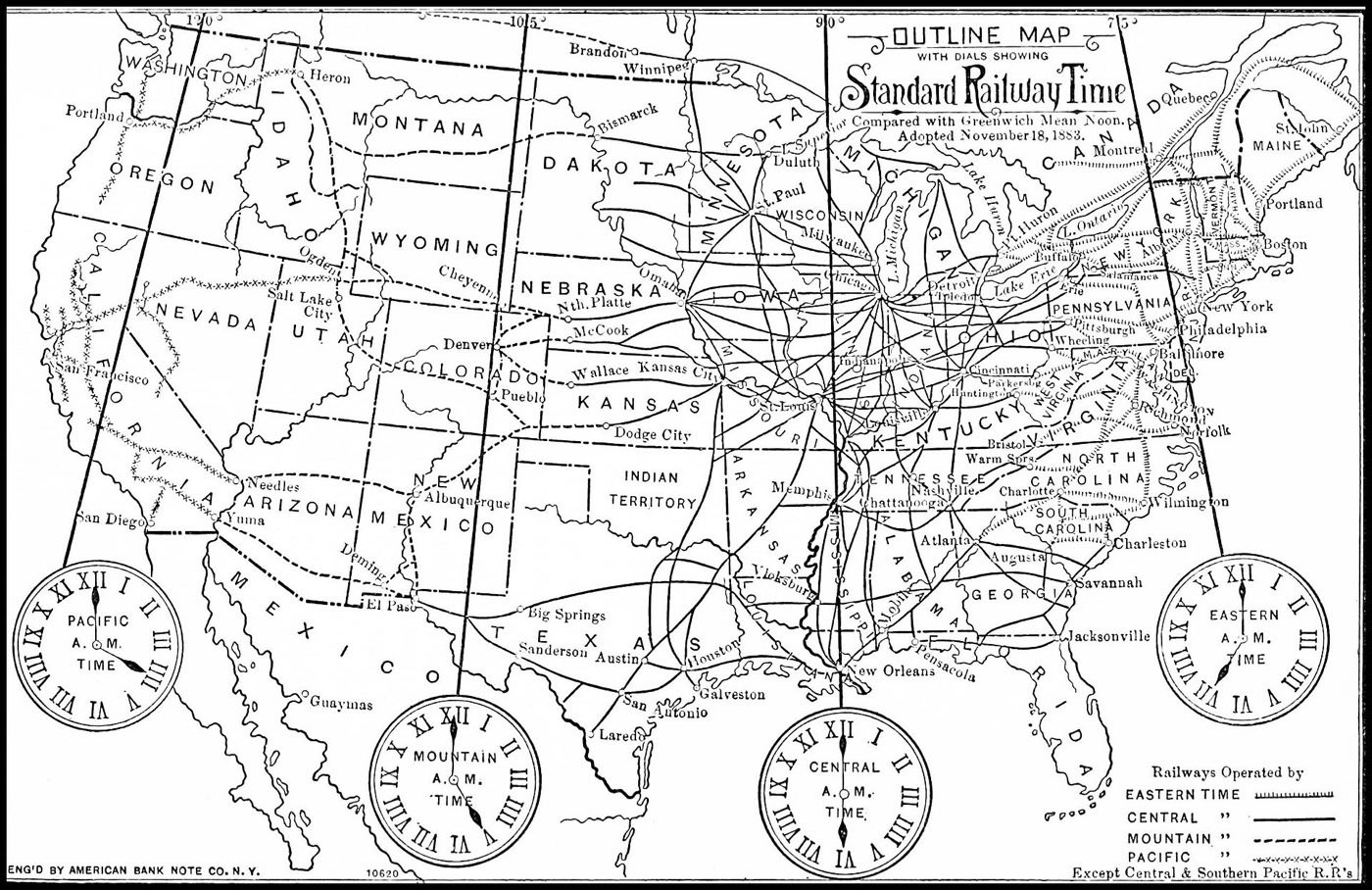
On 11 October 1883, at the Grand Pacific Hotel in Chicago, Allen put his plan to the railroad officials, who voted for it: zones an hour apart, each keeping the mean time of the 75th, 90th, 105th or 120th meridian west of Greenwich.1, 3, 8
At noon on 18 November 1883 the railroads’ clocks were reset to the new standard, and in several cities the clocks struck noon twice. The Naval Observatory and the Allegheny Observatory in Pittsburgh sent telegraph signals to set the clocks.1, 2, 3
Not everyone welcomed it: according to Wikipedia’s account, the Indianapolis Sentinel of 17 November complained that people would now have to live their lives by railroad time.3
In October 1884 Allen sat as a United States delegate at the International Meridian Conference in Washington and described the railroads’ new standard times on those meridians; the conference then chose the Greenwich meridian as the initial meridian for longitude.8, 10
The railroad watch
Wikipedia’s account says railroads set rules for their crews’ watches from the 1850s and 1860s, and that the American Railway Association produced a fairly standard set of requirements in 1887.11
On 18 April 1891 two trains of the Lake Shore and Michigan Southern collided near Kipton, Ohio. Wikipedia gives nine dead and a conductor’s watch that had stopped for about four minutes; a report published the next day counts eight dead, says blame was hard to fix, and does not mention a watch; the Encyclopedia of Cleveland History speaks of an accident caused by an inaccurate watch that killed 13.4, 5, 12
The railroad turned to the Cleveland jeweller Webb C. Ball; a newspaper of 1902 reports his appointment as chief watch inspector of the whole Vanderbilt system.4, 12, 13
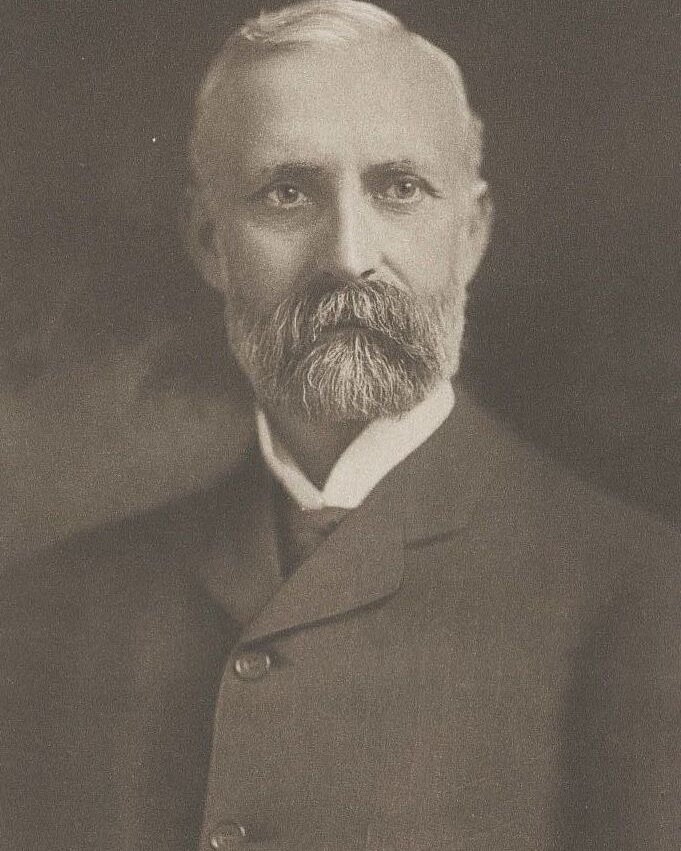
The Encyclopedia of Cleveland History says Ball ran a Railroad Time and Watch Inspection Service from his Cleveland business and extended it to three-quarters of the country’s railroads, some 125,000 miles of track.12
Wikipedia’s accounts give Ball’s requirements as resistance to magnetism, good timekeeping in five positions, a standard dial and a record for each watch, and date later rules to 1895 (seventeen jewels), 1906 (Arabic numerals) and 1908 (the crown at twelve, lever setting and a double-roller escapement).4, 11
Wikipedia’s account says Waltham, Elgin and most other American makers built watches to these standards, and Ball’s own company sold watches using their movements; Hamilton built its name on them.4
Standard time becomes law
NIST notes that most cities adopted railway time but that it was a matter of local dispute for nearly a decade.2
The Standard Time Act, “an Act to save daylight and to provide standard time for the United States”, was signed on 19 March 1918. It put the zones into federal law, gave the Interstate Commerce Commission the power to fix their limits, and brought in daylight saving time.1, 2, 6
Daylight saving did not last: its section was repealed in August 1919, over President Wilson’s veto. The Uniform Time Act of 1966 set the rules that followed.1, 6
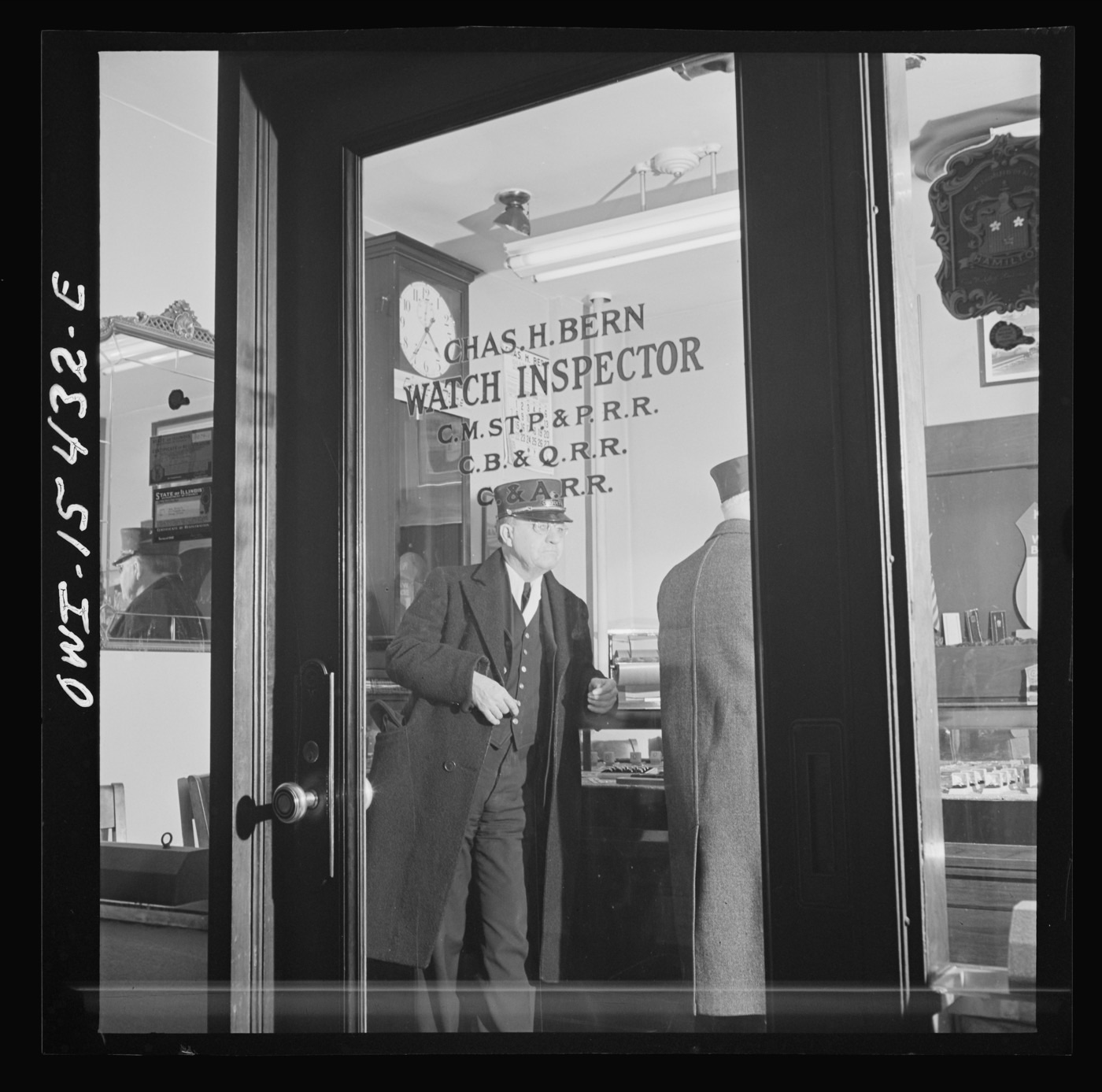
Inspection went on for decades: in 1943 a government photographer recorded railroad men having their watches checked at the inspector’s office in Chicago’s Union Station.15
Key dates
- 1870
Charles F. Dowd proposes standard times for the railroads.1, 3
- 1881
The General Time Convention asks William F. Allen for a plan.1, 3
- 1883
The railroads adopt standard time, 18 November.1, 2, 3
- 1884
Allen describes the railroad zones at the Washington meridian conference, which chooses Greenwich.8, 10
- 1891
The Kipton collision, 18 April; the railroad turns to Webb C. Ball.4, 5, 12
- 1902
Ball named chief watch inspector of the Vanderbilt system.13
- 1918
The Standard Time Act, 19 March, makes the zones federal law.1, 2, 6
- 1919
Daylight saving repealed over the President’s veto.1, 6
Where Railroad standard time leads
- In this story, ObjectThe Hamilton 992
Hamilton’s advertisements name it the most popular watch on American railroads for time inspection service.16, 17
- Part of, HistoryAmerica industrializes the watch
Standard time and the inspected railroad watch set the standards of the American industry.1, 2, 3, 4, 11, 13
- Part of, HistoryFrom the pocket to the wrist
Where the pocket watch held its ground: railroad rules still called for open-faced pocket watches.11, 15
- See also, CompanyHamilton
Hamilton marketed its watches for railroad accuracy, the company says.18, 19, 20
- See also, CompanyWaltham
A jeweller’s advertising card describes Waltham models as standards for railroad service.21
- See also, PlaceElgin, Illinois
Briska names the B. W. Raymond, Father Time and Veritas as Elgin models accepted for railroad service.22
- See also, PlaceGreenwich
A year after North America’s railroads adopted standard time, the 1884 Washington conference chose Greenwich as the meridian for longitude and proposed a universal day counted from it.3, 8, 10
- See also, EventThe International Meridian Conference
William F. Allen, secretary of the railroads’ time conventions, sat as a delegate and described the zones the railroads had adopted in 1883.1, 8
Facts and sources
- Period
- 1883 to 1918: the railroads changed on 18 November 1883; federal law from 19 March 19181, 2, 6
- Where
- United States and Canada1, 3
- Turning point
- Before, towns and railroads kept dozens of local times; from 18 November 1883 the railroads ran on standard zones an hour apart, which federal law adopted in 1918.1, 2, 6
Sources
- 1
- 2
- 3
- 4
- 5
Pittsburg Dispatch, 19 April 1891, page 1 (Chronicling America) (opens in a new tab)
- 6
- 7
- 8
- 9
Outline map of standard railway time, Popular Science Monthly, 1884-85. (opens in a new tab)
- 10
- 11
- 12
- 13
The Billings Gazette, 7 November 1902, page 7 (Chronicling America) (opens in a new tab)
- 14
Webb C. Ball, from a 1914 Cleveland publication (Cleveland Public Library). (opens in a new tab)
- 15
- 16
Baltimore and Ohio Employes Magazine, vol. 3 (1914-15) (opens in a new tab)
- 17
Baltimore and Ohio Magazine, vol. 9 (1921-22) (opens in a new tab)
- 18
- 19
The Hamilton Watch Co.: Mass-Producing Excellence (opens in a new tab)
- 20
Hamilton Watch Company advertisement, Baltimore and Ohio Magazine, October 1921 (opens in a new tab)
- 21
Waltham Railroad Watches (advertising card, ca. 1870s-1910s) (opens in a new tab)
- 22
Sources read November 12, 2026.