Waltham
The Massachusetts company, begun at Roxbury in 1849–50 and at Waltham from 1854, that showed watches could be made by machine from interchangeable parts. As the American Waltham Watch Company it supplied railroad watches and the world, until it closed its factory in 1950.
Founded 1850 (the venture began in 1849), Roxbury, Boston; at Waltham, Massachusetts, from 1854
In the history America industrializes the watch
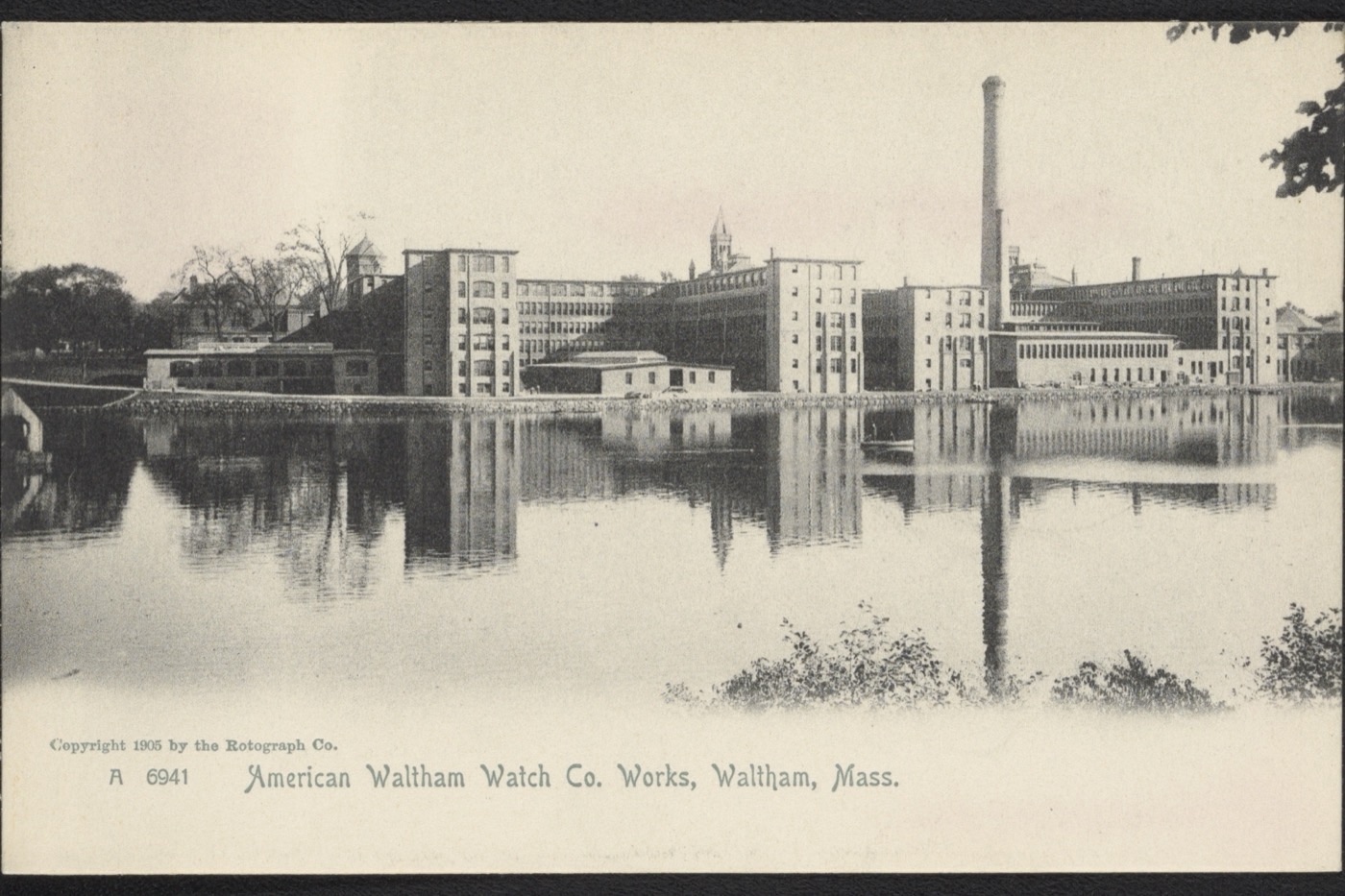
Beginnings
The company grew out of the venture Edward Howard and Aaron Dennison began in 1849–50 in the Howard & Davis clock factory at Roxbury.1, 2, 3
Its early names are given differently: Abbott’s history of 1888 gives American Horologe Company, then Warren Manufacturing Company, then Boston Watch Company, while Wikipedia’s accounts date the Boston name to 1853 or 1854.2, 5, 6
It moved to Waltham in 1854, with about ninety workers at the start; Abbott gives about five watches a day, Wikipedia thirty a week.4, 5, 6

The method
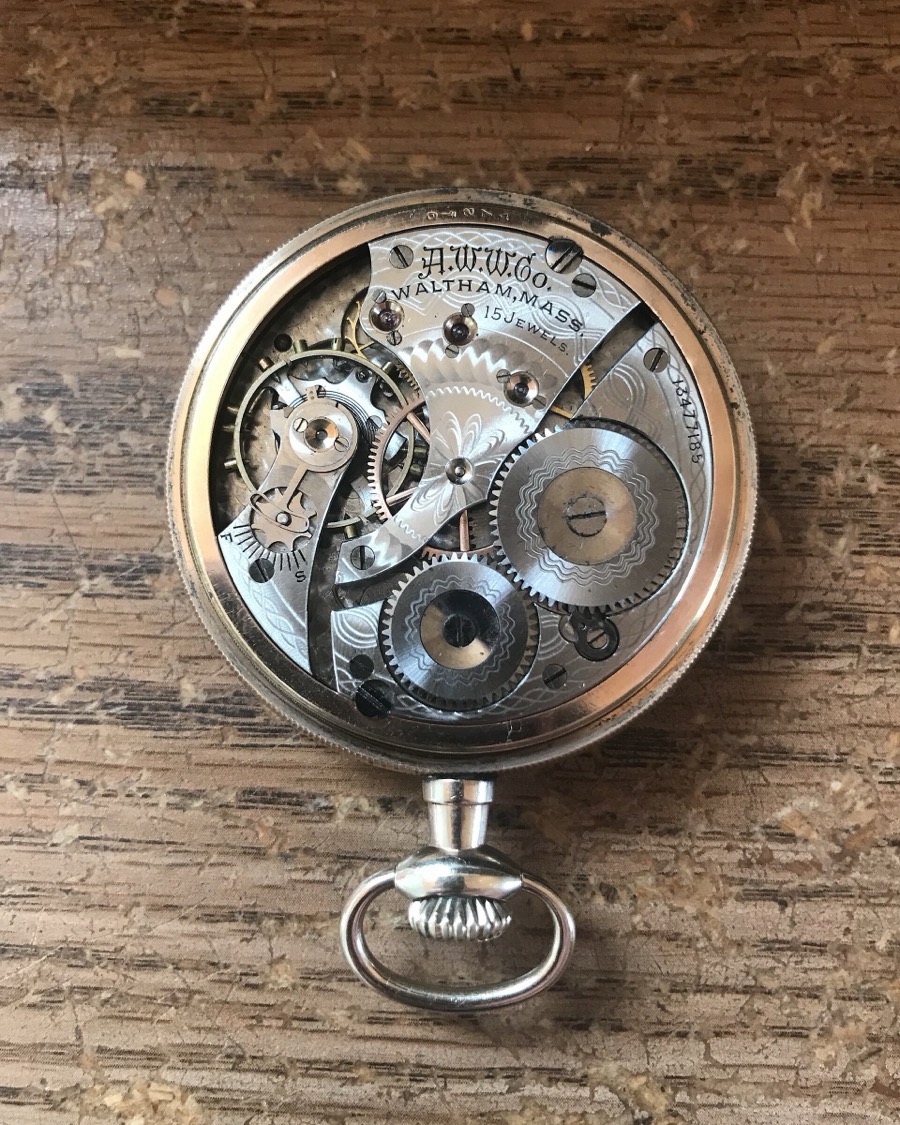
Waltham’s makers redesigned the watch so that its movement could be built from interchangeable parts made on special machines, and measured every part against a model and a set of master gauges.1
The watches of 1852–53 were large eight-day watches, followed by a simpler design with one going barrel; a batch of nine hundred sold for $40 each, cased, half the price of a comparable imported movement.1
The Library of Congress survey calls it the first civilian industry to use interchangeable parts, and says it spurred many other watch and watch-tool firms around Waltham.4
Under Robbins
In 1857 the company failed. Abbott says Royal E. Robbins bid $56,500 for the works; Wikipedia gives a sheriff’s auction after foreclosure and $56,000.5, 6
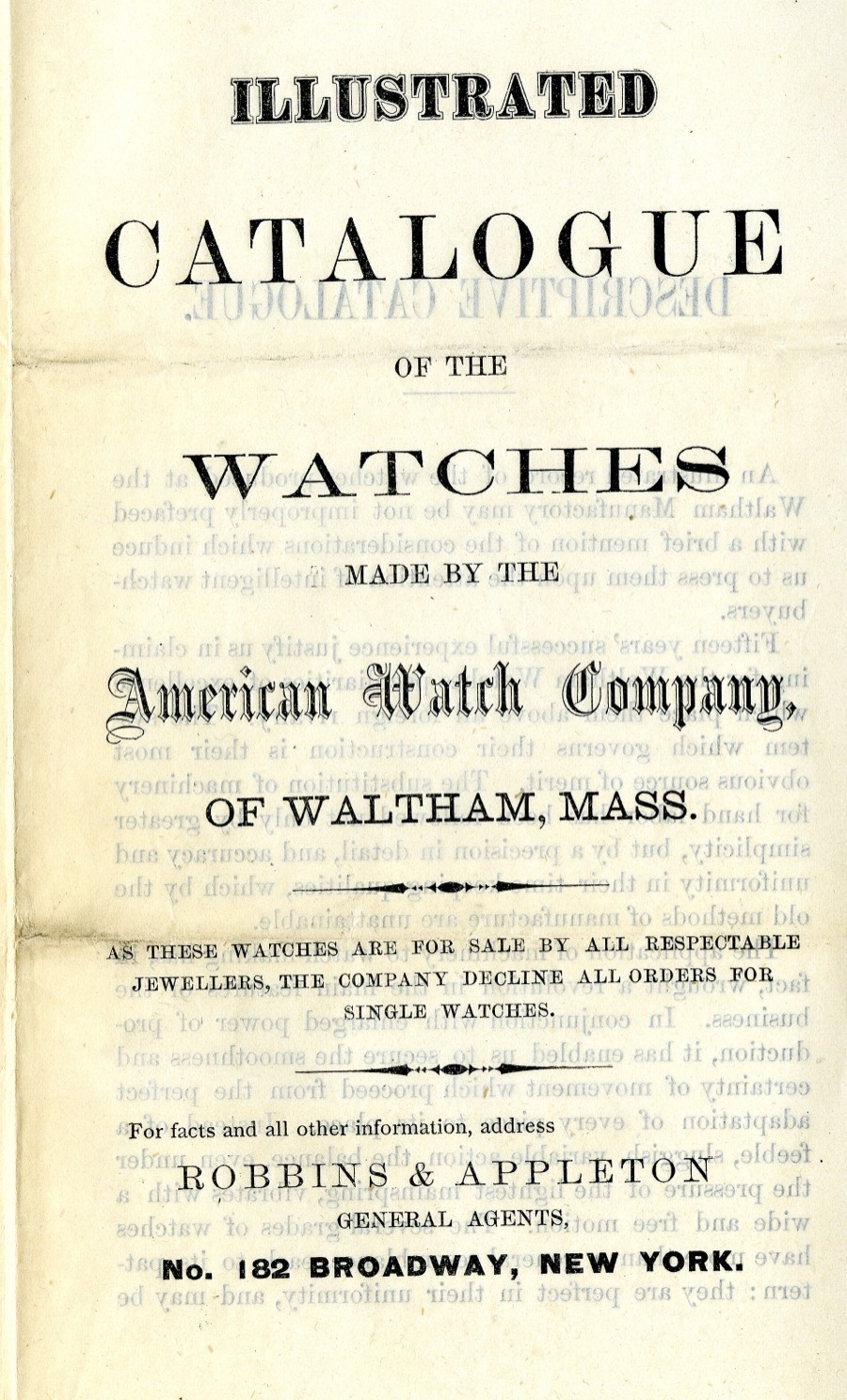
Contemporary prints name it the American Watch Company, and in 1885 it became the American Waltham Watch Company.5, 6, 10
At the Centennial Exhibition in Philadelphia in 1876 it showed automatic screw-making machinery and the official list of awards named it for its watches, its machinery and “a system of watch-making”; and Jacques David’s report on American watchmaking for the Swiss described the making of a watch step by step, probably largely from what he saw at Waltham.5, 6, 11, 12, 13
Wikipedia’s account says demand rose in the Civil War, when its $13 William Ellery model sold well, and that afterwards Waltham became a main supplier of railroad watches; a jeweller’s card names its Vanguard, Crescent Street and Riverside models as standards for railroad service.5, 14
The end of the factory
According to Wikipedia’s account, it made time fuses, speedometers and other instruments in the First World War; creditors took control in 1921; the company went bankrupt in 1949 and the factory closed on 3 February 1950, putting 1,200 people out of work; and in 1957 it became Waltham Precision Instruments, the Waltham name passing to other firms for watches.5
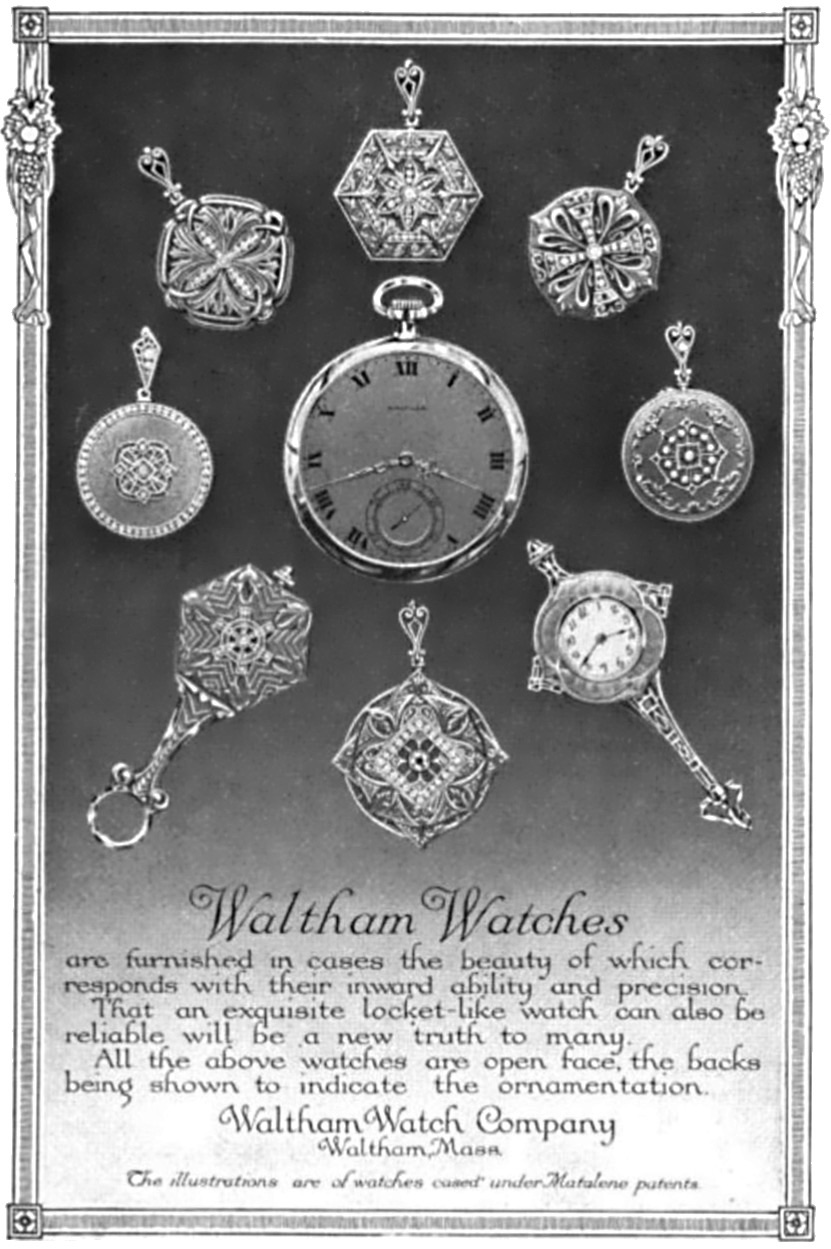
Wikipedia’s account puts its lifetime output at about 40 million watches, clocks and instruments, and records that its nineteenth-century buildings are preserved as the American Waltham Watch Company Historic District.5
Where Waltham leads
- Founded by, PersonAaron Lufkin Dennison
Dennison and Edward Howard started the venture at Roxbury in 1849–50.1, 2, 3
- Developed, TechnologyInterchangeable parts
Waltham’s makers built watches from parts made on special machines and checked against master gauges.1
- Made, SpecificationThe A-11
The Henry Ford's A-11 is a Waltham.16, 17
- Made, ObjectThe American Watch Company prototype
Oliver B. Marsh made the prototype for the venture that became the American Watch Company of Waltham.1
- Based in, PlaceWaltham, Massachusetts
The company built its factory on Waltham’s South Side in 1854 and made watches there until 1950.4, 18, 19
- Part of, HistoryAmerica industrializes the watch
Waltham was where the method was proved, from 1854.1, 4, 5, 6
- See also, HistoryFrom the pocket to the wrist
Donzé argues that Waltham stayed with pocket watches, a factor in its 1949 bankruptcy.20
- See also, HistoryJapan builds a watch industry
Donzé says Waltham refused Hattori machines in 1899 and sold them in 1906.21
- See also, EventRailroad standard time
A jeweller’s advertising card describes Waltham models as standards for railroad service.14
- See also, EventThe First World War
The Waltham company made time fuses and speedometers in the war, Wikipedia says.5
- See also, EventThe Philadelphia Centennial Exhibition
Favre-Perret records Waltham’s display of 2,200 watches and its claim of 425 a day, and David describes its factory workshop by workshop.22, 23
Facts and sources
- Founded
- 1850 (the venture began in 1849)1, 2, 5
- Founded in
- Roxbury, Boston; at Waltham, Massachusetts, from 18541, 3, 4
- Founders
- Aaron Lufkin Dennison and Edward Howard1, 2, 3
Sources
- 1
American Watch Company Prototype (NMAH 1204764) (opens in a new tab)
- 2
- 3
- 4
- 5
- 6
- 7
American Waltham Watch Co. Works, Waltham, Mass. Postcard, 1905. (opens in a new tab)
- 8
- 9
- 10
Works of the American Watch Company, Waltham, Mass. (opens in a new tab)
- 11
- 12
- 13
- 14
Waltham Railroad Watches (advertising card, ca. 1870s-1910s) (opens in a new tab)
- 15
Waltham Watch Company advertisement, The American Magazine, October 1913. (opens in a new tab)
- 16
Type A-11 Navigation Wrist Watch, 1943-1945 (opens in a new tab)
- 17
Military Watches of the World: A-11, the Watch That Won the War (opens in a new tab)
- 18
- 19
- 20
Watchmaking in 1927: major structural changes (opens in a new tab)
- 21
- 22
- 23
Sources read November 12, 2026.