Histories, Era III, The industrial watch
From the pocket to the wrist
1880 to 1930
How the wristwatch went from a woman’s bracelet to the ordinary watch between the 1880s and the 1930s: cyclists, soldiers and airmen who strapped watches to their wrists, the First World War that made it respectable for men, Swiss small movements and shaped cases, and the sealed, self-winding and shock-protected watches that by the early 1930s outsold the pocket watch in Swiss exports.

In short
In 1880 a man kept his watch in his pocket on a chain; a watch on the wrist was a lady’s bracelet, and a man who wore one risked being mocked. Cyclists, soldiers and airmen began strapping watches to their wrists because it was handy, and the First World War made the habit respectable for millions of men. In the 1920s Swiss makers answered with small movements, shaped cases, cases sealed against water and dust, and watches that wound themselves. By the early 1930s Switzerland was exporting more wristwatches than pocket watches, and the pocket watch held on mainly where rules required it, as on the railways.1, 2, 3, 4, 5, 22
Part 1
A jewel for the wrist
For most of the nineteenth century a watch worn on the wrist was a piece of women's jewellery; Wikipedia says early 'wristlets' were made almost entirely for women for about a hundred years, while men kept to the pocket watch into the early twentieth century.1, 2, 25
Breguet's archives record that Caroline Murat, Queen of Naples, ordered 'a repeater watch for bracelet' on 8 June 1810 for 5,000 francs; watch no. 2639, a thin oval repeater on a wristlet of hair and gold thread, was sold to her on 5 December 1811. Breguet calls it the first wristwatch ever known; it was last seen at Breguet for repair in 1855, and no collection lists it today.1, 26, 27
Patek Philippe dates 'the first Swiss wristwatch' to 1868, made for Countess Koscowicz of Hungary; the date comes from the company's own timeline, and Wikipedia repeats it.1, 28
'First' depends on definitions. Wikipedia mentions an 'armed watch' given to Elizabeth I in 1571 and calls a bracelet watch of 1806 for Joséphine de Beauharnais the oldest surviving; Breguet claims 1810 and Patek Philippe 1868 for Switzerland; Cartier calls its Santos of 1904 one of the first. None of these was the start of a continuous product line for men.1, 26, 28, 29
Wristwatches stayed a fashion item for women well into the 1920s. A Gazette du Bon Ton plate of 1922 shows 'bracelets et bracelets-montres' side by side, all to be made in gold, and Donzé describes the ladies' watch as a market the industry created, 'displayed on the wrist' as an accessory.3, 30
Part 2
A man’s watch goes in the pocket
Men resisted. A 1919 book written for Ingersoll says the wrist-watch 'had been often ridiculed as effeminate'; the Smithsonian curator Carlene Stephens told CBC that before the war wrist-worn watches 'were seen as effeminate', and CBC quotes a 1916 New York Times article calling them a 'silly-ass fad'.2, 25, 31
Even its defenders admitted the paradox: the same 1919 book notes that the wrist-watch had first been adopted 'as an obvious convenience in the Army and on the hunting-field', two of the most masculine settings it could imagine.2
Sport found uses for it early. In 1893 Henry Wood & Co. of London advertised a 'Cyclist Watch Wristlet' with a nickel watch for 17s 6d; the advertisement calls it 'the only way to carry a watch on a Cycle without injuring it'.32
Many early men's 'wristlets' were simply leather cups that held a small pocket watch. A registered design of 2 September 1893 granted to Arthur Garstin shows such a strap, with a compass; Wikipedia describes the Garstin design as a patented 'Watch Wristlet'.1, 33
Purpose-built wrist cases followed: Wikipedia says the Swiss firm Dimier Frères & Cie patented the now standard wire lugs in 1903, and the Swiss dictionary credits Eterna of Grenchen with the first alarm wristwatch, in 1914.1, 34
Part 3
The war makes it respectable
The First World War is usually credited with the change; Wikipedia says it 'dramatically shifted public perceptions' of the man's wristwatch, and the National WWII Museum calls the wristwatch 'a product of World War I'. These are later judgements, not sales records of the time.1, 2, 5
Period voices saw it the same way. The Horological Journal wrote in 1917 that the wristlet watch was 'little used by the sterner sex before the war' but was now seen on nearly every man in uniform, many of them trench watches; Ingersoll's book of 1919 says millions were strapped to the wrists of soldiers and sailors.1, 2
Doubts lingered. A Waltham booklet of 1919 prints a letter from Lieutenant Charles M. Burgess, who was told at the front 'that a wrist watch was not dependable and to rely on my pocket watch', and found his 17-jewel Waltham wristwatch the more reliable. It is a testimonial in an advertisement.35
American makers advertised the change: the same Waltham booklet illustrates a 10-ligne 'Silk Ribbon Wristlet', and Ingersoll's Radiolite luminous watch, the book says, went to war on soldiers' wrists.2, 35
Part 4
Small movements, new markets
Donzé, an economic historian, calls the change 'primarily about marketing': makers invented two new markets, the ladies' watch as a fashion accessory and the cheap everyday watch.3
Cheap watches drove the volume. Until 1927 Swiss exports of precious-metal wristwatches equalled those in steel and nickel; afterwards the precious-metal share collapsed to under 5 per cent by 1935, while steel and nickel watches, many of them simple Roskopf models, grew.3, 36
Switzerland's network of suppliers could launch new small calibres and cases quickly, Donzé argues, while the big American makers were slow: Waltham stayed with pocket watches, and its failure to adapt contributed to its bankruptcy in 1949.3, 5
Small movements were the technical problem, since small calibres tended to lose reliability. Jaeger-LeCoultre says its Duoplan of 1925, built on two levels by Henri Rodanet of the Jaeger firm, kept a large balance in a small watch, and that its Calibre 101 has 98 parts weighing about a gram.9, 10
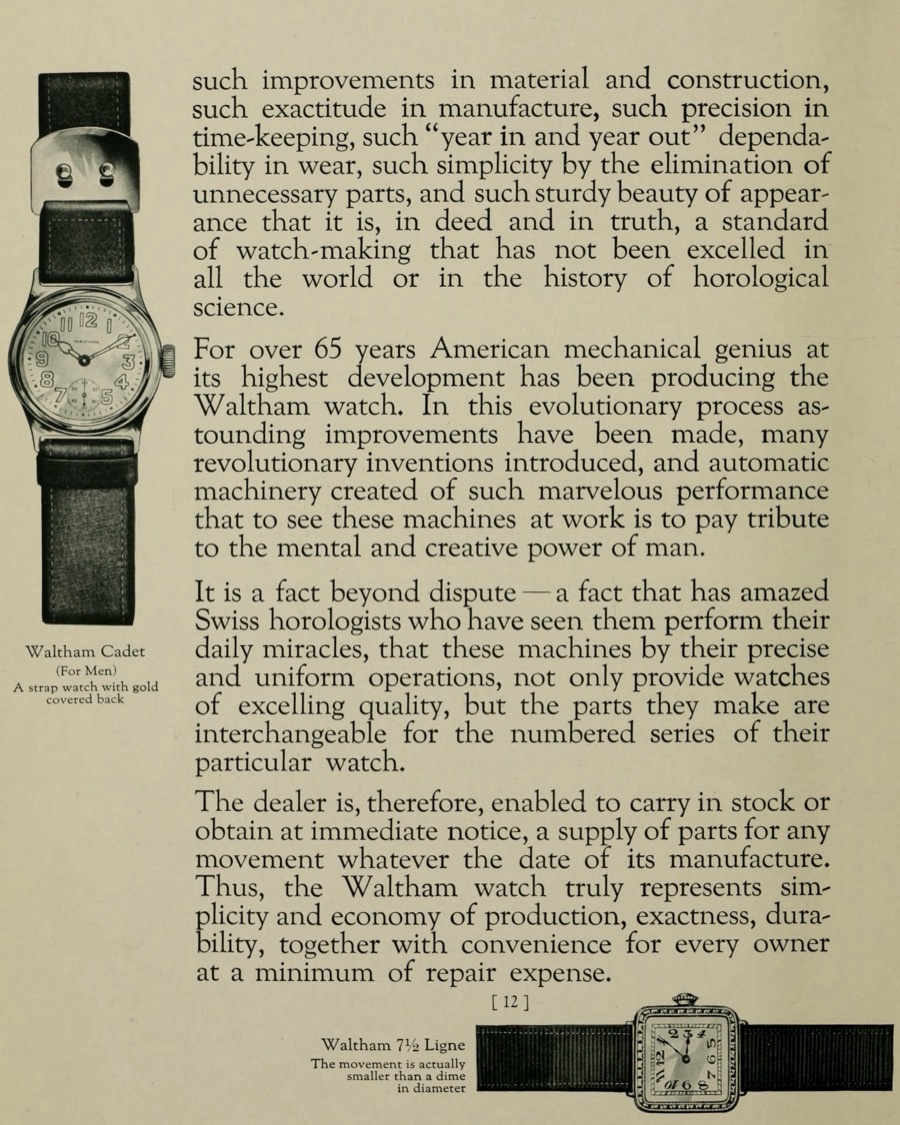
Sizes were counted in lignes (one ligne is about 2.26 mm). Waltham's booklet of 1919 offers a 10-ligne silk-ribbon wristlet, a 7½-ligne watch whose movement is 'actually smaller than a dime in diameter', and a 'Cadet' strap watch 'for men'; Eugène Meylan's self-winding module of 1930 was designed to fit almost any 8.75-ligne (19.74 mm) movement.1, 35, 38
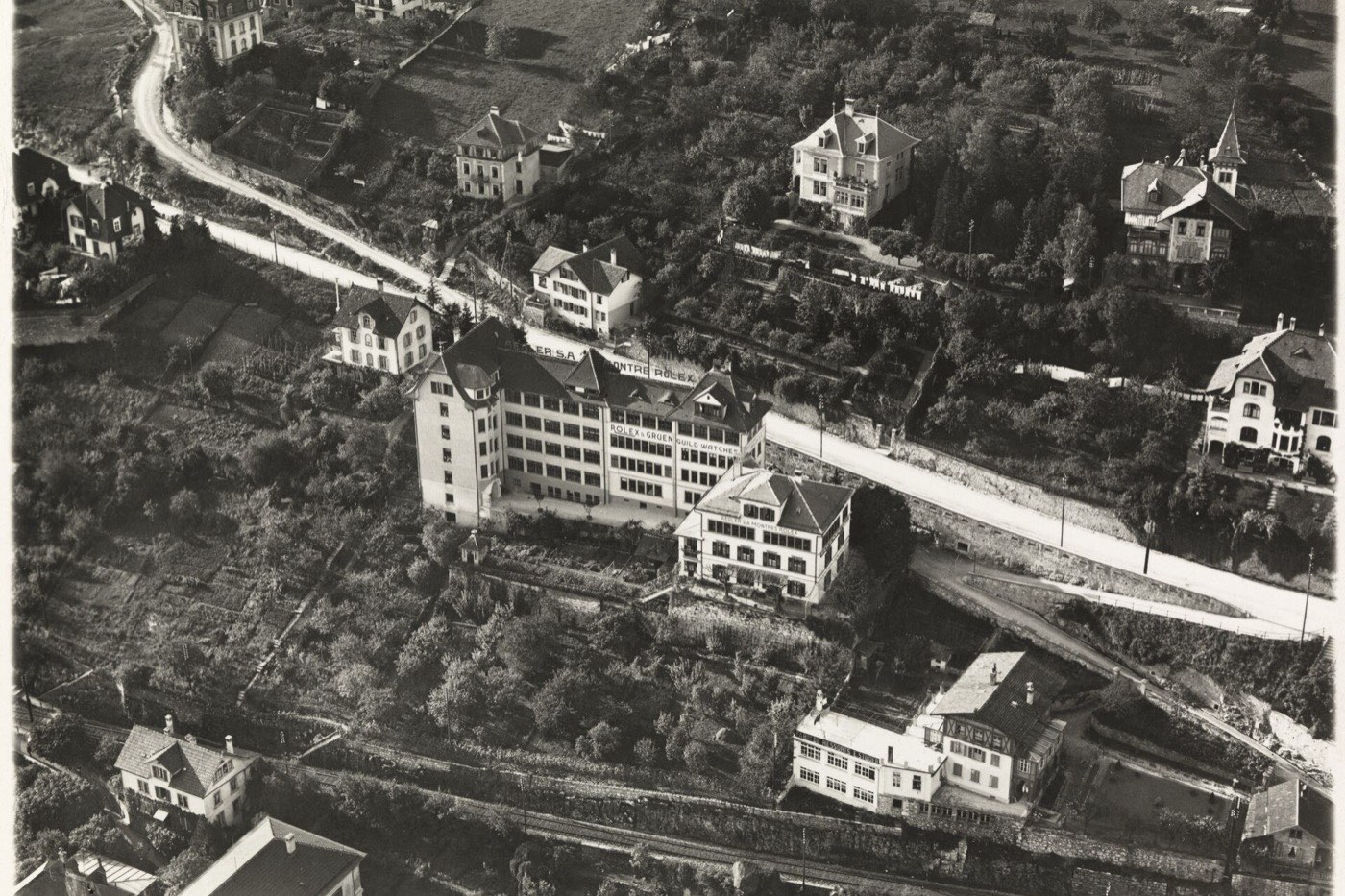
Switzerland also exported the know-how. Donzé counts that by 1927 movements without cases made up 30.1 per cent of Swiss export volume, against 5.4 per cent in 1890, and American firms such as Bulova (in Biel from 1911) and Gruen (on the Aegler board from 1927) built their wristwatch businesses on Swiss parts; in Japan, Rodolphe Schmid's workshop became part of Citizen in 1930.3
Geneva's old houses stood apart. Donzé says Patek Philippe and Vacheron Constantin refused mass-produced blanks, and quotes a Patek director, François Antoine Conty, speaking in 1926 of 'the junk watches of La Chaux-de-Fonds'. Patek nevertheless made complicated wristwatches: its timeline lists a ladies' five-minute repeater in 1916 and a perpetual calendar in 1925.3, 28
Part 5
Shaped cases and Art Deco
The wristwatch freed the case from the round shape of the pocket. Cartier says its Tank 'was born in 1917' from the idea of 'letting go of the traditional round watch', with the case running into the strap between two parallel brancards.40, 41
Accounts of the Tank's first years differ in detail: Cartier says the prototype went to General Pershing and the watch reached the market in 1919; Wikipedia says it was introduced in 1918 and entered production in 1919 with six pieces, its shape inspired by the Renault tanks on the Western Front.41, 42
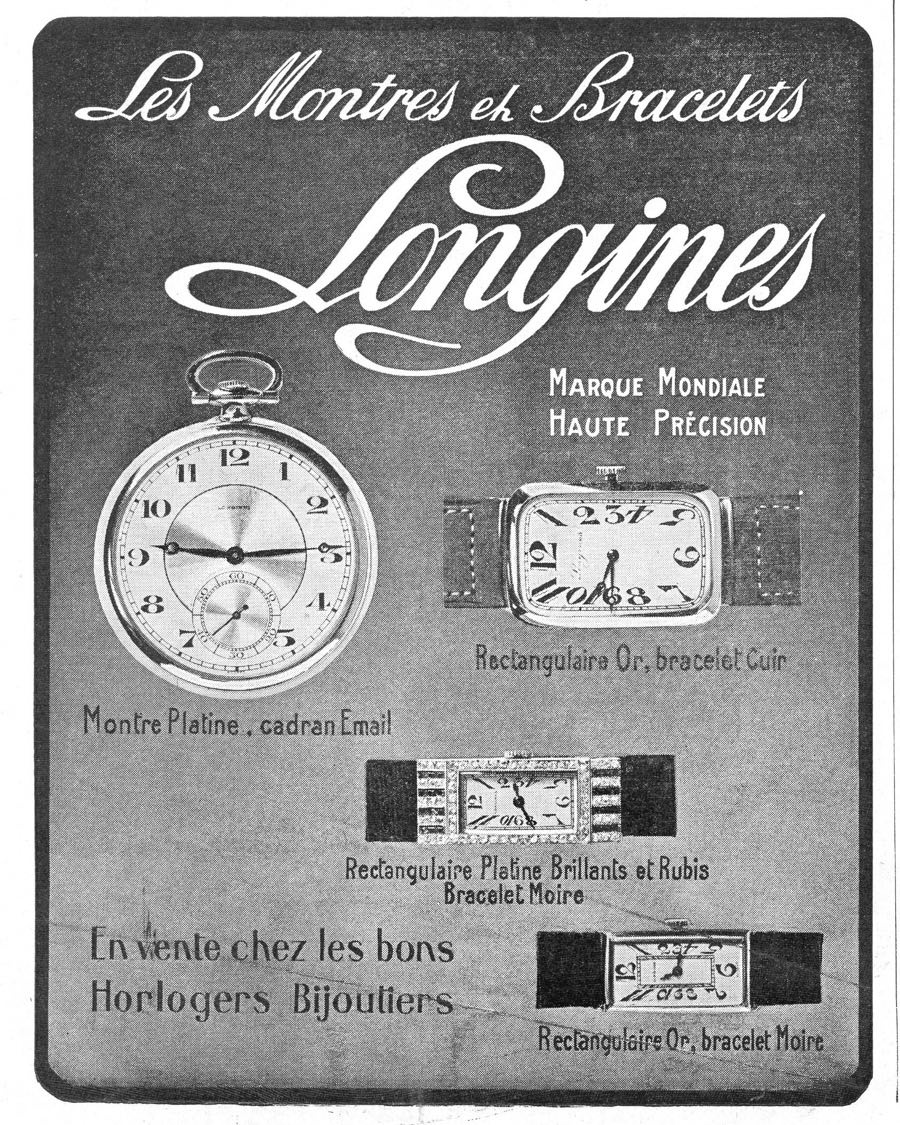
Rectangular watches became ordinary stock. A Longines advertisement of 1924 shows a round platinum pocket watch beside three rectangular wristwatches on leather and moiré straps, one set with diamonds and rubies, under the heading 'Les Montres et Bracelets Longines'.43
The Reverso of 1931 is the Art Deco wristwatch built for sport. Jaeger-LeCoultre tells it as a challenge from British officers playing polo in India; Wikipedia names the dealer César de Trey and the French engineer René-Alfred Chauvot, whose case swivels over to protect the glass.9, 10
Shaped cases mattered to engineers as well as designers: one of Hans Wilsdorf's patents of 1926 was for a shaped, octagonal case clamped by a screwed back and bezel, so that a non-round watch could also be sealed.44, 45
Part 6
Sealed, self-winding, shock-proof
A watch on the wrist met water, dust and knocks that a pocket watch did not. Wilsdorf's answer was the Oyster: Perregaux and Perret's screw-down crown, patented in 1925-26 and assigned to Wilsdorf, and Wilsdorf's own sealed-case patents of 1926. Rolex calls the Oyster of 1926 the first waterproof wristwatch.12, 14, 15, 16, 17
That claim is disputed. Richard Watkins points to Dennison's English patents for a screwed bezel and back (1872) and a screw-down crown (1915), and Wikipedia cites a waterproof case patented by Charles Depollier eight years before the Oyster.11, 46
In 1927 Rolex turned a swim into advertising. Mercedes Gleitze wore an Oyster in the Channel in October 1927 (Rolex and Wikipedia disagree about which of her two swims), and on 24 November Rolex took the front page of the Daily Mail for 'the Wonder Watch that Defies the Elements'.3, 46, 47, 48
Self-winding came back from the eighteenth century. John Harwood of the Isle of Man filed a British patent with Harry Cutts on 7 July 1923 for a wristwatch wound by a swinging weight, whose case needed no opening at all; Fortis of Grenchen says it began series production in 1926, and the Swiss dictionary records an automatic calibre made at Grenchen that year.4, 18, 20, 49
Rolex says it invented and patented the Perpetual rotor in 1931, a weight that turns a full circle; the Swiss dictionary dates Rolex's rotor watch to 1930, and Harwood disputed Rolex's later claim to the first automatic, which Rolex corrected, by Fortis's account, in 1956.14, 15, 20, 50
Omega calls its Marine of 1932, a double case sealed with cork, the first commercially available divers' watch, the start of the dive watch.51, 52
Knocks were the third enemy: a broken balance pivot was a common repair. Breguet's pare-chute of about 1790 is, by Breguet's account, the forerunner of modern shock protection; Incabloc's shock-absorbing jewel setting came from Fritz Marti and Georges Braunschweig at La Chaux-de-Fonds; the company dates the first patent to 1929 and the trademark to 1933, while Wikipedia gives 1934.53, 54, 55
Part 7
The tipping point
The numbers turned in the late 1920s. From Swiss foreign trade statistics, Donzé gives wristwatches 25 per cent of Swiss watch exports in 1920, 40 per cent in 1927 and 85 per cent by 1940.3
Wikipedia, citing a 1986 history of the wristwatch by Kahlert, Mühe and Brunner, says Switzerland exported as many wristwatches as pocket watches in 1930 and nearly twice as many in 1934; these figures sit between Donzé's.1, 3
Swiss customs counted the two separately by then. A lecture by E. Strahm of the Société Générale de l'Horlogerie Suisse in December 1934 gives export prices for wristwatches and pocket watches in metal, silver and gold, and shows pocket watches losing value faster in the slump: a nickel pocket watch fell from fr. 6.34 to 3.72 between 1929 and 1933, while a metal wristwatch fell from 7.47 to 6.20.36
The Swiss dictionary sums up the decade: in the 1920s the wristwatch left the military sphere and 'dethroned' the pocket watch. In the United States the National WWII Museum says wristwatches were outselling pocket watches by substantial margins by the end of the 1920s.4, 5
The pocket watch held its ground where rules required it. American railroad standards of the early twentieth century called for open-faced 16- or 18-size pocket watches, and railroad men were still having their watches inspected at Chicago's Union Station in 1943.5, 22, 23
Even the word changed: by Wikipedia's account, 'wristlet' gave way to 'wristwatch' in the early 1930s.7
Through this history
The companies, people, technologies, objects and events this chapter is made of, in the order the story meets them.
Specification
The trench watchThe converted pocket watch soldiers wore on the wrist in 1914 to 1918.7, 8
Company
Jaeger-LeCoultreJaeger-LeCoultre dates its small two-level Duoplan to 1925 and its turning Reverso case to 1931.9, 10
Technology
Water resistanceHow watch cases were sealed against water and dust, from screwed cases of the 1870s to today’s standards.11, 12, 13
Object
The Rolex OysterThe sealed case with a screw-down crown that Rolex introduced in 1926.14, 15, 16
Person
Hans WilsdorfRolex’s founder, who held the screw-down crown patent as assignee and patented the Oyster case in 1926.15, 16, 17
Person
John HarwoodThe Isle of Man watch repairer whose self-winding wristwatch was patented in 1923 and made in Grenchen from 1926.4, 18, 19
Object
The Harwood self-winding watchThe crownless self-winding wristwatch patented in 1923, which Fortis says it began making in Grenchen in 1926.18, 20
Technology
Automatic windingThe eighteenth-century self-winding watch, revived for the wrist in the 1920s.11, 21
Event
Railroad standard timeWhere the pocket watch held its ground: railroad rules still called for open-faced pocket watches.22, 23
Key dates
- 1810
The Queen of Naples orders a repeater 'for bracelet' from Breguet (sold December 1811).1, 26
- 1868
Patek Philippe's wristwatch for Countess Koscowicz, by the company's account.1, 28
- 1893
Henry Wood's Cyclist Watch Wristlet advertised; Garstin's wrist strap registered.32, 33
- 1904
Cartier's watch for Santos-Dumont, by Cartier's account.1, 29
- 1917
Cartier's Tank designed; Horological Journal notes the wristlet on 'nearly every man in uniform'.1, 40
- 1923
Harwood and Cutts file the British self-winding wristwatch patent (7 July).18, 49
- 1926
Rolex Oyster case; Fortis begins making Harwood automatics.4, 14, 16, 20
- 1927
Wristwatches reach 40 per cent of Swiss exports; Gleitze swim and the Oyster advertisement.3, 46
- 1931
Reverso; Rolex's Perpetual rotor (1930 by another account).10, 14, 15
- 1932
Omega Marine.51, 52
- 1934
Wristwatches nearly double pocket watches in Swiss exports; Incabloc dated to this year by Wikipedia.1, 54
Where this leads
- Before, Era IIIGerman watchmaking
1845 to today
- After, Era IVWatches go to war
1880 to 1960
Where From the pocket to the wrist leads
- In this story, PlaceBiel/Bienne
Aegler's Biel movements were the base of Rolex's wristwatches, and American firms sourced watches and movements in Biel.3, 15, 56
- See also, HistorySwitzerland’s network of specialists
Donzé argues that flexible Swiss suppliers adapted quickly to small wristwatch calibres and cases.3
- See also, HistoryWatches go to war
Once the wristwatch was the ordinary watch, the Second World War made it specified military equipment.1, 5
- See also, CompanyWaltham
Donzé argues that Waltham stayed with pocket watches, a factor in its 1949 bankruptcy.3
- See also, ObjectThe Seiko Laurel
The Seiko Museum dates wristwatch production around the world from about 1910.57
Facts and sources
Sources
- 1
- 2
- 3
Watchmaking in 1927: major structural changes (opens in a new tab)
- 4
- 5
War Time: How America's Wristwatch Industry Became a War Casualty (opens in a new tab)
- 6
- 7
- 8
'Sterling' watch by Ingersoll converted for use on the wrist (opens in a new tab)
- 9
- 10
- 11
The Origins of Self-Winding Watches 1773-1779 (opens in a new tab)
- 12
CH 114948: Montre à remontoir (Paul Perregaux; Georges Perret) (opens in a new tab)
- 13
ISO 22810:2010 Horology: Water-resistant watches (opens in a new tab)
- 14
Rolex history, 1926 to 1945: milestones in watchmaking (opens in a new tab)
- 15
- 16
CH 120848: Montre à remontoir (Wilsdorf Hans) (opens in a new tab)
- 17
- 18
GB 218,487: Improvements relating to wrist watches (Harwood, J., and Cutts, H.) (opens in a new tab)
- 19
- 20
100 Years of Automatic Watchmaking: Fortis Harwood Automatic 1926 (opens in a new tab)
- 21
- 22
- 23
- 24
Military Watches of the World: A-11, the Watch That Won the War (opens in a new tab)
- 25
From Wristwatches To Radio, How World War I Ushered In The Modern World (opens in a new tab)
- 26
- 27
- 28
- 29
- 30
Accessoires. Gazette du Bon Ton, 1922, No. 8: Bracelets et bracelets-montres (opens in a new tab)
- 31
- 32
- 33
- 34
- 35
- 36
La situation de l'industrie horlogère suisse (lecture, Basel, 10 December 1934) (opens in a new tab)
- 37
- 38
- 39
- 40
- 41
- 42
- 43
- 44
CH 120851: Boîte de montre de forme (Wilsdorf Hans) (opens in a new tab)
- 45
US 1,727,531: Watchcase (Hans Wilsdorf, London) (opens in a new tab)
- 46
- 47
- 48
- 49
CH 106583: Montre à remontage automatique (Harwood John; Cutts Harry) (opens in a new tab)
- 50
- 51
- 52
- 53
- 54
- 55
Invention of the pare-chute shock absorber (opens in a new tab)
- 56
- 57
History of Seiko and Its Products, Stage 1 (1881-1920s) (opens in a new tab)
Sources read November 12, 2026.