The First World War
How the war of 1914 to 1918 met the watch: officers took to luminous wristlets, armies timed their attacks by the watch, Swiss and American factories made fuses, Britain taxed imported watches and Europe put its clocks forward; most accounts credit the war with making the wristwatch a man’s watch, though it did not invent it.
28 July 1914 to 11 November 1918
In the histories Britain’s watch industry, From the pocket to the wrist, Watches go to war
Before 1914
Wikipedia’s history of the wristwatch says wristlets were made mostly for women for about their first hundred years, and NPR, drawing on the Smithsonian, says men rarely wore them before the war.1, 2
The idea was not new to soldiers. Worn & Wound describes men in the Boer War of 1899 to 1902 strapping small pocket watches to the wrist, and Wikipedia records a “Watch Wristlet” patented by the London firm Garstin in 1893.1, 8
Some makers were already betting on the wrist. Wikipedia says Kew Observatory gave a Rolex wristwatch a class A certificate on 14 July 1914 and that Hans Wilsdorf predicted that year that wristwatches would largely replace pocket watches.9
The watch at the front, 1914 to 1918
Austria-Hungary declared war on Serbia on 28 July 1914; Britain and Germany were at war from 4 August. The fighting ended with the Armistice of 11 November 1918.10, 11
A pocket watch was hard to reach in a trench. NPR quotes Doran Cart of the National WWI Museum on belts, whistles and gas masks leaving no room, and Wikipedia says pocket watches were impractical in combat.2, 3
Most early trench watches were converted pocket watches with lugs soldered on for a strap. A Science Museum Group object shows one: an Ingersoll “Sterling” in a silver case hallmarked 1915, with lugs added at 12 and 6.3, 12
Timing became part of the attack. The Smithsonian curator Carlene Stephens has said that artillery cover for an advance was an elaborately timed, choreographed movement and that pilots used the watch to judge their fuel; the Western Front Association notes that the army’s clocks were put forward an hour shortly before the Somme, which began at 7.30 a.m. on 1 July 1916.2, 6
Officers bought their own. In the Commons on 30 September 1915 Sir Alfred Mond called watches necessities for officers at the front; Capt. B. C. Lake’s handbook of 1916 lists a luminous wristwatch with unbreakable glass; and from 1917, Worn & Wound says, the British Army issued a limited number of luminous wristwatches, mainly to signallers and engineers.3, 5, 8
The factories went to war as well. The Historical Dictionary of Switzerland notes that the war was very profitable to the Swiss watch industry, which made aircraft counters and shell timers and, being mechanised, munitions from 1914; Waltham, by Wikipedia’s account, made time fuses and speedometers.4, 13
What the war changed
Luminous dials spread. Wikipedia dates the Radium Luminous Material Corporation to 1914 and Ingersoll’s Radiolite watches to 1916; the company’s plant at Orange, New Jersey, opened in 1917, when newspapers advertised luminous watches as gifts for men at the front.14, 15, 16
Britain taxed imported watches. From 29 September 1915 clocks, watches and their parts paid a customs duty of 33⅓ per cent of value, to cut imports in wartime; Mond told the Commons the trade came mostly from Switzerland and the flat rate was practically prohibitive on better watches. The duty belongs to the story of British watchmaking.5
Wikipedia ties that duty to Rolex moving its international headquarters from London to Bienne in 1915, and dates the move to Geneva to 1919, after the war.9
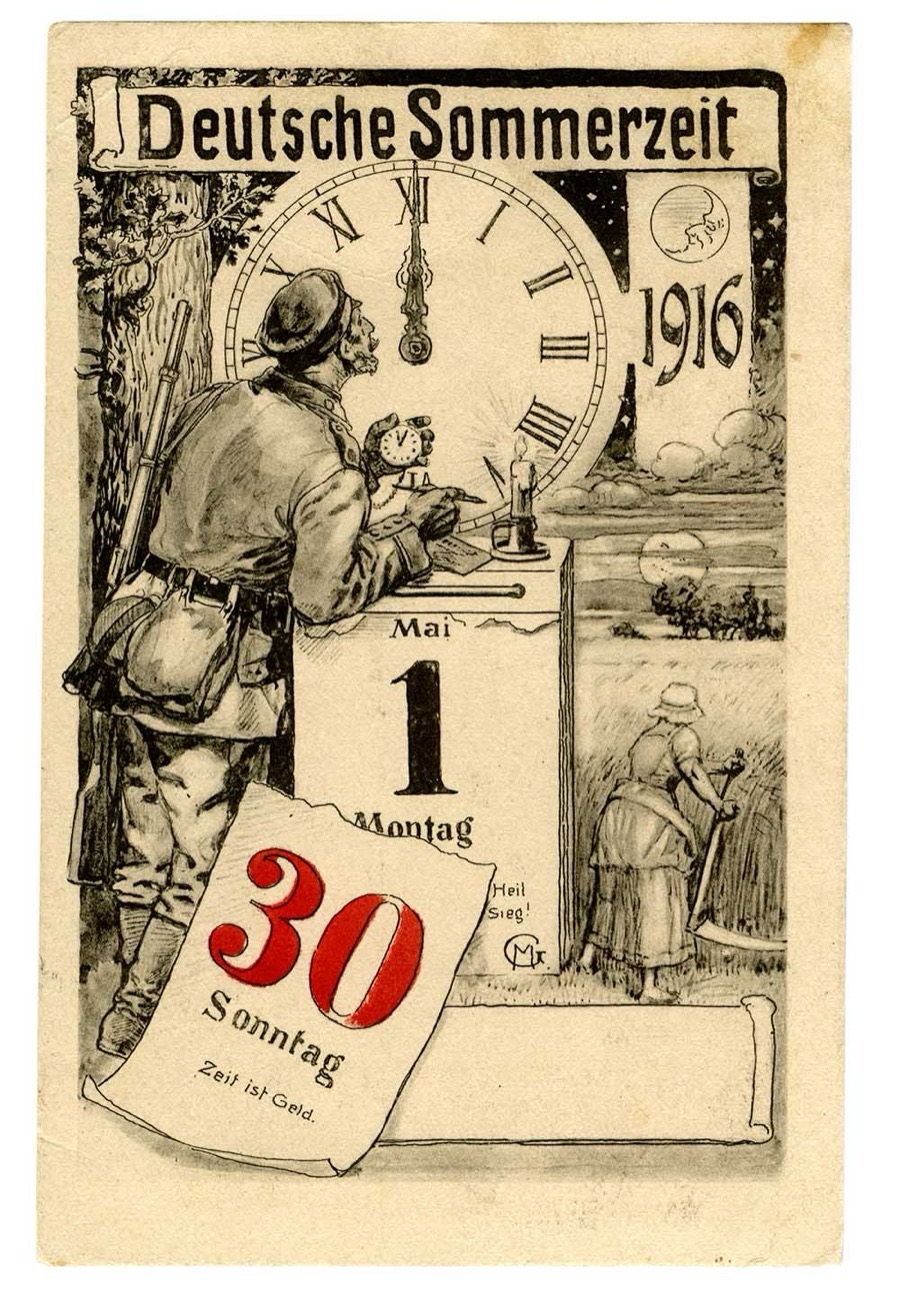
Public time changed by law. By the Western Front Association’s account, Germany and Austria-Hungary put their clocks forward on 30 April 1916 to save coal, Britain followed on 21 May, and the British armies in France took French time on 14 June.6
Not every army changed. Worn & Wound says the wristwatch did not catch on in German military circles during the war as it did in the British and American forces.17
After 1918
The wristwatch overtook the pocket watch within fifteen years. Wikipedia gives Swiss exports of the two as level by 1930 and wristwatches nearly double by 1934; the National WWII Museum says wristwatches outsold pocket watches by the end of the 1920s.1, 18
How far the war caused that is a matter of interpretation, not of sales records of the time. Wikipedia gives a Horological Journal of 1917 as saying the wristlet was little used by men before the war; the wristwatch itself was older, as told in From the pocket to the wrist.1, 2
The radium had a cost. Dial painters at Orange were taught to point their brushes with their lips; by 1924 about fifty former workers were ill and about a dozen dead, and five who sued settled in June 1928.15, 16
The next war wrote the soldier’s watch into specifications: the British W.W.W., the American A-11 and the German observation watch, told under the Second World War.17, 18, 19
Key dates
- 1914
War from 28 July; Swiss watch factories begin making munitions; Cyril Brudenell White’s silver wristwatch, about 1914 (Australian War Memorial).4, 10, 11, 20
- 1915
A 33⅓ per cent duty on imported clocks and watches from 29 September; an Ingersoll pocket watch hallmarked 1915 is converted for the wrist.5, 12
- 1916
Summer time: Germany and Austria-Hungary on 30 April, Britain on 21 May, by the Western Front Association’s account; the Somme begins at 7.30 a.m. on 1 July.6
- 1917
Limited British army issue of luminous wristwatches; Elgin wristwatch with shrapnel guard (Smithsonian); the radium plant at Orange opens.2, 8, 15
- 1918
London retailers advertise “Military” luminous watches; the Armistice of 11 November.10, 11, 21
Where the First World War leads
- Part of, HistoryBritain’s watch industry
The war that brought a 33⅓ per cent duty on imported watches from 1915.5
- Part of, HistoryFrom the pocket to the wrist
The war credited with making the wristwatch acceptable for men.1, 22
- Part of, HistoryWatches go to war
The war credited with making the wristwatch a man’s watch.1, 2
- See also, HistorySwitzerland’s network of specialists
The Historical Dictionary of Switzerland notes that the war was very profitable to the Swiss watch industry.4
- See also, CompanyRolex
By Wikipedia’s account, the 1915 duty led Rolex to move its headquarters from London to Bienne.9
- See also, CompanyWaltham
The Waltham company made time fuses and speedometers in the war, Wikipedia says.13
- See also, PersonHans Wilsdorf
He predicted in 1914 that the wristwatch would replace the pocket watch, Wikipedia says.9
- See also, PlaceBiel/Bienne
Where Rolex moved its international headquarters in 1915, by Wikipedia’s account.9
- See also, PlaceWaltham, Massachusetts
The Waltham factory made time fuses, speedometers and blood-pressure gauges in the First World War.23
- See also, TechnologyThe wristwatch
The war is credited with making the wristwatch acceptable for men.1, 22
- See also, SpecificationThe trench watch
The converted wristlet was the soldier's watch of the war.2, 3
- See also, EventThe Second World War
The next war turned the soldier’s wristwatch into written specifications.18, 19
Facts and sources
- Period
- 28 July 1914 to 11 November 191810, 11
- Where
- Fought mainly in Europe; the watches came from Switzerland, Britain and the United States2, 4, 8, 13
- Turning point
- Before 1914 a man carried his watch in a pocket and a watch on the wrist was mostly a woman’s; by 1918 officers wore luminous wristlets, and by 1930 Switzerland exported as many wristwatches as pocket watches.1, 2, 8, 18
Sources
- 1
- 2
From Wristwatches To Radio, How World War I Ushered In The Modern World (opens in a new tab)
- 3
- 4
- 5
Clocks, Watches, etc. (HC Deb 30 September 1915 vol 74 cc1061-7) (opens in a new tab)
- 6
Spring Forward, Fall Back. The changing of the clocks and the First World War (opens in a new tab)
- 7
- 8
Military Watches of the World: Great Britain Part 1 (opens in a new tab)
- 9
- 10
- 11
- 12
'Sterling' watch by Ingersoll converted for use on the wrist (opens in a new tab)
- 13
- 14
- 15
The Radium Girls at the National Archives (opens in a new tab)
- 16
- 17
Military Watches of the World: Germany Part 1 (opens in a new tab)
- 18
War Time: How America's Wristwatch Industry Became a War Casualty (opens in a new tab)
- 19
- 20
Watch: Lieutenant General C B B White, Australian Imperial Force (opens in a new tab)
- 21
Frontispiece, watch advertisement (Signalling, 1918) (opens in a new tab)
- 22
- 23
Sources read November 12, 2026.