The trench watch
The soldier’s wristwatch of the First World War: usually a small pocket watch given wire lugs, a luminous dial and sometimes a shrapnel guard, bought by officers as kit and issued in small numbers from 1917.
By Swiss, British and American makers, among them Omega, Longines, Elgin, Waltham and many unnamed Swiss firms, About 1914 to 1918, with earlier wristlets from the 1890s
In the histories From the pocket to the wrist, Watches go to war
What it was
A trench watch is a wristwatch of the First World War era, often a small pocket watch adapted for the wrist, made because pocket watches were impractical in combat.1, 2
Typical features were wire lugs for a strap, hinged front and back covers carried over from pocket watches, white enamel dials with large numerals, radium-painted luminous hands and numerals, and an unbreakable crystal.1, 3
Some carried a shrapnel guard, a pierced metal grille over the glass; the Smithsonian's Carlene Stephens told NPR it protected the tender dial in the field.1, 5
Many trench watches carry no maker's name, only 'Swiss' on the movement; their movements often derived from ladies' pendant watches of the 1890s.1
Radium dials lost their glow in three or four years, and surviving dials should be treated as radioactive.1, 6
Surviving examples
The Science Museum Group's example, lent by the Clockmakers' Company, is an Ingersoll 'Sterling' pocket watch in a Dennison case hallmarked 1915, with lugs added at 12 and 6; its luminous numbers were possibly added during the war.2
NPR reports that the Smithsonian holds an Elgin wristwatch of 1917 with a shrapnel guard, the kind many American officers wore.5
The Australian War Memorial holds a silver wristwatch of about 1914 given to Cyril Brudenell Bingham White, chief of staff of the Australian Imperial Force, by his sister-in-law and worn by him throughout the war.7
Officer’s kit
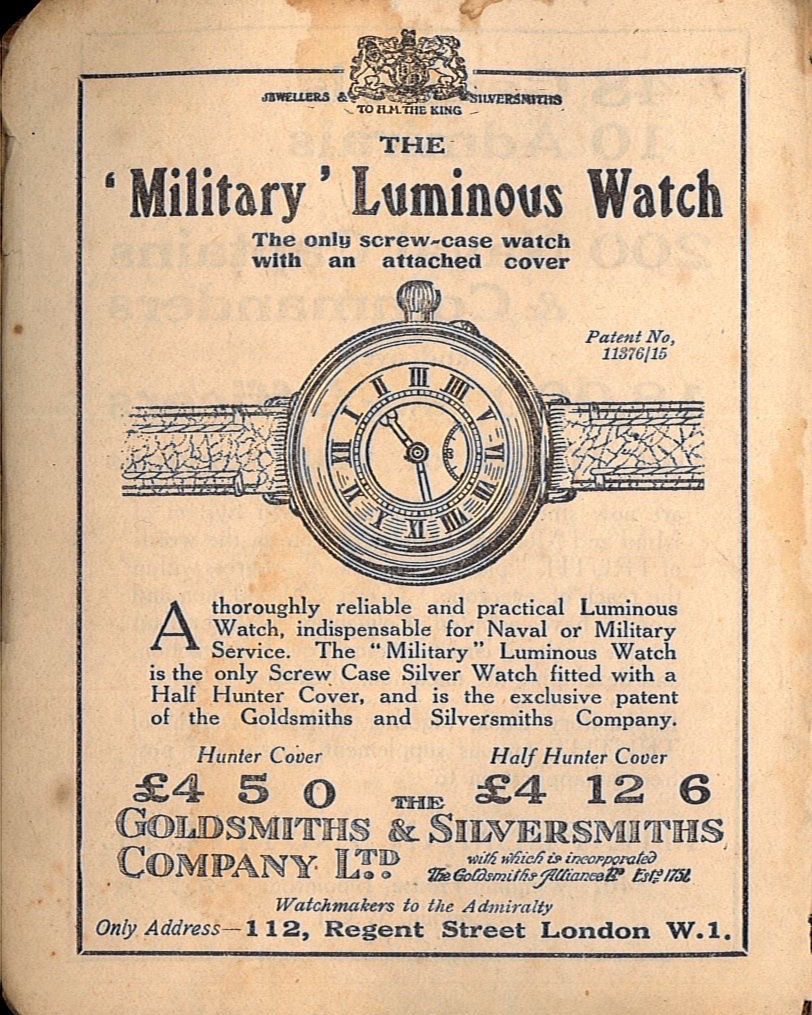
Retailers sold them to officers as kit. A London advertisement of 1918 offers the Goldsmiths & Silversmiths Company's 'Military' Luminous Watch, a silver screw case with a hunter or half-hunter cover, 'indispensable for Naval or Military Service', at £4 5s 0d or £4 12s 6d.8
Officers usually bought their own; from 1917 the British Army issued a limited number with luminous dials and the broad arrow, mainly to signals personnel and engineers, after testing Swiss watches and preferring screw-back cases by Dennison or Borgel.3, 9
Not the first wristwatch
The trench watch is not 'the first wristwatch'. Wristlets for women are much older, men's military wristlets predate 1914 (Garstin's patent of 1893, Mappin & Webb's campaign watch advertised from 1898), and the 1880 Girard-Perregaux naval order is disputed.9, 10
The name 'wristlet' gave way to 'wristwatch' in the early 1930s, by Wikipedia's account.1
Key dates
- 1915
Hallmark on the case of the Science Museum Group's converted Ingersoll.2
- 1916
Capt. B. C. Lake's Knowledge for War lists a luminous wristwatch as officer's kit; Ingersoll's Radiolite appears.1, 6
- 1917
British Army begins a limited issue of luminous wristwatches.3, 9
- 1918
The 'Military' Luminous Watch advertised in the signalling manual Signalling.8
Where the trench watch leads
- Part of, HistoryFrom the pocket to the wrist
The converted pocket watch soldiers wore on the wrist in 1914 to 1918.1, 2
- Part of, HistoryWatches go to war
The converted pocket watch soldiers wore on the wrist from 1914.1, 2
- See also, TechnologyThe wristwatch
The trench watch was an early men's wristwatch, often a converted pocket or pendant watch.2, 9
- See also, EventThe First World War
The converted wristlet was the soldier's watch of the war.1, 5
Facts and sources
- Period
- About 1914 to 1918, with earlier wristlets from the 1890s1, 9
- Made by
- Swiss, British and American makers, among them Omega, Longines, Elgin, Waltham and many unnamed Swiss firms1, 5
Sources
- 1
- 2
'Sterling' watch by Ingersoll converted for use on the wrist (opens in a new tab)
- 3
Military Watches of the World: Great Britain Part 1 (opens in a new tab)
- 4
- 5
From Wristwatches To Radio, How World War I Ushered In The Modern World (opens in a new tab)
- 6
- 7
Watch: Lieutenant General C B B White, Australian Imperial Force (opens in a new tab)
- 8
Frontispiece, watch advertisement (Signalling, 1918) (opens in a new tab)
- 9
- 10
Military Watches of the World: Germany Part 1 (opens in a new tab)
Sources read November 11, 2026.