Histories, Era IV, War and new industries
Watches go to war
1880 to 1960
How war moved the watch from the pocket to the wrist and set the rules it is still built to: trench watches and radium dials in 1914 to 1918, observation watches, A-11s and W.W.W.s in 1939 to 1945, watch factories turned to fuses and chronometers, neutral Switzerland selling to both sides, and the specifications that became today’s tool watches.

In short
For most of the nineteenth century a man kept his watch in his pocket; a watch on the wrist was a woman's jewel. War changed that. Soldiers and airmen needed to read the time instantly, in the dark and with their hands full, so they strapped watches to their wrists, and after 1918 men in peacetime kept wearing them. In the Second World War every fighting nation set rules for its watches, built them by the hundred thousand and turned its watch factories to fuses and instruments, while neutral Switzerland sold to both sides. The war's specifications (black dials, luminous hands, seconds that stop for synchronising, sealed and anti-magnetic cases) became the pattern of the pilot's, field and diving watches still made today.2, 4, 5, 7, 9, 11
Part 1
From the pocket to the wrist
Before 1914 a watch worn on the wrist was mostly a woman's ornament; Wikipedia's history says early 'wristlets' were made for women for about their first hundred years, and NPR, drawing on the Smithsonian, says men rarely wore them before the war.2, 9
Military use came earlier, but how much earlier is disputed. Wikipedia says Girard-Perregaux and other Swiss makers supplied German naval officers with wristwatches in about 1880; Worn & Wound tells it as an 1879 order from Kaiser Wilhelm I to Constant Girard for 2,000 gold watches, but notes that none has been recovered intact and that the brand’s modern example is built from records. No naval record of the order appears in the sources read for this page.1, 9, 12
British soldiers wore watches on straps in colonial wars. Worn & Wound describes men in the Boer War of 1899 to 1902 fitting wire lugs and leather straps to small pocket watches; Wikipedia adds that Mappin & Webb advertised a 'campaign watch' as in production since the Sudan campaign of 1898, an advertising claim, and that the London firm Garstin patented a 'Watch Wristlet' in 1893.9, 22
Wikipedia says officers took to wristwatches as early as the First Boer War of 1880 to 1881; Worn & Wound places the practice in the Second Boer War.9, 22
Aviation gave the wrist watch its first famous male wearer. Cartier says that in 1904 Louis Cartier made a watch so that the Brazilian aviator Alberto Santos-Dumont could tell the time while flying; Monochrome says the watch, made with the movement maker Edmond Jaeger, went on sale in 1911.9, 23, 24
Who made the first wristwatch has no single answer. Cartier calls the Santos one of the first; Monochrome credits Patek Philippe; Wikipedia names a Breguet watch of 1810 for the Queen of Naples, and the Girard-Perregaux naval watches as the first series for men.1, 23, 24
Part 2
The Great War and the trench watch
In the trenches a pocket watch was hard to reach. Doran Cart of the National WWI Museum is quoted on belts, whistles and gas masks leaving no room; Wikipedia simply says pocket watches were not practical in combat.1, 2
Timing became a weapon. The Smithsonian curator Carlene Stephens has said that artillery cover for an advance was an elaborately timed, choreographed movement, and that pilots used the watch as a fuel gauge.2
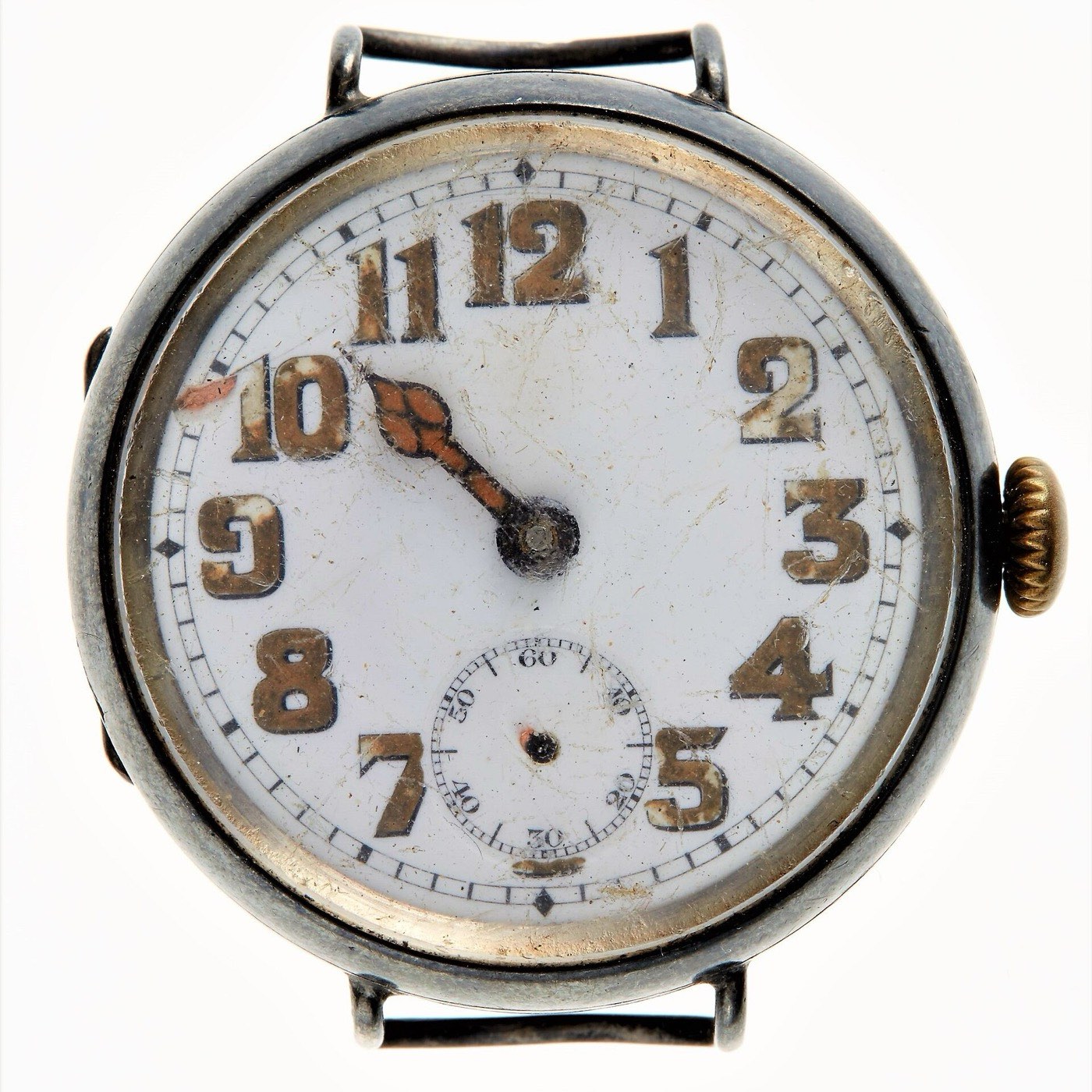
Most early trench watches were converted pocket watches: lugs soldered on for a strap, hinged covers kept, white enamel dials with large numerals and radium-painted hands, sometimes a pierced metal 'shrapnel guard' over the glass. A Science Museum Group object shows the conversion: an Ingersoll 'Sterling' in a case hallmarked 1915, with lugs added at 12 and 6.1, 10
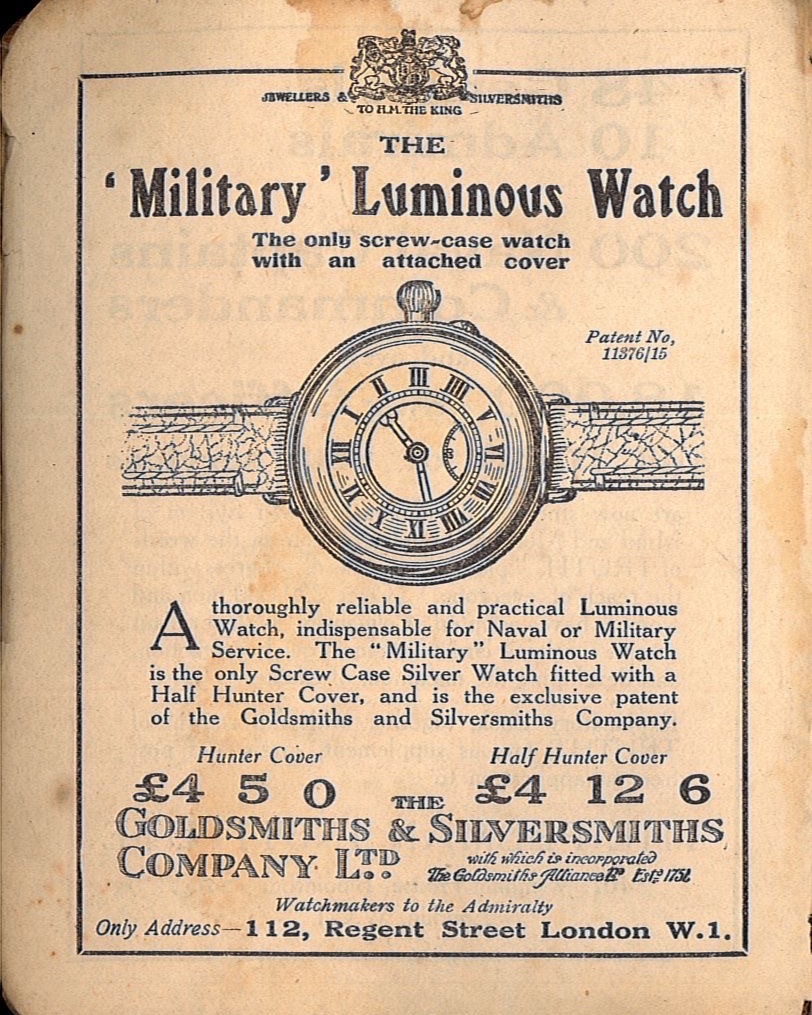
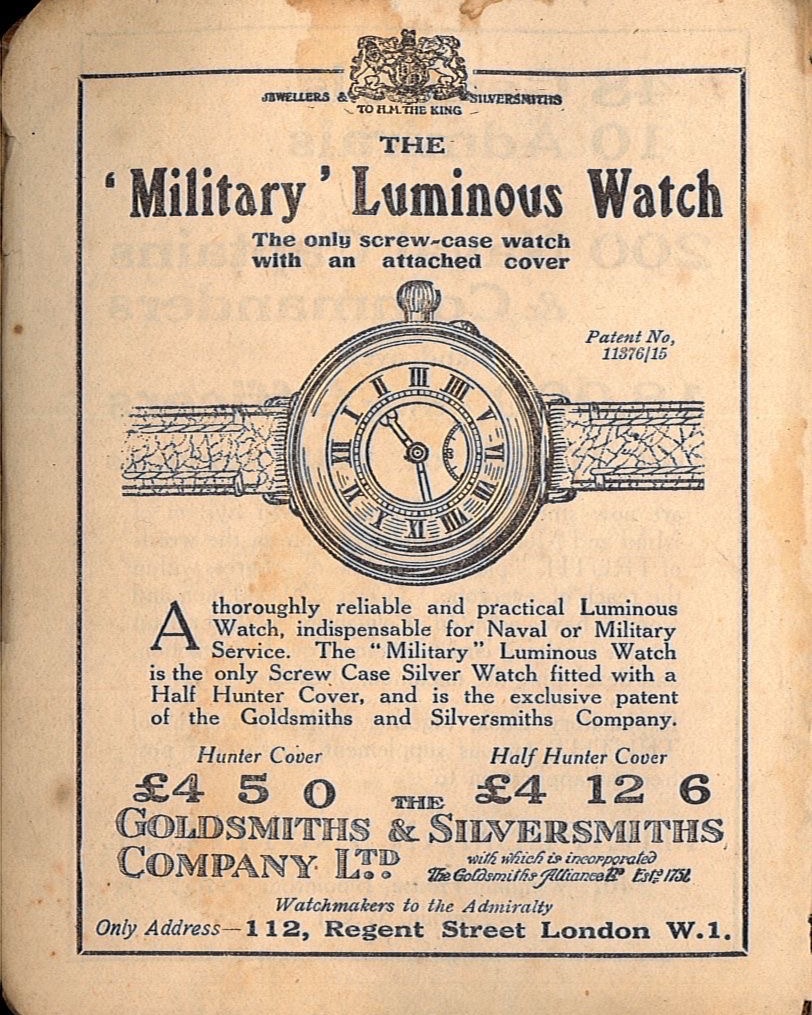
Officers generally bought their own. Capt. B. C. Lake's handbook of 1916 lists a luminous wristwatch with unbreakable glass as officer's kit, and from 1917 the British Army issued a limited number of luminous wristwatches with the broad arrow, mainly to signallers and engineers.1, 9, 22
Not every army followed. Worn & Wound says the wristwatch did not catch on in German military circles during the First World War as it did in the British and American forces.12
The war changed civilian habits, most accounts agree, though the causal claim comes from commentators rather than sales records of the time: a 1917 Horological Journal is quoted that the wristlet 'was little used by the sterner sex before the war'; by 1930 Switzerland exported as many wristwatches as pocket watches, and by 1934 nearly twice as many; the National WWII Museum says wristwatches outsold pocket watches by the end of the 1920s.2, 9, 11
Part 3
Light in the dark: radium and the dial painters
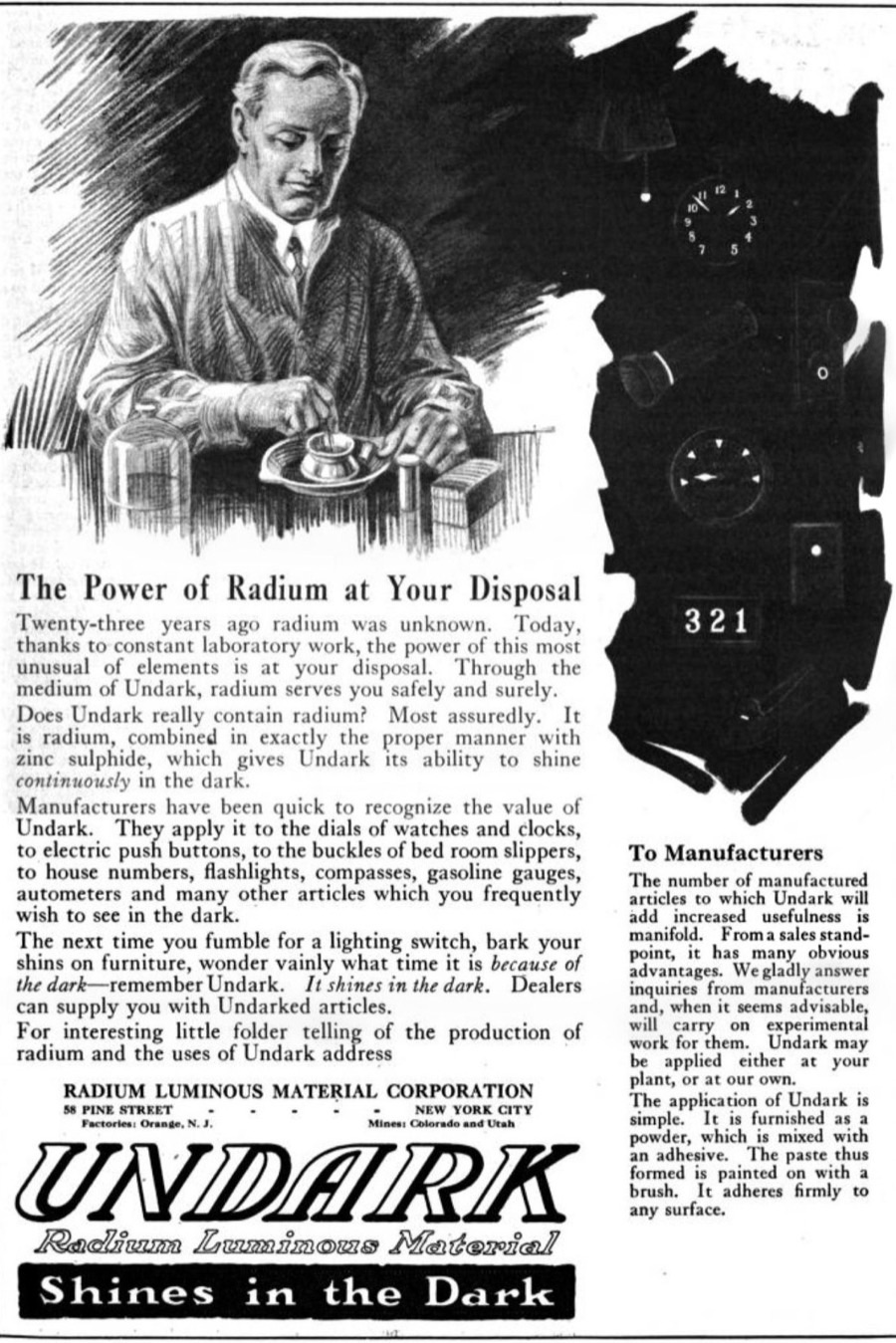
Luminous dials needed radium. The Radium Luminous Material Corporation was founded in 1914 by Sabin von Sochocky and George S. Willis and opened a plant at Orange, New Jersey, in 1917; it became the United States Radium Corporation in 1921 and sold its paint as Undark.28, 29, 30
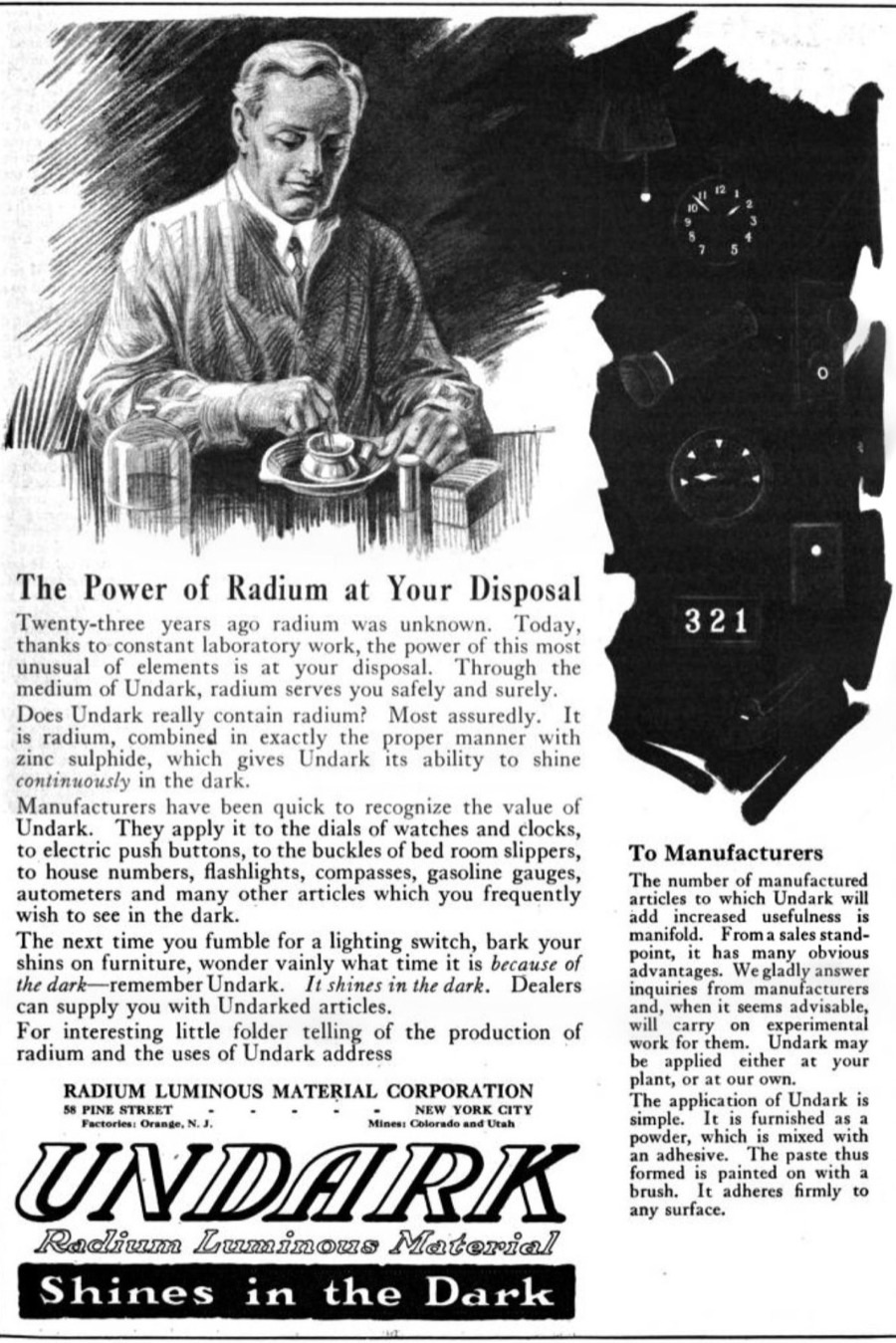
Wikipedia says Ingersoll's Radiolite watches of 1916 helped make radium dials popular, and wartime demand for luminous instruments followed.28
The painters, mostly young women, were taught to point their brushes between their lips, swallowing radium with every dial. A dial painter had died by 1923; by 1924 about fifty former workers at Orange were ill and about a dozen were dead.32, 33, 34
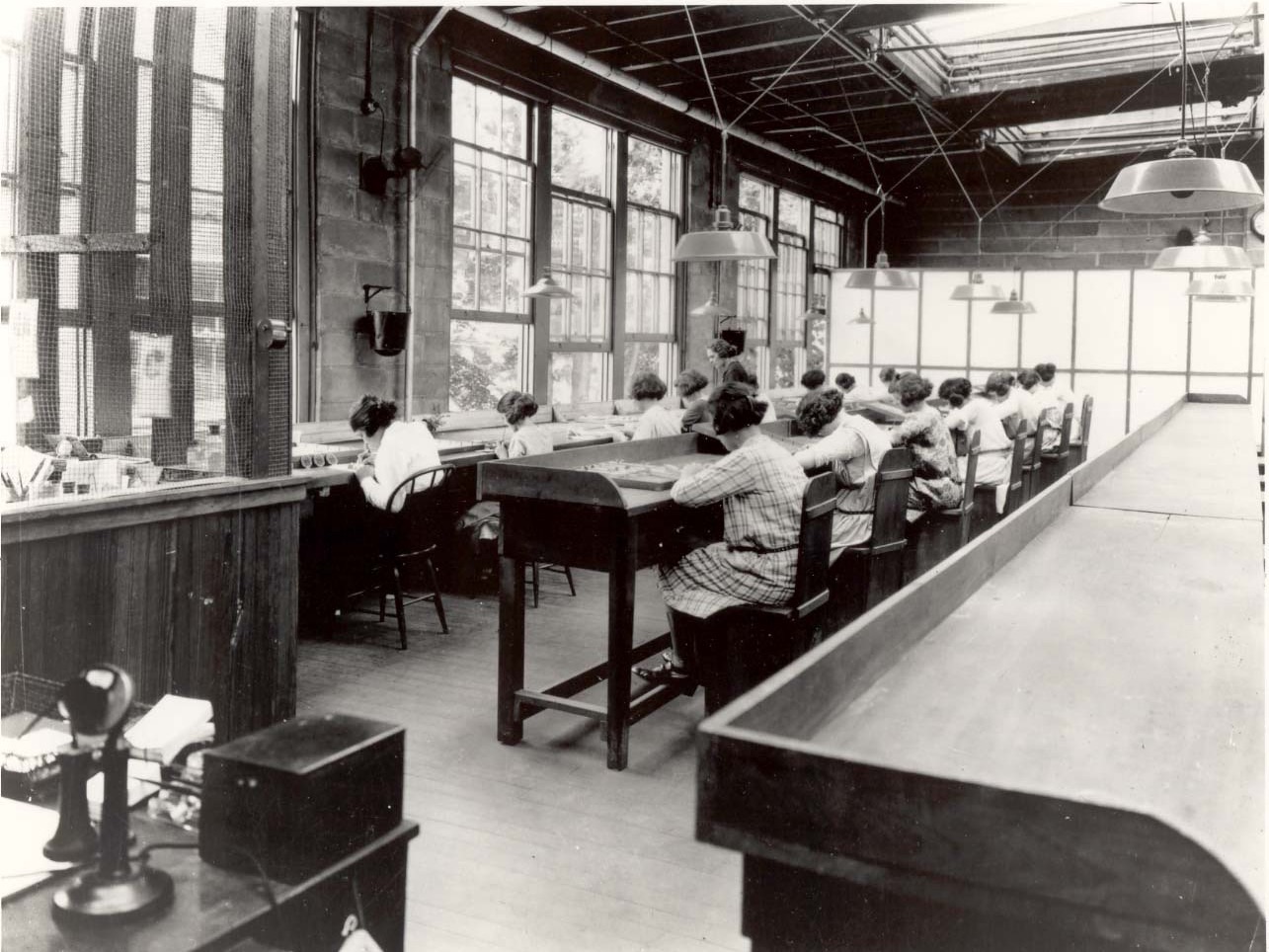
Five former painters, Grace Fryer, Katherine Schaub, Edna Hussman, Albina Larice and Quinta McDonald, sued from 1927 against a two-year statute of limitations. They accepted a settlement on 4 June 1928; the agreement in the National Archives is dated 8 June: $10,000 each, $600 a year for life, and medical costs approved by a committee of three doctors.29, 32, 33
In Ottawa, Illinois, women at the Radium Dial Company, which painted dials mainly for Westclox, won before the Illinois Industrial Commission in 1938 with the lawyer Leonard Grossman; Catherine Wolfe Donohue died in July 1938, and on 23 October 1939 the US Supreme Court declined the company's final appeal.32, 33
The cases are remembered as a turning point for occupational health law in the United States; a radium tolerance limit was set by the National Bureau of Standards in 1941, partly from data on dial painters.32, 33
Radium went on glowing on military watches until tritium replaced it from the 1970s; Panerai's own Radiomir and Luminor names record that change.13, 28
Part 4
Watches to a specification
Between the wars air navigation needed exact time. The Smithsonian holds a pair of Waltham 'avigation' watches made for the Army Air Corps around 1934, and a Waltham second-setting watch on the Weems system that belonged to Charles Lindbergh, links to the pilot's watch story.37, 38, 39
Germany's air ministry wrote the most famous specification: the Beobachtungsuhr, a 55 mm navigator's watch built by five firms, A. Lange & Söhne, Wempe, Laco, Stowa and IWC.3, 12, 40
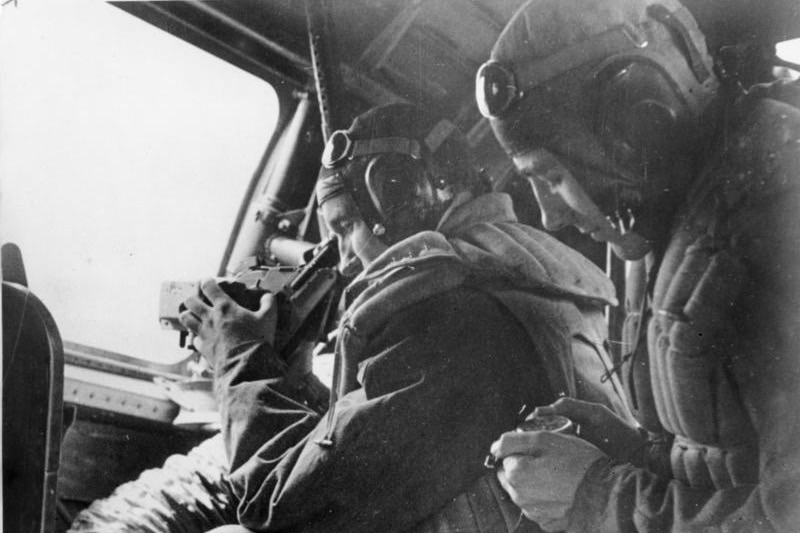
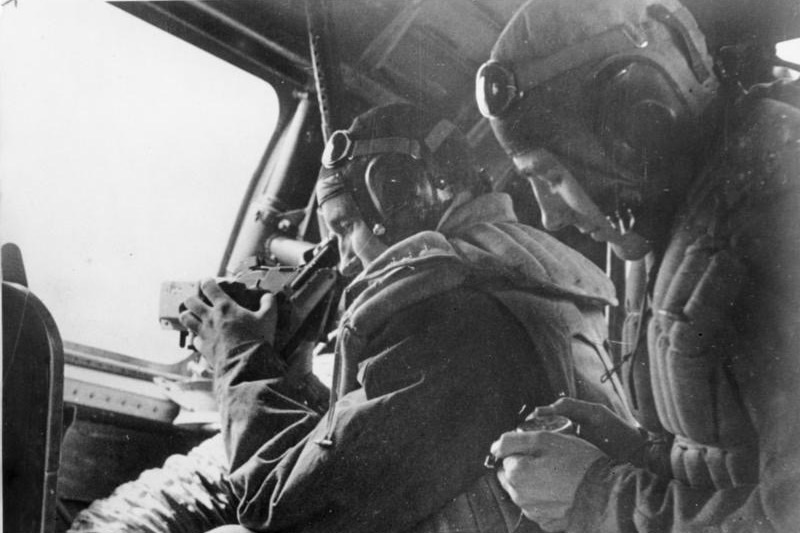
German ground forces received small 'DH' service watches from well over thirty makers, many Swiss, such as Longines, Record, Omega and IWC; the Schild AS 1130 movement was common enough to be called the Wehrmachtswerk.12
The United States Army Air Forces bought the A-11: a minimum 15-jewel movement whose seconds stopped when the crown was pulled, so that crews could set their watches together to the second.4, 11, 43
Britain's War Office drew up the W.W.W. ('watch, wristlet, waterproof') specification: black dial, luminous hands and numerals, shatter-resistant crystal, a 15-jewel movement in a case sealed against water and dust. Twelve Swiss firms delivered about 145,000, mostly from May 1945; collectors call them the 'Dirty Dozen'.5, 11, 22
Japan's Seikosha made infantry, naval and air-force wristwatches distinguished by a star, an anchor or a cherry blossom on the dial, and the Tensoku ('astronomical observation') pilot's watch from about 1940; Worn & Wound says Seikosha appears to have been the only Japanese maker with military wristwatch contracts.44
Italy's navy took a different path: from 1935 Panerai of Florence supplied luminous diving watches to its underwater assault units, built on a base supplied by Rolex.13, 14
Part 5
Industries at war
In the United States, watch factories went to war. After Pearl Harbor makers were barred from new civilian watches except railroad watches and special instruments; Waltham, Elgin, Hamilton and Bulova made bomb timers and navigation, pilot and infantry watches, the great majority of American military watches.6, 11
Hamilton built the Navy's marine chronometer. Prototypes of its Model 21 reached the Naval Observatory on 27 February 1942, and by mid-1945 it had delivered 10,902, most to the Navy; Hamilton says it made over a million timepieces in 1942 to 1945.6, 15
Smaller firms converted entirely. In February 1942 the Office for Emergency Management photographed the Wadsworth Watch Case Company in Kentucky turning from watch cases and compacts to bomb fuze baffles, compass cases, radio parts and parts for carbines and machine guns.45, 46
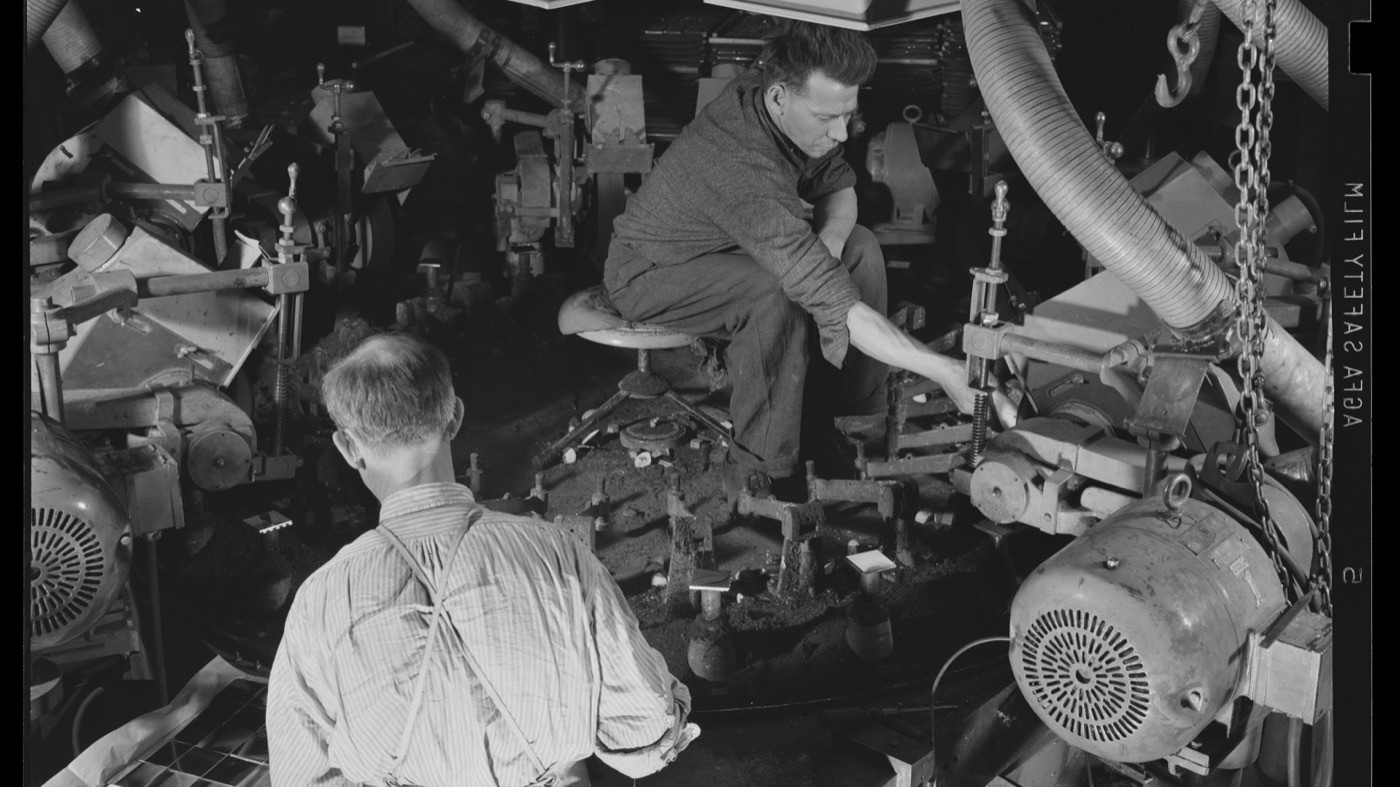
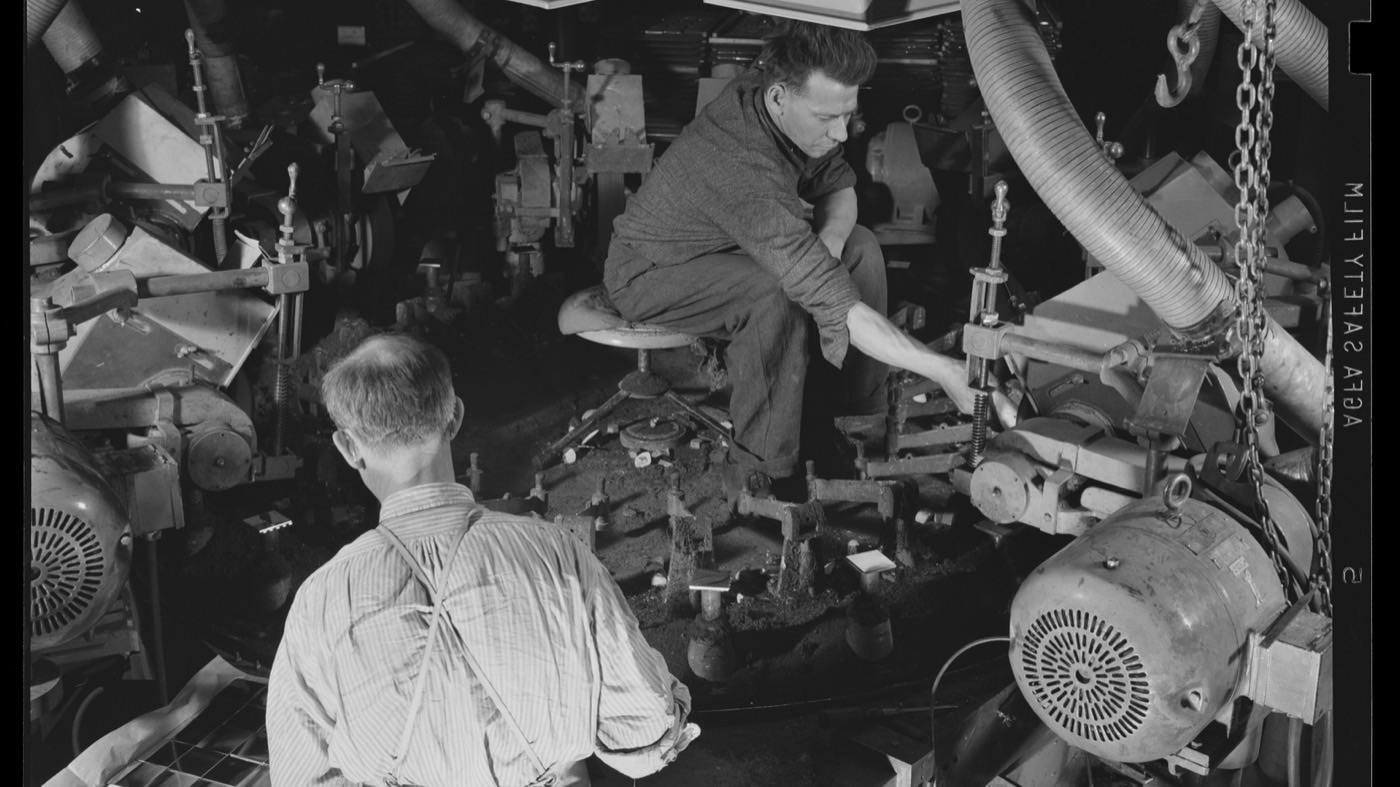
In Germany, Glashütte's makers were part of the armaments industry from late 1938: observation watches, chronographs, marine chronometers and time fuzes. Wempe in Hamburg and A. Lange & Söhne built a standard naval chronometer, the Einheitschronometer, from 1942; Wempe's company history says its wartime workforce of up to 200 included forced labourers from Russia and France.17, 49, 50
Germany never freed itself from Swiss supply: the German Wikipedia's account says that despite great efforts it remained dependent on watches from Switzerland, and Worn & Wound lists Swiss makers among the suppliers of its service watches.3, 12
In Japan, the Seiko Museum says the war forced Seikosha and Daini Seikosha into full war production, as the firm had made shell fuses since the Russo-Japanese War; civilian output had virtually stopped by 1945, the Kameido watch factory was destroyed, and production restarted in evacuation factories at Kiryu, Toyama, Sendai and Suwa.20, 51
The Soviet Union's First Moscow Watch Factory, built in 1930 with machinery bought from the American Dueber-Hampden company, was evacuated as the Germans approached in 1941. Accounts differ on where: Wikipedia's Poljot article says to Zlatoust, its Vostok article says to Chistopol, where a new factory first made military equipment.52, 53
Part 6
Neutral Switzerland
Surrounded by the Axis after 1940, Switzerland traded with both sides. The US National Archives' finding aid says its factories produced precision instruments, fuses, clocks and watches, and that by 1943 Germany took nearly a third of all Swiss exports.7
The Allies answered with a black list of Swiss firms trading with the Axis. Under an agreement of 19 December 1943 the Swiss limited exports to Germany, and the Allies lifted their embargo and promised to black-list firms on specific proof alone.7
Swiss watches also crossed to the Allies. The same finding aid says a third of all Swiss watches went to the United States in 1943 and 1944, freeing American watch factories for war work, and the National WWII Museum says that by 1945 the US Army in Europe was buying Swiss watches too.7, 11
Swiss firms supplied every side's specifications: IWC built German observation watches, twelve Swiss firms the British W.W.W., and Swiss makers many German service watches.3, 5, 12
One maker's wartime trade became a legend. Rolex sent watches to British prisoners of war on credit; an auction catalogue of 2007 describes an Oyster Chronograph sent in July 1943 to Corporal Clive Nutting at Stalag Luft III, with Hans Wilsdorf's letter telling him not to think of paying during the war.54
Europa Star says Switzerland kept its watchmaking know-how to itself where it could: in trade talks with the Soviet Union it refused to sell watch-manufacturing machinery, and the trade agreement signed on 24 February 1941 collapsed after Germany invaded the Soviet Union that June.55
Part 7
After the war
Glashütte was bombed on 8 May 1945 and its factories dismantled by the Soviet occupying power, then expropriated and merged into one state company; the story continues under VEB Glashütter Uhrenbetriebe.16, 17
Some German knowledge went east. WatchTime says the Einheitschronometer was later made by the First Moscow Watch Factory; collector accounts that Glashütte equipment went to Moscow as reparations are not confirmed by a record read for this page.49
Stalin chose the name Pobeda, 'Victory', for a new Soviet wristwatch in April 1945, built on a movement licensed earlier from the French firm LIP; the first prototype came from Penza at the end of 1945 and production spread to Moscow and Petrodvorets.21, 52
American makers lost their head start. The National WWII Museum argues that wartime exposure to Swiss watches undid the US industry; Waltham went bankrupt in 1949 and Elgin ended US manufacturing in 1968.11, 56, 57
The war also left veterans to retrain: Arde Bulova founded the tuition-free Joseph Bulova School of Watchmaking in 1945 for disabled veterans; its opening class graduated 20 of them.58, 59
Military rules became civilian forms. Stowa and Laco build their pilot's watches on the B-Uhr dial patterns, Panerai's navy watches became a civilian line in 1993, and the hacking seconds, luminous dials, soft-iron cases and screw-down crowns of wartime specifications live on in tool watches, pilot's watches and diving watches.11, 13, 18, 19
The thread leads on: from the instrument watch to the electronic one. Hamilton, which built the Navy's chronometers, sold an electric wristwatch in 1957, the start of the electric and quartz revolution.11, 15
Through this history
The companies, people, technologies, objects and events this chapter is made of, in the order the story meets them.
Event
The Second World WarEvery watch industry put to work, and neutral Switzerland selling to both sides.7, 11
Group
VEB Glashütter Uhrenbetriebe (GUB)Bombed and dismantled in 1945, Glashütte’s industry was rebuilt as one state company.16, 17
Key dates
- 1879
Kaiser Wilhelm I's reported order to Constant Girard for wristwatches for naval officers (dated 1879 or about 1880; no record found).9, 12
- 1904
Louis Cartier makes a watch for the aviator Alberto Santos-Dumont, by Cartier's account.9, 23
- 1917
The British Army begins a limited issue of luminous wristwatches; the US Radium plant opens at Orange, New Jersey.9, 22, 29
- 1928
The New Jersey dial painters settle with the United States Radium Corporation.29, 32
- 1935
Italy's navy begins its underwater units; Panerai tests diving watches for them.13, 14
- 1942
US makers barred from new civilian watches; Hamilton's Model 21 chronometer delivered to the Navy; Wadsworth Watch Case converts to war work.6, 45
- 1943
Allied-Swiss agreement of 19 December limits Swiss exports to Germany.7
- 1945
W.W.W. deliveries to the British Army; Glashütte bombed on 8 May and dismantled; Pobeda named; Bulova school founded.5, 16, 21, 58
Where this leads
- Before, Era IIIFrom the pocket to the wrist
1880 to 1930
- After, Era IVJapan builds a watch industry
1873 to today
Where Watches go to war leads
- In this story, PlaceElgin, Illinois
By mid-1942 the Elgin factory’s whole output, watches, timers, chronometers and fuzes, went to the war.57, 60
- In this story, PlaceSchaffhausen
IWC in Schaffhausen was one of the five makers of the German air force's observation watch.3, 12
- In this story, PlaceWaltham, Massachusetts
In the First World War the Waltham factory turned to time fuses, speedometers and gauges.56, 61
- See also, HistoryFrom the pocket to the wrist
Once the wristwatch was the ordinary watch, the Second World War made it specified military equipment.9, 11
- See also, HistoryGerman watchmaking
German clock and watch factories turned to fuses in both world wars, and Pforzheim and Glashütte were bombed in 1945.16, 62, 63, 64
- See also, HistoryJapan builds a watch industry
Seikosha and Daini Seikosha in war production from 1937.20
- See also, ObjectThe Pobeda
The Pobeda, named in 1945, was the Soviet victory watch.21, 65, 66
- See also, TraditionDive watches
Panerai's navy watches are part of the diving watch's origins.13
- See also, TraditionTool-watch engineering
Wartime requirements (hacking, luminous dials, sealed and anti-magnetic cases) became tool-watch features.4, 11
Facts and sources
- Period
- 1880s to the 1960s9, 11
- Where
- Britain, Germany, the United States, Switzerland, Japan, the Soviet Union, Italy7, 11, 12, 20, 22
Sources
- 1
- 2
From Wristwatches To Radio, How World War I Ushered In The Modern World (opens in a new tab)
- 3
- 4
Military Watches of the World: A-11, the Watch That Won the War (opens in a new tab)
- 5
- 6
How Hamilton Watch Co. Won World War II (opens in a new tab)
- 7
RG 84: Switzerland (Holocaust-Era Assets finding aid) (opens in a new tab)
- 8
A trench watch owned by Private E. A. Thompson, 1916 (Museums Victoria). (opens in a new tab)
- 9
- 10
'Sterling' watch by Ingersoll converted for use on the wrist (opens in a new tab)
- 11
War Time: How America's Wristwatch Industry Became a War Casualty (opens in a new tab)
- 12
Military Watches of the World: Germany Part 1 (opens in a new tab)
- 13
- 14
- 15
- 16
- 17
- 18
- 19
- 20
History of Seiko and Its Products, Stage 1 (1881-1920s) (opens in a new tab)
- 21
- 22
Military Watches of the World: Great Britain Part 1 (opens in a new tab)
- 23
- 24
The History of the Pilot Watch Part I: Cartier Santos 1904 (opens in a new tab)
- 25
- 26
- 27
- 28
- 29
The Radium Girls at the National Archives (opens in a new tab)
- 30
Undark (Radium Girls) advertisement, 1921 (opens in a new tab)
- 31
- 32
- 33
- 34
- 35
Women at work in a factory of the United States Radium Corporation, about 1922. (opens in a new tab)
- 36
Women at work in a factory of the United States Radium Corporation, about 1922. (opens in a new tab)
- 37
Watches, Army Air Corps, Avigation [Air Navigation], A-6 (opens in a new tab)
- 38
Watch, Torpedo Boat, Navigation, Waltham, USN Mod, Second-Setting, Lindbergh (opens in a new tab)
- 39
- 40
The History of the Pilot Watch Part Five: B-Uhr (opens in a new tab)
- 41
- 42
- 43
- 44
- 45
- 46
Conversion. Watch cases to war production. Keeping the chips flying ... (opens in a new tab)
- 47
- 48
- 49
175 Jahre Uhrmacherei in Glashütte: Chronometergenaue Uhren (opens in a new tab)
- 50
- 51
- 52
- 53
- 54
- 55
The watch industry, Switzerland and the USSR under Stalin (opens in a new tab)
- 56
- 57
- 58
Veteran Watchmakers at the Bulova School (opens in a new tab)
- 59
- 60
- 61
- 62
- 63
- 64
OB-Ansprache Gedenkfeier Hauptfriedhof, 23. Februar 2020 (opens in a new tab)
- 65
- 66
The Birth of Soviet Watchmaking: continuing the Hampden story (updated edition) (opens in a new tab)
Sources read November 12, 2026.