The Pobeda
The Soviet wristwatch named Victory in 1945, built on a movement reworked from Lip’s R-26 and made at Penza, Moscow, Chistopol, Petrodvorets and other factories from 1945.
By Penza, both Moscow watch factories, Chistopol, Petrodvorets and the Maslennikov plant
In the history The Soviet watch industry
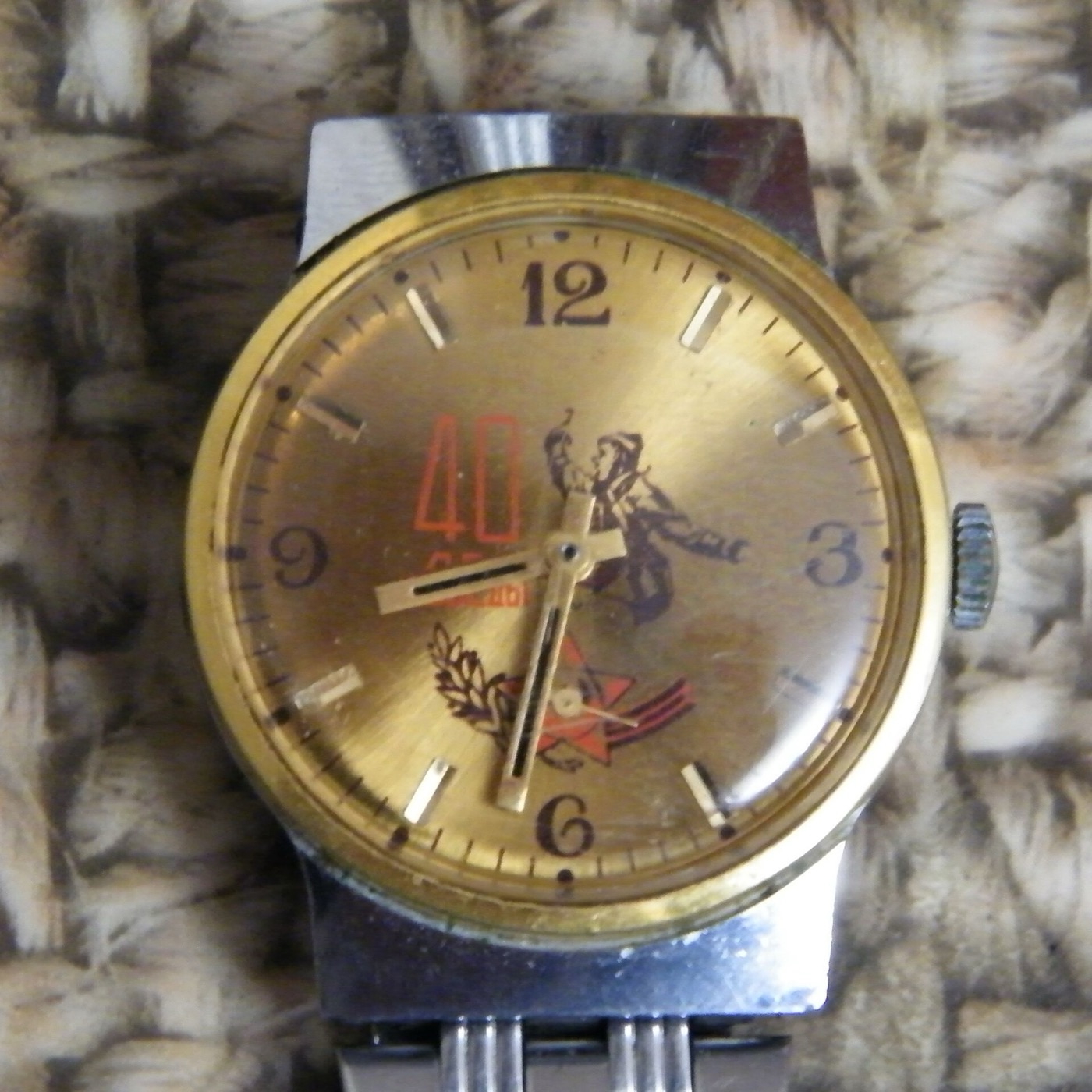
A watch for victory
The Pobeda, Victory, was by Garratt’s account the Soviet Union’s most popular wristwatch. Stalin approved the name in 1945; English Wikipedia says he chose it in April and wanted the watch ready for the anniversary of victory.1, 2, 3
Its movement, the K-26, was a Soviet reworking of the R-26 of the French maker Lip.1, 2, 3
By Wikipedia’s account a prototype came from Penza late in 1945 and the Moscow Kirov factory released the watch to the public in March 1946.1, 2
Made everywhere
It was made at Penza from 1945, at the First Moscow Watch Factory from 1946, at Chistopol, at the Second Moscow factory from 1953 and at Petrodvorets, by Wikipedia’s and Garratt’s lists, and by the Maslennikov plant until the 1990s or later.1, 2, 3
Accounts of its end at the First Moscow factory differ: the Great Soviet Encyclopedia gives 1961, Wikipedia 1953.1, 6
Chistopol’s start is reported as 1949 in Russian Wikipedia; Izvestiya reported in July 1953, in a summary the CIA circulated, that the plant had just begun making the Pobeda on three conveyors.4, 7
Garratt writes that Pobeda assembly moved to conveyor lines in 1950 and that the First Moscow factory’s yearly output reached half a million watches by 1951 and 1.1 million by 1955.3
What it left
Its movement outlived its name. Wikipedia says Petrodvorets built on it for watches sold as Raketa from 1962, and that the Raketa 2609 movement is dimensionally interchangeable with the K-26; Chistopol’s early brands, among them Vostok, used it too.1
Wikipedia says Pobedas were often made to mark battles, Party congresses and space flights and given as presents, and are still common across Eastern Europe and Central Asia.1
Russian Wikipedia says the Maslennikov plant sold its version as ZiM from the 1970s and revived the Pobeda name in 1985, and that a Pobeda cost no more than 27 roubles in the 1980s.2
Wikipedia says the Pobeda name now belongs to the Petrodvorets Watch Factory, maker of Raketa.1
Where the Pobeda leads
- Part of, HistoryThe Soviet watch industry
The victory watch of 1945, on a movement reworked from Lip’s R-26.1, 2, 3
- See also, HistoryWatches go to war
The Pobeda, named in 1945, was the Soviet victory watch.1, 2, 3
- See also, CompanyLip
The Pobeda’s K-26 movement was a reworking of Lip’s R-26.1, 2, 3
- See also, CompanyVostok
Chistopol made the Pobeda from 1949 by Russian Wikipedia’s account, or from 1953 by Izvestiya’s report of that year.4, 7
- See also, EventThe Second World War
The Soviet wristwatch Stalin named Victory in April 1945, by Wikipedia’s account.1
Facts and sources
- Makers
- Penza, both Moscow watch factories, Chistopol, Petrodvorets and the Maslennikov plant1, 2, 3
- Movement
- K-26, 15 jewels, after Lip’s R-261, 2, 3
Sources
- 1
- 2
- 3
The Birth of Soviet Watchmaking: continuing the Hampden story (updated edition) (opens in a new tab)
- 4
- 5
- 6
Московский 1-й часовой завод им. С. М. Кирова (opens in a new tab)
- 7
Sources read November 12, 2026.