Histories, Era IV, War and new industries
The Soviet watch industry
1930 to 1991
How the Soviet Union built a watch industry from nothing after 1930: American machinery bought from a failed Ohio maker, French designs from Lip, wartime evacuation to the Urals and the Kama, the Pobeda and the postwar factories from Petrodvorets to Minsk, watches for cosmonauts and for export, and the collapse after 1991.

In short
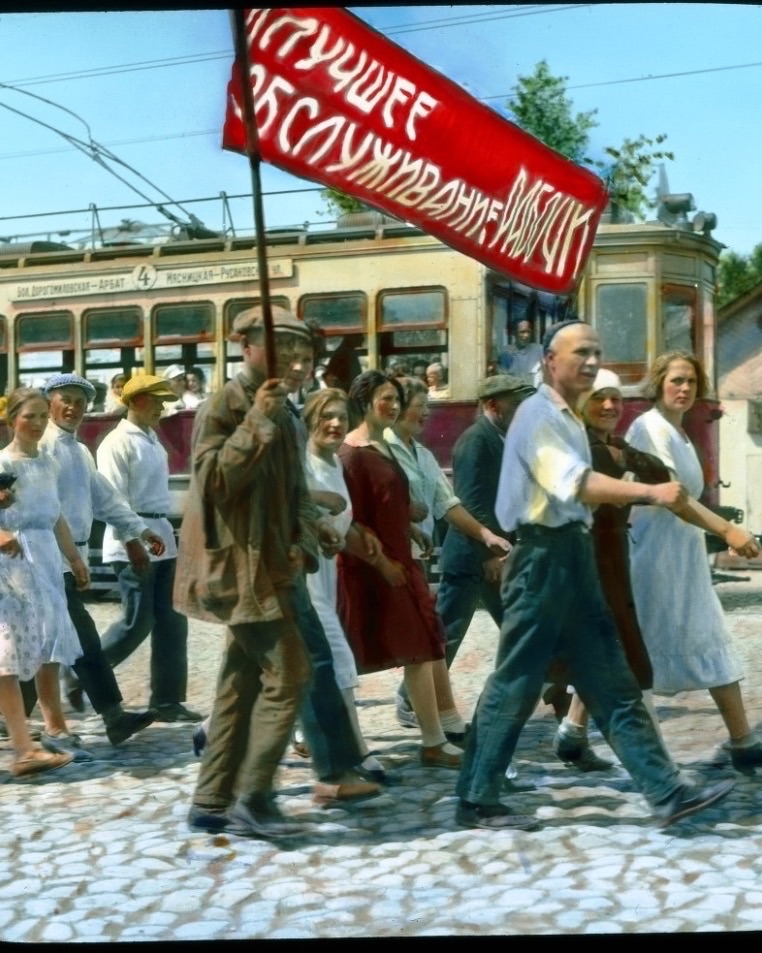
Before 1930 the Soviet Union made almost no watches: those it had were imported, or assembled from Swiss parts. Under Stalin’s Five-Year Plans it bought the worn machinery of a failed Ohio watch company and, a few years later, designs and tooling from the French firm Lip, and built state watch factories in Moscow and Penza; the war scattered them east, to Zlatoust and Chistopol. After 1945 the Pobeda wristwatch was made by the million, new factories opened from Petrodvorets to Minsk, and by the 1970s the country made tens of millions of watches a year, some for cosmonauts and many for export. When the Soviet Union ended most of the factories shrank or closed; Vostok at Chistopol and Raketa at Petrodvorets are among the few that survive.1, 2, 3, 4, 5, 6, 7, 11, 15, 16, 17
Part 1
A country that bought its watches
Before 1917 the watches sold in Russia were mostly assembled there from imported, chiefly Swiss, parts; the Great Soviet Encyclopedia names Swiss-owned houses such as Paul Buhre, Moser and Langendorf, and Alan Garratt, a historian of the Hampden company, adds that tariffs made assembly more profitable than importing finished watches.2, 3
In the early 1920s, the Great Soviet Encyclopedia records, the Aviapribor works in Moscow made simple pendulum wall clocks, the hodiki, and assembled alarm clocks partly from imported parts.2
What was left of the old trade, Paul Buhre’s shop among them, passed to a State Trust of Precision Mechanics, Tochmekh. Garratt writes that through the 1920s it finished imported Swiss and German parts under its own dials, while the country went on importing watches from Switzerland and Germany.3
An early attempt to bring the Swiss in failed. Garratt writes that in 1923 Soviet officials in Berlin agreed in principle a joint company, Tsentrochasy, with Swiss makers, who would import watches and help build a Soviet factory; the talks ended that summer, when a Swiss court acquitted the man who had killed a Soviet diplomat in Lausanne and Moscow ordered a boycott of Swiss firms.3
On 30 December 1927, Garratt records (20 December by the Luch museum’s account), the Council of Labour and Defence ordered watch and clock factories to be built from nothing. A commission formed in 1928 to buy equipment in Europe was refused entry to Switzerland and found no European maker willing to work with it.3, 18
Switzerland kept its distance through the 1930s. Daniel Bujard writes in Europa Star that Swiss watch exports to the USSR fell from 838,000 francs in 1929 to 190,000 in 1938, and that Switzerland refused to sell the Soviets machinery for making watches.19
Part 2
Machines from Ohio
The commission went to the United States instead, on a tour of American plants arranged by the Soviet trading company Amtorg. The Dueber-Hampden Watch Company of Canton, Ohio, in receivership since 1927, sold Amtorg its machinery and tools for $325,000, with a large stock of finished and part-finished parts, a CIA report records.1, 3, 9
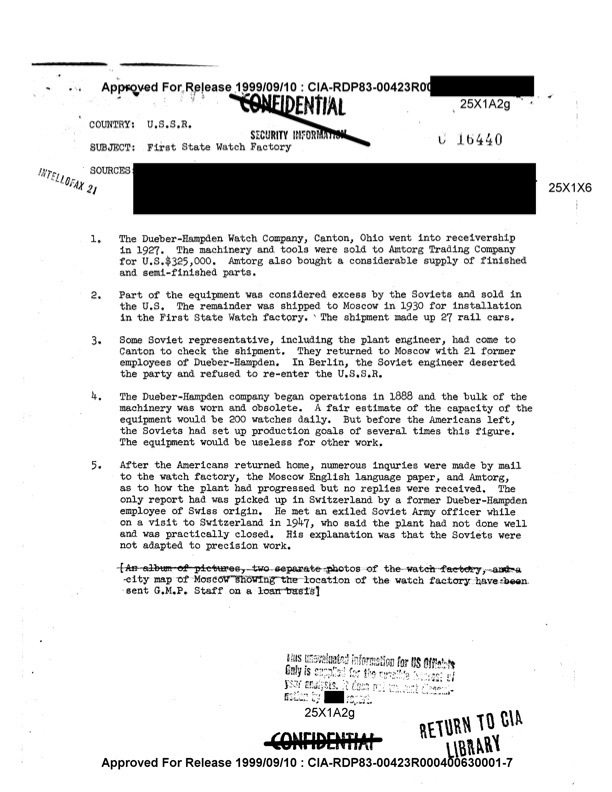
Part of the equipment was sold off in America; the rest went to Moscow in 1930 for the new First State Watch Factory. The Soviet representatives who had checked the shipment in Canton came back with some twenty former Dueber-Hampden employees to set the machines to work (the counts differ, below). The American side of the sale is told under America industrializes the watch.1, 9, 10
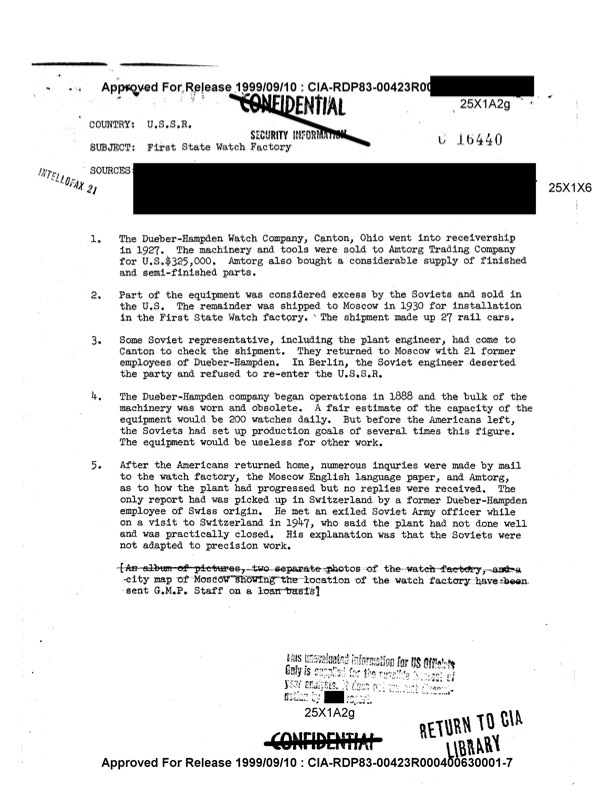
The numbers differ. The CIA report gives 27 rail cars and 21 former employees; Wikipedia’s account of Poljot gives 28 freight cars and 21 technicians; Garratt counts 23 foremen and shop managers, hired for one year.1, 3, 10
The machines were old. The CIA report calls most of them worn and obsolete, Dueber-Hampden having begun work in 1888, and puts their capacity at about 200 watches a day, against Soviet targets several times higher.1
Garratt records that the factory was built between February and June 1930 on the site of a tobacco factory in Vorontsovskaya Street, that its machinery was in place by mid-September, and that its opening 50 pocket watches were presented on 7 November 1930. Its movement, the Type-1, followed the Hampden 16-size pattern.3
A second American purchase went to a second plant. Garratt writes that the Moscow Electro-Mechanical Plant became the Second State Watch Factory in November 1930 and made alarm and table clocks with parts and machines from the Ansonia Clock Company of Brooklyn; Wikipedia says Ansonia sold most of its clock machinery to Amtorg in 1929.3, 22
Skilled hands were short. Garratt writes that Moscow tried to recruit Swiss watchmakers, whom their own authorities discouraged from going, and cites a German report that on 8 August 1930 twelve workers from Glashütte left for Moscow on five-year contracts.3
In 1935 the First State Watch Factory was named after the murdered Bolshevik Sergei Kirov, and its watches became known as Kirovskie.3, 4, 23
The Great Soviet Encyclopedia counts 2.4 million pocket watches from the factory between 1930 and 1940, and national output of 42,000 pocket watches in 1931 and 192,000 in 1935.2, 4
Part 3
A French model, and a war
For a modern wristwatch the Soviets turned to France. A third state watch factory was set up at Penza in 1935 in a former bicycle plant; Garratt writes that it used tooling bought from Lip of Besançon, and Wikipedia’s account of the Zarya brand says its senior engineer trained at Lip and the French firm supplied licences and equipment.3, 11
Garratt dates the agreement to 1936, when Fred Lipmann, Lip’s technical director, signed a deal to sell the USSR movements and parts and then the technology to make them; Lip engineers, he writes, supervised the installation at Penza, and Lip’s T-18 became the Soviet Zvezda.3
The jewels came from an old imperial workshop. The Encyclopaedia of Saint Petersburg records that the Peterhof lapidary works, renamed in 1932 as a factory of technical stones, made watch jewels from 1935, and that by 1940 they no longer had to be bought abroad.5
By 1940, the Great Soviet Encyclopedia records, the country had three watch factories, two jewel factories and one factory for wooden cases.2
Switzerland changed its mind too late. Bujard writes that a Swiss delegation went to Moscow in December 1940, where Anastas Mikoyan pressed for watch machinery, and that the trade agreement signed on 24 February 1941 died when Germany invaded that June; the episode is part of Watches go to war.19
As the Germans approached Moscow in 1941 the First State Watch Factory was evacuated to Zlatoust in the Urals and turned to defence work; the war itself is told under the Second World War.3, 4, 10, 23
Which factory went to Chistopol, on the Kama, is disputed. Russian Wikipedia, Garratt and the Kazan newspaper Vechernyaya Kazan say a decree of 15 October 1941 sent the Second Moscow factory there; English Wikipedia’s Vostok article says it was the First.3, 12, 14, 15
So is the date of the return. The Great Soviet Encyclopedia says the Moscow plant resumed work in 1942; Wikipedia’s Poljot article and Garratt put its return in 1943, when it took the name First Moscow Watch Factory. Zlatoust and Chistopol kept factories of their own.3, 4, 10
Part 4
Victory, and what Germany paid
In 1945 Stalin approved the name Pobeda, Victory, for a new men’s wristwatch; English Wikipedia says he chose it in April 1945 and wanted the watches ready for the anniversary of victory.7, 13
Its 15-jewel movement, the K-26, was a reworking of Lip’s R-26. See the Pobeda.3, 7, 13
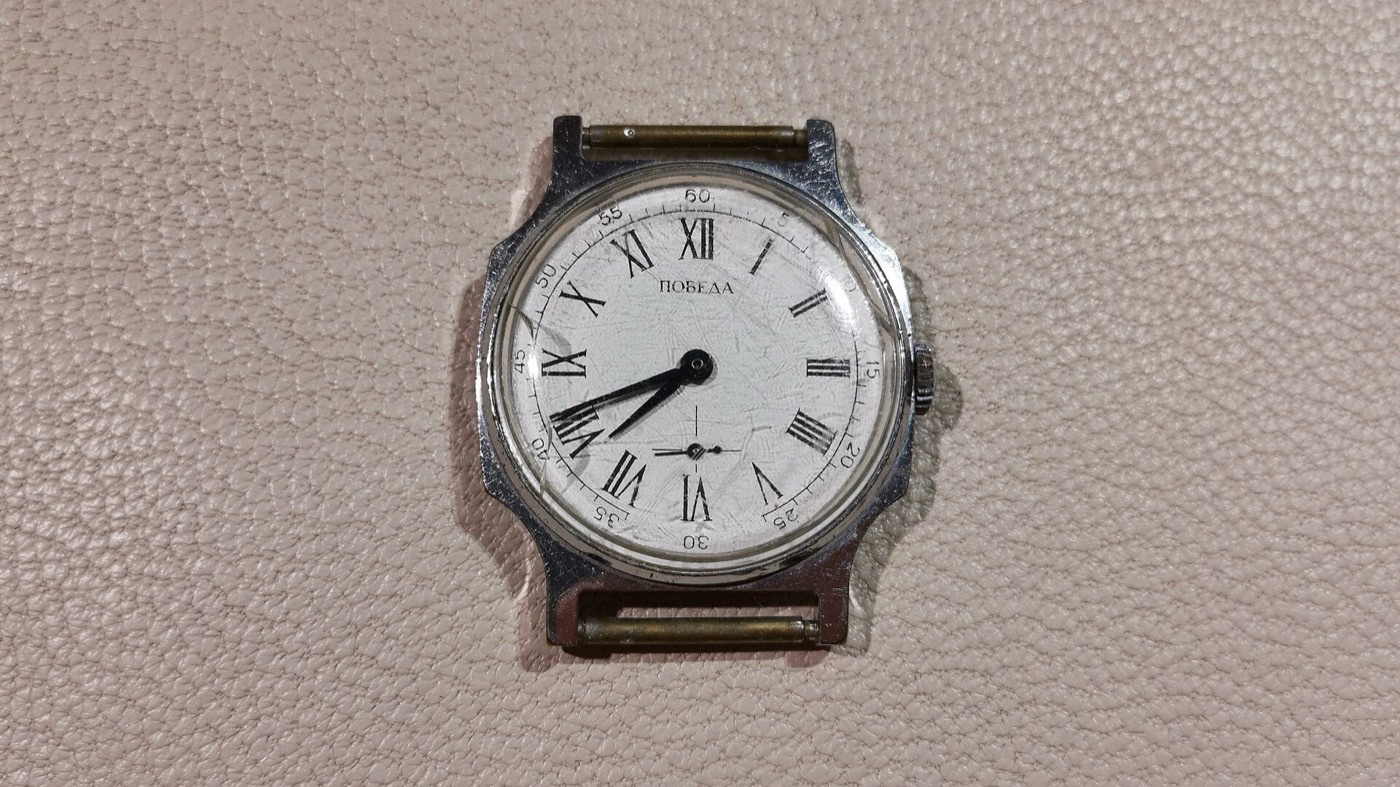
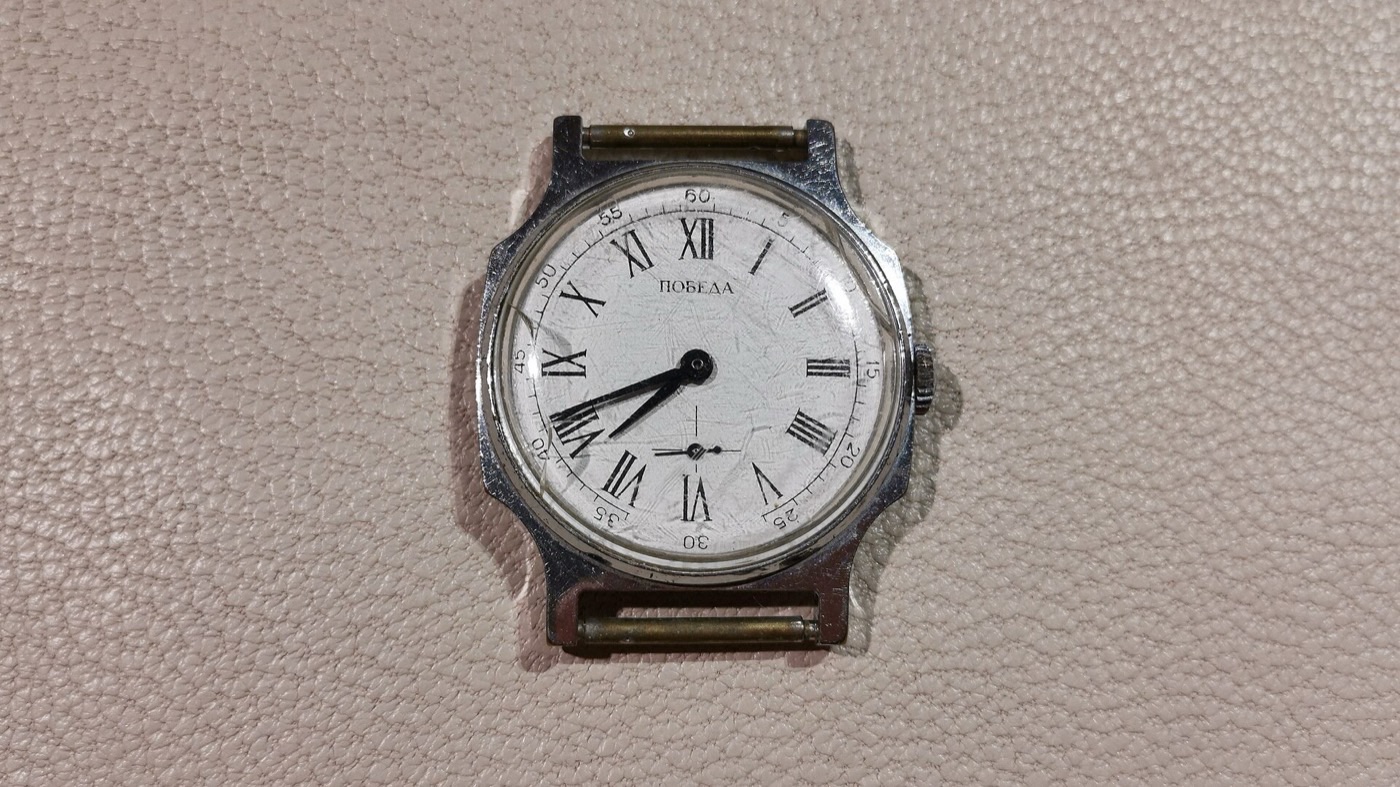
A prototype came from Penza late in 1945, by Wikipedia’s account, and the watch reached the public from the Moscow Kirov factory in March 1946. The Great Soviet Encyclopedia says that factory made the Pobeda from 1946 to 1961; Wikipedia’s list of makers says until 1953.4, 7, 13
Chistopol’s start is reported differently: Russian Wikipedia dates its series production of the Pobeda to 1949, while Izvestiya, in a summary the CIA circulated in 1954, reported in July 1953 that the plant had just begun making it.12, 16
Germany paid in machines and knowledge. Garratt quotes Walter Lange as saying he helped pack machines for shipment to Russia and that A. Lange & Söhne had to make drawings showing the Russians how to build marine chronometers; WatchTime says the German navy’s standard chronometer, the Einheitschronometer, was later made by the First Moscow Watch Factory. No Soviet record of where Glashütte’s machines went was read for this page; the dismantling is told under VEB Glashütter Uhrenbetriebe.3, 26
Watches also went east by purchase. A US intelligence report of June 1947 records a contract to supply the Soviet military government in Germany with Swiss watches worth 150 million Reichsmarks, paid in Swiss francs through the Swiss clearing office in Berlin.27
Garratt writes that after the war the Soviets sought help from the Swiss firm Cortébert and that the Molnija pocket watch copied its calibre 616.3
Part 5
The great expansion
Between 1944 and 1952, the Great Soviet Encyclopedia records, watch factories were built at Serdobsk, Yerevan, Petrodvorets and Uglich, together with a research institute for the industry, a design bureau for its machine tools, and plants for mainsprings, elinvar hairsprings, ruby jewels and oils.2
Soviet newspapers, in summaries the CIA translated, show the method: in 1951 the Penza plant brought in an intermittent conveyor that cut one assembly operation from 37 steps to 19, and in 1953 it raised output per worker by 21 per cent and prepared the small Zarya ladies’ watch; Yerevan was making thousands of watches a day, and a new plant was announced for Minsk.16, 28
A British delegation toured factories in Moscow and Penza in 1956. A report of the visit in the Hamilton Watch Company’s staff magazine of November 1957, reprinted by Garratt, judged the Soviet industry probably the second largest in the world and noted that it made only jewelled lever watches.3
A 1957 US intelligence report names a plant at Chelyabinsk, presumed to be the Molnija works, as the centre for the most precise work, such as aviation clocks and navigation watches.29
Petrodvorets became a watch factory in 1954. The Encyclopaedia of Saint Petersburg dates its Raketa men’s watch to 1960; Wikipedia says the name came in 1961, after Gagarin’s flight. It made up to five million watches a year in the 1970s and 1980s.5, 17
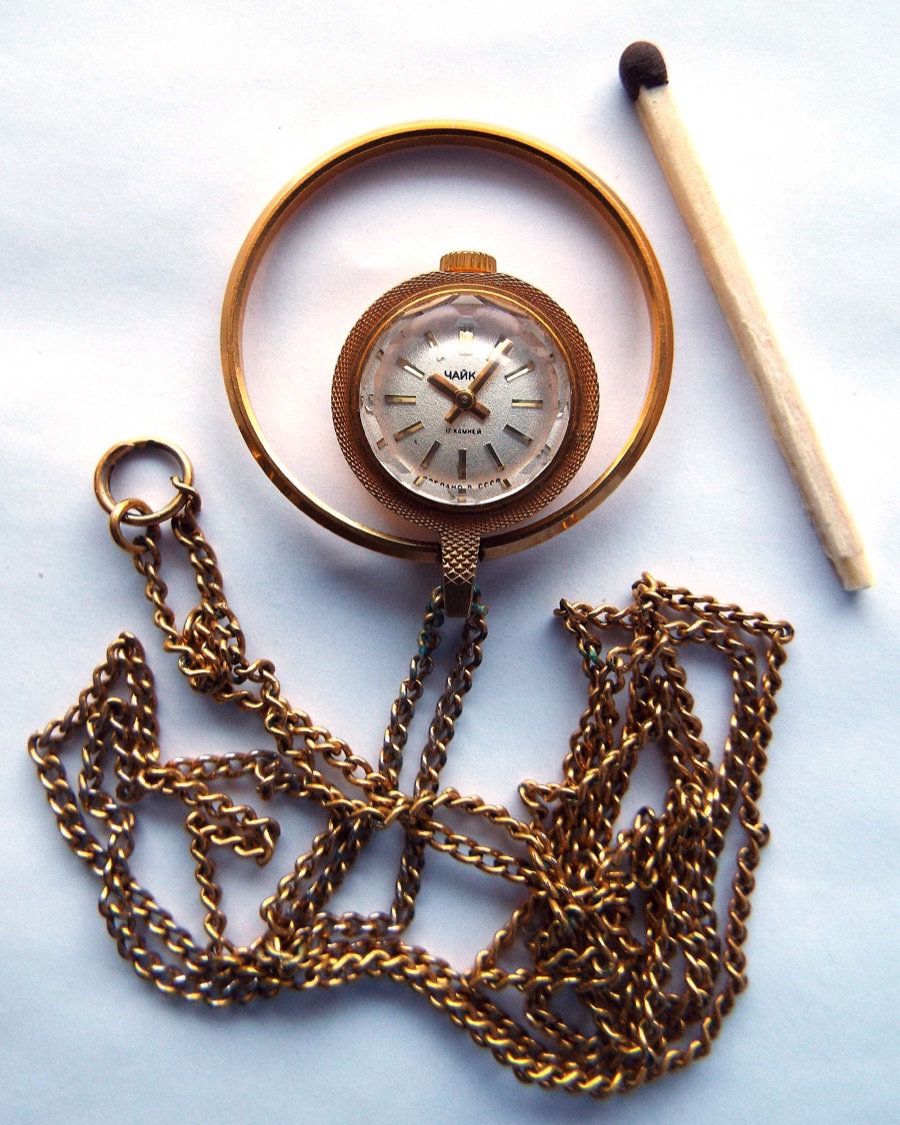
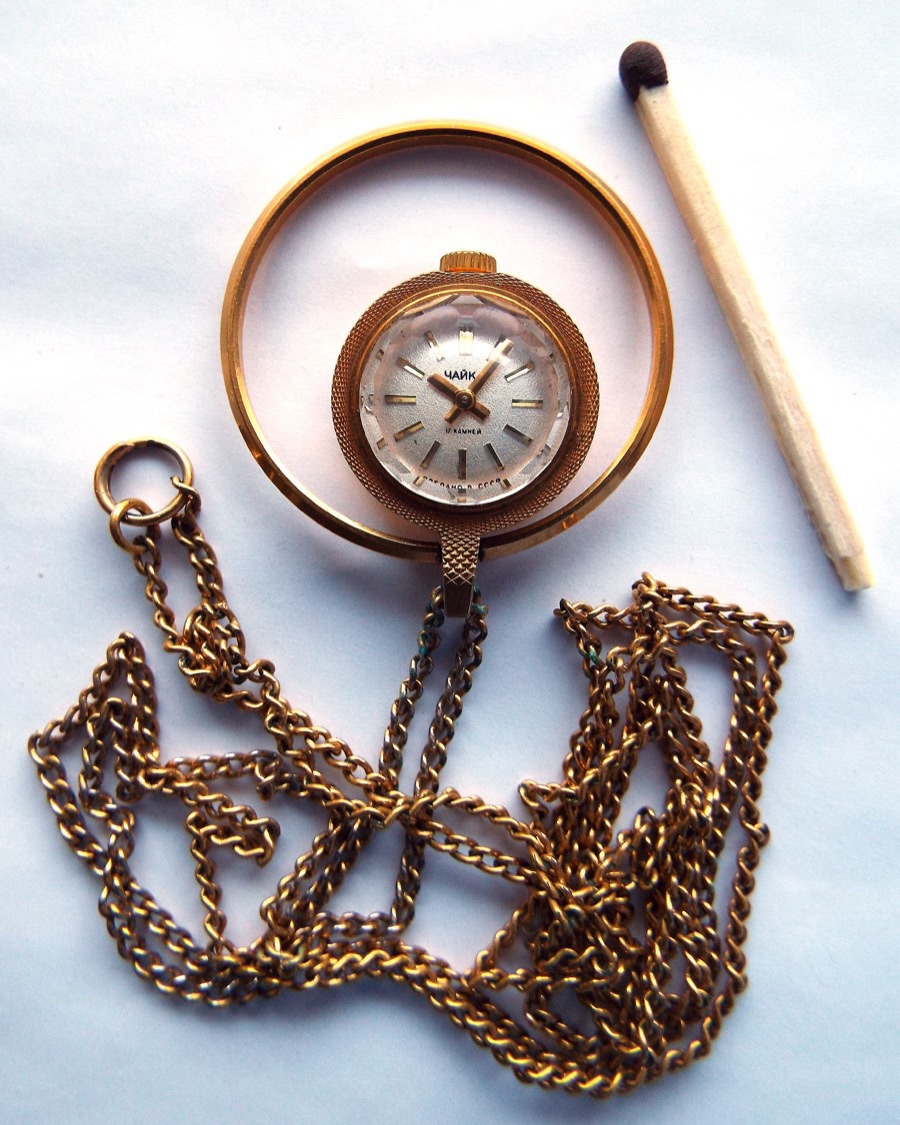
At Uglich, Russian Wikipedia records, a works for technical stones finished in 1942 began assembling Zvezda watches from Penza parts in 1950 and became the Uglich Watch Factory in 1954, later selling its watches as Chaika.31
Chistopol became the army’s watchmaker. Russian and English Wikipedia say it supplied the Ministry of Defence from 1965, when it launched the Komandirskie, and sold all its watches as Vostok from 1969.12, 15
The Great Soviet Encyclopedia gives output of all clocks and watches as 2.8 million in 1940, 7.6 million in 1950, 26 million in 1960 and 55 million in 1975, 31 million of them wristwatches.2
Pierre-Yves Donzé, a historian of the watch industry, writes in Europa Star that Soviet production rose from 16 million pieces in 1960 to almost 40 million in 1980, which put the USSR third in the world after Switzerland and Japan.6
Exports grew. A summary of the Neue Zürcher Zeitung circulated by the CIA records Soviet wrist and pocket watches on sale in Czechoslovakia in large numbers in 1950; the Great Soviet Encyclopedia says that by the mid-1970s Chaika, Zarya, Slava, Raketa and Poljot watches went abroad widely; the Encyclopaedia of Saint Petersburg says Petrodvorets exported about 40 per cent of its output to more than 30 countries.2, 5, 33
Many were sold under other names. Wikipedia says the Sekonda brand was created in 1966 to export watches from all the Soviet factories, and Russian Wikipedia that it went mainly to Britain; Donzé notes a Soviet advertisement of 1982 claiming exports to more than 100 countries.6, 23, 34
Lip came back. Garratt writes that it was invited in 1969 to bring Soviet production up to date, that a further agreement followed in 1972, and that the cooperation, which ended with Lip’s collapse in the mid-1970s, produced a Franco-Soviet quartz watch.3
Part 6
Watches in orbit
What Yuri Gagarin wore on 12 April 1961 is disputed. Wikipedia and the First Moscow factory’s tradition name a Shturmanskie made for the air force; the Museum of Cosmonautics, which shows the Shturmanskie he received on leaving flight school in October 1957, doubts he took it into orbit; Donzé notes that Europa Star reported in 1964 that Gagarin and Gherman Titov wore watches by the Geneva firm Camy; and Wikipedia’s account of Petrodvorets claims the flight for a Pobeda.6, 10, 23, 35, 36
Garratt rejects the story that Gagarin’s watch was made on the old Canton machines: by then, he writes, the First Moscow factory had been fully re-equipped.3
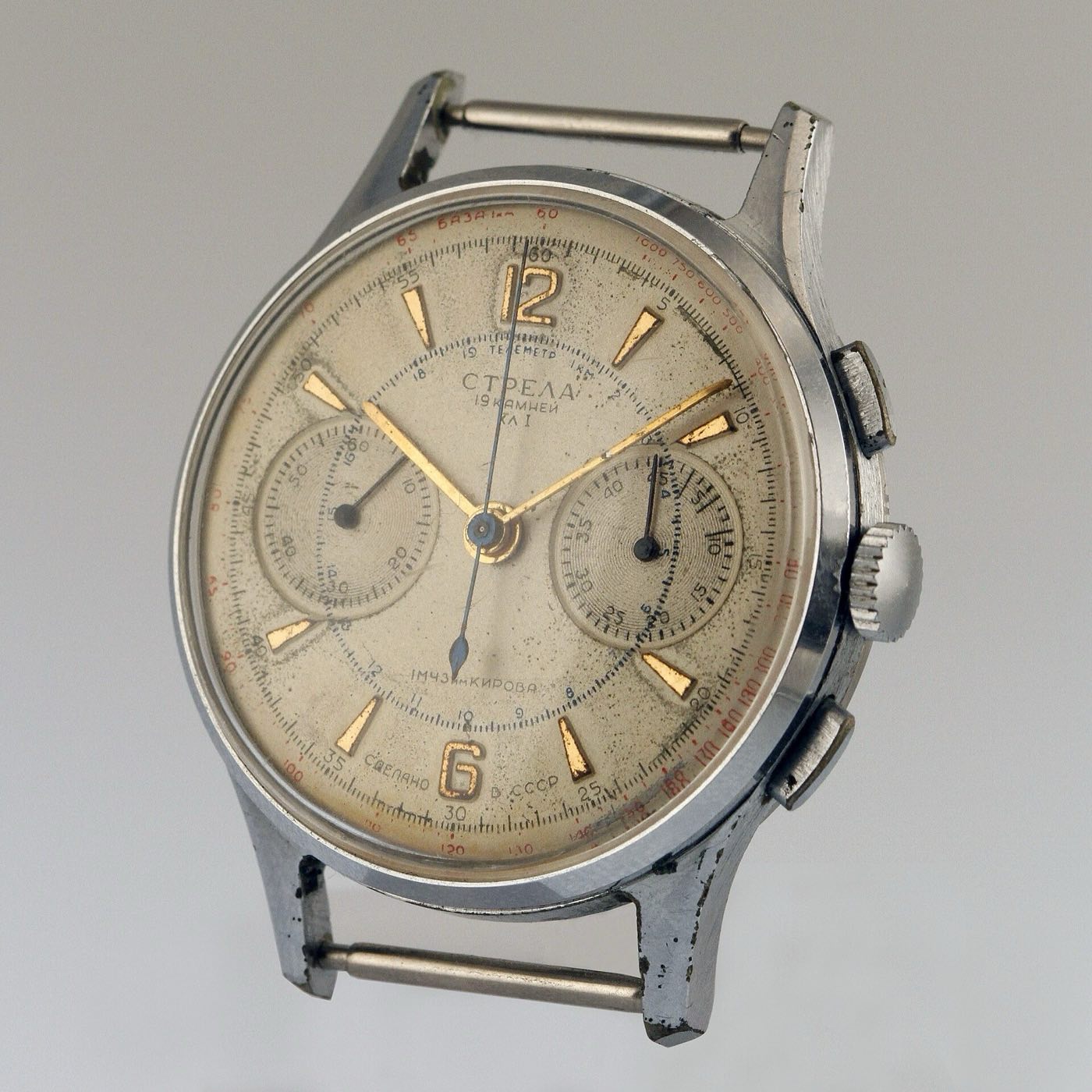
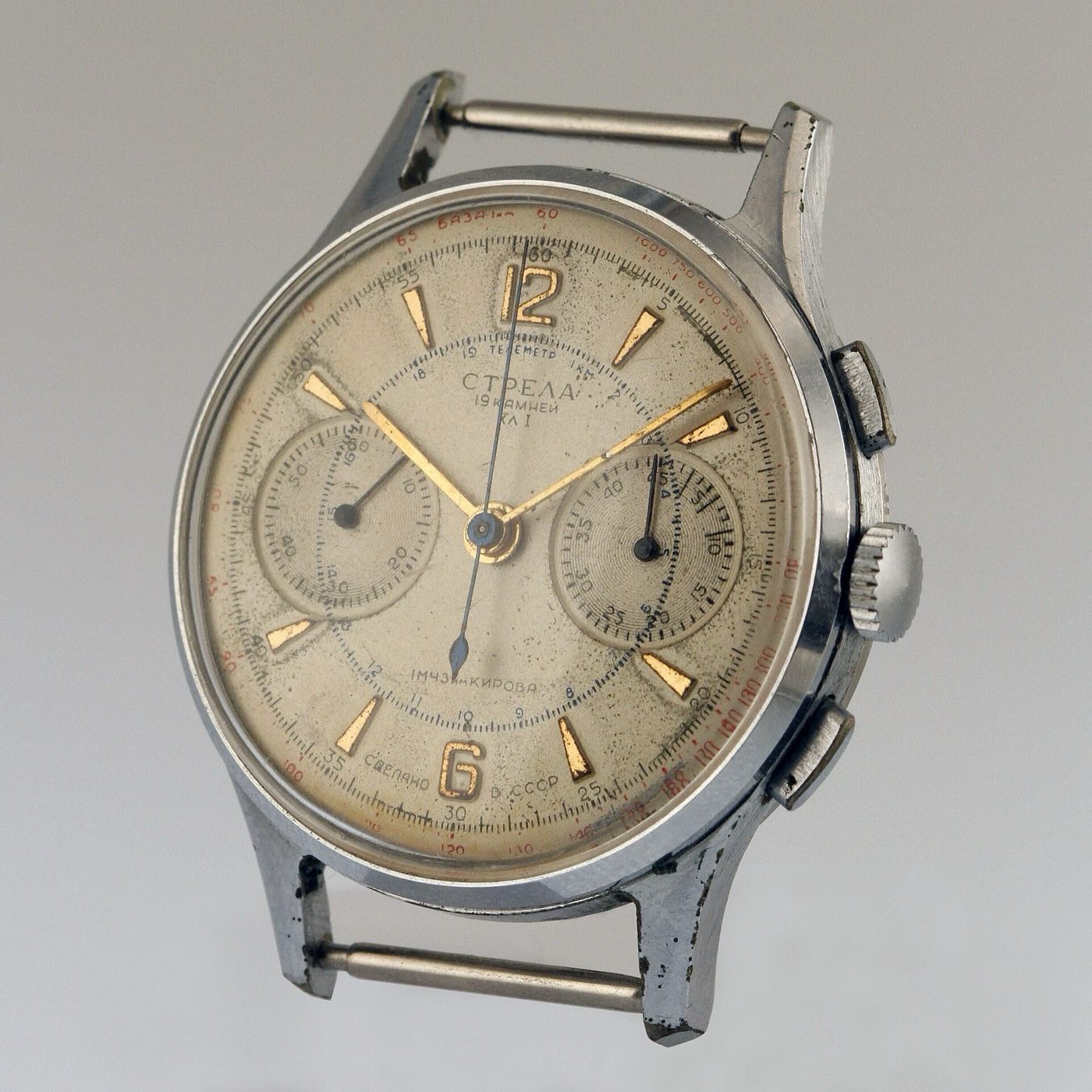
For Alexei Leonov’s spacewalk of March 1965, Wikipedia and Worn & Wound name a Strela chronograph from the First Moscow Watch Factory; Garratt says the Strela’s movement derived from the Swiss Venus 150.3, 10, 37
The Museum of Cosmonautics says a ladies’ watch from Uglich flew with Valentina Tereshkova in 1963 and was later named Chaika, after her call sign.35
Western watches flew too: Donzé notes that Omega watches were worn by both crews of the Apollo-Soyuz mission in 1975, though the USSR never took more than 0.1 per cent of Swiss watch exports.6
Part 7
Collapse and after
The industry did not survive the end of the Soviet Union whole. Donzé writes that Russian production fell to 4.8 million pieces in 2000 and nearly disappeared over the following decade.6
Russian Wikipedia says the First Moscow Watch Factory became a joint-stock company in 1992 and stopped making watches after its equipment was sold in 2005; Vechernyaya Kazan reported in 2003 that Poljot wristwatches and Slava alarm clocks were to be made at Chistopol.14, 23
The Second Moscow factory’s site was sold in 2006 and its buildings demolished by 2010, Wikipedia says; the Slava name lives on under licence.40
Uglich stopped mass production in 2006, and by 2009, Russian Wikipedia says, its machines and technical archive were gone; a museum in the old gatehouse is what remains.31
Petrodvorets became a joint-stock company in 1991 and came near to bankruptcy, the Encyclopaedia of Saint Petersburg records; the Raketa name carried on, and Wikipedia says the factory still makes its own movements, hairsprings and escapements.5, 17
Chistopol held on. Wikipedia records that it was privatised in 1993, signed a distribution agreement with a Swiss trading firm the same year, went bankrupt in 2010 and was reorganised, and still makes Vostok watches.12, 15
Through this history
The companies, people, technologies, objects and events this chapter is made of, in the order the story meets them.
Group
Tochmekh (State Trust of Precision Mechanics)The state trust that gathered the old watch trade in the 1920s and, Garratt writes, set up the two Moscow factories of 1930.3
History
America industrializes the watchThe American industry whose failed Dueber-Hampden company sold its machines to Moscow.1, 9
Company
Poljot (First Moscow Watch Factory)The First State Watch Factory, later the First Moscow Watch Factory and Poljot.1, 4, 10
Group
VEB Glashütter Uhrenbetriebe (GUB)Where, by Walter Lange’s account as Garratt quotes it, machines were packed for Russia after 1945.3
Key dates
- 1930
The First State Watch Factory is set up in Moscow with machinery bought from Dueber-Hampden of Canton, Ohio.1, 3, 4
- 1935
The First State Watch Factory is named after Sergei Kirov; a third factory opens at Penza.3, 4
- 1941
The First State Watch Factory is evacuated to Zlatoust; a decree of 15 October sends a Moscow factory to Chistopol.3, 4, 12
- 1945
Stalin approves the name Pobeda; a prototype comes from Penza.3, 7
- 1947
A US intelligence report records a contract for Swiss watches for the Soviet military government in Germany.27
- 1950
Soviet watches are sold in Czechoslovakia in large numbers.33
- 1951
The Penza plant introduces an intermittent assembly conveyor.28
- 1953
Chistopol begins making the Pobeda; a watch plant is announced for Minsk.16
Where this leads
- Before, Era IVJapan builds a watch industry
1873 to today
- After, Era IVChina builds a watch industry
1950 to today
Where the Soviet watch industry leads
- See also, HistoryThe electric and quartz revolution
The Great Soviet Encyclopedia records that Soviet factories had begun making quartz wristwatches by the mid-1970s; Garratt writes that Lip and the USSR worked on a quartz watch together.2, 3
- See also, CompanyHamilton
Hamilton’s staff magazine reported in November 1957 on a British delegation’s visit to Soviet watch factories, a report Garratt reprints.3
Facts and sources
- Period
- 1930 to 1991, with the imported and assembled watches of the years before1, 2, 6
- Where
- Moscow above all; also Penza, Zlatoust, Chistopol, Petrodvorets, Uglich, Chelyabinsk, Minsk, Yerevan and Serdobsk2, 3, 5, 16, 29
Sources
- 1
First State Watch Factory (CIA-RDP83-00423R000400630001-7) (opens in a new tab)
- 2
Часовая промышленность (Watch industry) (opens in a new tab)
- 3
The Birth of Soviet Watchmaking: continuing the Hampden story (updated edition) (opens in a new tab)
- 4
Московский 1-й часовой завод им. С. М. Кирова (opens in a new tab)
- 5
- 6
When watchmakers face political risk: selling watches in the USSR (opens in a new tab)
- 7
- 8
- 9
- 10
- 11
- 12
- 13
- 14
- 15
- 16
- 17
- 18
- 19
The watch industry, Switzerland and the USSR under Stalin (opens in a new tab)
- 20
- 21
- 22
- 23
- 24
A Pobeda wristwatch (photograph of 2024). (opens in a new tab)
- 25
A Pobeda wristwatch (photograph of 2024). (opens in a new tab)
- 26
175 Jahre Uhrmacherei in Glashütte: Chronometergenaue Uhren (opens in a new tab)
- 27
Russians purchase Swiss watches (CIA-RDP82-00457R000600680002-3) (opens in a new tab)
- 28
- 29
- 30
- 31
- 32
- 33
- 34
- 35
- 36
- 37
- 38
- 39
- 40
Sources read November 12, 2026.