Poljot (First Moscow Watch Factory)
The Moscow factory founded in 1930 as the First State Watch Factory on machinery from Dueber-Hampden of Canton, Ohio, named after Kirov in 1935, later the First Moscow Watch Factory, maker of the Pobeda, marine chronometers and the Poljot watches; Russian Wikipedia says it stopped making watches in 2005.
Founded 1930, as the First State Watch Factory
In the history The Soviet watch industry
The First State Watch Factory
The factory behind the Poljot name was the First State Watch Factory, set up in Moscow in 1930 with the worn machinery of the Dueber-Hampden Watch Company of Canton, Ohio, which Amtorg had bought for $325,000; some twenty former Dueber-Hampden employees came to set it working (21 in a CIA report, 23 foremen by Garratt’s count).1, 3, 7
Garratt writes that its opening pocket watches were presented on 7 November 1930 and that its Type-1 movement copied the Hampden 16-size; the Hamilton company’s magazine, reporting a British visit of 1956, says the factory began with four types of watch, two pocket and two wrist, in October 1930.3
It was named after Sergei Kirov in 1935, and its watches were called Kirovskie; the Great Soviet Encyclopedia counts 2.4 million pocket watches from it between 1930 and 1940.2, 3, 5

War, Pobeda and chronometers
Evacuated to Zlatoust in the Urals in 1941, it made products for the front. It was back in Moscow by 1942 according to the Great Soviet Encyclopedia, or 1943 according to Wikipedia and Garratt, and took the name First Moscow Watch Factory.2, 3, 4
It made the Pobeda from 1946, until 1961 by the Great Soviet Encyclopedia’s account or 1953 by Wikipedia’s.2, 8
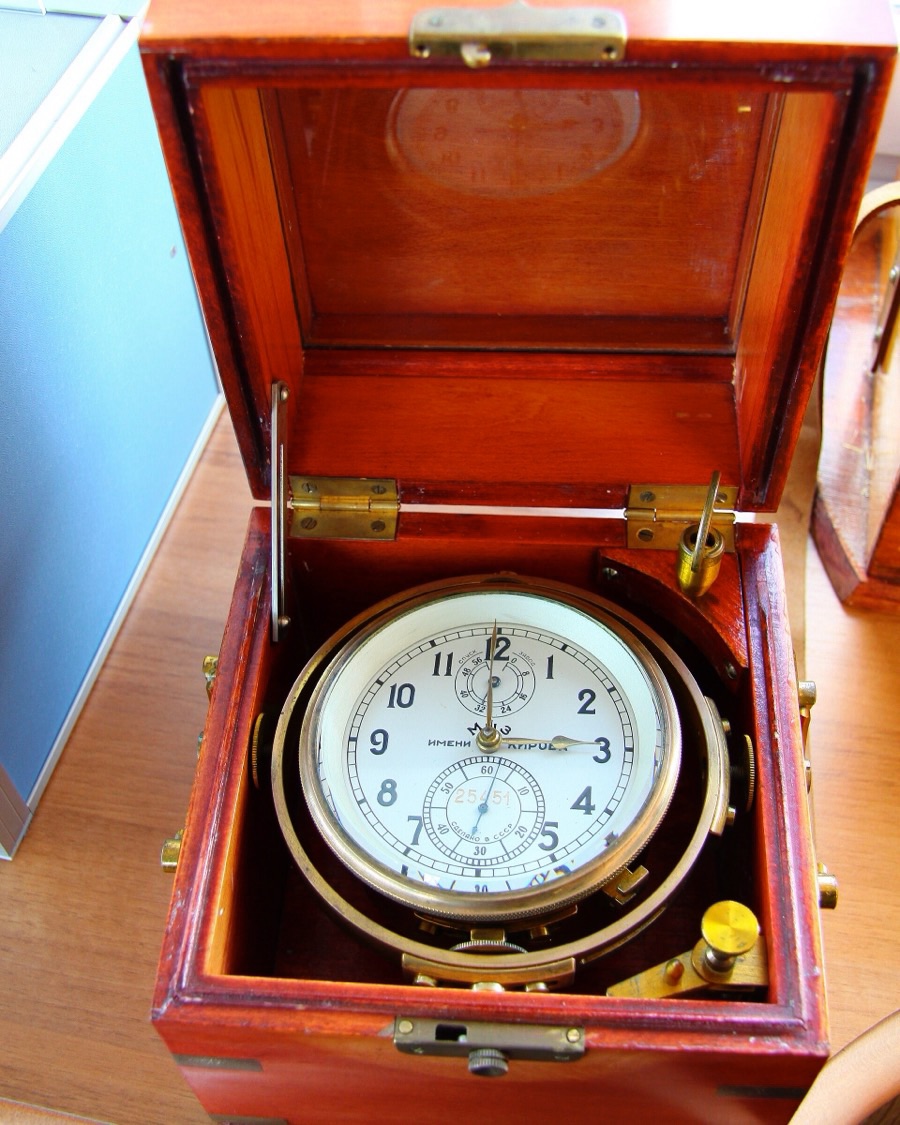
It also made marine chronometers. Wikipedia dates its marine chronometers and deck watches to 1947, and WatchTime says it took over the German navy’s wartime standard chronometer, the Einheitschronometer; Garratt quotes Walter Lange that Lange made drawings to show the Russians how to build them.3, 4, 9
In 1957 a US intelligence report noted that the Moscow No. 1 factory was making an automatic watch, which its informant thought crude.10
Poljot
Wikipedia says the factory’s watches have carried the Poljot name, meaning flight, since 1964.4
The Great Soviet Encyclopedia records more than three million Poljot watches in 114 designs in 1973, after a reconstruction of the works, and the Order of Lenin for the factory in 1966.2, 5
The factory made the watches tied to Soviet spaceflight: Wikipedia names its Shturmanskie for Gagarin’s flight of 1961 and its Strela chronograph for Leonov’s spacewalk of 1965, though the Museum of Cosmonautics doubts that Gagarin’s Shturmanskie went into orbit.4, 5, 11, 12
Russian Wikipedia says watches from the factory were exported from the late 1960s under the Sekonda name, mainly to Britain, and that its 3133 chronograph calibre was licensed from a Swiss firm; English Wikipedia adds that Swiss machinery for complicated watches was bought in 1975.4, 5
After 1991
The factory became a joint-stock company in February 1992, Russian Wikipedia says; successor companies used the Poljot name, and in 2005 its equipment and the technology of the 3133 chronograph were sold to the Maktime group and watchmaking at the factory ended.5
According to Vechernyaya Kazan, Poljot wristwatches were to be made from 2003 at Chistopol, home of Vostok.13
Wikipedia says former employees formed a new company, Volmax, which sold watches under names such as Shturmanskie and Buran with movements from Maktime, and that Maktime later went bankrupt.4
Key dates
- 1930
The First State Watch Factory is set up with Dueber-Hampden machinery.1, 2, 3
- 1935
The factory is named after Sergei Kirov.2, 3
- 1941
Evacuated to Zlatoust.2, 3
- 1957
A US intelligence report notes an automatic watch at the factory.10
- 1966
The factory is awarded the Order of Lenin.2, 5
- 1973
More than three million Poljot watches in 114 designs.2, 5
Where Poljot (First Moscow Watch Factory) leads
- Formerly owned by, GroupTochmekh (State Trust of Precision Mechanics)
Garratt gives the factory’s name in 1930 as the First State Watch Factory of the Trust of Precision Mechanics; he dates the trust’s dissolution to 1933.3
- Based in, PlaceMoscow
The First State Watch Factory, later the First Moscow Watch Factory, was founded in Moscow in 1930.1, 2, 3
- Part of, HistoryThe Soviet watch industry
The First State Watch Factory, later the First Moscow Watch Factory and Poljot.1, 2, 4
- See also, TechnologyThe marine chronometer
Wikipedia dates the First Moscow factory’s marine chronometers to 1947; WatchTime says it made the German Einheitschronometer design.4, 9
Facts and sources
- Founded
- 1930, as the First State Watch Factory1, 2, 3
- Based
- Moscow (evacuated to Zlatoust in 1941)2, 3
- Names
- First State Watch Factory; Kirov (1935); First Moscow Watch Factory (1942 or 1943); Poljot as the brand from 19642, 3, 4
Sources
- 1
First State Watch Factory (CIA-RDP83-00423R000400630001-7) (opens in a new tab)
- 2
Московский 1-й часовой завод им. С. М. Кирова (opens in a new tab)
- 3
The Birth of Soviet Watchmaking: continuing the Hampden story (updated edition) (opens in a new tab)
- 4
- 5
- 6
- 7
- 8
- 9
175 Jahre Uhrmacherei in Glashütte: Chronometergenaue Uhren (opens in a new tab)
- 10
- 11
- 12
- 13
Sources read November 12, 2026.