The marine chronometer
The precision timekeeper a ship carried to keep the time of a reference meridian, so that longitude could be found from the Sun and stars. Harrison showed it could be done; Le Roy, Berthoud, Arnold and Earnshaw made it simpler, and by the nineteenth century every navy carried it.
Introduced 1730s to 1780s
Companies Poljot (First Moscow Watch Factory)
Came after Harrison’s H4
Developed by Ferdinand Berthoud, John Harrison
In the histories The balance spring and the age of precision, Longitude and the marine chronometer, France and the science of horology
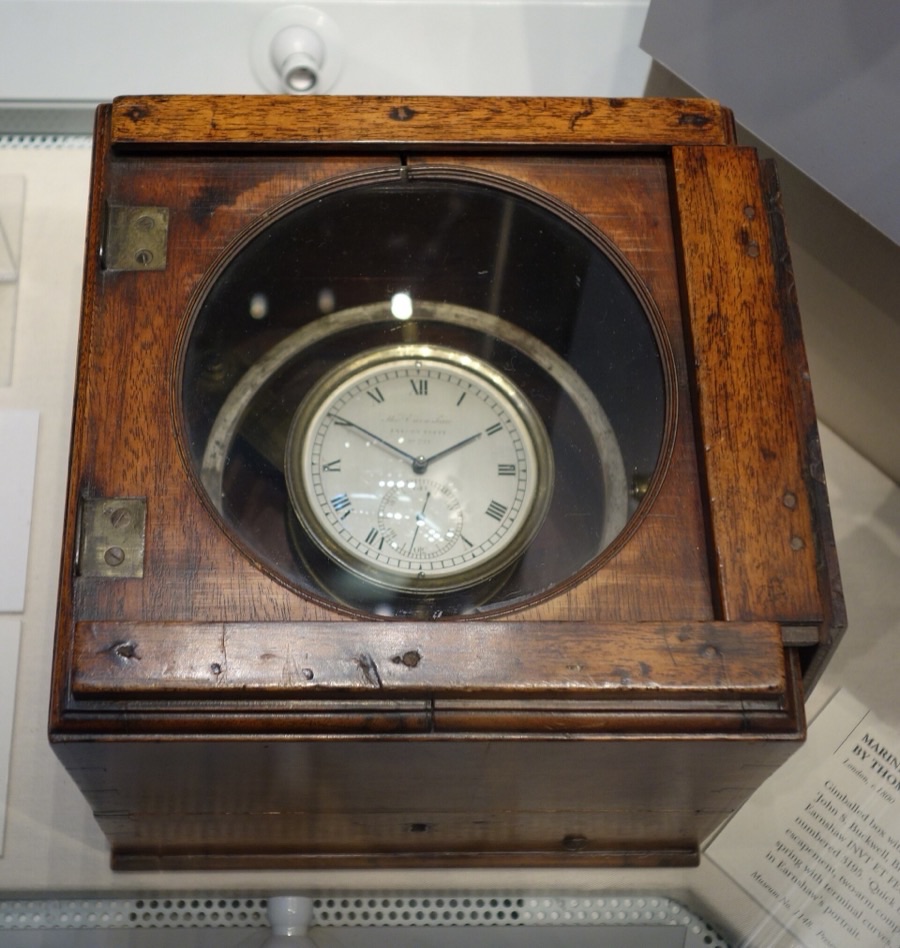
What it is
A marine chronometer keeps the time of a reference meridian at sea, so that the ship’s longitude can be worked out from observations of the Sun or stars.1, 2
Rating made it usable: a chronometer’s average daily gain or loss was recorded on a certificate, and the navigator corrected its readings by that rate.1, 5
Beginnings
Christiaan Huygens attempted sea clocks from 1673; Robert Hooke said he had conceived a spring-driven clock earlier, and that priority is still disputed.1, 6
Royal Museums Greenwich calls Harrison’s timekeepers, made between 1735 and 1759, the first successful marine timekeepers, but they were too complex to copy cheaply: Kendall’s exact copy of H4 cost £450.2, 7
The detent and the compensation balance
In Paris, Pierre Le Roy combined a detached, or detent, escapement with a temperature-compensated balance and a balance spring that kept time whatever the size of the swing, and won the Académie prize after trials at sea.6, 8
Ferdinand Berthoud’s sea clocks were tried at sea in 1768–69, and in 1770 he was named clockmaker to the King and the Navy.8, 9, 10
In London, John Arnold patented a spring detent escapement in 1782; Wikipedia’s account also dates a patent to 1775 for a bimetallic compensation balance and a helical balance spring.11, 12
Wikipedia’s account of Arnold says his No. 36, tested at Greenwich in 1779–80, was the watch he called a chronometer, helping give the word its modern sense; some at the time suspected its result was luck.11
Thomas Earnshaw’s spring detent of 1780, patented through Thomas Wright in 1783, and his compensation balance became the usual form of the marine chronometer. Whether Arnold or Earnshaw had the spring detent first, and how far they were rivals, is debated.11, 13
Royal Museums Greenwich says Earnshaw made the chronometer a relatively simple design that others could reproduce. Arnold made them in quantity at Well Hall, Eltham.2, 3, 11, 14
Arnold and Breguet
According to Wikipedia’s account of Arnold, he let Breguet make broad use of his inventions and sent his son to train with him, and Breguet later credited Arnold with the idea behind the tourbillon. Breguet became chronometer-maker to the French Navy in 1815.11, 15, 16
Navies and the trade
In 1821 the Royal Observatory began testing chronometers for the Royal Navy under John Pond, its Superintendent of Chronometers.1, 17
A good trial meant sales: Porthouse No. 233 was bought by the Navy straight after its trial of 1823 to 1825 and served for 112 years.1, 5
Admiralty chronometers went on the long voyages: Royal Museums Greenwich records twenty-two on the Beagle’s second voyage, and more with Franklin in 1845.2
The London trade of the nineteenth century included makers such as Molyneux, French and Mercer. Mechanical chronometers were made well into the twentieth century, until radio time signals and, later, electronic navigation took over their work.1, 2, 18
Key dates
- 1769
Kendall completes K1, the copy of H4.7
- 1782
Arnold patents a spring detent escapement.11, 12
- 1783
Earnshaw’s spring detent is patented, in Thomas Wright’s name.12, 13
- 1815
Breguet becomes chronometer-maker to the French Navy.15, 16
- 1821
The Royal Observatory begins testing chronometers for the Navy.1, 17
- 1858
Thomas Mercer sets up in Clerkenwell.18
Where the marine chronometer leads
- Developed by, PersonFerdinand Berthoud
His sea clocks were tried at sea in 1768-69 and supplied to the French Navy.9, 19
- Developed by, PersonJohn Harrison
Royal Museums Greenwich calls Harrison’s timekeepers the first successful marine timekeepers.2
- Came after, ObjectHarrison’s H4
Kendall’s copy of H4 proved the timekeeper at sea; Arnold and Earnshaw then made cheaper ones.2, 7
- Part of, HistoryFrance and the science of horology
The sea clocks Berthoud and Le Roy built and tried at sea for the French Navy.6, 9
- Part of, HistoryLongitude and the marine chronometer
The chronometer made Harrison’s answer simple enough to put on every ship.1, 2
- Part of, HistoryThe balance spring and the age of precision
Mudge spent his later years on marine timekeepers for the Board of Longitude.20, 21
- See also, HistoryBritain’s watch industry
The fusee lasted longest in marine chronometers, and Davies lists the defence case for hand-made chronometers among the reasons the trade resisted change.22, 23
- See also, CompanyPoljot (First Moscow Watch Factory)
Wikipedia dates the First Moscow factory’s marine chronometers to 1947; WatchTime says it made the German Einheitschronometer design.24, 25
- See also, PersonAbraham-Louis Breguet
Breguet became chronometer-maker to the French Navy in 1815.15, 16
- See also, PersonThomas Mudge
Mudge spent his later years on marine timekeepers tried by the Board of Longitude.20, 21
- See also, PlaceClerkenwell
Thomas Mercer made chronometers in Clerkenwell from 1858 to 1874.18
- See also, PlaceGreenwich
The Navy bought its chronometers on the results of trials at Greenwich.5, 26
- See also, TraditionChronometry and certification
Chronometers were rated and tested at the Royal Observatory from 1821.1, 17
Facts and sources
Sources
- 1
- 2
Time machines: chronometers from the collection (opens in a new tab)
- 3
Our collections: a unique history of timekeeping (opens in a new tab)
- 4
- 5
233 (ZAA0057), marine chronometer by Thomas Porthouse (opens in a new tab)
- 6
- 7
- 8
Movements and maps – the French quest for longitude (opens in a new tab)
- 9
- 10
Chronomètre de marine / Horloge marine n° 12 (opens in a new tab)
- 11
- 12
- 13
- 14
Arnold, John (Chalmers, General Biographical Dictionary, vol. 2, 1812) (opens in a new tab)
- 15
- 16
- 17
History of the Royal Observatory and the Astronomers Royal (opens in a new tab)
- 18
Marine chronometer 16285 by Thomas Mercer (ZBA7843) (opens in a new tab)
- 19
Chronomètre de marine / Horloge marine no 12 (IV-84) (opens in a new tab)
- 20
Mudge, Thomas (Dictionary of National Biography, 1885-1900, vol. 39) (opens in a new tab)
- 21
- 22
- 23
- 24
- 25
175 Jahre Uhrmacherei in Glashütte: Chronometergenaue Uhren (opens in a new tab)
- 26
Edward John Dent's glass springs, archive and technical analysis combined (opens in a new tab)
Sources read November 11, 2026.