John Harrison
The Yorkshire carpenter and self-taught clockmaker who spent four decades on the longitude problem, built the sea clocks H1 to H3 and the watch H4, and fought the Board of Longitude for the prize he believed he had won.
Born 1693, Foulby, Yorkshire, Died 24 March 1776, London
In the histories The balance spring and the age of precision, Longitude and the marine chronometer
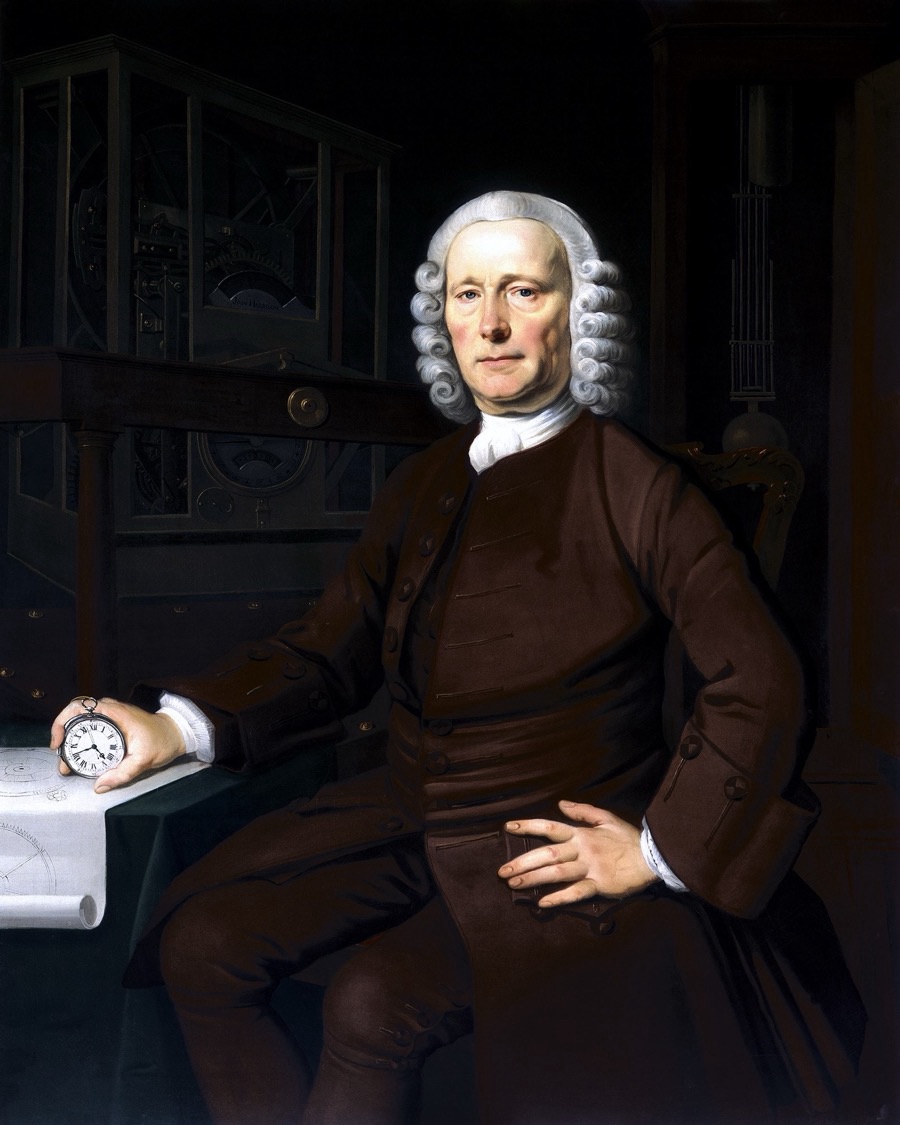

A carpenter who made clocks
Harrison was a carpenter by trade and taught himself clockmaking. The Science Museum dates his earliest clock to 1713, made almost entirely of wood, and wooden clocks of 1713 and 1715 survive.1, 2, 4, 7
He developed the gridiron pendulum, which kept its length as the temperature changed, and the grasshopper escapement.2, 5
Royal Museums Greenwich says his precision longcase clocks of the mid-1720s kept time to about one second a month.1
The sea clocks
Seeking the reward of the Longitude Act, he went to London, where Edmond Halley sent him to the clockmaker George Graham.1, 2
He built H1 at Barrow upon Humber, probably with his brother James, and brought it to London in 1735. On a voyage to Lisbon in 1736 it let him correct the ship’s reckoning, and in 1737 the Commissioners agreed £500 for an improved clock.1, 8
H2 was never tried at sea, because of a flaw in its balances. H3 took him from 1740 for about two decades; its lasting results were the bimetallic strip and the caged roller bearing.1, 2
His watch H4 was completed in 1759, building on ideas tried earlier in a watch the London maker John Jefferys made to his design.1, 9
The prize
His son William carried H4 to Jamaica in 1761–62 and to Barbados in 1764. Under the Act of 1765 the Board awarded Harrison £10,000 but required him to disclose his design and show it could be copied; he felt the rules had been changed against him.1, 2
Wikipedia’s biography records that he wrote he had been extremely ill used.2
King George III tested Harrison’s fifth timekeeper, H5, himself. Parliament paid Harrison £8,750 in 1773; with earlier sums he received about £23,065, but never the official prize.2, 5, 6
According to Wikipedia’s biography, in 1775 he published a description of his mechanism and of a land clock he said would keep time to a second in a hundred days, a claim ridiculed at the time; he was buried at St John-at-Hampstead.2
Key dates
- 1693
Born at Foulby, Yorkshire.2, 4, 5
- 1713
Completes a clock made almost entirely of wood.2, 7
- 1735
Brings H1 to London.1, 8
- 1736
H1 is tried on a voyage to Lisbon.1, 2
- 1740
Begins H3.1, 2
- 1759
Completes H4.9
- 1765
Awarded £10,000 under a new Longitude Act.1, 2
- 1773
Parliament pays him £8,750.2, 6
- 1776
Dies in London, 24 March.2, 6
Where John Harrison leads
- Developed, TechnologyThe marine chronometer
Royal Museums Greenwich calls Harrison’s timekeepers the first successful marine timekeepers.11
- Made, ObjectHarrison’s H4
Harrison completed H4 in 1759.9
- Worked with, PersonGeorge Graham
Graham advised John Harrison and lent him money when Harrison came to London.12, 13
- Part of, HistoryLongitude and the marine chronometer
Harrison spent four decades seeking the Act’s reward and solved the problem with a watch.1, 2
- Part of, HistoryThe balance spring and the age of precision
Came to London with plans for a sea clock and was advised and lent money by Graham.12, 13
- See also, PersonFerdinand Berthoud
Sent by the King to London in 1763 to examine Harrison’s H4, which Harrison would not show him.14, 15
- See also, PlaceGreenwich
Harrison’s timekeepers, restored by Rupert Gould, are usually shown at the Royal Observatory.8, 10
- See also, EventThe Longitude Act
From 1737 to 1773 Harrison sought the Act’s reward, and was paid under it and by Parliament.1, 2
Facts and sources
- Born
- 1693, Foulby, Yorkshire2, 4, 5
- Died
- 24 March 1776, London2, 6
- Known for
- The marine timekeepers H1 to H51, 2
Sources
- 1
Longitude found: the story of Harrison's timekeepers (opens in a new tab)
- 2
- 3
John Harrison, painted by Thomas King in 1767. (opens in a new tab)
- 4
- 5
- 6
- 7
Harrison's eight-day wooden clock movement, with pendulum, weights and parts (opens in a new tab)
- 8
- 9
- 10
Gould, Rupert Thomas, Lieutenant Commander, 1890-1948 (opens in a new tab)
- 11
Time machines: chronometers from the collection (opens in a new tab)
- 12
- 13
- 14
- 15
Sources read November 11, 2026.