Histories, Era II, The age of precision
Longitude and the marine chronometer
1714 to 1900
How a clock solved the problem of finding a ship’s position at sea: the 1714 Longitude Act and its prizes, John Harrison’s timekeepers and his long dispute with the astronomers, and the makers in London and Paris who turned the marine chronometer into an instrument every navy carried.

In short
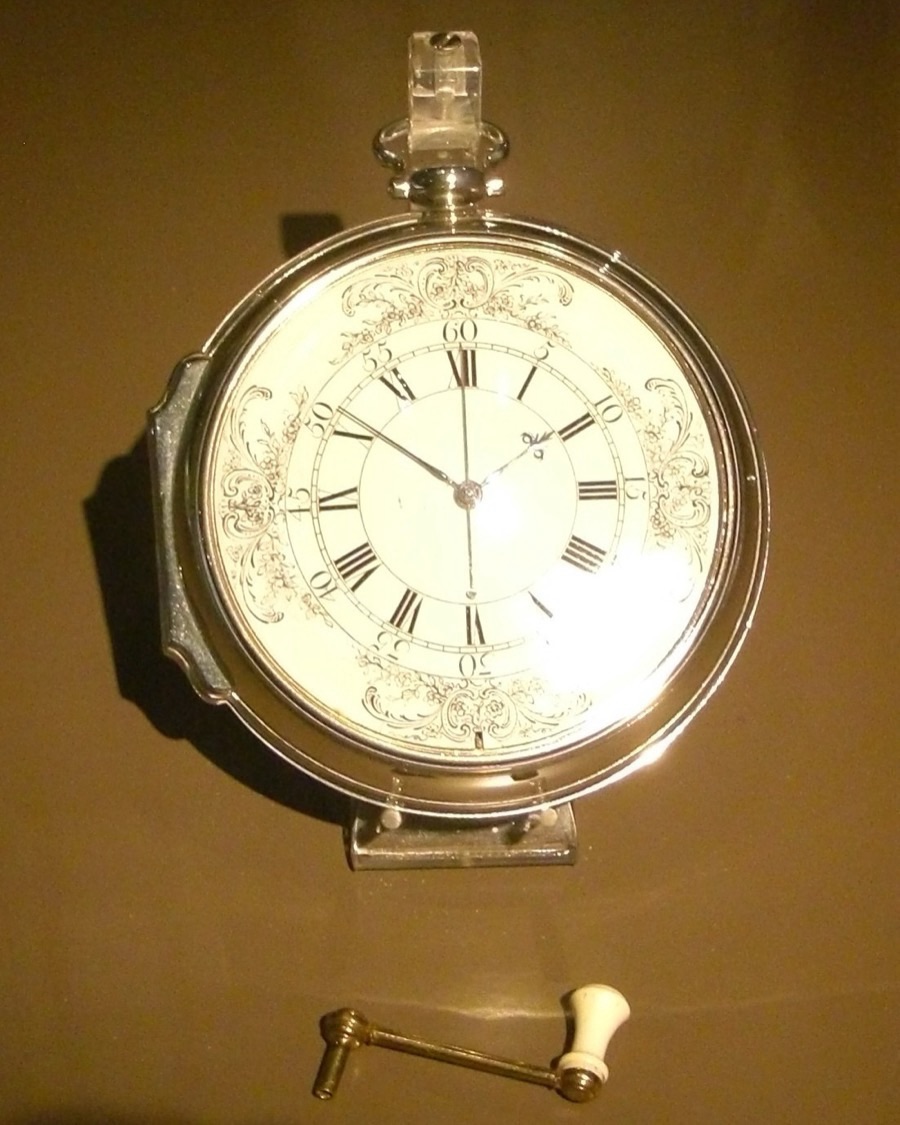
For centuries a ship at sea could not tell how far east or west it was. In 1714 Britain offered a prize for a way to find out, and a self-taught clockmaker, John Harrison, answered with a watch that kept time on a rolling ship. Makers in London and Paris then made such timekeepers simpler and cheaper, and by the nineteenth century navies carried them as a matter of course.1, 2, 3, 4, 16
Part 1
A problem of time
At sea, a navigator could find latitude from the Sun or the stars, but longitude was a question of time: a ship’s longitude follows from the difference between its local time and the time at a reference place at the same moment. A clock that kept that reference time, Greenwich time for the British, carried the answer to sea.3, 4
Rewards for a solution are older than Britain’s: Royal Museums Greenwich says Spain set up a scheme as early as 1567, and the States of Holland and others followed.1
On 22 October 1707 ships of Admiral Sir Cloudesley Shovell’s fleet struck the rocks of the Isles of Scilly, through errors of navigation. Royal Museums Greenwich puts the dead at more than 1,400; Wikipedia’s account of the Longitude Act says nearly 2,000.1, 17
Two kinds of answer competed for the rest of the century. The astronomers’ method, lunar distances, measured the angle between the Moon and a star or the Sun and looked up the Greenwich time in printed tables. The mechanical one was a clock that kept time on a moving, rolling ship through heat and cold.3, 18
Part 2
The Act and its prizes
Royal Museums Greenwich says the Act came less from public outcry over Scilly than from lobbying by mathematicians such as William Whiston, who with Humphry Ditton campaigned for a reward from 1713.1, 6
Queen Anne gave the Longitude Act royal assent on 9 July 1714. It offered £10,000, £15,000 or £20,000 for a method that found longitude at sea to within one degree, forty minutes or half a degree.1, 6, 17
It named twenty-four Commissioners, by name or by office, to judge proposals. They did not meet together until 1737, when John Harrison’s sea clock gave them something to judge.6, 19
The History of Parliament describes the Act as an early case of a government paying rewards to solve a specific scientific problem.6
Part 3
John Harrison’s sea clocks
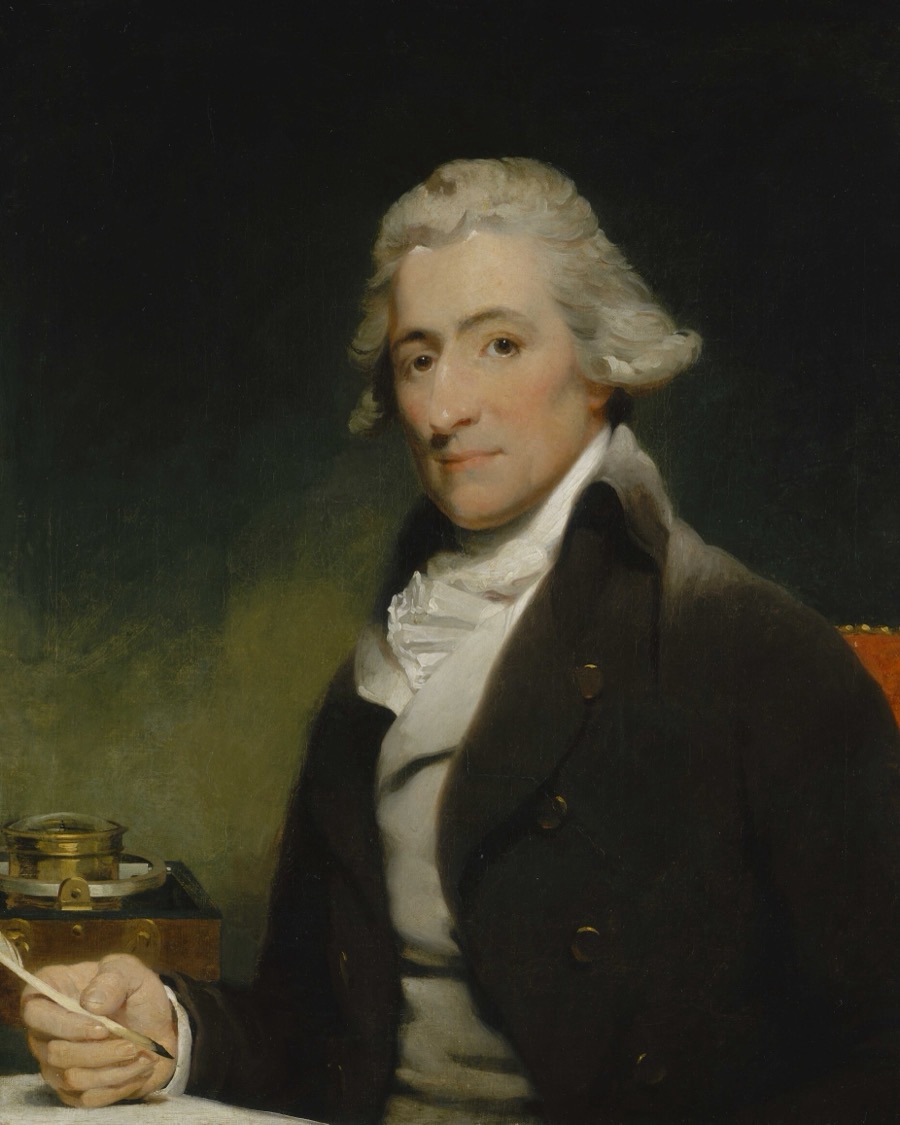
John Harrison was a carpenter who taught himself clockmaking and in the 1720s made precision longcase clocks. Seeking the Act’s rewards he went to London, where the astronomer Edmond Halley sent him to the clockmaker George Graham.2, 7
Harrison brought his sea clock H1 to London in 1735. After a trial on a voyage to Lisbon in 1736, the Commissioners agreed in June 1737 to pay £500 towards an improved one.2, 20
H2 was finished but never tried at sea, because Harrison found a flaw in it. H3 occupied him from 1740 for about two decades; the bimetallic strip and the caged roller bearing came out of that work.2, 7
He then turned from a clock to a large watch. H4, completed in 1759, beats five times a second. Royal Museums Greenwich gives two dates for its beginning: about 1751–52 in one account and 1755 in its catalogue.2, 8
Part 4
H4 at sea, and the dispute
Carried by Harrison’s son William on a voyage to Jamaica in 1761–62, H4 was about five seconds slow on arrival. The Commissioners judged the trial insufficient.2, 7
A second trial, to Barbados in 1764, tested H4 against lunar distances and the satellites of Jupiter, with the astronomer Nevil Maskelyne in charge of the observations. In February 1765 the Board found that H4 had kept time within the Act’s strictest limit.2, 21
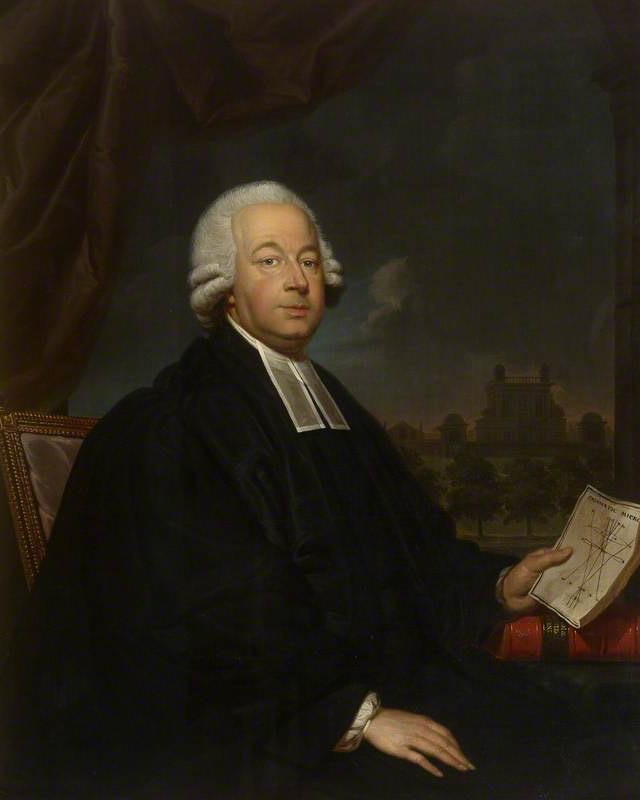
Maskelyne was the champion of the lunar method. His British Mariner’s Guide of 1763 proposed tables of predicted lunar distances, and as Astronomer Royal from 1765 he oversaw the Nautical Almanac, whose tables began with the almanac for 1767.18, 21, 23
Instead of the prize, a new Act of 10 May 1765 gave Harrison £10,000 and promised the rest once other makers could produce timekeepers like his. The Harrisons felt the rules had been changed; from May 1766 Maskelyne tested H4 at the Royal Observatory for ten months, it did not perform well, and the quarrel deepened.2, 7
Whether Maskelyne was biased against Harrison is still argued. The Harrisons said so, and the historian Rupert Gould and the writer Dava Sobel repeated it; Wikipedia’s account of Maskelyne answers that he never put a method of his own before the Board and helped develop timekeepers too.7, 21
Parliament, not the Board, made the last payment: £8,750 in 1773, bringing what Harrison had received to about £23,065. The prize itself was never awarded to him.2, 7, 24
Part 5
Copies, and chronometers by the dozen
The Board had the watchmaker Larcum Kendall copy H4 part for part. His copy, K1, finished in 1769, cost £450, with £50 more for adjusting it.25, 26
K1 sailed with James Cook on his second voyage, of 1772 to 1775, and Cook came to call it his trusty friend. Kendall’s cheaper versions did not match it: K2, at £200, later went out with William Bligh on the Bounty, and K3, at £100, sailed on Cook’s third voyage.25, 26, 27, 28
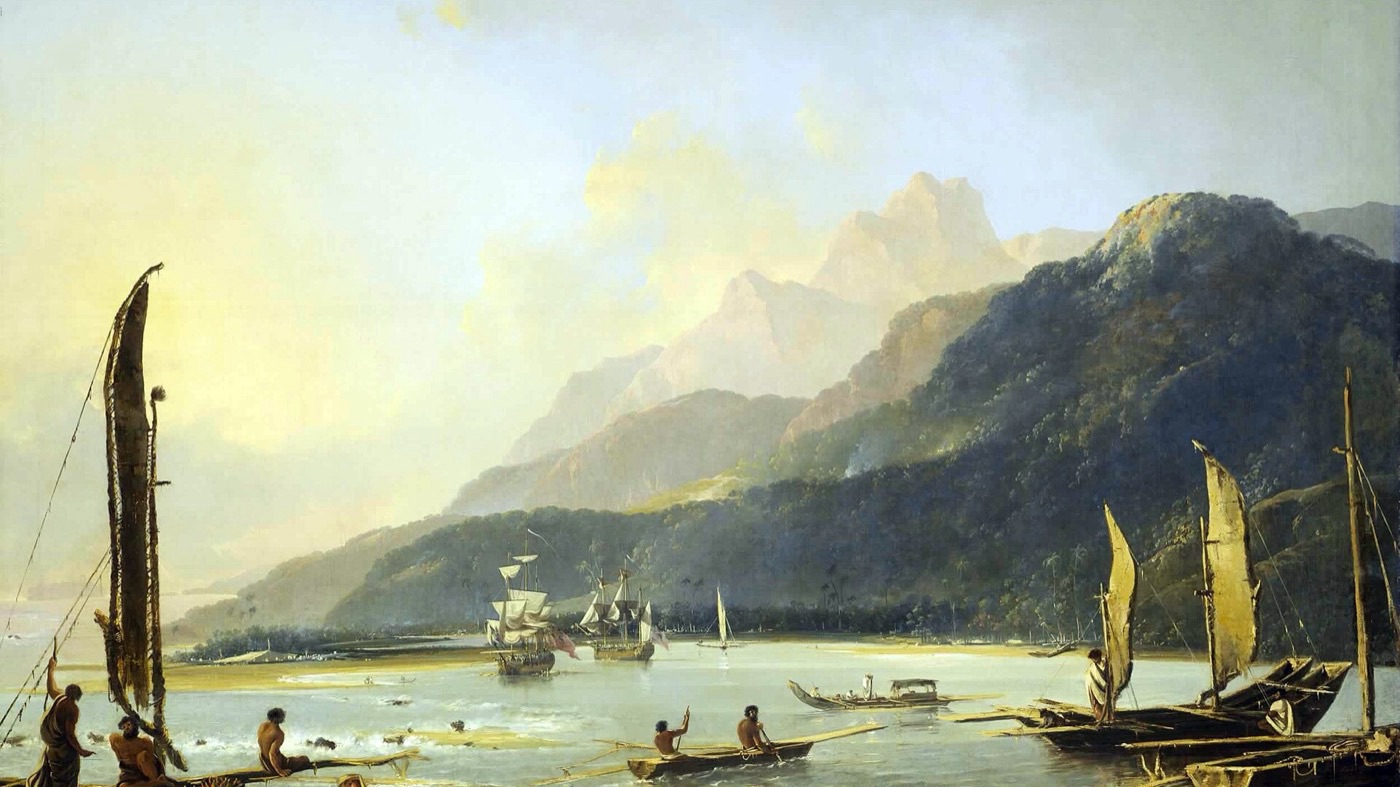
In London, John Arnold set out to make a timekeeper cheaper than K1. Three of his sailed on Cook’s second voyage. He patented a spring detent escapement in 1782 and made marine and pocket chronometers in quantity at his works at Well Hall, Eltham.30, 31, 32
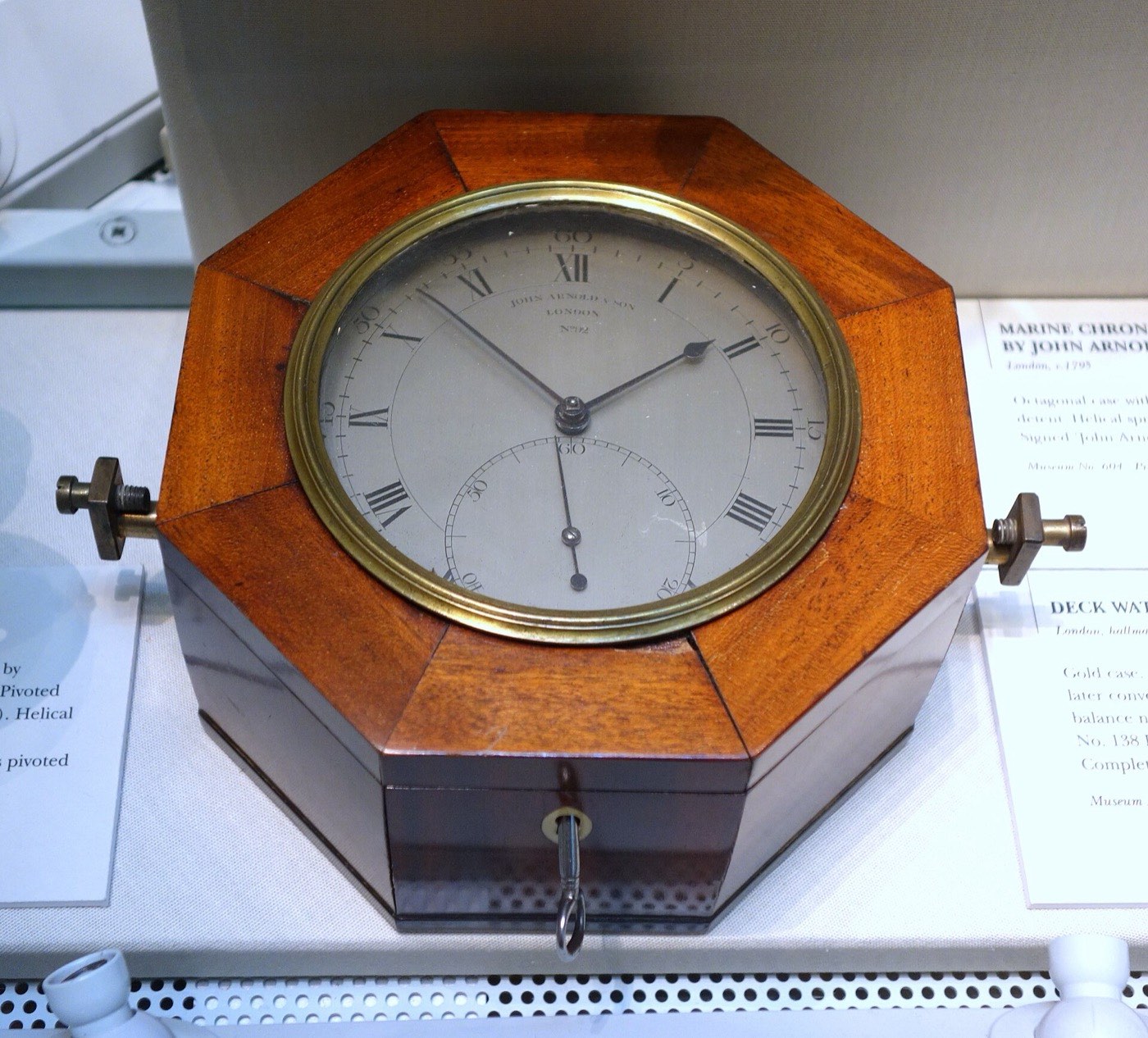
Thomas Earnshaw turned to marine timekeepers around 1780, and his spring detent was patented in 1783 in the name of Thomas Wright. Whether Arnold or Earnshaw came to the spring detent first is still disputed.30, 31, 34
Royal Museums Greenwich says Arnold simplified Harrison’s design and that Earnshaw gave the marine chronometer its modern, reproducible form.4, 36
In 1805 the Board rewarded Earnshaw and John Roger Arnold, John Arnold’s son. Earnshaw’s award is given as £2,500 in Wikipedia’s account and £3,000 in the Royal Museums Greenwich catalogue.34, 37
Prices fell but stayed high: according to Wikipedia’s account of Earnshaw, William Bligh paid 40 guineas for one of his chronometers in 1791, and the two for HMS Investigator in 1801 cost 100 guineas each.34
Part 6
The French line
In Paris, Pierre Le Roy built a marine clock with a detached escapement, a temperature-compensated balance and a balance spring whose swings kept the same time whatever their size, and after trials at sea it won the Académie des sciences prize.14, 38
Wikipedia’s account of Le Roy dates his detent escapement to 1748, the clock to 1766 and the prize to 1769.14
Rupert Gould regarded Le Roy’s 1766 clock as the foundation of the modern chronometer, according to the accounts of both; it is one historian’s judgement.3, 14
Ferdinand Berthoud’s sea clocks were tried on the corvette Isis in 1768–69. In 1770 he was named clockmaker to the King and the Navy, and in 1773 he published his treatise on marine clocks.15, 38, 39
Le Roy and Berthoud were rivals, notably over the balance spring; which of them came to it first is not settled in the sources.14, 15
In the next generation Abraham-Louis Breguet joined the French Bureau des Longitudes in 1814 and the following year was appointed chronometer-maker to the French Navy.9, 10
Part 7
A chronometer on every ship
In 1821 the Admiralty took over the Royal Observatory at Greenwich, which began testing chronometers for the Navy under John Pond, its Superintendent of Chronometers. Wikipedia’s history of the chronometer says they were not supplied to the fleet as a matter of course until about 1825.3, 16
Makers sent chronometers to Greenwich for months of trial. Thomas Porthouse’s No. 233, on trial from 1823 to 1825, was bought at once by the Navy and served for 112 years.3, 11
Each chronometer was rated: its average daily gain or loss was written on a certificate, so the navigator could correct what it showed. That practice is the root of the observatory trials and certificates described under Chronometry and certification.3, 11
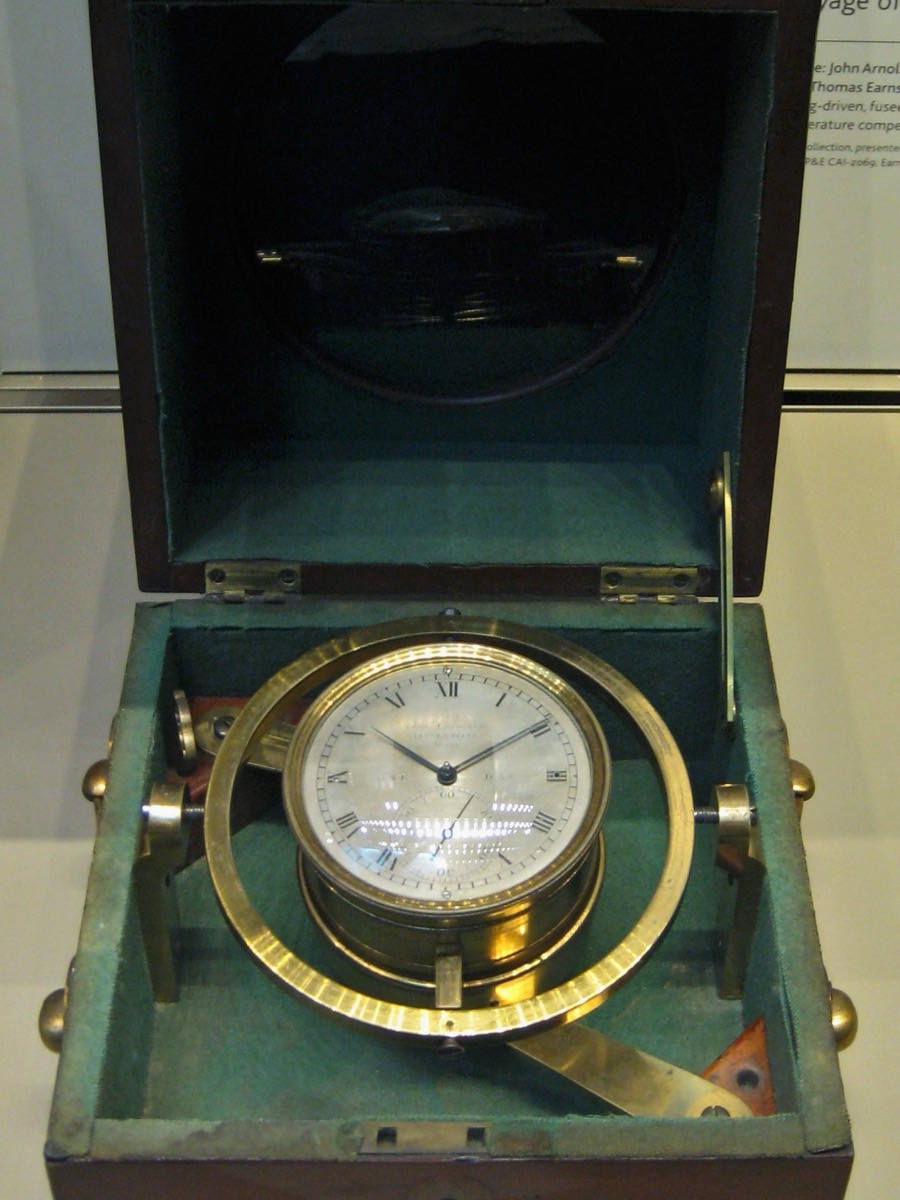
By the 1830s ships carried them in numbers. Royal Museums Greenwich records that the Beagle took twenty-two on its second voyage, that Franklin’s last Arctic expedition took Admiralty chronometers in 1845, and that after 1823 the East India Company required its commanders to report how their chronometers had performed after each voyage.4
A London trade grew up to supply them. Thomas Mercer, who set up in Clerkenwell in 1858 and moved to St Albans in 1874, was among the most prolific makers of the later nineteenth century, supplying retailers across Britain and sending chronometers to the Greenwich trials.41
By around 1850 the chronometer had largely replaced lunar distances at sea, though the British almanac went on printing lunar tables into the twentieth century, to 1906 by Wikipedia’s account and 1907 by de Grijs’s history of the method.18, 23
Mechanical chronometers were made well into the twentieth century. Radio time signals and, much later, electronic navigation ended their working life.3, 41
Parliament abolished the Board of Longitude in 1828. Its papers, from 1737 to 1828, are held at Cambridge University Library.16, 19, 23
Through this history
The companies, people, technologies, objects and events this chapter is made of, in the order the story meets them.
Event
The Longitude ActThe 1714 Act set the prizes, and the Board it created judged every proposal for a century.1, 6
Person
John HarrisonThe self-taught clockmaker who spent four decades on the problem and solved it with a watch.2, 7
Object
Harrison’s H4The watch that kept time within the Act’s strictest limit on the 1764 trial to Barbados.2, 8
Technology
The marine chronometerHow Harrison’s answer became a simpler instrument that London and Paris could make by the dozen.3, 4
Tradition
Chronometry and certificationThe rating of chronometers at Greenwich is the root of later timing trials and certificates.3, 11
Event
The International Meridian ConferenceThe conference fixed the meridian from which longitude is still counted, the line through the transit instrument at Greenwich.12, 13
Key dates
- 1707
Ships of Shovell’s fleet are wrecked on the Isles of Scilly.1, 17
- 1714
The Longitude Act receives royal assent, 9 July.1, 17
- 1736
Harrison’s H1 is tried on a voyage to Lisbon.2, 7
- 1759
Harrison completes H4.8
- 1764
H4 is tried on a voyage to Barbados.2, 7
- 1765
The Board finds H4 within the Act’s limits; a new Act grants Harrison £10,000.2, 7
- 1767
The Nautical Almanac begins publication, with lunar-distance tables.18, 23
- 1769
Kendall completes K1.25
- 1772
K1 sails with Cook’s second voyage.25, 26
- 1773
Parliament pays Harrison £8,750; Berthoud publishes his treatise on marine clocks.7, 15, 24, 39
- 1783
Earnshaw’s spring detent is patented, in Thomas Wright’s name.31, 34
- 1805
The Board rewards Earnshaw and John Roger Arnold.34, 37
- 1821
The Admiralty takes over the Royal Observatory, which begins testing chronometers for the Navy.3, 16
- 1828
The Board of Longitude is abolished.19, 23
- 1858
Thomas Mercer sets up in Clerkenwell.41
Where this leads
- Before, Era IIThe balance spring and the age of precision
1675 to 1800
- After, Era IIFrance and the science of horology
1750 to 1850
Where Longitude and the marine chronometer lead
- In this story, PlaceClerkenwell
Clerkenwell makers built marine chronometers for the Greenwich trials, Thomas Mercer among them from 1858.41
- In this story, PlaceGreenwich
Where the Royal Observatory tried Harrison’s H4, published the Nautical Almanac and rated the Navy’s chronometers.2, 16, 42
- See also, HistoryFrance and the science of horology
The French marine-clock makers (Le Roy, Berthoud) and the Bureau des Longitudes belong to both stories.14, 43
- See also, HistoryThe balance spring and the age of precision
The balance spring made portable timekeepers possible; Huygens claimed it could find longitude.44, 45
- See also, PersonThomas Mudge
Mudge's timekeepers were tested by Maskelyne and rewarded by the House of Commons in 1792-93.46, 47
Facts and sources
Sources
- 1
What made the search for longitude so important? (opens in a new tab)
- 2
Longitude found: the story of Harrison's timekeepers (opens in a new tab)
- 3
- 4
Time machines: chronometers from the collection (opens in a new tab)
- 5
- 6
- 7
- 8
- 9
- 10
- 11
233 (ZAA0057), marine chronometer by Thomas Porthouse (opens in a new tab)
- 12
- 13
What is the prime meridian and why is it in Greenwich? (opens in a new tab)
- 14
- 15
- 16
History of the Royal Observatory and the Astronomers Royal (opens in a new tab)
- 17
- 18
- 19
- 20
- 21
- 22
Nevil Maskelyne, painted by Gerard van der Puyl in 1785 (Royal Society). (opens in a new tab)
- 23
- 24
- 25
- 26
- 27
- 28
- 29
- 30
- 31
- 32
Arnold, John (Chalmers, General Biographical Dictionary, vol. 2, 1812) (opens in a new tab)
- 33
- 34
- 35
- 36
Our collections: a unique history of timekeeping (opens in a new tab)
- 37
- 38
Movements and maps – the French quest for longitude (opens in a new tab)
- 39
Chronomètre de marine / Horloge marine n° 12 (opens in a new tab)
- 40
- 41
Marine chronometer 16285 by Thomas Mercer (ZBA7843) (opens in a new tab)
- 42
- 43
Décret du 7 messidor an III créant le Bureau des longitudes (opens in a new tab)
- 44
- 45
- 46
Mudge, Thomas (Dictionary of National Biography, 1885-1900, vol. 39) (opens in a new tab)
- 47
Sources read November 11, 2026.