Histories, Era II, The age of precision
The balance spring and the age of precision
1675 to 1800
How a spiral spring on the balance made the watch a timekeeper: the watches before it, the 1675 dispute between Huygens in Paris and Hooke in London, Tompion and the English fusee watch, repeaters, jewelled bearings and the cylinder escapement, London’s trade and its exports, Mudge’s lever and the problem of heat, and the Paris rivals who came next.

In short
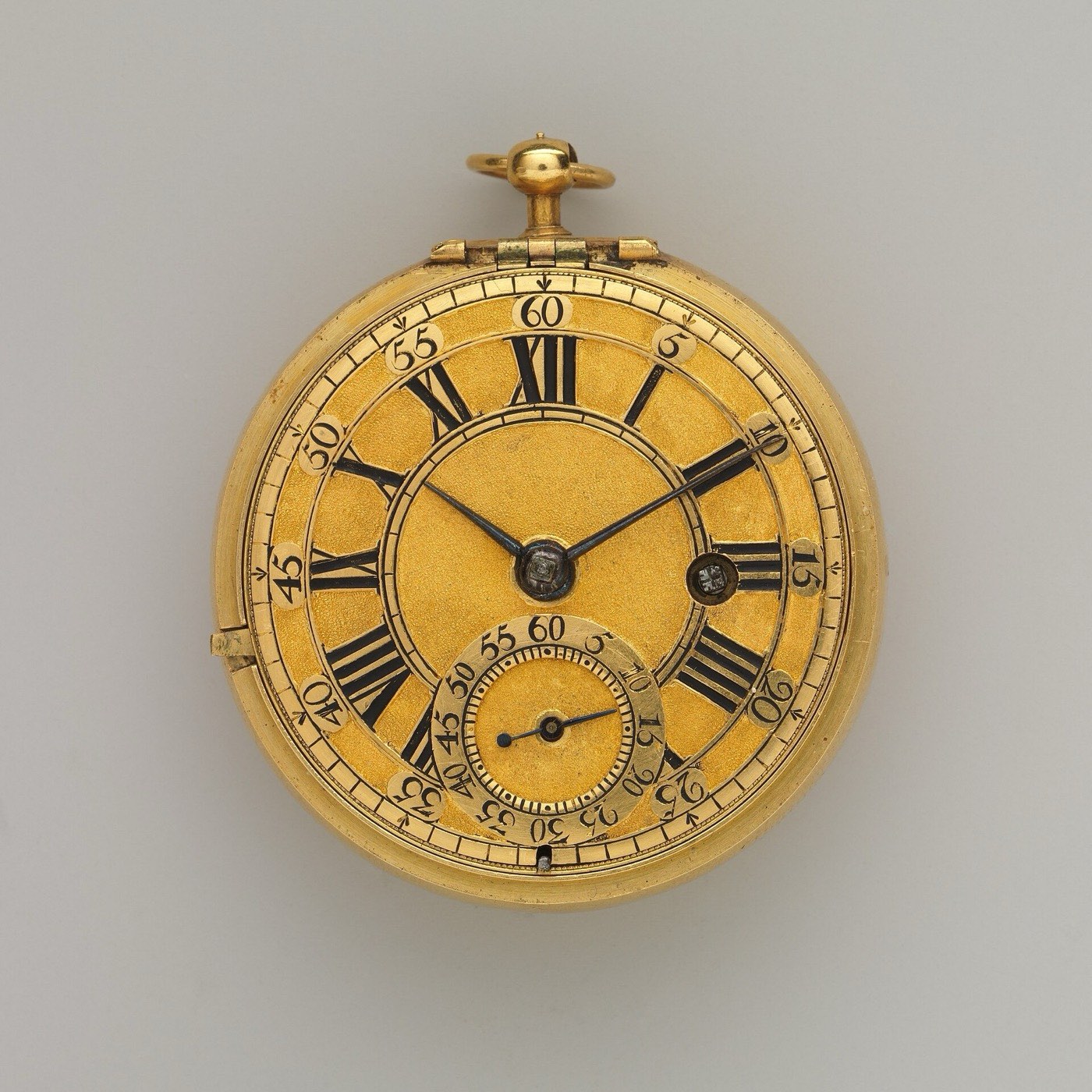
Before 1675 a watch was a costly ornament that could gain or lose a great deal in a day. That year a hair-thin spiral spring fitted to the balance, claimed by Christiaan Huygens in Paris and Robert Hooke in London, gave the watch a steady beat of its own. London makers such as Thomas Tompion, George Graham and Thomas Mudge built on it, adding repeating work, jewelled bearings and new escapements, and their trade exported watches across Europe. Their work led on to the marine chronometer and to the French makers who came next.1, 2, 3, 4, 5, 15, 17, 20
Part 1
Watches before the spring
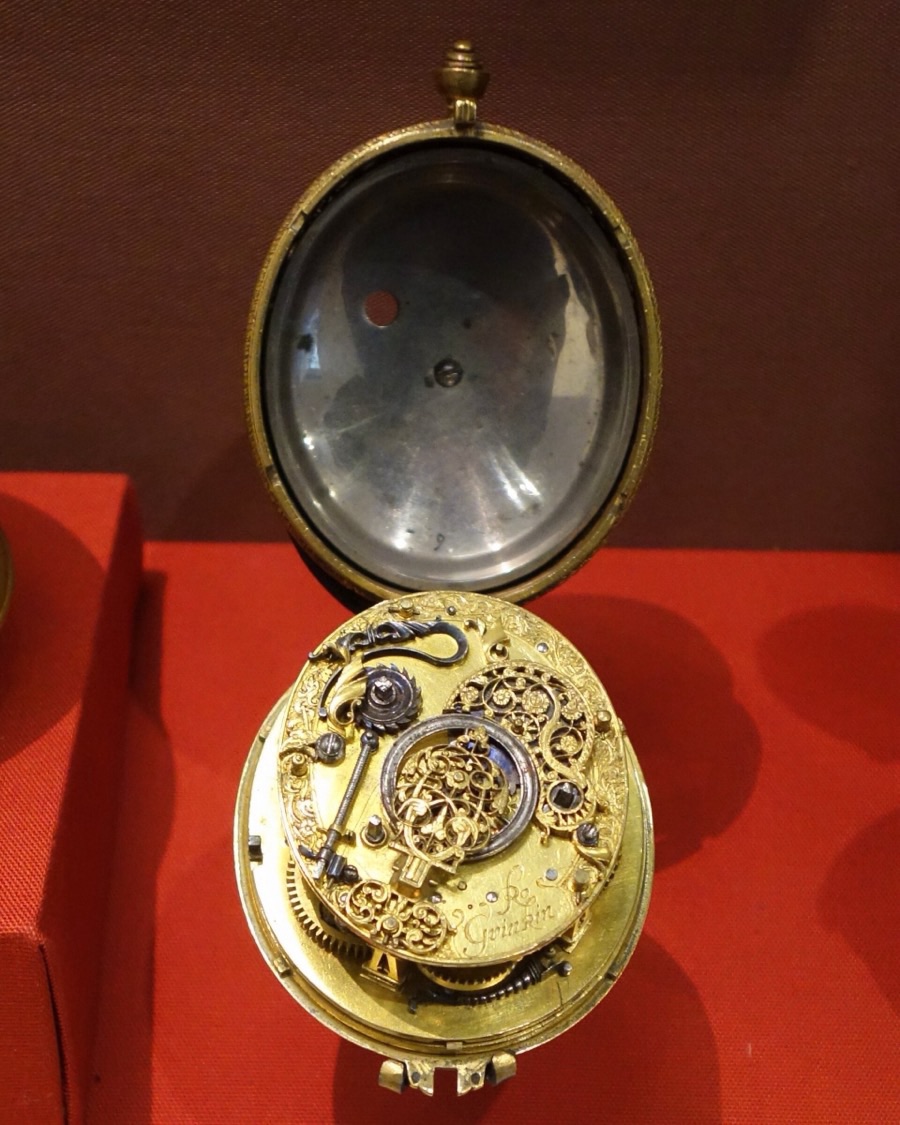
Before 1675 a watch was regulated by a balance with no spring of its own. The verge escapement pushed it one way and then the other, so how fast it swung depended on how hard the mainspring was pushing, and the watch slowed as the spring ran down.11, 23
To even out the pull of the mainspring, English verge watches carried a fusee, a cone-shaped pulley wound with a chain or gut. The Clockmakers’ Museum holds a watch by Thomas Tompion from before the balance spring, made in London about 1671: it is a fusee verge movement.23, 24
Such watches were poor timekeepers, and accounts disagree about how poor. Wikipedia's balance-spring article says the spring improved accuracy from perhaps several hours a day to about ten minutes; its history of timekeeping says from about half an hour to a few minutes a day.4, 25
Before 1600, according to the Clockmakers' Company, smaller clocks and watches in England were imported or made by immigrant craftsmen, particularly in London. The London makers won their own guild by royal charter on 22 August 1631.14, 26
Part 2
A spring for the balance, 1675
Christiaan Huygens, the Dutch scientist behind the pendulum clock of 1657, was working in Paris as a member of the Académie des Sciences when he turned to watches in January 1675.27, 28
Huygens had the Paris clockmaker Isaac Thuret build a model under a promise of secrecy. He then found that Thuret had shown a similar model to the minister Colbert before him; Huygens showed his own to Colbert on 31 January.29, 30
On 15 February 1675 a royal privilege signed by Colbert gave Huygens the sole right for twenty years to make and sell in France clocks and watches regulated by a spiral spring, with a fine of 1,500 livres for anyone who copied them.28
The Journal des Sçavans of 25 February 1675 printed his description: a spiral spring fixed at its inner end to the arbor of a larger, heavier balance and at its outer end to the watch plate, so that the balance swings in equal times whether its swings are wide or narrow.1, 9
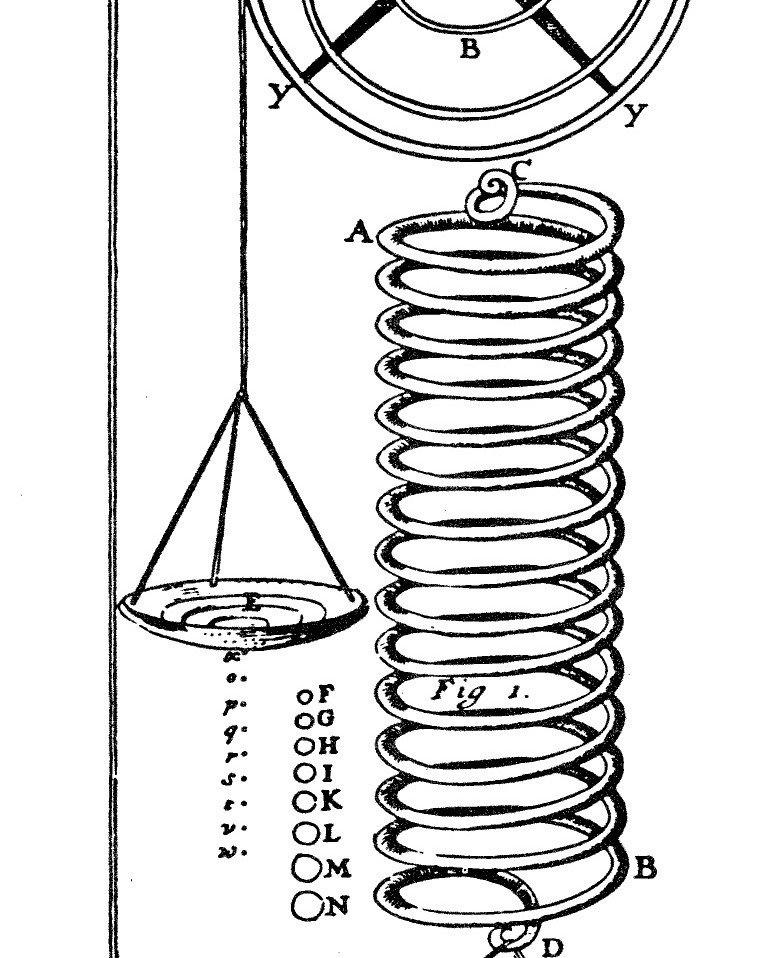
London read it within weeks: issue 112 of the Royal Society's Philosophical Transactions, dated 20 March 1675, printed an English extract with an engraved figure of the spring.9, 31
Huygens did not defend his monopoly for long. His notes say he dropped the privilege rather than lobby and litigate, and when he left Paris on 1 July 1676 he released all watchmakers to use the invention freely.29
In London Robert Hooke said the idea was his. In a printed postscript of 1675 he wrote that he had applied springs to the balance of a watch about seventeen years earlier, that a patent agreement of about 1660 broke down over its terms, and that he had shown spring-regulated models in a Gresham College lecture of 1664.2, 10, 32
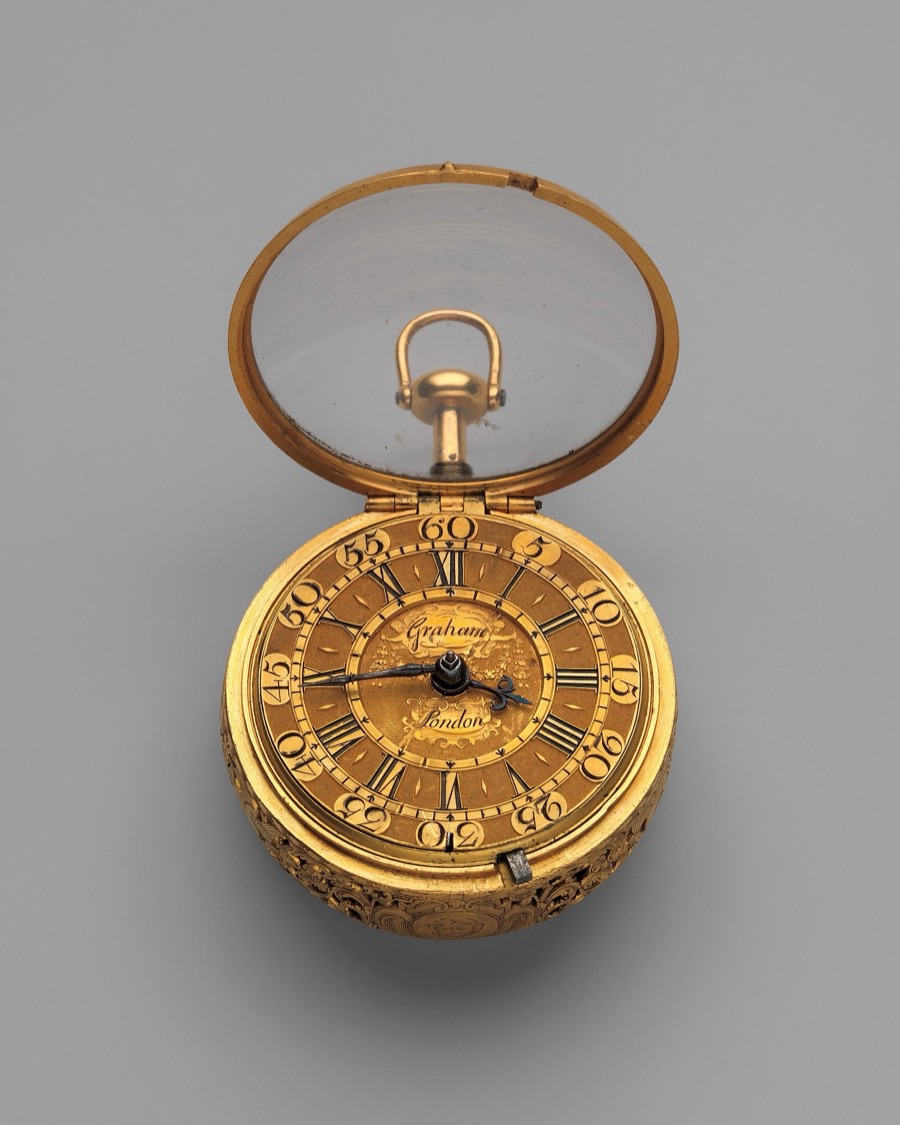
To press his claim Hooke had Thomas Tompion make balance-spring watches. One made for Charles II was signed 'Robert Hooke invent. 1658. T. Tompion fecit, 1675'; it does not appear to survive.3, 12, 24
Who had the idea is still argued. The Dictionary of National Biography (1891) saw no doubt of Hooke’s priority; the editors of Huygens’s collected works note that Hooke’s mechanism was never published and may not have been a spiral; Wikipedia says Hooke probably had the idea first and Huygens built the first working watch, and that a Royal Society note of 23 June 1670, found in 2006, may support Hooke.2, 4, 10, 32
Part 3
Tompion and the English watch
Thomas Tompion, born in 1639 at Northill in Bedfordshire, a blacksmith's son, was apprenticed to a London clockmaker in 1664 and made free of the Clockmakers' Company in 1671.3, 12, 34
Hooke was his most important early patron and opened the way to royal work: in 1676 Tompion made the clocks for Charles II's new Royal Observatory at Greenwich.3, 34
A silver watch Tompion made in Fleet Street between 1675 and 1679, now in the Science Museum, survives from the spring’s opening years. Its dial puts the minutes on the main dial, with small dials for the hours and the seconds.13
Huygens expected the spiral to make the balance keep equal time on its own, and his early watches had no fusee. Tompion kept the fusee, and the fusee with a spiral-sprung balance became the standard English watch of the next century and more.3, 27
Tompion numbered his work. A signed but unnumbered movement in the Clockmakers' Museum is dated before about 1680 for that reason, and the Metropolitan Museum dates a numbered gold pair-case watch to 1682-83. Wikipedia says the numbering may be the first serial numbering of manufactured goods.3, 35, 36
He became Master of the Clockmakers' Company in 1704. Edward Banger was his partner from 1701 to about 1708, and from about 1711 George Graham, who had married his niece.3, 12, 16
Tompion died on 20 November 1713 and was buried in the nave of Westminster Abbey; Graham was buried in the same grave in 1751.12, 34
Part 4
Repeaters, jewels and the cylinder
A repeating watch strikes the hours and quarters on a bell when a button or the pendant is pressed, telling the time in the dark. Edward Barlow, a Catholic priest also known as Booth, devised the rack-and-snail repeating work for clocks in the 1670s.25, 37
In 1687 Barlow sought a patent for repeating watches and the London maker Daniel Quare disputed it. Accounts of the outcome differ: Wikipedia’s Quare article says the Clockmakers’ Company defeated Barlow’s application because Quare’s watch came first; its Barlow article says James II tried both watches and preferred Quare’s; the V&A says Quare was granted a patent in 1687.37, 39, 40
Nicolas Fatio de Duillier, a mathematician from Geneva living in London, found a way in the 1690s to pierce a small round hole in a ruby. Paris makers showed no interest, so he joined the Huguenot brothers Peter and Jacob Debaufre, watchmakers in Soho.11, 21
In 1704 Fatio and the Debaufres were granted a fourteen-year English patent, no. 371, for jewelled bearings in watches; an attempt to extend it to all precious and common stones failed.21, 41
The cylinder escapement has three claimed parents: Wikipedia credits Tompion in 1695 with Graham perfecting it in 1726; the Dictionary of National Biography says Tompion patented it in 1695 with William Houghton and Edward Barlow and credits Barlow; another Wikipedia article names the abbé de Hautefeuille. The 1911 Britannica calls Graham its author.11, 12, 23, 42
Its attraction was thinness: it lies flat, so watches could be slimmer than verge watches. Its teeth rub on the cylinder throughout the swing, so it wore quickly unless the cylinder was made of ruby.11, 23
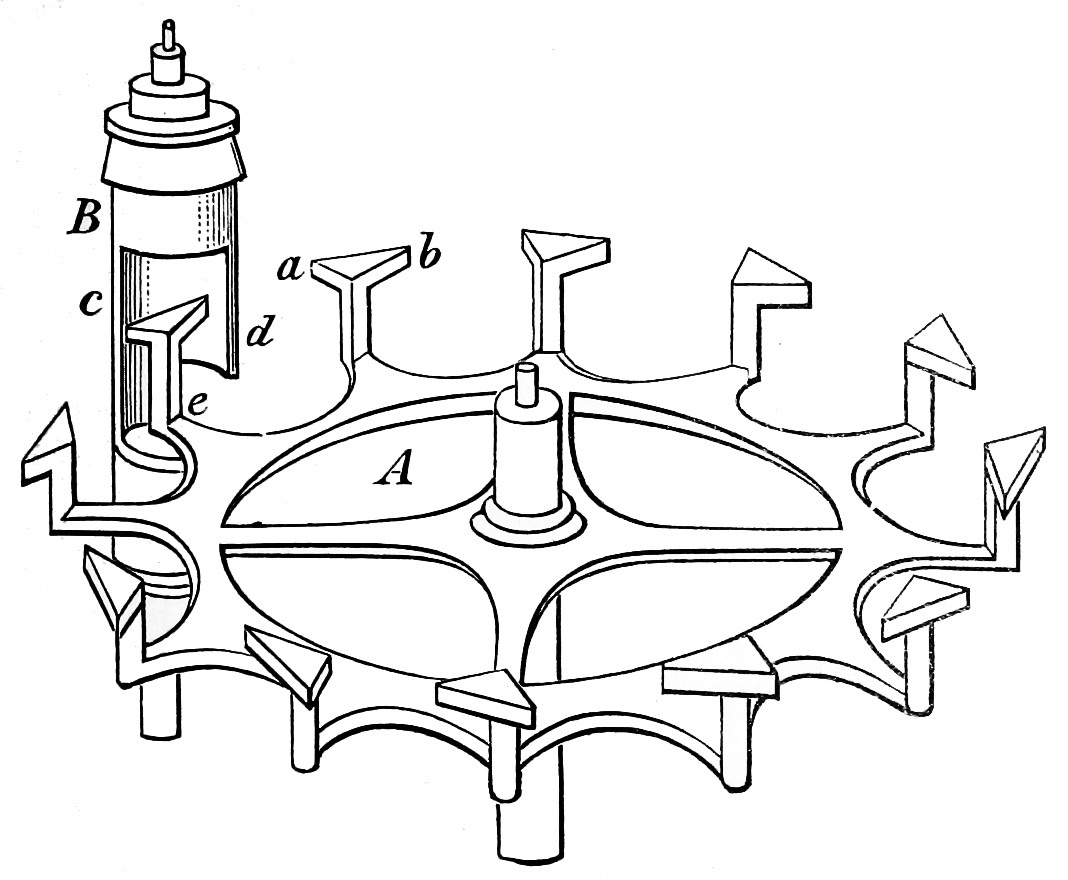
Graham built astronomical instruments for Halley and Bradley at Greenwich and was a Fellow of the Royal Society. He advised and lent money to John Harrison when Harrison came to London.16, 17
Part 5
London’s trade and its exports
The Clockmakers' Company controlled the trade in the City and within ten miles of it, through seven-year apprenticeships and the freedom of the Company; in 1765 an Act of Common Council required City watch and clockmakers to become its freemen.14, 26
London watches were valued enough to be forged. The Dictionary of National Biography says the Company reported in 1703 that Amsterdam makers put the names of Tompion, Windmills and Quare on their work; a 2017 thesis cites the Company minutes of 3 July 1704 complaining of 'Amsterdam forgers'.5, 12
The trade gathered in Clerkenwell, Holborn and St Luke's, north of the City, and by the late eighteenth century rough movements came from Lancashire, around Prescot, to be finished in London.5, 15
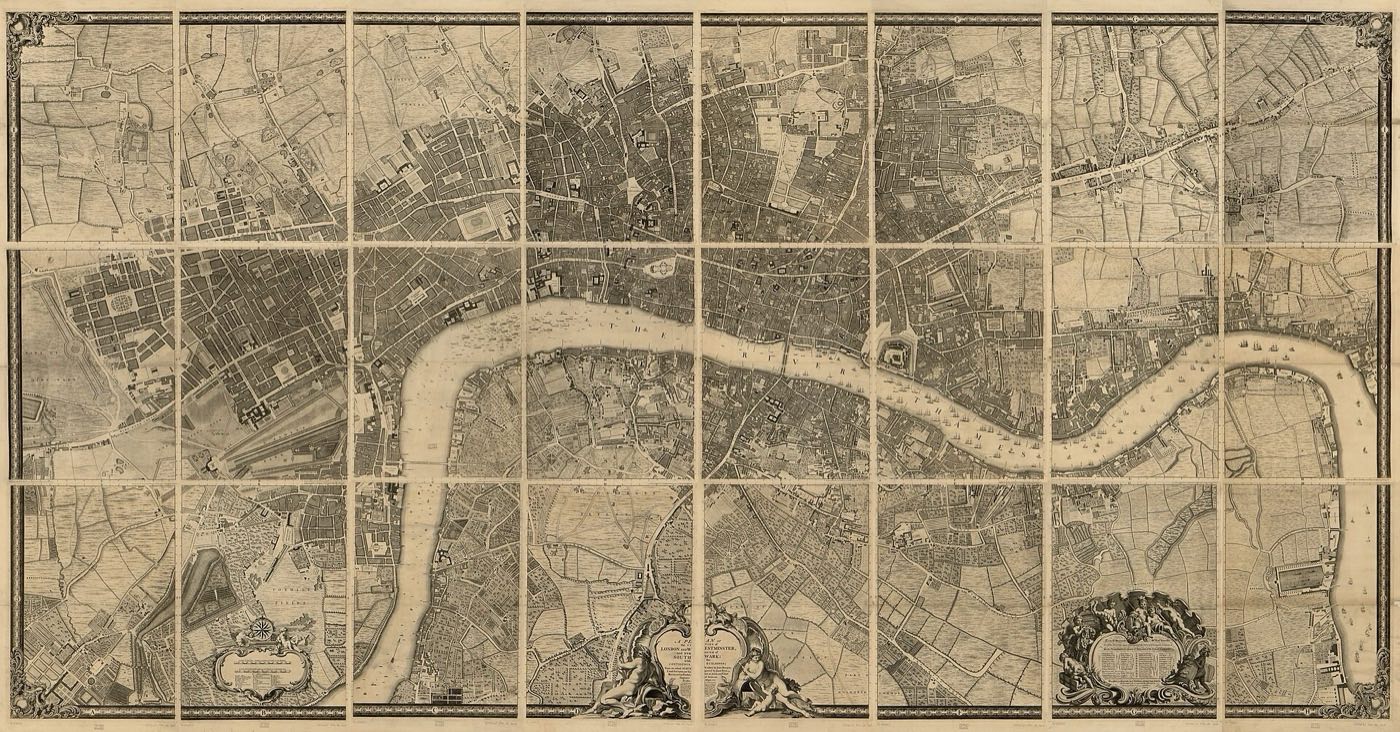
By the 1790s London was making on a large scale: Goldsmiths' Hall assayed 6,576 gold and 185,102 silver watch cases in 1796, and the historian Alun Davies puts Clerkenwell's output at almost 200,000 watches a year.5, 15
Davies writes that by the end of the century Britain made about half the world's watches; Geneva had grown from about 5,000 watches a year in 1685 to about 85,000 a century later.15
Part 6
Mudge’s lever and the problem of heat
Thomas Mudge, from Exeter, was apprenticed to George Graham as a boy and became a free clockmaker in 1738. In his early years he worked for retailers such as John Ellicott, under their names.18, 20
Mudge’s lever separates the balance from the train: a pivoted lever locks the escape wheel and touches the balance for no more than a brief push as it swings through the middle, leaving it free for the rest of its swing; it also restarts itself if the watch is jolted.19, 23
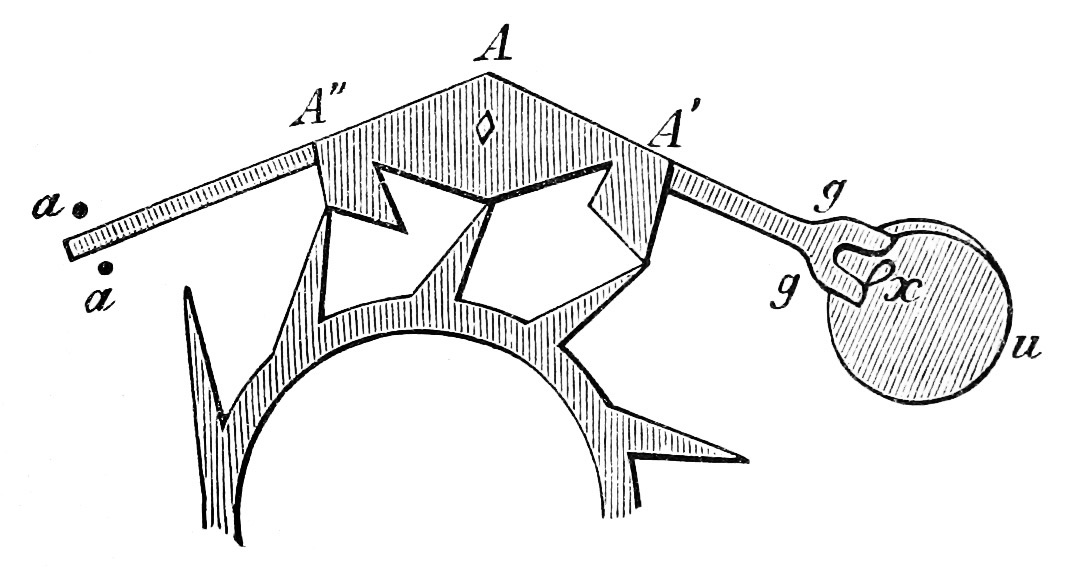
When he invented it is uncertain: the Royal Collection says 1754, Wikipedia gives about 1754, by 1755 or 1750 in different articles, and the Dictionary of National Biography says only that it came during his partnership and was first used in Queen Charlotte's watch.6, 18, 20, 23
Queen Charlotte's watch, a gold watch signed 'Tho Mudge London' with a case hallmarked in London for 1769-70, was probably bought by George III for the Queen. The Royal Collection calls it the earliest known lever escapement and the first pocket watch with an automatic device to compensate for temperature.6, 18, 20
Mudge did not pursue it in ordinary watches. He published Thoughts on the Means of Improving Watches in 1765, left London for Plymouth in 1770 or 1771, and spent his last decades on marine timekeepers for the Board of Longitude.18, 20
Others put the lever into watches for sale. The Geneva-born Josiah Emery at Charing Cross made one in a case hallmarked 1781, and by 1792 had moved from a Mudge-type layout to a straight-line lever.46, 47, 48
Heat was the other enemy. A balance spring weakens as it warms, so a watch loses time in heat; Hooke and Huygens noticed this without solving it, and Ferdinand Berthoud measured in 1773 a loss of 393 seconds a day for a 60°F rise.4, 49
Harrison's answer was a compensation curb, a bimetallic strip that shortened or lengthened the working spring with temperature. Mudge used one too: his watch sold to Ferdinand VI in 1755 has a second hairspring as a compensation curb.4, 11, 50
The lasting answer came from Paris: Pierre Le Roy's compensation balance of about 1765, whose rim changes shape with temperature. Improved by John Arnold and Thomas Earnshaw into a split bimetallic rim, it became the standard.4, 7, 11
Part 7
Rivals in Paris, and what came next
London and Paris watched each other. The English maker Henry Sully, trained under Charles Gretton, settled in France, set up a watch factory at Versailles in 1718 and worked with Julien Le Roy, clockmaker to Louis XV from 1739.7, 51, 52
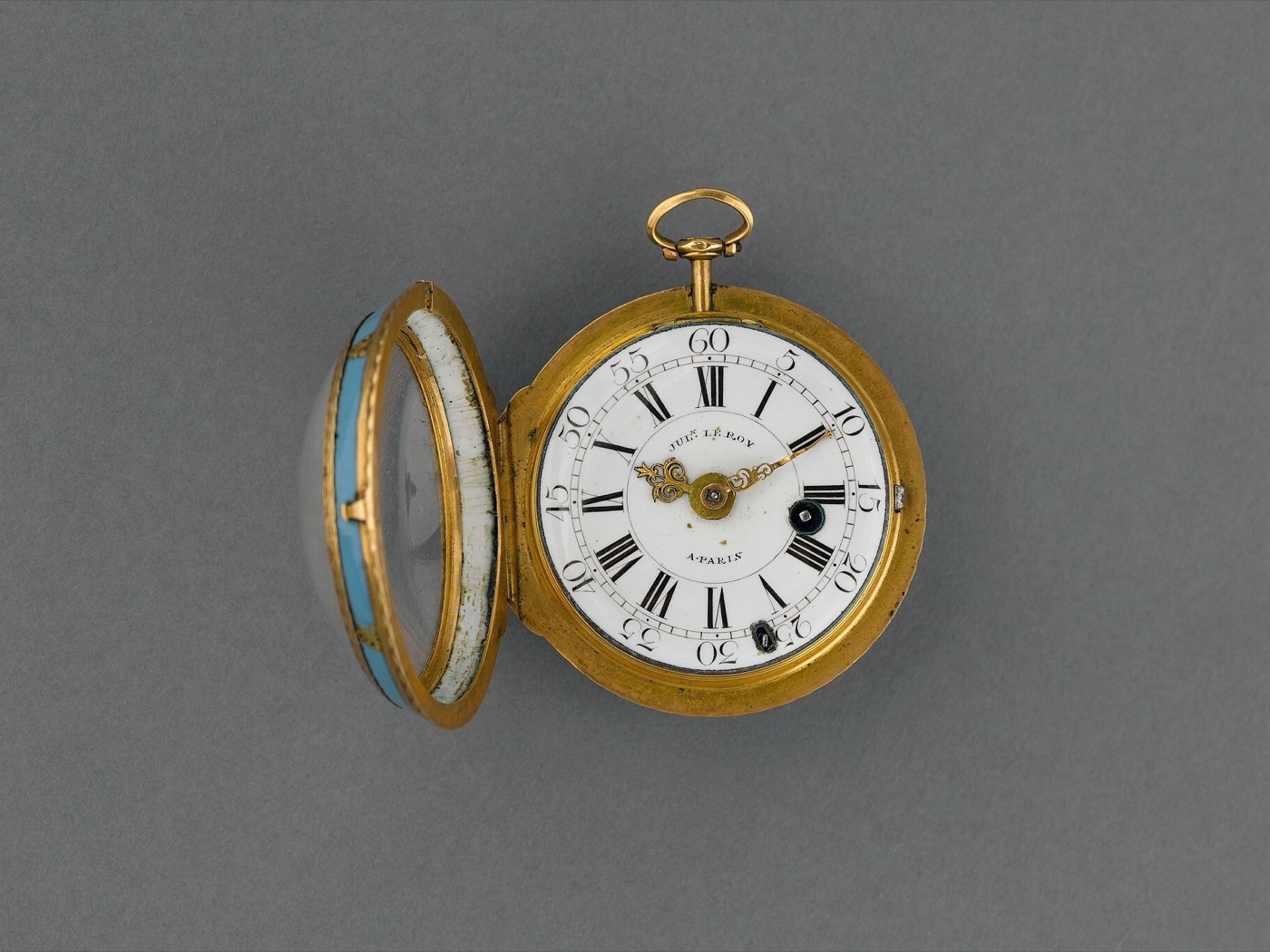
The two trades chose different escapements: French makers took up the thinner cylinder, while English makers kept the verge in cheaper watches into the nineteenth century and moved to the duplex and the lever in fine ones.11, 54
The balance spring also opened the road to the longitude: Graham advised John Harrison and lent him money when he came to London with his sea-clock plans, and Mudge’s marine timekeepers were tested by Maskelyne, refused by the Board and rewarded with £2,500 by the House of Commons.17, 18, 20
In Paris Pierre Le Roy combined a detached escapement, a compensation balance and an isochronous balance spring in his chronometer of 1766, and Breguet improved Mudge’s lever in 1787.7, 19
Mudge's lever, little used in his lifetime, became the escapement of almost every mechanical watch: Wikipedia dates its near-universal use to about 1900, and the 1911 Britannica describes it as 'now universally made'.11, 19
Through this history
The companies, people, technologies, objects and events this chapter is made of, in the order the story meets them.
Person
Robert HookeSaid he had put a spring on the balance about 1658, and disputed Huygens’s claim.2, 10
Technology
The balance springThe spring itself: how it gives the balance a steady beat, and how makers dealt with its weakness in heat.1, 4, 11
Person
Thomas TompionMade Hooke’s balance-spring watches in 1675 and kept the fusee that English watches carried for a century.3, 12, 13
Person
George GrahamTompion’s heir, who worked on the cylinder escapement and trained Thomas Mudge.16, 17, 18
Object
Mudge’s lever watch for Queen CharlotteQueen Charlotte’s watch of 1770, which the Royal Collection calls the earliest known example of the lever escapement.6
Technology
The lever escapementMudge’s escapement, which became that of almost every mechanical watch.11, 19
Person
John HarrisonCame to London with plans for a sea clock and was advised and lent money by Graham.16, 17
Technology
The marine chronometerMudge spent his later years on marine timekeepers for the Board of Longitude.18, 20
Key dates
- 1631
The Clockmakers' Company receives its royal charter (22 August).14, 26
- 1675
Huygens's spiral balance spring: privilege 15 February, Journal des Sçavans 25 February, Philosophical Transactions 20 March; Tompion makes Hooke's watch for Charles II.1, 9, 12, 28
- 1676
Huygens leaves Paris and frees watchmakers to use the spring; Tompion makes the Greenwich clocks.3, 29, 34
- 1687
Barlow and Quare dispute the repeating watch; Quare's is preferred.37, 39, 40
- 1695
A cylinder escapement is patented by Tompion with Houghton and Barlow.12, 23
- 1704
Fatio and the Debaufres patent jewelled bearings (no. 371); Tompion becomes Master of the Clockmakers.12, 21, 41
- 1754
Mudge invents the lever escapement, by the Royal Collection's date.6, 19
- 1770
Queen Charlotte’s lever watch by Mudge, cased in London in 1769-70.6, 18
- 1791
Litherland patents the rack lever in Liverpool.55, 56
Where this leads
- Before, Era ITime in the pocket
1500 to 1675
- After, Era IILongitude and the marine chronometer
1714 to 1900
Where the balance spring and the age of precision lead
- Came after, HistoryTime in the pocket
The balance spring of 1675 gave the watch the steady beat that earlier watches lacked.4, 57
- In this story, PlaceClerkenwell
Where London’s eighteenth-century watch trade was divided among specialist outworkers, making close to 200,000 watches a year by the 1790s by one estimate.15, 58, 59
- In this story, PlaceGreenwich
The Observatory’s clocks came from Tompion in 1676, and Graham built its instruments for Halley and Bradley.3, 16, 34
- See also, HistoryFrance and the science of horology
The next chapter: Le Roy, Berthoud and Breguet in Paris built on the spring, the compensation balance and the lever.7, 19
- See also, HistoryLongitude and the marine chronometer
The balance spring made portable timekeepers possible; Huygens claimed it could find longitude.1, 9
Facts and sources
- Period
- 1675 to about 18001, 47
- Where
- London, with Paris as rival14, 28
- Balance spring announced
- 25 February 1675, Journal des Sçavans (Huygens)1, 9
Sources
- 1
- 2
- 3
- 4
- 5
- 6
Queen Charlotte's lever watch and pedestal (Royal Collection Trust, RCIN 63759) (opens in a new tab)
- 7
- 8
- 9
- 10
Hooke, Robert (Dictionary of National Biography, 1885-1900, vol. 27) (opens in a new tab)
- 11
Watch (Encyclopaedia Britannica, 11th edition, 1911) (opens in a new tab)
- 12
Tompion, Thomas (Dictionary of National Biography, 1885-1900, vol. 57) (opens in a new tab)
- 13
Early balance spring watch by Thomas Tompion (1985-1537) (opens in a new tab)
- 14
- 15
- 16
- 17
- 18
Mudge, Thomas (Dictionary of National Biography, 1885-1900, vol. 39) (opens in a new tab)
- 19
- 20
- 21
- 22
Watch by Robert Grinkin, London, about 1625, in the Clockmakers' Museum. (opens in a new tab)
- 23
- 24
Pre-balance-spring era watch movement by Thomas Tompion c.1671 (L2015-3114) (opens in a new tab)
- 25
- 26
- 27
- 28
- 29
- 30
Oeuvres complètes, Tome VII, No. 2007: Huygens to J. Gallois, 11 February 1675 (opens in a new tab)
- 31
Geometric diagrams and watch mechanism (RS.18682) (opens in a new tab)
- 32
- 33
- 34
- 35
Watch movement by Thomas Tompion with a later case and dial (L2015-3122) (opens in a new tab)
- 36
Pair-case watch by Thomas Tompion, 1682-83 (17.190.1489a, b) (opens in a new tab)
- 37
- 38
- 39
- 40
Watch, Daniel Quare, London, ca. 1700 (O77399) (opens in a new tab)
- 41
- 42
- 43
The cylinder escapement, from Poul la Cour's Tidens naturlære, 1903. (opens in a new tab)
- 44
- 45
An English lever escapement, from Poul la Cour's Tidens naturlære, 1903. (opens in a new tab)
- 46
- 47
Lever escapement watch by Josiah Emery (L2015-3366) (opens in a new tab)
- 48
- 49
- 50
- 51
- 52
- 53
- 54
- 55
- 56
- 57
A Walk Through Time - A Revolution in Timekeeping (opens in a new tab)
- 58
- 59
Introduction, in Survey of London: Volume 46, South and East Clerkenwell (2008) (opens in a new tab)
Sources read November 11, 2026.