The lever escapement
The escapement Thomas Mudge devised in the 1750s, which leaves the balance free for most of its swing; taken up slowly by London and Liverpool makers, it became the escapement of almost every mechanical watch.
Introduced About 1754 (dates from 1750 to 1755 are given), by Thomas Mudge, From about 1770; in almost every mechanical watch from about 1900
Led to The co-axial escapement
Developed by Thomas Mudge
In the histories The balance spring and the age of precision, Britain’s watch industry
How it works
An escapement lets the wheels of a watch advance one step at each swing of the balance and gives the balance a small push to keep it going.1, 5
In Mudge’s lever a pivoted lever carries two pallets that lock and release the escape wheel; a fork at its other end meets a pin on the balance just as it swings through the centre.1, 4
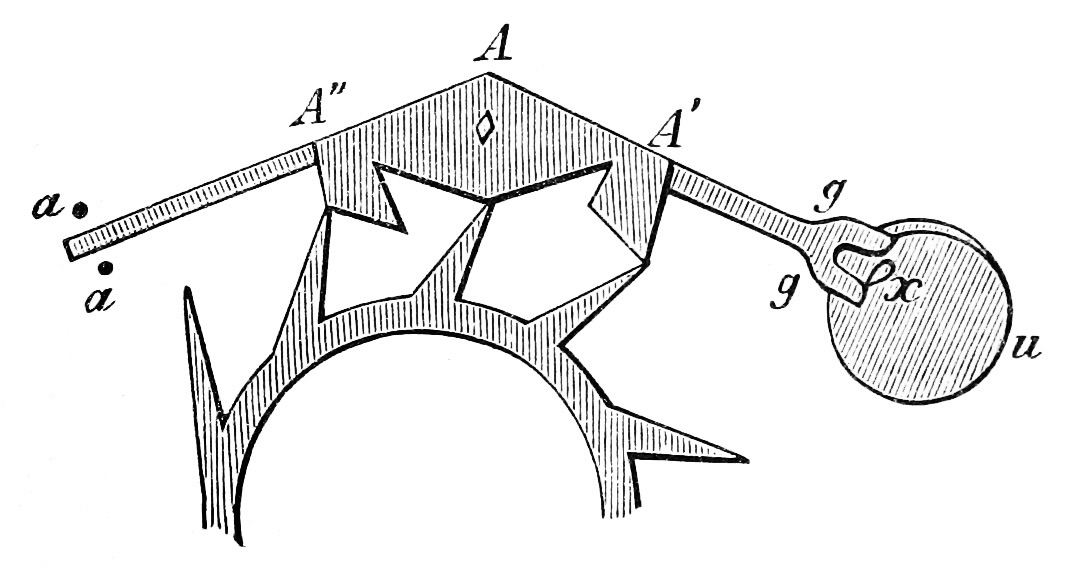
Its great advantage is that it is detached: for most of each swing the balance runs free of the train. It also restarts itself if a jolt stops the balance.1, 5
The earlier rack lever kept a toothed lever always in mesh with a pinion on the balance; the 1911 Britannica calls the lever 'originally a French invention' that Mudge greatly improved.4, 5
Mudge’s lever
The date of Mudge’s lever is given as 1750, about 1754 and by 1755; Wikipedia says he used it in a clock before a watch.2, 5, 7
The Royal Collection calls Queen Charlotte’s watch, signed by Mudge and cased in 1769-70, the earliest known lever watch.2, 3
Mudge made few: he turned to marine timekeepers, and the escapement spread slowly.3, 7
Emery, Litherland and Massey
Josiah Emery of Charing Cross made lever watches from about 1781, at the start on Mudge’s layout and by 1792 as a straight-line lever without draw.8, 9, 10
Peter Litherland of Liverpool patented a rack lever in 1791, and Edward Massey a modified lever used by Liverpool makers about 1800.1, 11, 12
Early levers lacked draw, the angle of the pallets that holds the lever safely against its banking pins; some makers thought draw caused friction, but without it a jolt could unlock the escapement.1, 9
Wikipedia says Breguet improved the lever in 1787, and that George Savage devised the table-roller form in the early 1800s.1
The modern lever
Two forms followed: the English lever, with the lever at right angles, and the in-line lever later used by Swiss and American makers, which became the modern form; Emery was already making a straight-line lever in London in 1792.5, 9
A cheap pin-pallet version put the lever into alarm clocks and dollar watches; Wikipedia credits it to Georges-Frédéric Roskopf, mass-produced from 1867, in one article and to Louis Perron in 1798 in another.1, 5
By the 1911 Britannica it was 'now universally made'; Wikipedia says almost every mechanical watch has used it since about 1900.1, 4
Where the lever escapement leads
- Developed by, PersonThomas Mudge
Mudge devised the detached lever about 1754; Queen Charlotte’s watch of 1770 has one.2, 3
- Led to, TechnologyThe co-axial escapement
Wikipedia describes the co-axial as a modification of the lever escapement with features of the detent.14
- Part of, HistoryBritain’s watch industry
The English escapement, devised by Mudge and developed by Liverpool makers.1, 11, 12
- Part of, HistoryThe balance spring and the age of precision
Mudge’s escapement, which became that of almost every mechanical watch.1, 4
- See also, PersonAbraham-Louis Breguet
Wikipedia says Breguet improved the lever escapement in 1787.1
- See also, ObjectMudge’s lever watch for Queen Charlotte
The Royal Collection calls Queen Charlotte’s watch the earliest known example of the lever escapement.2
Facts and sources
- Introduced
- About 1754 (dates from 1750 to 1755 are given), by Thomas Mudge1, 2, 7
- In use
- From about 1770; in almost every mechanical watch from about 19001, 2, 4
Sources
- 1
- 2
Queen Charlotte's lever watch and pedestal (Royal Collection Trust, RCIN 63759) (opens in a new tab)
- 3
Mudge, Thomas (Dictionary of National Biography, 1885-1900, vol. 39) (opens in a new tab)
- 4
Watch (Encyclopaedia Britannica, 11th edition, 1911) (opens in a new tab)
- 5
- 6
An English lever escapement, from Poul la Cour's Tidens naturlære, 1903. (opens in a new tab)
- 7
- 8
- 9
Lever escapement watch by Josiah Emery (L2015-3366) (opens in a new tab)
- 10
- 11
- 12
Massey patent lever escapement pocket watch mechanism (1920-557) (opens in a new tab)
- 13
- 14
Sources read November 11, 2026.