Abraham-Louis Breguet
A watchmaker born in Neuchâtel who opened a workshop in Paris in 1775, worked for the French court and much of Europe’s nobility, patented the tourbillon in 1801 and founded the house that still carries his name.
Born 1747, Neuchâtel, Died September 17, 1823
Companies Breguet
In the histories Longitude and the marine chronometer, France and the science of horology
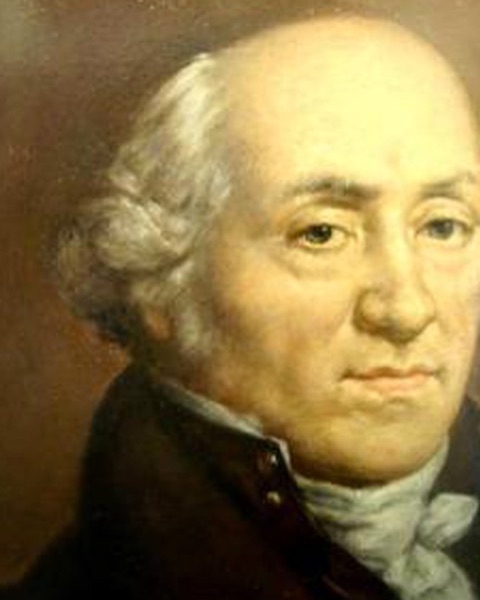

From Neuchâtel to the Quai de l’Horloge
His stepfather’s family were watchmakers, and as a teenager Breguet left Neuchâtel to train in France, at Versailles and then in Paris, where he also studied mathematics in the evenings under the Abbé Marie.1, 3
In 1775, newly married, he set up his own workshop on the Quai de l’Horloge on the Île de la Cité. The Abbé Marie introduced him at court, and Louis XVI and Marie-Antoinette became clients; in 1783 one of the queen’s guards ordered the watch now known as the Marie-Antoinette, meant to carry every complication then known.1, 3
Exile, return and the tourbillon
During the Revolution his links with the court put him in danger, and in 1793 he took refuge in Switzerland, running what was left of his workshop from a distance. He returned to Paris in 1795 and rebuilt his business, selling as far as Russia and the Ottoman Empire.1, 3
On June 26, 1801, he was granted a patent for the tourbillon, a regulator that carries the escapement in a rotating cage to even out the errors of a watch’s position. The house he founded also dates to him the gong spring for repeaters and the hands and numerals that bear his name, in 1783, the “pare-chute” shock protection in 1790 and the Breguet balance spring in 1795.1, 2, 3
Honours followed: the Bureau des Longitudes in 1814, appointment as watchmaker to the French Royal Navy in 1815, the Academy of Sciences and the Legion of Honour. He died on September 17, 1823, aged 76.1, 3
The house after him
His son Antoine-Louis, already his partner, carried on the business, and his grandson Louis-Clément took over in 1833. In 1870 the family sold the watchmaking firm to its workshop manager, Edward Brown, and after a century with the Browns and a series of later owners, Breguet has belonged to the Swatch Group since 1999, with its manufacture in the Vallée de Joux.1, 3, 5
Where Abraham-Louis Breguet leads
- Founded, CompanyBreguet
Abraham-Louis Breguet opened the workshop on the Quai de l’Horloge in Paris in 1775 from which the house descends.1, 6
- Developed, TechnologyThe tourbillon
Granted the tourbillon patent on 26 June 1801.7, 8
- Made, ObjectBreguet No. 160
No. 160 was ordered from Breguet in 1783 and finished in his workshop.9, 10
- Based in, PlaceParis
Workshop on the Quai de l'Horloge from 1775.1, 11
- Supplied by, PersonJean-Antoine Lépine
Breguet’s archive records many watches supplied by Lépine, and Breguet built most of his watches on modified Lépine calibres.12, 13
- Part of, HistoryFrance and the science of horology
The watchmaker of the Quai de l’Horloge who made the Paris watch a precision instrument.1, 14
- Part of, HistoryLongitude and the marine chronometer
Breguet joined the Bureau des Longitudes in 1814 and made chronometers for the French Navy from 1815.3, 15
- Part of, TraditionChronometry and certification
Breguet was a member of the Bureau des Longitudes and watchmaker to the French Royal Navy, and patented the tourbillon in 1801.1, 3
- See also, HistorySwitzerland’s network of specialists
Pierre-Frédéric Ingold worked for Breguet in Paris; the Breguet family is named among Vallée de Joux dynasties.16, 17
- See also, PersonGeorge Daniels
Daniels restored many of Breguet’s watches and wrote The Art of Breguet, the AHCI says.18, 19
- See also, PlaceThe Jura Arc
Exile in Geneva, Neuchâtel and Le Locle, 1793-95.13, 14
- See also, TechnologyAutomatic winding
Breguet made side-weight perpétuelles from about 1780.20, 21
- See also, TechnologyThe balance spring
Wikipedia says the Breguet overcoil became the usual way to make the spring keep even time.22
- See also, TechnologyThe co-axial escapement
Wikipedia names Breguet’s natural escapement among the forerunners of the co-axial.23
- See also, TechnologyThe lever escapement
Wikipedia says Breguet improved the lever escapement in 1787.24
- See also, TechnologyThe marine chronometer
Breguet became chronometer-maker to the French Navy in 1815.3, 15
Facts and sources
Sources
- 1
- 2
225 years since the invention of the Tourbillon (opens in a new tab)
- 3
- 4
Abraham-Louis Breguet (around 1810), painted portrait (opens in a new tab)
- 5
- 6
- 7
Patent granted for a completely new type of regulator called the "Tourbillon" (opens in a new tab)
- 8
- 9
Order for watch N°160, known as the "Marie-Antoinette" watch (opens in a new tab)
- 10
Watches collection: In Search of Lost Time (opens in a new tab)
- 11
- 12
- 13
Breguet: history (exhibition 'Breguet, un apogée de l'horlogerie européenne') (opens in a new tab)
- 14
- 15
- 16
- 17
- 18
- 19
- 20
Appearance of the first automatic watches (opens in a new tab)
- 21
The Origins of Self-Winding Watches 1773-1779 (opens in a new tab)
- 22
- 23
- 24
Sources read November 11, 2026.