The balance spring
The fine spiral spring fixed to a watch’s balance, announced by Huygens in 1675 and claimed by Hooke, which gives the balance its own steady beat; later makers shaped it, compensated it for heat and changed its metal.
Introduced 1675 (Huygens); claimed by Hooke from about 1658
Developed by Christiaan Huygens
In the history The balance spring and the age of precision
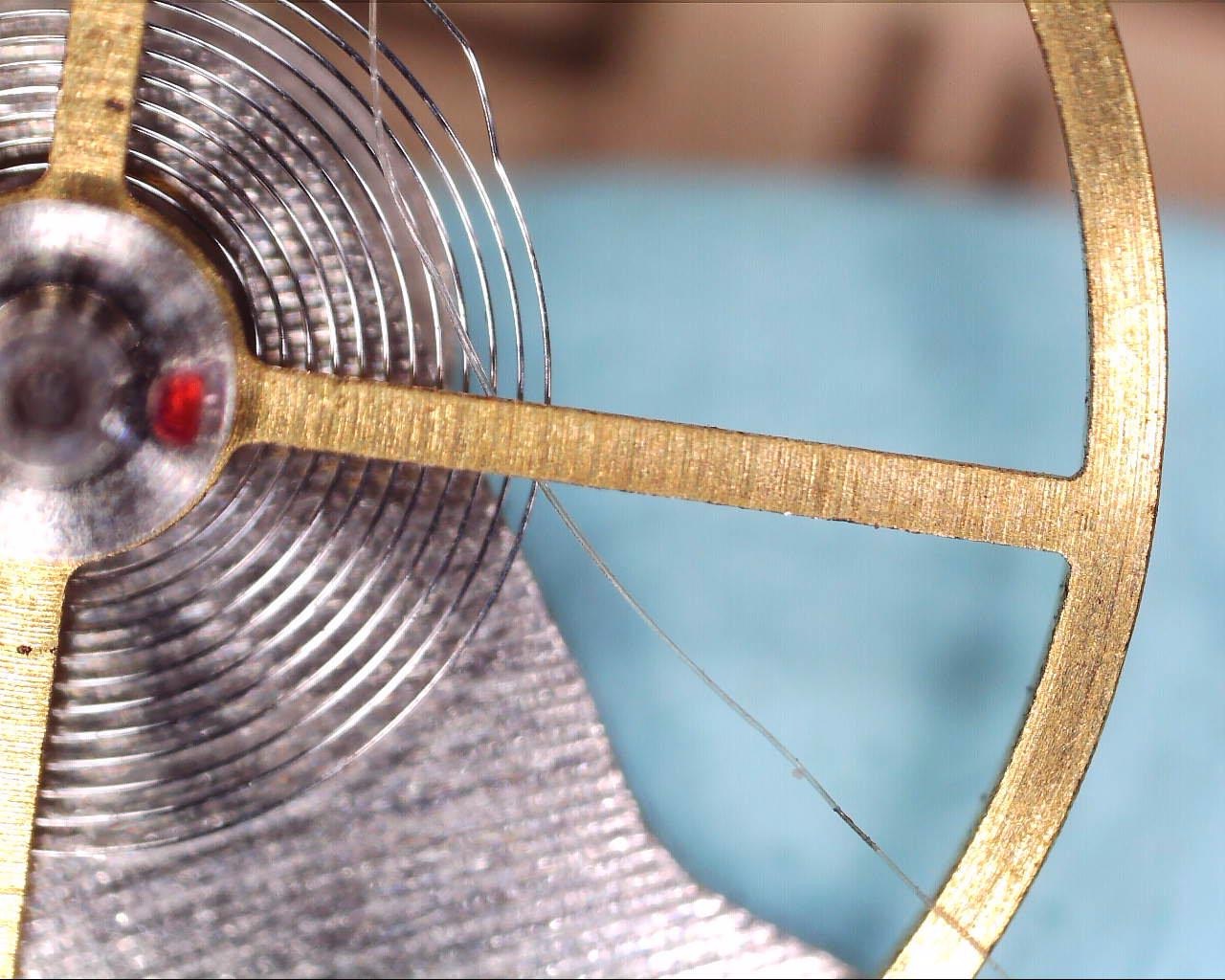
What it does
A balance spring, or hairspring, is a fine coiled spring fixed to the balance wheel. It pulls the balance back each time it swings out, so the balance oscillates at its own steady rate and controls the speed of the whole watch.1, 2
Huygens's 1675 description: a spiral fixed at the centre to the balance arbor and at its outer end to the watch plate, whose coils alternately close and open as the balance swings.2, 6
Who had the idea
Early springs and regulators
Early balance springs had few turns: an early Tompion quarter-repeating movement in the Clockmakers’ Museum has a spring of five turns.1, 9, 10
A regulator alters the working length of the spring to make the watch gain or lose. The rack-and-pinion type was long called the Tompion regulator; the lever type now used was patented by Joseph Bosley in 1755 but did not displace it until the early 1800s.1, 11
A spring that kept equal time however wide the swing would make the watch independent of the mainspring's pull. Huygens hoped his spiral would do this; with the verge escapement of his day it could not.11, 12
Heat, shape and metal
Warmth weakens a steel spring, so watches lost time in heat. Wikipedia records that Ferdinand Berthoud measured in 1773 that a brass balance with a steel spring lost 393 seconds a day for a rise of 60°F, 312 of them from the spring.8
Harrison's compensation curb, a bimetallic strip, altered the working length of the spring as the temperature changed; Mudge used a second hairspring as a curb in a watch of 1755.1, 4, 13
The compensation balance of Pierre Le Roy, perfected by Earnshaw, put the correction in the balance rim instead and became the standard.1, 4, 14
Makers learned to shape the spring for even timekeeping: John Arnold patented a helical spring with incurved ends in 1776, and Breguet's overcoil, which lifts the outer coil above the rest, became the common method.1, 15
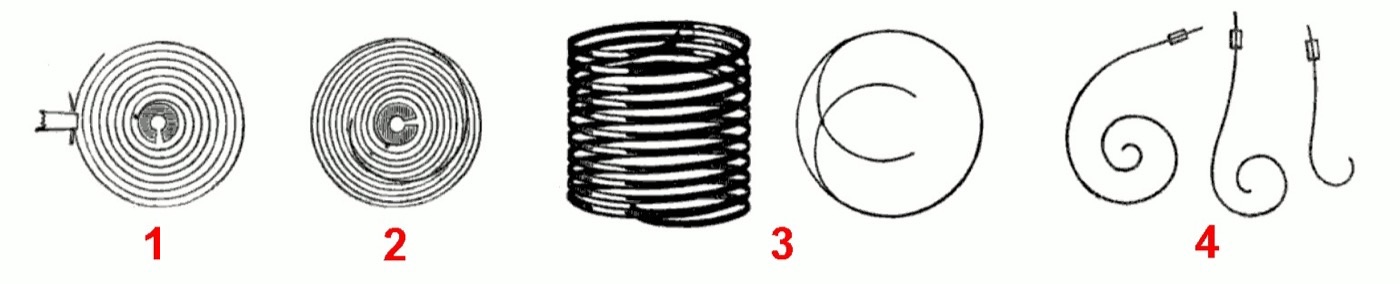
Wikipedia says early springs were of soft steel, which weakened, and that Harrison used hardened and tempered steel, which remained standard until the twentieth century.1
Charles-Édouard Guillaume's Elinvar alloy, from about 1900, kept its elasticity with temperature and made compensation balances unnecessary; silicon springs followed in recent decades.1, 8
Where the balance spring leads
- Developed by, PersonChristiaan Huygens
Huygens announced the spiral balance spring in the Journal des Sçavans of 25 February 1675.2, 6
- Part of, HistoryThe balance spring and the age of precision
The spring itself: how it gives the balance a steady beat, and how makers dealt with its weakness in heat.1, 2, 4
- See also, PersonAbraham-Louis Breguet
Wikipedia says the Breguet overcoil became the usual way to make the spring keep even time.1
- See also, PersonRobert Hooke
Hooke claimed to have applied a spring to the balance about 1658; the priority is disputed.3, 17
- See also, PersonThomas Tompion
Tompion made balance-spring watches from 1675 and kept the fusee with them.11, 18
- See also, TechnologySilicon in the movement
The silicon balance spring is a new material for the balance spring, compensated for temperature by an oxide layer.19, 20
- See also, TechnologyThe verge escapement
The balance spring was fitted to verge watches from 1675 and greatly improved them.4, 21
- See also, TraditionChronometry and certification
Temperature compensation of balance and spring underlies precision timekeeping.1, 4
Facts and sources
- Introduced
- 1675 (Huygens); claimed by Hooke from about 16582, 3
- Made of
- Steel; later gold, palladium, Elinvar-type alloys and silicon1, 4
Sources
- 1
- 2
- 3
- 4
Watch (Encyclopaedia Britannica, 11th edition, 1911) (opens in a new tab)
- 5
- 6
- 7
- 8
- 9
- 10
Watch movement by Thomas Tompion with a later case and dial (L2015-3122) (opens in a new tab)
- 11
- 12
- 13
- 14
- 15
- 16
- 17
Hooke, Robert (Dictionary of National Biography, 1885-1900, vol. 27) (opens in a new tab)
- 18
Early balance spring watch by Thomas Tompion (1985-1537) (opens in a new tab)
- 19
EP 1422436 B1: Spiral watch spring and its method of production (opens in a new tab)
- 20
Silicon: the gateway to the future of mechanical watches? (November 2022) (opens in a new tab)
- 21
Sources read November 11, 2026.