Silicon in the movement
Silicon parts in the mechanical watch: escape wheels from Ulysse Nardin’s Freak of 2001, the temperature-compensated silicon balance spring patented by CSEM in Neuchâtel in 2002 and made industrially by a consortium of Patek Philippe, Rolex and the Swatch Group, and, since the patent expired in 2022, a material open to every maker.
Introduced 2001 (escape wheels, Ulysse Nardin Freak); 2002 (CSEM balance-spring patent)
Companies Patek Philippe, Rolex
In the history Making watches today
Why silicon
Silicon parts are etched from wafers of monocrystalline silicon by deep reactive ion etching, the DRIE process of microelectronics, and can be cut to almost any flat shape.2, 5
Patek Philippe lists the properties that drew watchmakers: silicon is hard, about a third the density of steel, non-magnetic and resistant to corrosion, and flexible in thin structures. WorldTempus adds that it needs almost no lubrication but breaks if stressed in the wrong direction.2, 5
Its use is in the escapement and the regulating organ: the balance spring, the lever and the escape wheel, where weight, magnetism, temperature and friction matter most, as WorldTempus describes.2
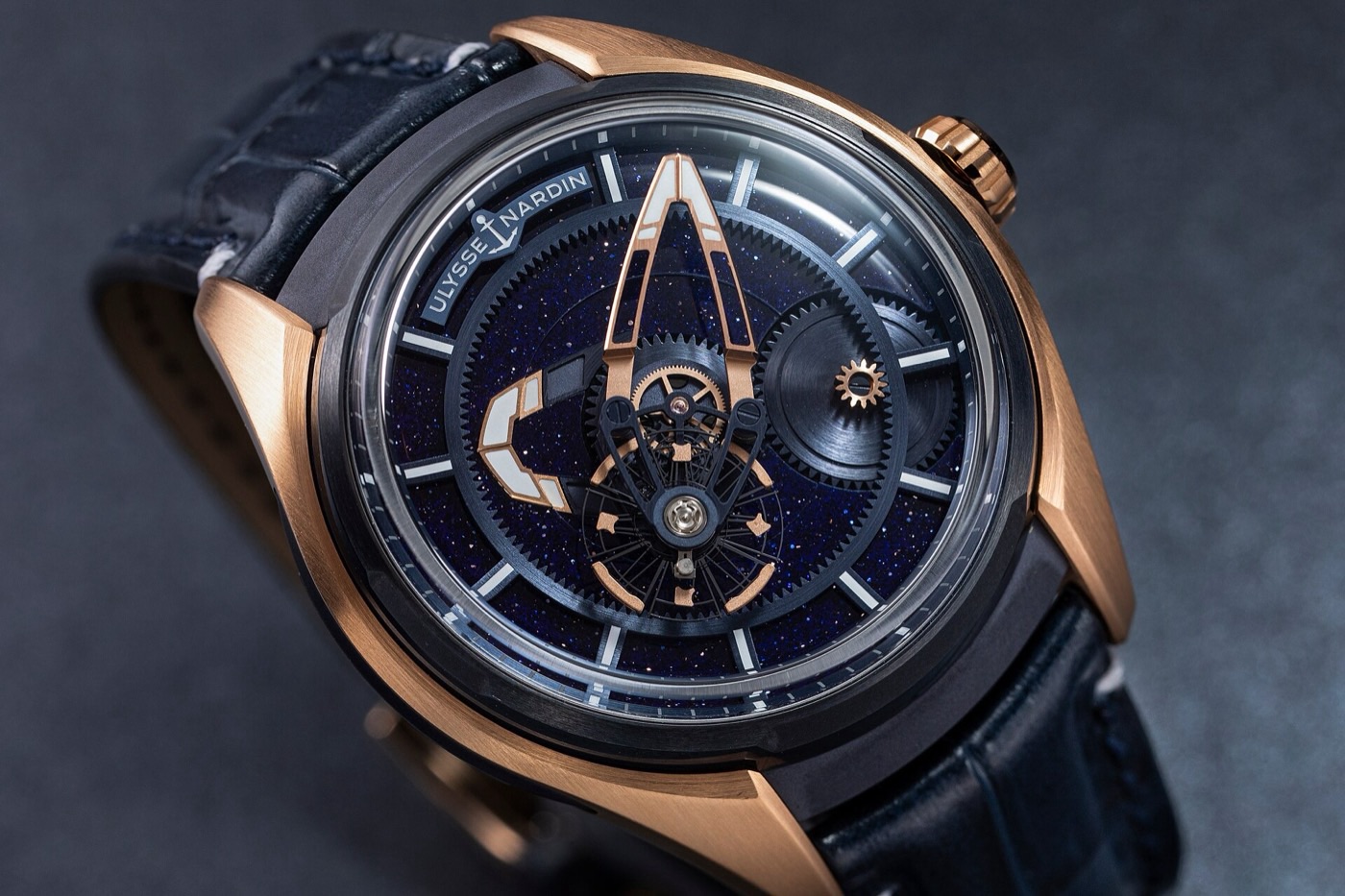
The Freak, 2001
Ulysse Nardin’s Freak of 2001 had no dial and no crown, and its Dual Direct escapement gave impulse from two escape wheels. Monochrome reports that aluminium wheels worked but wore too fast, so the wheels were etched from silicon.1
Monochrome credits the project to the company’s owner Rolf Schnyder, the watchmaker and historian Ludwig Oechslin and the designer Carole Forestier, and says Ulysse Nardin set up Sigatec with Mimotec in 2006 to make parts by LIGA and DRIE. WorldTempus reports that Ulysse Nardin and Sigatec supply silicon parts to other brands.1, 2
The silicon balance spring
A balance spring of plain silicon would change its stiffness with temperature. CSEM’s European patent, filed on 25 November 2002, covers a spring cut from monocrystalline silicon with an outer layer, such as silicon dioxide, whose thermal coefficient has the opposite sign, so that the two cancel.3
CSEM calls the result Silinvar, the first temperature-compensated silicon balance spring; Patek Philippe uses Silinvar as the name of its own silicon material.5, 7
A consortium of Patek Philippe, Rolex and the Swatch Group, formed at CSEM, licensed the patent and took silicon balance springs into industrial production, as Europa Star and WorldTempus report; Europa Star says Patek had first worked with the microengineering institute of the University of Neuchâtel.2, 4
Patek Philippe dates a Silinvar escape wheel to 2005, the Spiromax balance spring to 2006 and the Pulsomax escapement to 2008. Europa Star dates Rolex’s Syloxi spring, of silicon and silicon oxide, to 2014, in the women’s calibre 2236.4, 5
WorldTempus reports that the Swatch Group fits silicon parts across almost all its brands, and that Breguet was among the early users.2
After the patent
The core European patent expired on 25 November 2022; Europa Star gives 2023 for Japan.3, 4
Europa Star reports that a silicon balance spring cost about 100 francs at first and about 20 by 2022, and that makers outside the consortium, such as the Biel brand Horage, prepared springs of their own for when the patent lapsed.4
New shapes followed, because silicon is easy to prototype: WorldTempus names Girard-Perregaux’s Constant Escapement of 2008, with a flexible silicon blade, and the Zenith Defy Lab of 2017, developed with CSEM and TAG Heuer, whose one-piece silicon oscillator runs at 15 hertz.2
CSEM says it developed with Vaucher Manufacture Fleurier, in 2014, a new mechanical regulator to replace the Swiss lever escapement that cuts a movement’s energy use by up to six times.7
Key dates
- 2001
Ulysse Nardin’s Freak runs on silicon escape wheels.1, 2
- 2002
CSEM files its patent on the temperature-compensated silicon balance spring.3, 7
- 2005
Patek Philippe dates its Silinvar escape wheel to this year.5
- 2006
Patek Philippe introduces the Spiromax balance spring; Sigatec is founded.1, 4, 5
- 2014
Rolex fits its silicon Syloxi spring.2, 4
- 2022
The core European patent expires on 25 November.3, 4
Where Silicon in the movement leads
- Used by, CompanyPatek Philippe
Patek Philippe dates its silicon escape wheel to 2005 and its Spiromax balance spring to 2006.5
- Used by, CompanyRolex
Europa Star dates Rolex’s silicon Syloxi balance spring to 2014.4
- Used by, GroupThe Swatch Group
WorldTempus reports that the Swatch Group, a member of the CSEM consortium, fits silicon parts across almost all its brands.2, 4
- Part of, HistoryMaking watches today
Silicon escape wheels and balance springs, from 2001.1, 3, 4
- See also, PlaceNeuchâtel
The silicon balance spring was patented by CSEM in Neuchâtel in 2002.3, 7
- See also, TechnologyThe balance spring
The silicon balance spring is a new material for the balance spring, compensated for temperature by an oxide layer.3, 4
Facts and sources
- Introduced
- 2001 (escape wheels, Ulysse Nardin Freak); 2002 (CSEM balance-spring patent)1, 2, 3
- Made by
- Deep reactive ion etching (DRIE) of monocrystalline silicon wafers2, 5
Sources
- 1
In-depth: Ulysse Nardin Freak, 20 years of watchmaking innovation (opens in a new tab)
- 2
Silicon in the watch industry: the great all-rounder (opens in a new tab)
- 3
EP 1422436 B1: Spiral watch spring and its method of production (opens in a new tab)
- 4
Silicon: the gateway to the future of mechanical watches? (November 2022) (opens in a new tab)
- 5
Patek Philippe Advanced Research: Oscillomax (press release, 2011) (opens in a new tab)
- 6
The Freak X wristwatch, introduced in 2019, photographed in 2024. (opens in a new tab)
- 7
Sources read November 12, 2026.