Thomas Tompion
The London clockmaker who made Robert Hooke’s balance-spring watches in 1675, kept the fusee with the new spring, numbered his work, and left his Fleet Street business to George Graham.
Born 1639 (baptised 25 July), Northill, Bedfordshire, Died 20 November 1713, London
In the history The balance spring and the age of precision

From Bedfordshire to Fleet Street
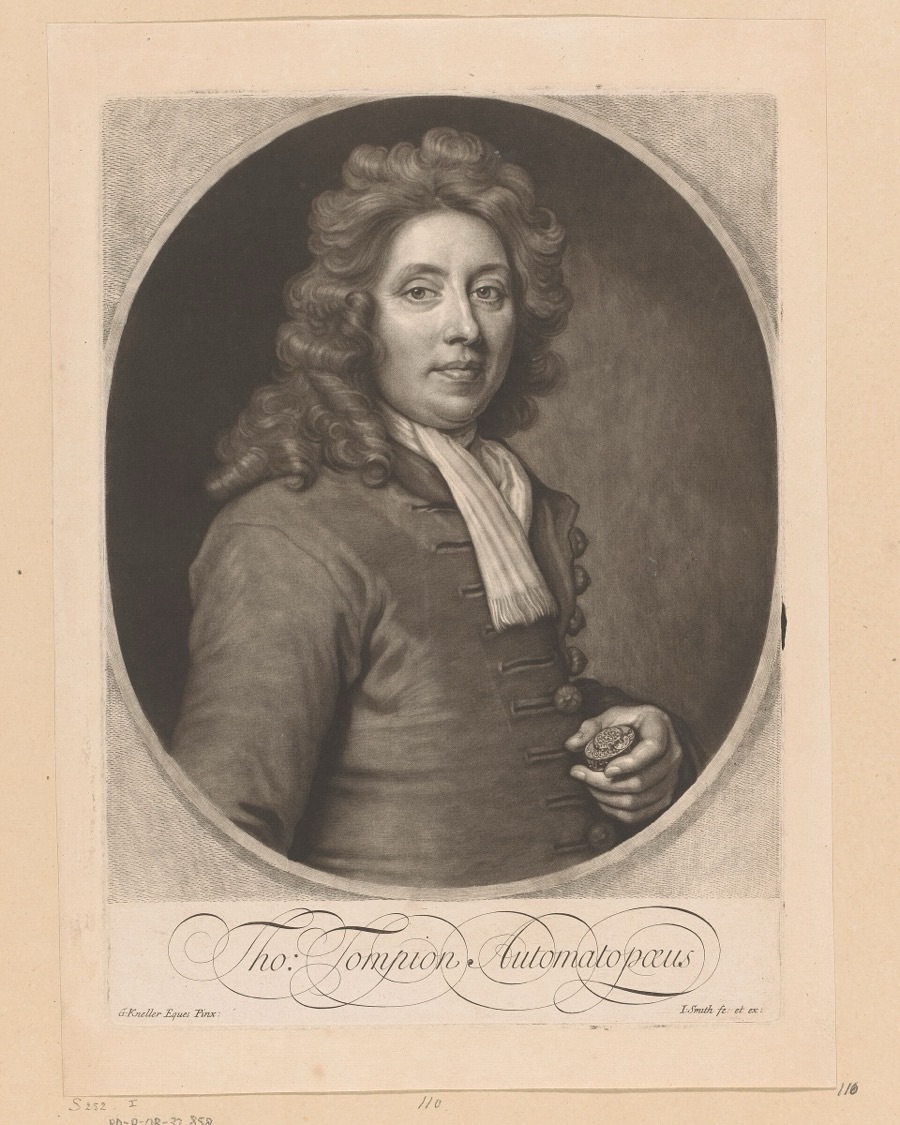
Thomas Tompion was born in 1639 at Northill in Bedfordshire, the son of a blacksmith; the DNB notes that the parish registers do not begin until 1672, so the place rests on tradition.1, 2, 6
He was apprenticed to a London clockmaker in 1664 and made free of the Clockmakers' Company on 4 September 1671.1, 2
The Clockmakers’ Museum holds a fusee verge movement by him of about 1671, from before the balance spring.7
Robert Hooke was his early patron, and through Hooke he gained royal work, including the clocks for the Royal Observatory at Greenwich in 1676.2, 6
Balance-spring watches
In 1675 he made balance-spring watches under Hooke's direction, one for Charles II.1, 2, 8
Wikipedia says he kept the fusee in his spring-balance watches, and that the fusee watch with a spiral-sprung balance became the English standard.2
He numbered his watches and clocks; a signed but unnumbered movement is dated before about 1680 by the Clockmakers' Museum, and Graham continued the numbering.2, 3
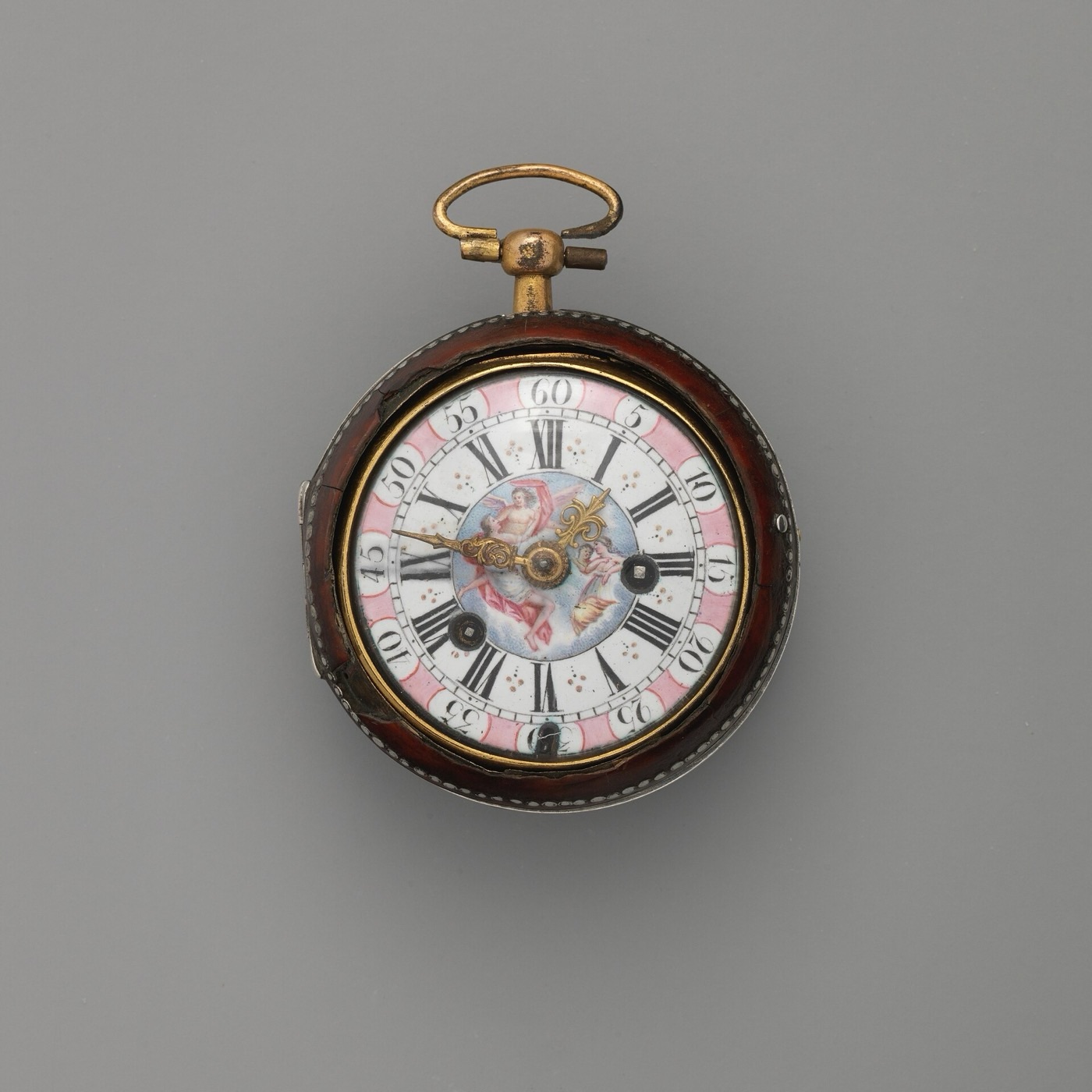
Wikipedia credits his workshop with about 5,500 watches and 650 clocks, and says many of his workmen were Huguenots.2
The DNB says he patented a cylinder escapement in 1695 with William Houghton and Edward Barlow; others credit him or Graham with the cylinder.1, 10
Master of the trade
He was Master of the Clockmakers' Company in 1704 and, with Quare and Windmills, complained of Amsterdam makers putting their names on foreign work.1, 11
His partners were Edward Banger (from 1701) and then George Graham, husband of his niece Elizabeth, who inherited the business.1, 2, 4
He died on 20 November 1713 and was buried in Westminster Abbey; Graham joined him in the same grave in 1751.1, 6
Where Thomas Tompion leads
- Based in, PlaceLondon
Tompion worked in Fleet Street and was Master of the Clockmakers' Company in 1704.1, 8
- Trained, PersonGeorge Graham
Graham joined Tompion's workshop, married his niece and inherited the business in 1713.4, 12
- Worked with, PersonRobert Hooke
Tompion made Hooke's balance-spring watches in 1675, one for Charles II.1, 2
- Part of, HistoryThe balance spring and the age of precision
Made Hooke’s balance-spring watches in 1675 and kept the fusee that English watches carried for a century.1, 2, 8
- See also, PlaceClerkenwell
Tompion worked in Fleet Street, but Tompion Street beside Northampton Square was named after him in 1935.2, 13
- See also, PlaceGreenwich
Tompion made the new Observatory’s clocks in 1676.2, 6
- See also, TechnologyThe balance spring
Tompion made balance-spring watches from 1675 and kept the fusee with them.2, 8
Facts and sources
- Born
- 1639 (baptised 25 July), Northill, Bedfordshire2, 6
- Died
- 20 November 1713, London1, 6
- Worked in
- Fleet Street, London2, 8
Sources
- 1
Tompion, Thomas (Dictionary of National Biography, 1885-1900, vol. 57) (opens in a new tab)
- 2
- 3
Watch movement by Thomas Tompion with a later case and dial (L2015-3122) (opens in a new tab)
- 4
- 5
- 6
- 7
Pre-balance-spring era watch movement by Thomas Tompion c.1671 (L2015-3114) (opens in a new tab)
- 8
Early balance spring watch by Thomas Tompion (1985-1537) (opens in a new tab)
- 9
- 10
- 11
- 12
- 13
Sources read November 11, 2026.