Robert Hooke
The English natural philosopher who said he had put a spring on a watch balance about 1658, had Thomas Tompion make watches to his design in 1675, and disputed Huygens’s priority.
Born 18 July 1635, Freshwater, Isle of Wight, Died 3 March 1703, London
In the history The balance spring and the age of precision

Curator of experiments
A spring on the balance
He said he applied springs to the balance of a watch about 1658, to solve the longitude problem.1, 2
Boyle and Lord Brouncker tried to win him a patent about 1660; the deal failed when Hooke refused a clause that would let others benefit from improvements to his principle.1, 2, 3
He said he showed spring-regulated models in a Gresham College lecture in 1664, and a Royal Society note of 23 June 1670 records a demonstration of a balance-controlled watch.1, 3
When Huygens announced the spiral spring in 1675, Hooke had Tompion make watches to his design; one for Charles II was signed with both his claimed date of 1658 and Tompion's of 1675.2, 4, 5
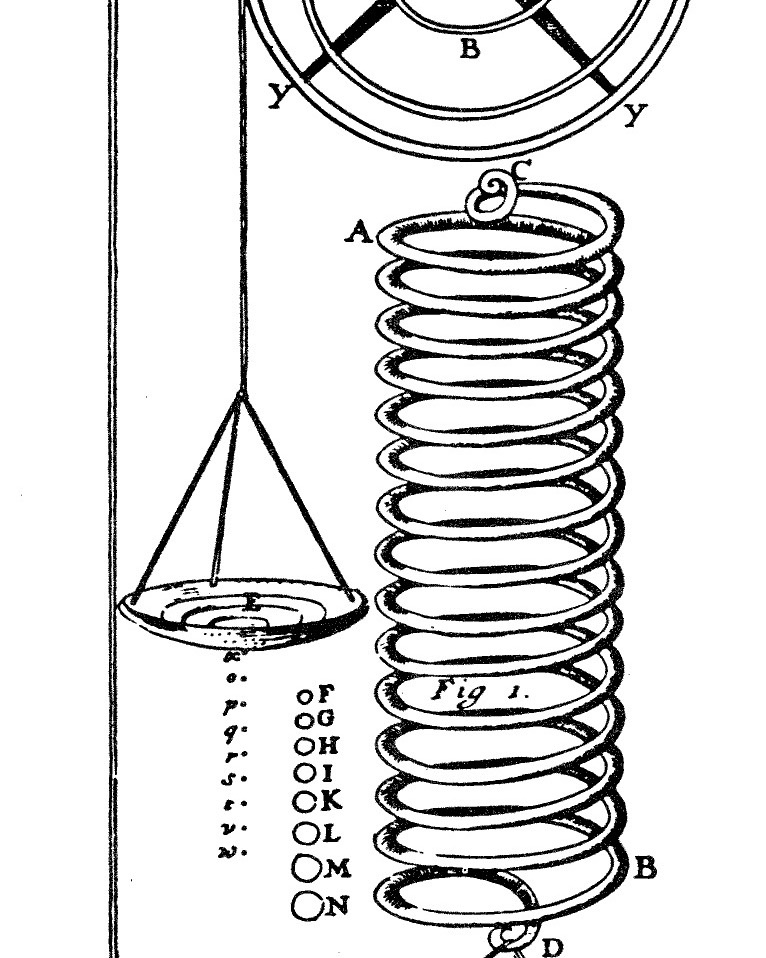
He published the principle behind springs, 'ut tensio, sic vis' (as the extension, so the force), as an anagram in 1676 and solved it in 1678: Hooke's law.2, 3
The quarrel over priority
He attacked the Royal Society's secretary Oldenburg over the printing of Huygens's announcement, and the Society made him withdraw the charge that Oldenburg trafficked in intelligence.1, 2
Historians still disagree how far his claim goes: the DNB saw no doubt of his priority, while the editors of Huygens's works note that his mechanism was never published and may not have been a spiral.1, 2
Wikipedia notes that his published diary shows him in constant contact with the clockmaker Tompion.3
Key dates
- 1658
Hooke's claimed date for applying a spring to the balance.1, 2
- 1664
Gresham lecture on spring regulation, by his own account.1
- 1675
Disputes Huygens's balance spring; Tompion makes his watch for Charles II.1, 2
- 1678
Publishes 'ut tensio, sic vis', Hooke's law of springs.2, 3
- 1703
Dies in London.2, 3
Where Robert Hooke leads
- Worked with, PersonThomas Tompion
Tompion made Hooke's balance-spring watches in 1675, one for Charles II.4, 8
- Part of, HistoryThe balance spring and the age of precision
Said he had put a spring on the balance about 1658, and disputed Huygens’s claim.1, 2
- See also, PersonChristiaan Huygens
Rival claimants to the balance spring in 1675.1, 9
- See also, TechnologyThe balance spring
Hooke claimed to have applied a spring to the balance about 1658; the priority is disputed.1, 2
Facts and sources
- Born
- 18 July 1635, Freshwater, Isle of Wight2, 3
- Died
- 3 March 1703, London2, 3
- Worked in
- London (Royal Society; Gresham College)1, 3
Sources
- 1
- 2
Hooke, Robert (Dictionary of National Biography, 1885-1900, vol. 27) (opens in a new tab)
- 3
- 4
- 5
Pre-balance-spring era watch movement by Thomas Tompion c.1671 (L2015-3114) (opens in a new tab)
- 6
- 7
- 8
Tompion, Thomas (Dictionary of National Biography, 1885-1900, vol. 57) (opens in a new tab)
- 9
Sources read November 11, 2026.