Christiaan Huygens
The Dutch scientist behind the pendulum clock, who announced the spiral balance spring in Paris in 1675, took a French royal privilege for it, and then released it to every watchmaker.
Born 14 April 1629, The Hague, Died 8 July 1695, The Hague
In the history The balance spring and the age of precision
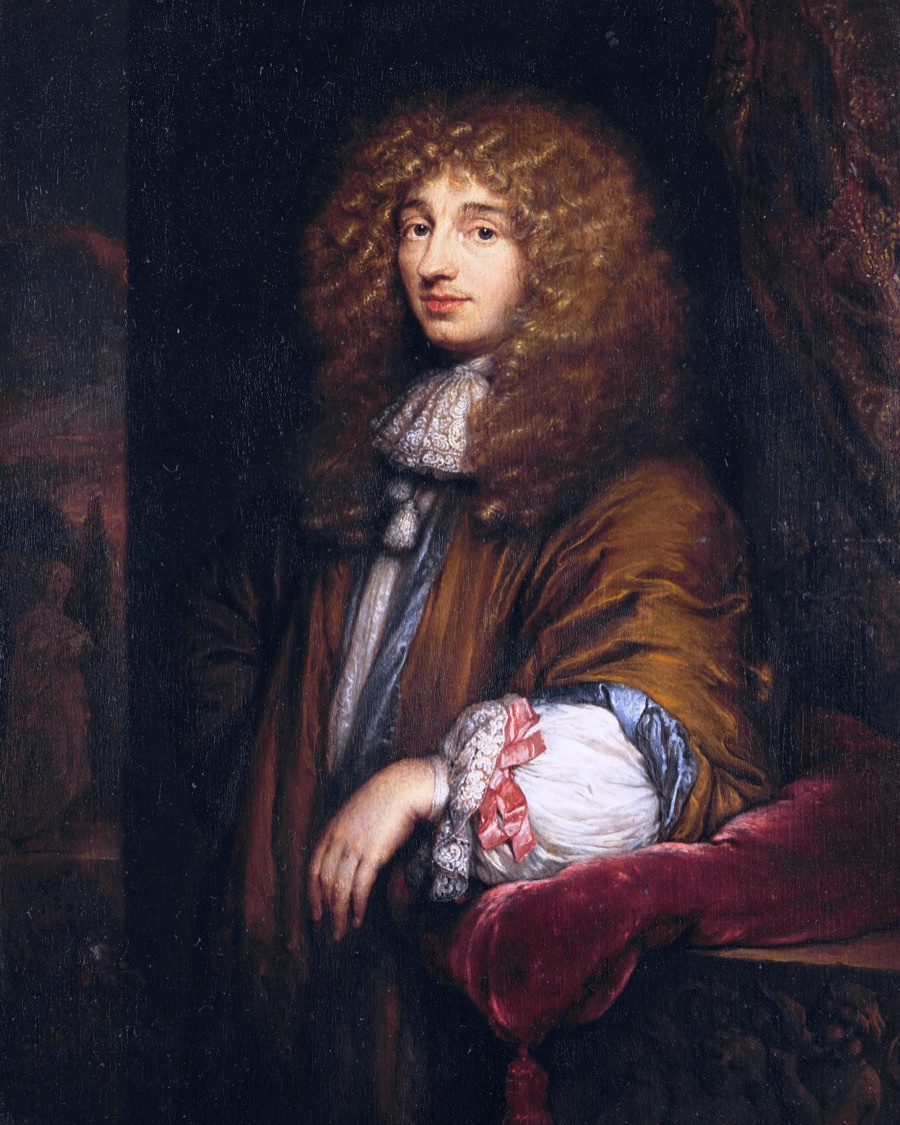

Scientist and clockmaker
Wikipedia describes Christiaan Huygens as a Dutch mathematician, physicist and astronomer, born in The Hague in 1629, the second son of Constantijn Huygens.1
In 1657 he designed the pendulum clock, made under contract by Salomon Coster and manufactured in Paris by Isaac Thuret.1, 6
His Horologium Oscillatorium of 1673, Wikipedia notes, analysed the pendulum mathematically and showed that a bob moving on a cycloid swings in equal times whatever the width of its swing.1
Wikipedia says his sea clocks were tried from 1660 but failed, because a ship’s motion upset the pendulum.1
The spiral spring, 1675
In January 1675 he worked out the spiral balance spring, sent an anagram of it to Oldenburg at the Royal Society on 30 January and showed a model to Colbert on 31 January.4, 7
Louis XIV's privilege of 15 February 1675 gave him twenty years' monopoly of spiral-sprung clocks and watches in France.3
His letter in the Journal des Sçavans of 25 February 1675 described the spring and said it would make exact pocket watches and, in larger form, find longitude.2, 8
He believed the spring would make the balance isochronous, so his early watches did without a fusee; English makers soon found the fusee still necessary.1, 9
Rivals and release
He fell out with Thuret, who had shown Colbert a model before him, and later let Thuret make the watches under his own mark.4, 7
Hooke in London and Hautefeuille in Paris both disputed his priority; the argument has lasted ever since.10, 11, 12
He gave up his privilege and, leaving Paris on 1 July 1676, released all watchmakers to use the invention.4
According to Wikipedia, he returned to The Hague in 1681, and the revocation of the Edict of Nantes stopped his return to France in 1685. He died in The Hague on 8 July 1695.1
Where Christiaan Huygens leads
- Developed, TechnologyThe balance spring
Huygens announced the spiral balance spring in the Journal des Sçavans of 25 February 1675.2, 8
- Part of, HistoryThe balance spring and the age of precision
Announced the spiral balance spring in Paris in February 1675.2, 8
- See also, PersonRobert Hooke
Rival claimants to the balance spring in 1675.10, 12
Facts and sources
- Born
- 14 April 1629, The Hague1
- Died
- 8 July 1695, The Hague1
- Worked in
- The Hague and Paris (Académie des Sciences)1, 3
Sources
- 1
- 2
- 3
- 4
- 5
Christiaan Huygens, painted by Caspar Netscher in 1671. (opens in a new tab)
- 6
- 7
Oeuvres complètes, Tome VII, No. 2007: Huygens to J. Gallois, 11 February 1675 (opens in a new tab)
- 8
- 9
- 10
- 11
- 12
Sources read November 11, 2026.