The verge escapement
The escapement of European mechanical clocks from the late 13th century and of watches until the 18th and early 19th centuries: a crown-shaped wheel pushing in turn on two pallets on a swinging rod, its rate set by a foliot or a balance.
Introduced Late 13th century, in European tower clocks, About 1300 to the mid-19th century
In the history Time in the pocket
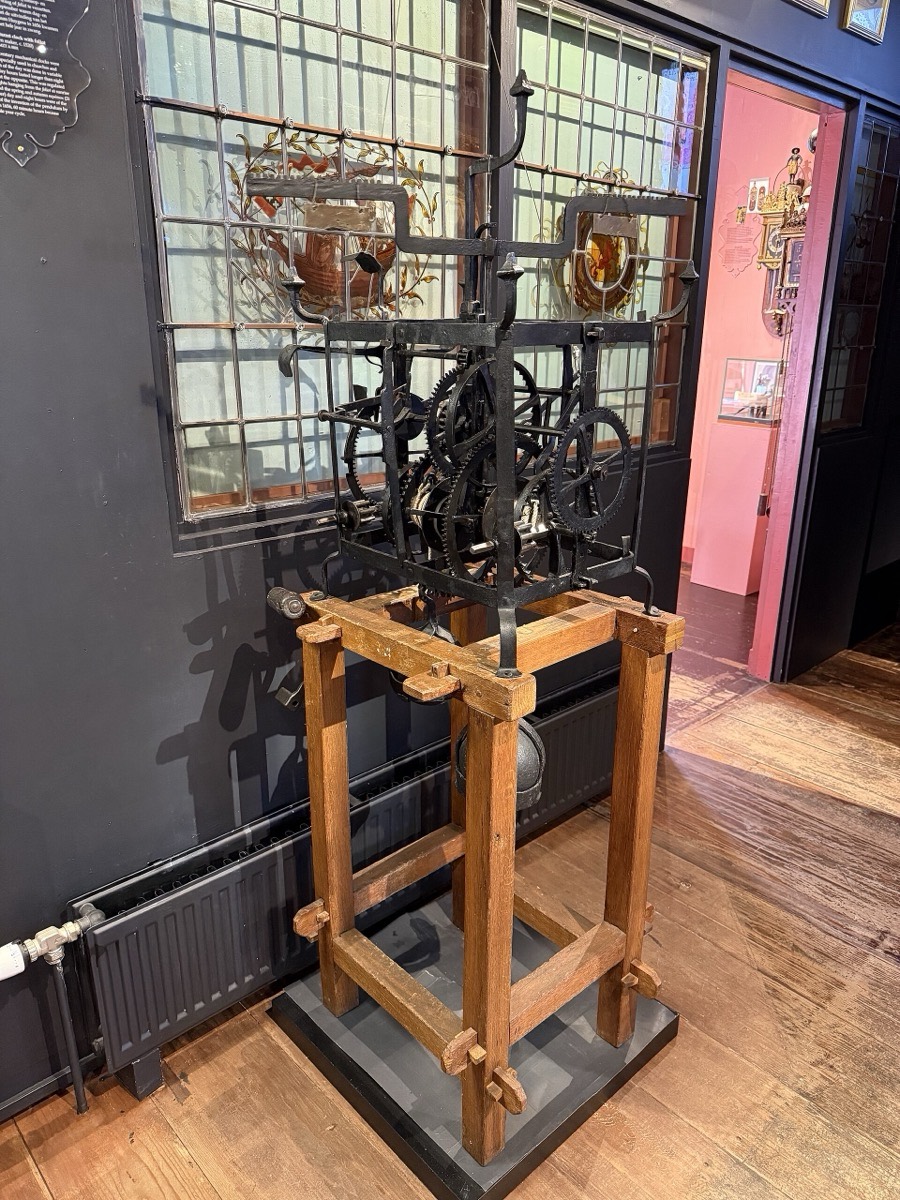
How it works
An escapement lets a clock's wheels turn in small, regular steps. In the verge, a crown-shaped wheel pushes in turn on two small plates (pallets) set on a rod, the verge, so that the rod swings back and forth.1, 6
In early clocks the rod carried a foliot, a bar with movable weights at its ends that set the rate; later a wheel-shaped balance did the same job, and this balance is what went into watches.1, 4
The fault lay mostly in the oscillator, not the escapement: a foliot or unsprung balance has no natural period, so its rate follows the driving force. The pendulum (1656) and the balance spring (1675) cured that while keeping the verge.1, 4, 7
Origins
Nobody knows who devised it. Dohrn-van Rossum's study finds no record of the invention, in contrast to the striking clock, which contemporaries noticed at once.1, 2
Wikipedia says it probably grew out of earlier alarm mechanisms that rang a bell; a 1237 drawing by Villard de Honnecourt was once taken for an escapement but is generally not, and in 1271 Robertus Anglicus wrote that clockmakers were still trying to make one.1
Wikipedia calls Richard of Wallingford's treatise of 1327 the earliest written description of an escapement; it describes not a verge but a variant with two escape wheels, the 'strob'. Giovanni Dondi's treatise on his astrarium (built 1348-1364) is one of the few other detailed descriptions of a 14th-century clock.1, 8, 9
Possible Chinese roots are argued over: Su Song's tower of 1088 used a water-wheel escapement descended from one of 725, and Derek de Solla Price held that this spread west, but no transmission route is documented.2, 10, 11
In clocks and watches
Wikipedia notes that how accurate verge-and-foliot clocks were is debated: estimates of one to two hours a day are quoted, while modern trials suggest minutes a day with care; the best were within about 15 minutes a day by the mid-17th century.1
For about 350 years the verge had no rival: it drove the tower clocks at Salisbury (about 1386) and Wells (1386-1392), the 16th-century watches of Nuremberg and Augsburg, and English watches such as Robert Grinkin's of about 1610-1620.1, 12, 13
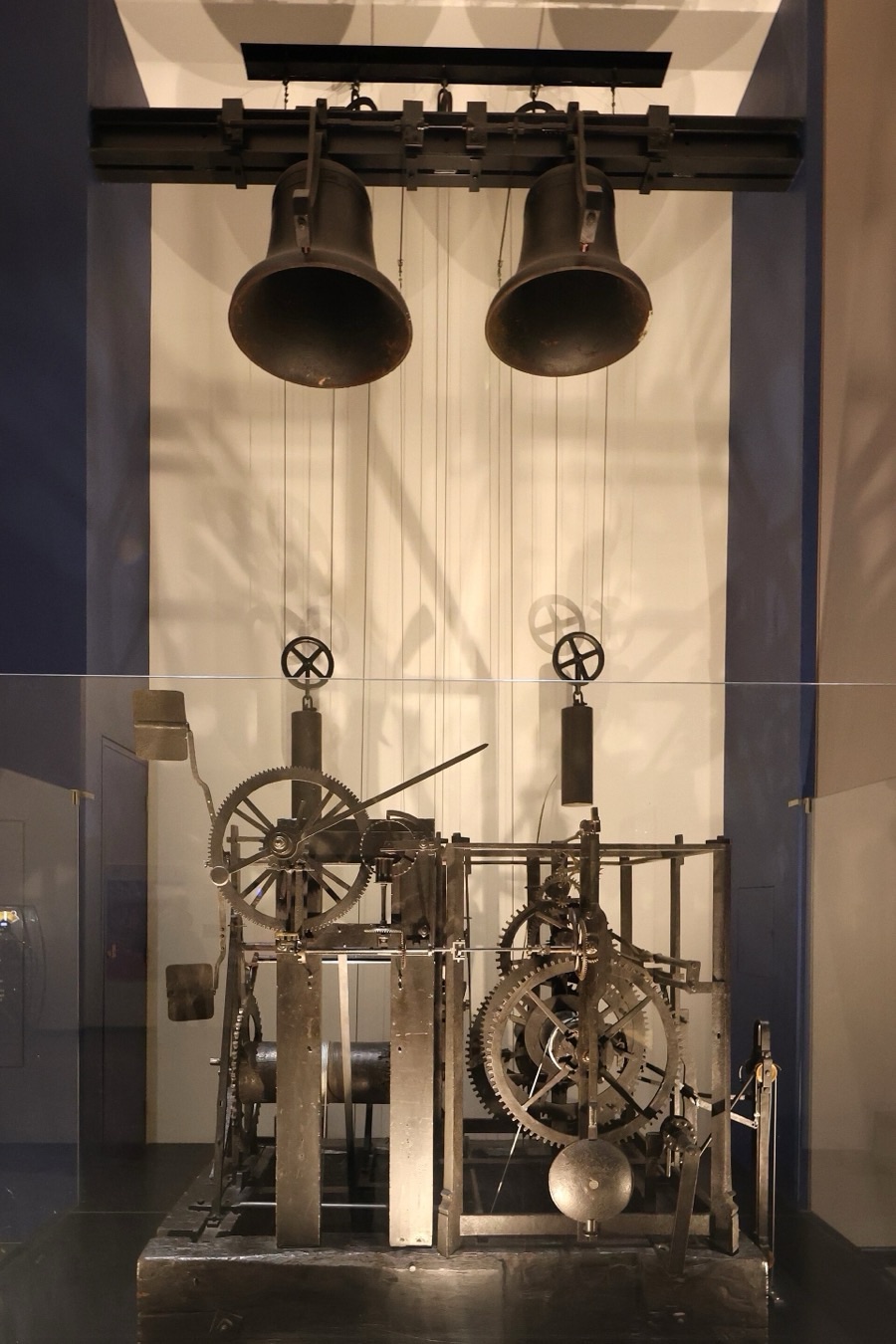
Few early verge-and-foliot clocks survive unaltered, because most were converted to pendulums after 1656.1, 12
Watches kept the verge until the 18th and early 19th centuries, when the cylinder and lever escapements replaced it in quality work.3, 15
Where the verge escapement leads
- Used by, ObjectThe pomander watch of 1505
Early watches used the verge with a small balance.1, 4
- Part of, HistoryTime in the pocket
The escapement of the tower clocks of about 1300, still beating in watches when the balance spring arrived in 1675.1, 2
- See also, PlaceAugsburg
Wikipedia counts Augsburg's 16th-century watches among the timekeepers the verge drove.1
- See also, TechnologyThe balance spring
The balance spring was fitted to verge watches from 1675 and greatly improved them.1, 4
- See also, TechnologyWadokei: Japanese clocks
Wadokei kept the verge and foliot, regulated by moving weights on the foliot.16, 17
Facts and sources
- Introduced
- Late 13th century, in European tower clocks1, 2
- In use
- About 1300 to the mid-19th century1, 3
Sources
- 1
- 2
- 3
- 4
Watch (Encyclopaedia Britannica, 11th edition, 1911) (opens in a new tab)
- 5
- 6
Clock (Encyclopædia Britannica, 11th edition, 1911) (opens in a new tab)
- 7
A Walk Through Time - A Revolution in Timekeeping (opens in a new tab)
- 8
- 9
- 10
- 11
- 12
- 13
Watch, Robert Grinkin, London, ca. 1610-1620 (M.3-2003) (opens in a new tab)
- 14
The original mechanism of the Wells Cathedral clock. (opens in a new tab)
- 15
- 16
The World of Japanese Traditional Clock (opens in a new tab)
- 17
Sources read November 12, 2026.