Augsburg
The free imperial city in Swabia that, with Nuremberg, led south German clock and watchmaking from about 1550 to 1650, under a guild whose masterpiece rules produced astronomical table clocks, and whose makers built automata for the courts of Europe.
Germany, Swabia, in Bavaria
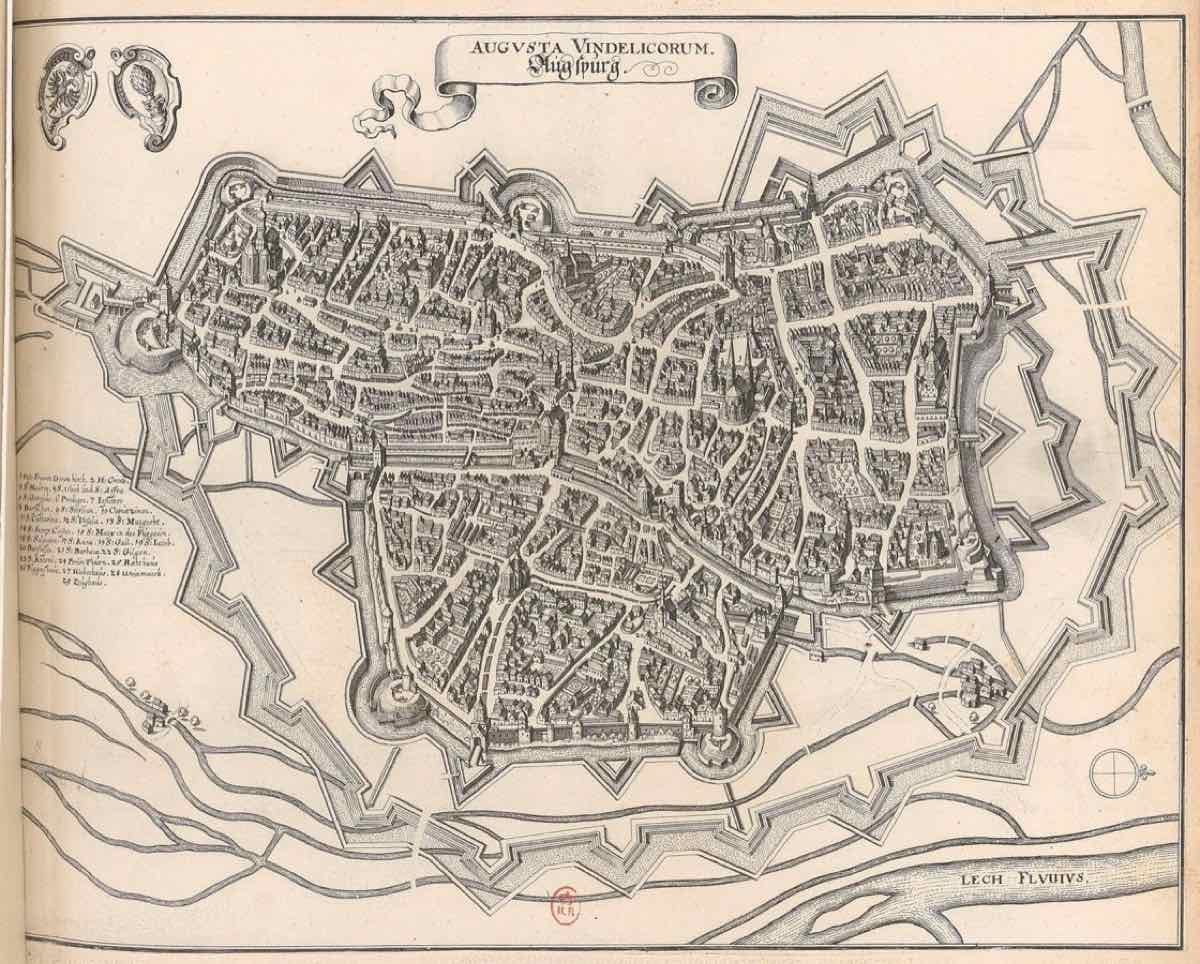
Why Augsburg?
Augsburg was a free imperial city, answering to the emperor alone and well placed on established trade routes; it held its status from 1276, and imperial diets met there.7, 8
It was also a city of money. The Fugger and Welser merchant houses were based there, and the Fuggers lent to the Habsburg emperors from Frederick III to Charles V.7, 8
Its metalworkers were already skilled: armourers from the fifteenth century, goldsmiths, and makers of mathematical and astronomical instruments, whose portable sundials were exported widely.7, 8, 9
With Nuremberg, it made the watches of the sixteenth century. A drum watch of about 1520 to 1550 in the Walters Art Museum has an iron movement stamped with a pinecone, the Augsburg mark, and the verge drove them all.5, 10, 11
What grew here: the guild, the masterpiece and the automaton
The Antiquarian Horological Society dates the Augsburg clockmakers' guild to 1564, a year ahead of Nuremberg's. A clock in the Victoria and Albert Museum is signed in that year 'Jeremias Metzger, clockmaker, 1564, in Augsburg'.3, 12
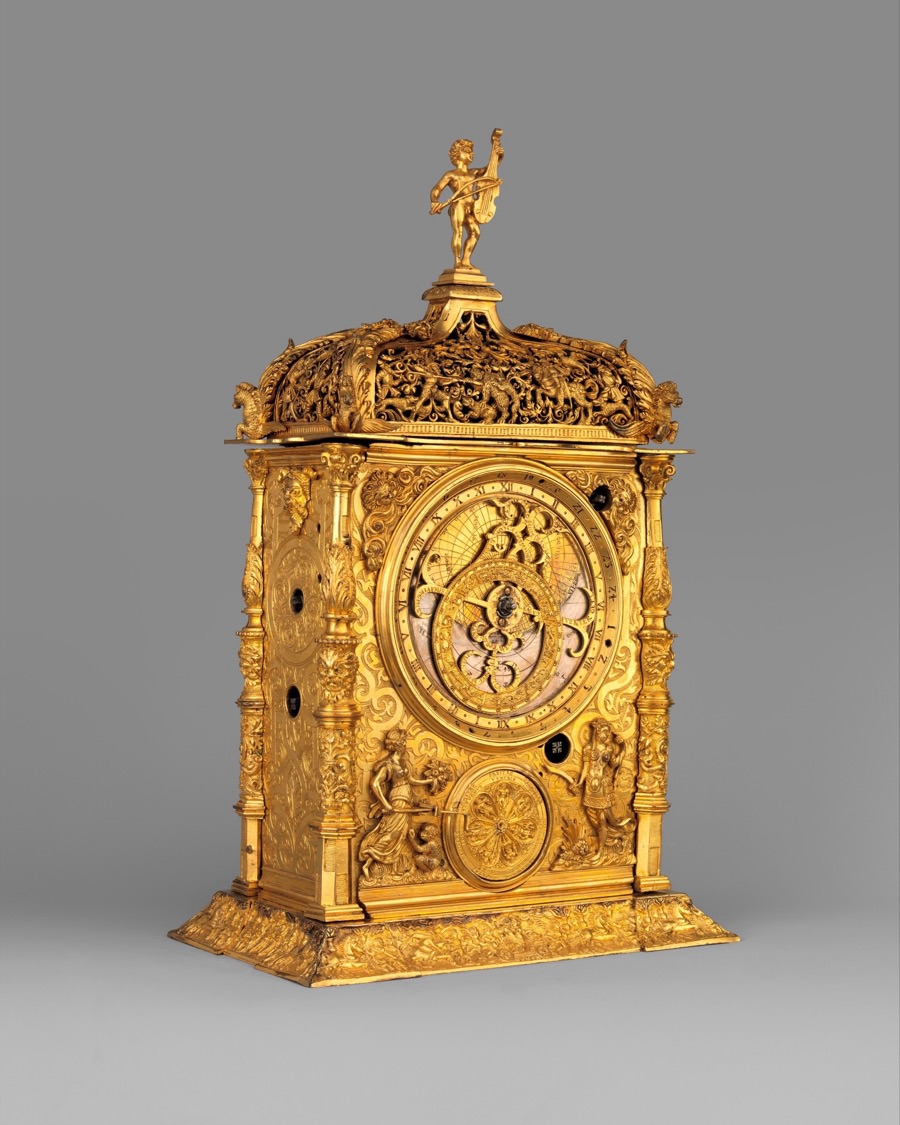
To become a master, a clockmaker had to make a masterpiece under the guild's rules. Surviving ones are astronomical table clocks with calendars, astrolabe dials and alarms: Johann Schneider's of 1625, made to the guild rules of 1577, and David Weber's of about 1653, with seven dials.1, 2, 14
The work was divided. The V&A notes that Metzger made movements while goldsmiths and bronze-workers supplied the gilt cases, so the same case designs appear on clocks signed by other makers.3
Watches went on alongside the clocks: Christoph Schissler's drum watch of about 1550 to 1570 has a sundial in its lid for resetting it, and Nicolaus Rugendas the Elder made a watch of lapis lazuli and rock crystal about 1620.15, 16
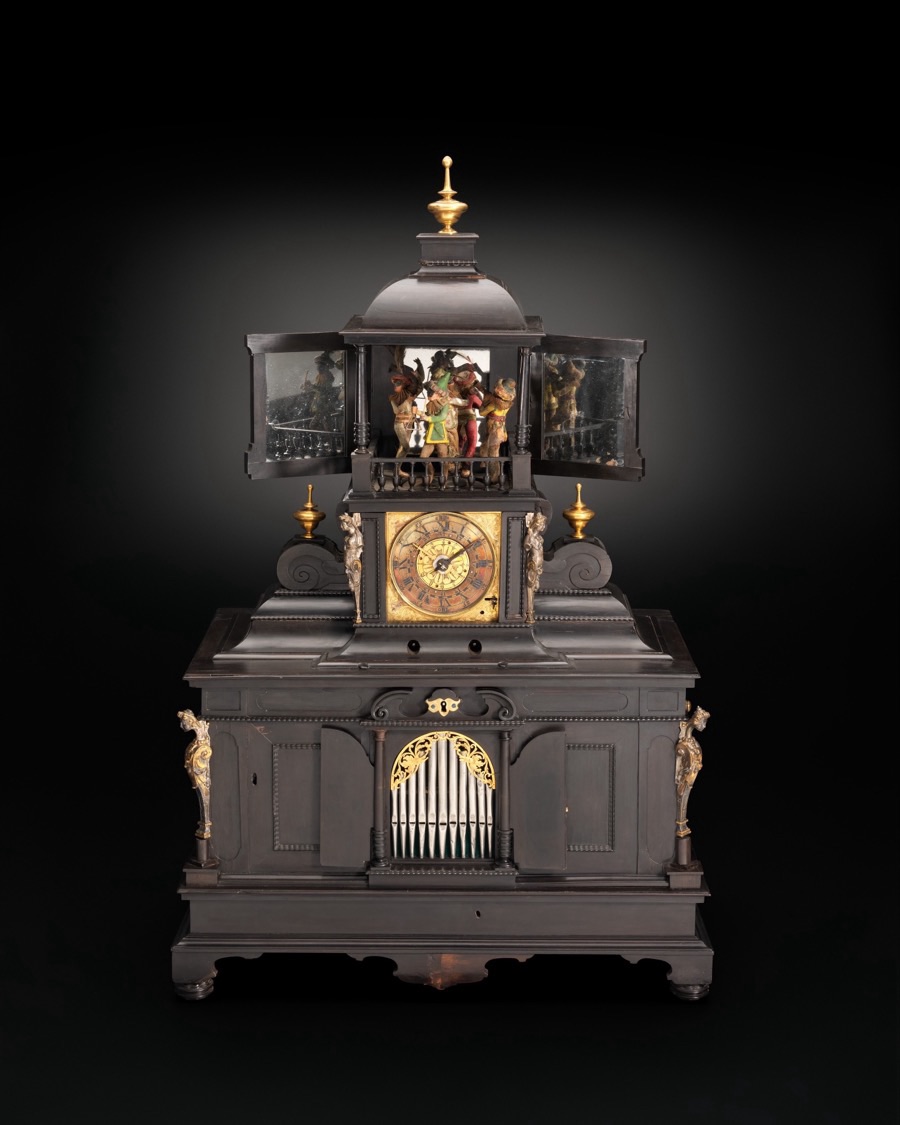
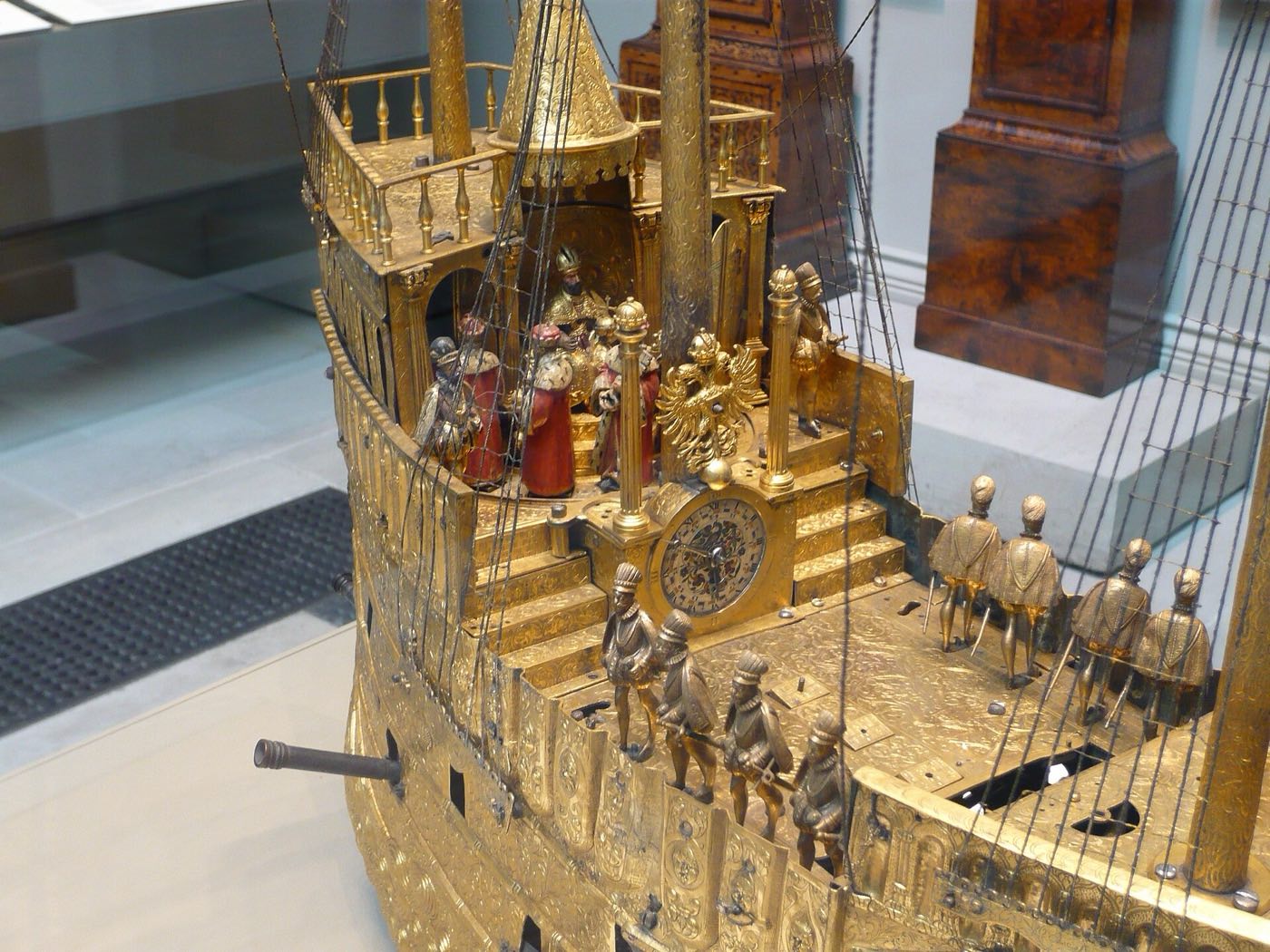
The city's speciality was the clock that moved. Hans Schlottheim built three clockwork galleons between 1585 and 1590, with an emperor and electors on deck, an organ inside and cannon that fired, and Veit Langenbucher made a musical clock with a spinet and an organ about 1625.4, 17, 18
Who and what moved through
These were treasury pieces for princes, kept with automata, astrolabes and sundials in their cabinets of wonders. The V&A notes that a Metzger clock of 1564 now in Vienna is probably one in the inventory of Archduke Ferdinand II, who built rooms at Schloss Ambras for his collections.3
Schlottheim's ships went to the greatest courts. Wikipedia notes that the one now in the British Museum, long thought to be Rudolf II's, is now linked to the 1585 inventory of the Elector Augustus of Saxony in Dresden; the others are at Écouen and in Vienna.4, 17
The Habsburgs' Ottoman neighbours appear in the work too: the Kunsthistorisches Museum holds an Augsburg figure clock of about 1580 to 1590 in which a pasha in a boat rolls his eyes while a rower pulls and a monkey bites an apple.21
What changed because of it
The Frick Collection puts Augsburg's time as a centre of clockmaking between 1550 and 1650, and notes that its clocks, like others in Europe, kept poor time and were prized as luxuries.1
War cut the city down. Wikipedia gives a fall in population from about 70,000 to about 16,000 after the Swedish occupation and the siege of the winter of 1634 to 1635 in the Thirty Years' War.8
The guild itself held the trade back, by the account of the Clockmakers' Museum record: its sixteenth-century rules stayed in force well into the eighteenth century, and Augsburg's clocks grew old-fashioned and hard to sell.2
The free city ended with the Holy Roman Empire: Wikipedia records that it passed to the Kingdom of Bavaria in 1806.8
Its clocks became museum pieces far from home. The V&A bought its Metzger clock in 1857 for £30, Octavius Morgan gave Schlottheim's galleon to the British Museum in 1866, and a Metzger table clock of 1568 came to the Metropolitan Museum as a gift of J. Pierpont Morgan in 1917.3, 17, 22
In Augsburg the Maximilianmuseum, opened in 1855, shows the work of the city's clockmakers among more than sixty art trades, with the model chamber of mechanical models that Elias Holl set up in the town hall in 1620, by the museum's account.9
Key dates
- 1564
Jeremias Metzger signs a clock "in Augsburg".3
- 1568
Metzger's astronomical table clock, now in the Met.22
- 1577
The guild rules for masterpiece clocks that stayed in force into the 18th century.2
- 1585
Hans Schlottheim's clockwork galleon.4, 17
- 1625
Johann Schneider's astronomical masterpiece clock.2
- 1653
David Weber's masterpiece clock, about this year.1
- 1857
The V&A buys Metzger's clock of 1564.3
- 1917
J. Pierpont Morgan's gift brings Metzger's 1568 clock to the Met.22
Where Augsburg leads
- Part of, HistoryTime in the pocket
With Nuremberg, the south German city where the first watches worn on the body were made, by the Walters Art Museum's account; its watches carry a pinecone mark.5, 10
- See also, PersonPeter Henlein
The Walters Art Museum gives Augsburg, with a question mark, as the origin of the 1530 Melanchthon watch that others attribute to Henlein.23, 24
- See also, PlaceNuremberg
The other south German centre: the Antiquarian Horological Society dates their clockmakers' guilds to 1564 and 1565.12
- See also, TechnologyThe verge escapement
Wikipedia counts Augsburg's 16th-century watches among the timekeepers the verge drove.11
- See also, ObjectThe Melanchthon watch
The Walters gives Augsburg, with a question mark, as the place the Melanchthon watch was made.23
Facts and sources
Sources
- 1
David Weber (1623/24–1704): table clock with astronomical and calendrical dials (opens in a new tab)
- 2
- 3
Clock, Jeremias Metzger, Augsburg, 1564 (4273-1857) (opens in a new tab)
- 4
- 5
Portable Drum Watch, Augsburg, ca. 1520-1550 (Walters 58.68) (opens in a new tab)
- 6
- 7
- 8
- 9
- 10
- 11
- 12
- 13
- 14
Masterpiece clock from Augsburg, Germany, 1625-1635 (1952-312) (opens in a new tab)
- 15
Portable Drum Watch, Christoph Schissler, Augsburg, 1550-1570 (Walters 58.70) (opens in a new tab)
- 16
Watch, Nicolaus Rugendas the Elder, ca. 1620 (17.190.1519) (opens in a new tab)
- 17
- 18
- 19
- 20
- 21
- 22
- 23
Spherical Table Watch (Melanchthon's Watch), 1530 (Walters 58.17) (opens in a new tab)
- 24
Sources read November 12, 2026.