Nuremberg
The Free Imperial City in Franconia where locksmiths were making small spring-driven clocks to carry by 1511: home of Peter Henlein, and of the Germanisches Nationalmuseum, which holds the Burgundy clock and the disputed 'Henlein watch'.
Germany, Franconia, in Bavaria
In the history Time in the pocket
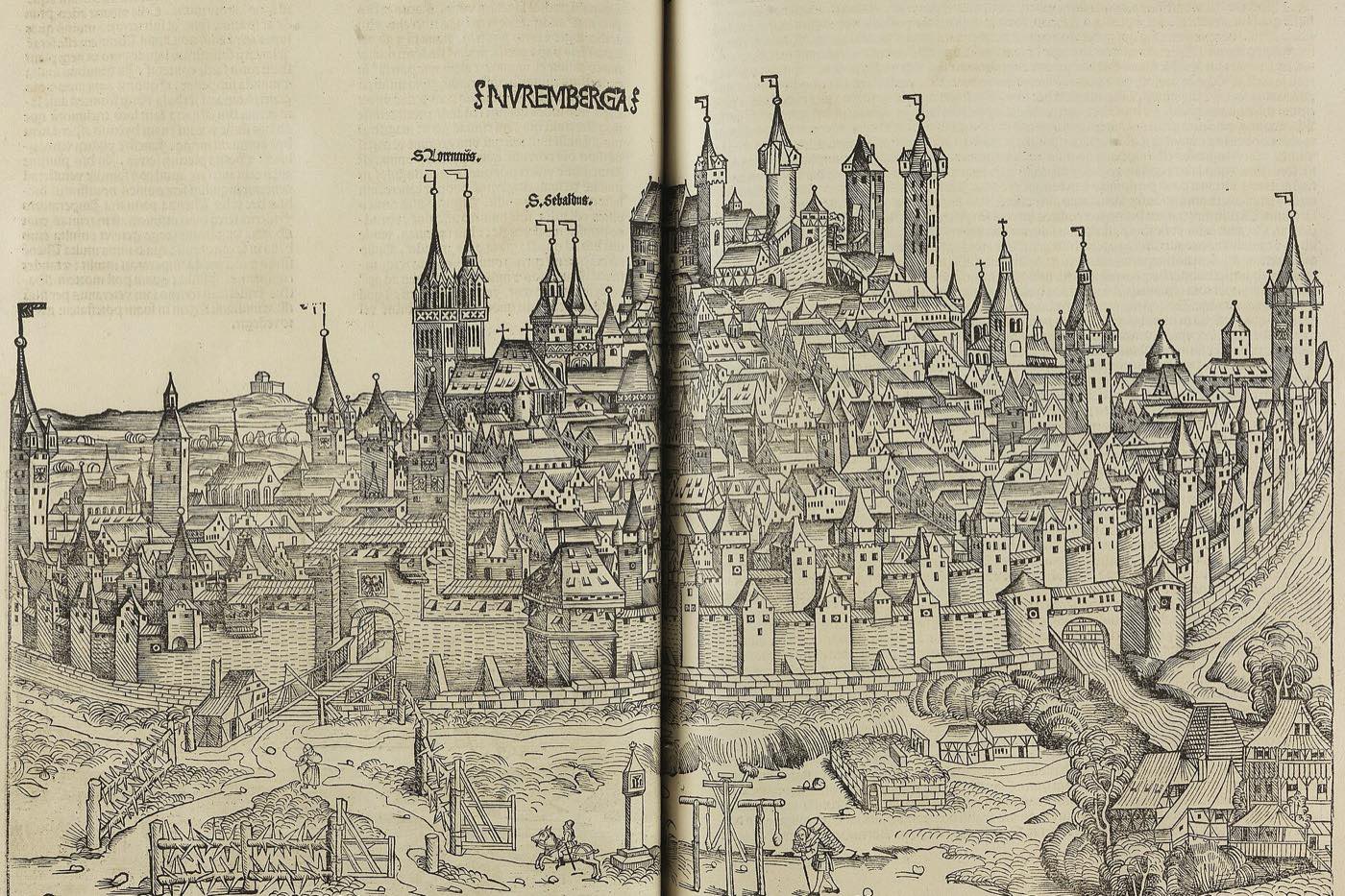
The imperial city
Wikipedia describes Nuremberg as a Free Imperial City and, in the 15th and 16th centuries, as a centre of the German Renaissance in art, printing and science, home to Albrecht Dürer and Martin Behaim; it adopted the Reformation in 1525.1
According to a review of Gerhard Dohrn-van Rossum's history of the hour, Nuremberg kept its own way of counting hours: the 'Nuremberg hour' divided day and night into between 8 and 16 hours depending on the season.6
Clockmakers and watchmakers
Clocks were made in the city well before watches: the merchant Hans Praun bought a small alarm clock from 'Meister Ludbig' in 1476, and Ludwig Gerung was made a citizen as a clockmaker ('Orelmacher') in 1469 and paid for a clock for St Sebald's tower in 1483.2
Wikipedia and the Walters Art Museum name Nuremberg, with Augsburg, as the city where the first watches worn on the body were made in the 16th century.7, 8
Its makers included Peter Henlein, praised by Cochlaeus in 1511; Jörg Heuß, who built the Männleinlaufen figure clock on the Frauenkirche in 1509 for 4,000 gulden; Jakob Bulmann; Andreas Osterberger; and Caspar Werner, who moved to Regensburg in 1557.2, 4
Nuremberg clocks went abroad: in 1506 a Milanese nobleman ordered one through Willibald Pirckheimer, and Henlein supplied the court of Mecklenburg at Schwerin from 1526 to 1542.2, 9
The specialist trade grew quickly after 1540: the Germanisches Nationalmuseum finds 'Uhrmacher' in the city's death register from 1542, and several more watchmakers named there in the 1550s.2
Sundials and eggs
Nuremberg also made portable sundials, including ivory diptych dials, the rival of the early watch for anyone who needed the time in daylight.2, 3
Oval 'Nuremberg eggs' came in the later 16th century, about 1580, and the name rests on a misreading; the Germanisches Nationalmuseum's Scheurl family watch of about 1580-1600 is a typical example.2, 10, 11
Museum and memory
The Germanisches Nationalmuseum, founded in 1852, holds the Burgundy clock of about 1430, the disputed 'Henlein watch' and a large collection of early timekeepers and astrolabes.3, 12
In 1905 German watchmakers and the city raised the Henlein fountain on the Hefnersplatz, and held a watch exhibition at the Bavarian Trade Museum.2, 9
Where Nuremberg leads
- Based here, PersonPeter Henlein
Locksmith and clockmaker of Nuremberg, master from 1509.9, 13
- Part of, HistoryTime in the pocket
The city of locksmiths where small spring-driven clocks to carry were being made by 1511.2, 4
- See also, PlaceAugsburg
The other south German centre: the Antiquarian Horological Society dates their clockmakers' guilds to 1564 and 1565.14
- See also, ObjectThe Melanchthon watch
The Walters notes that Nuremberg is considered the home of spherical watches.15
- See also, ObjectThe pomander watch of 1505
Pomander watches were a Nuremberg form of the early 16th century.10, 16
Facts and sources
Sources
- 1
- 2
- 3
Scientific instruments and the history of medicine (opens in a new tab)
- 4
- 5
Nuremberg, from the Nuremberg Chronicle printed in the city in 1493. (opens in a new tab)
- 6
- 7
- 8
Portable Drum Watch, Augsburg, ca. 1520-1550 (Walters 58.68) (opens in a new tab)
- 9
- 10
- 11
- 12
Standuhr Herzog Philipps des Guten von Burgund (opens in a new tab)
- 13
- 14
- 15
Spherical Table Watch (Melanchthon's Watch), 1530 (Walters 58.17) (opens in a new tab)
- 16
Sources read November 12, 2026.