The pomander watch of 1505
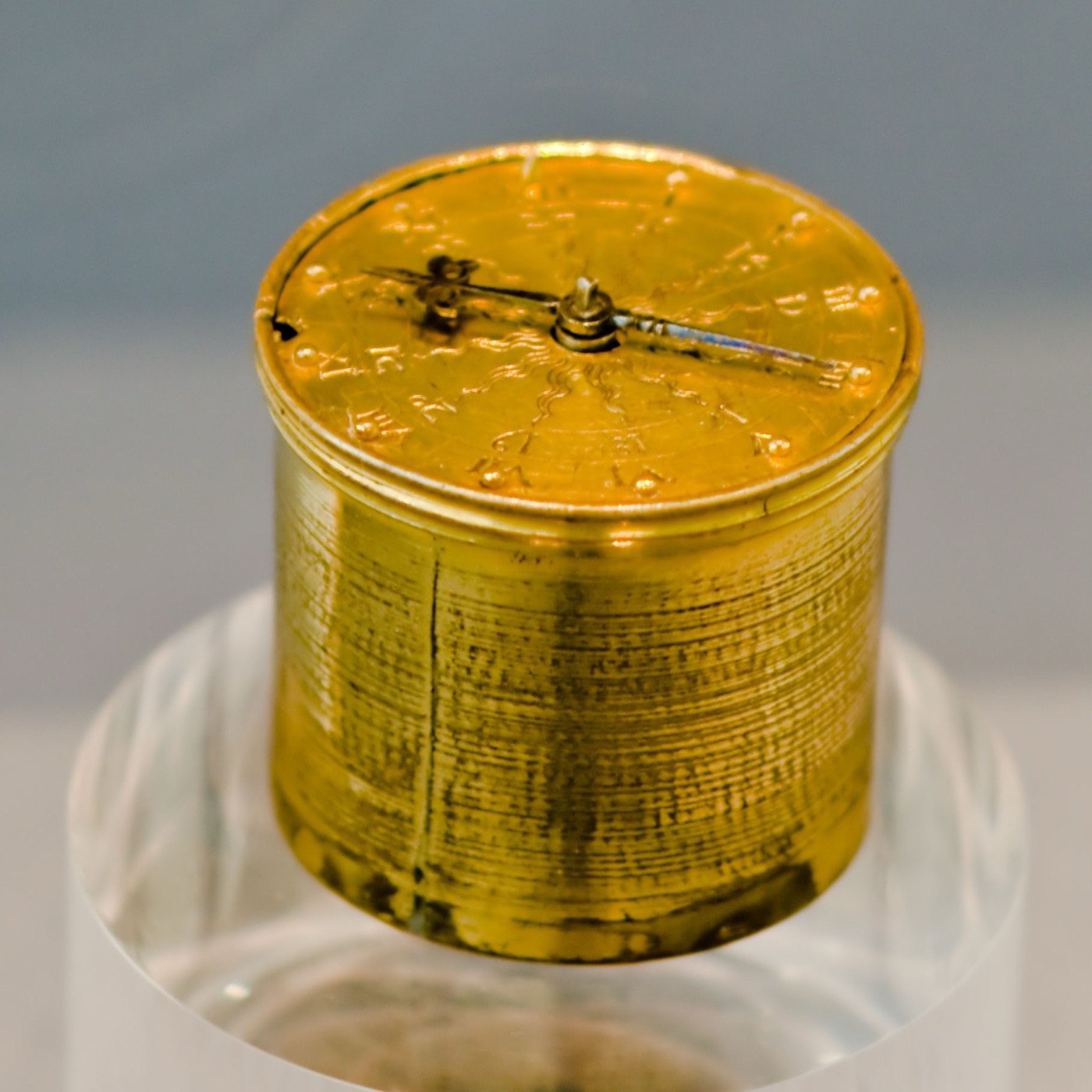
A gilt pomander watch found at a London flea market in 1987 and now in a private collection. Its owner's experts dated it to 1505 and attributed it to Peter Henlein in 2014; that date and attribution are their claim and have not been generally accepted. It is not the Germanisches Nationalmuseum's drum-shaped 'Henlein watch' signed 1510, and it is one of a handful of pomander watches, with the Melanchthon watch of 1530.
Made 1505 according to its owner's experts; the date is not generally accepted, By Peter Henlein according to its owner's experts; the attribution is not generally accepted, Now at A private collector (bought in 2002)
In the history Time in the pocket
The watch dated 1505
The pomander watch dated 1505 surfaced in 1987, when a watchmaker's apprentice found it in a box of parts bought for ten pounds at a London flea market; after an expert called it a forgery or copy it changed hands, and a private collector bought it in 2002.1, 2
Its owner's experts (Hermann Grieb, Peter Mikitisin, Frank Fox and Georg von Tardy) used CT scanning, laser spectral analysis and microphotography, and read the engraving 'MDV PHN' under the dial as '1505, Peter Henlein Nürnberg'; they presented it as genuine at a press conference in Nuremberg on 2 December 2014.1, 2
Quill & Pad describes the 1505 watch as having a fire-gilt copper case about 4.5 cm across, an iron movement with fusee and chain, a regulator with holes for two hog's bristles, a single hand and about 12 hours' running.1, 2
The owner's experts maintain the 1505 date and the Henlein attribution, but neither has been generally accepted: Quill & Pad noted that many found the results inconclusive, and the Germanisches Nationalmuseum's research of the same years treated the dating of every early 'oldest watch' with caution.1, 3, 5
Not the Nuremberg museum's watch
The pomander watch is not the Germanisches Nationalmuseum's 'Henlein watch'. That object is a drum-shaped watch signed 1510, bought by the museum in 1897 and shown by the museum in 2014 to be largely a 19th-century assembly.3, 6, 7
Watches in scent balls
A pomander (Bisamapfel) was a perforated ball, often of precious metal, for carrying musk or other scent, believed to ward off disease; in the early 16th century Nuremberg makers began to fit small clock movements inside them.2, 4
A pomander watch by Henlein is documented: on 11 January 1524 the city paid him 15 gulden for a gilded pomander 'for all things, with a clock'. Which surviving object, if any, is his is the question.9, 10
Few pomander watches survive: the German Wikipedia counts the Melanchthon watch and two others that are incomplete or lack their movement, and the Wuppertal clock museum has an empty pomander case.2, 4
The Melanchthon watch of 1530
Melanchthon's watch, a gilt brass sphere 4.8 cm across with an iron movement, is engraved 'PHIL. MELA. GOTT. ALEIN. DIE. EHR. 1530'. The Walters Art Museum calls it the earliest dated watch known; it runs 12 to 16 hours on one winding.4, 11
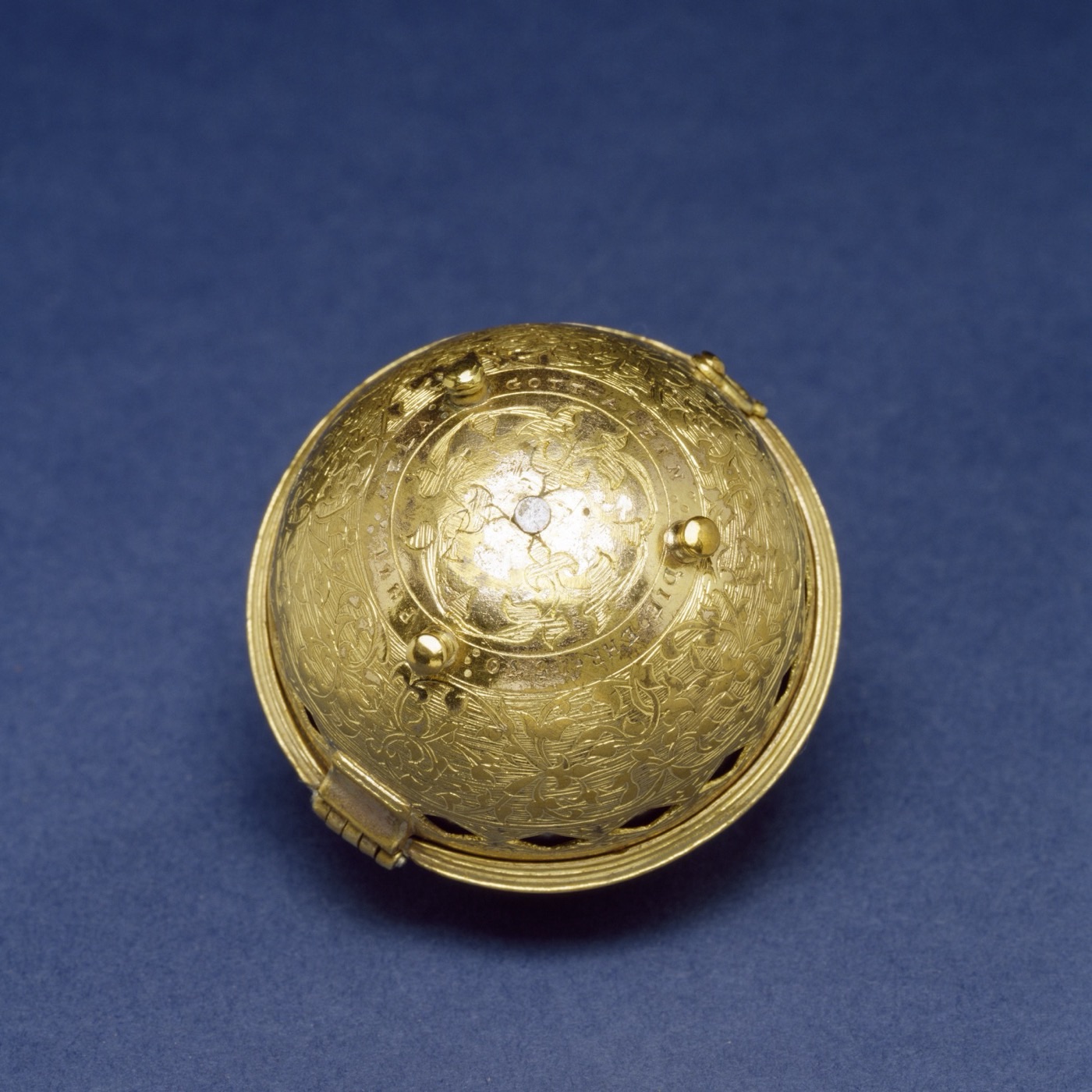
Who made the Melanchthon watch is disputed: the Walters text names no maker and gives its origin as Augsburg with a question mark, while the English Wikipedia says Henlein was probably commissioned to make it as a gift from Nuremberg.2, 11
The Melanchthon watch was sold by Jacques Seligmann of Paris to Henry Walters in 1910 and came to the Baltimore museum by his bequest in 1931; it was lent to the Germanisches Nationalmuseum for its 2014-2015 Henlein exhibition.4, 11
Key dates
- 1505
Date its owner's experts read in the watch's engraving; not generally accepted.1, 2
- 1524
Henlein paid for a gilded pomander with a clock.9, 10
- 1530
Melanchthon's watch engraved with this date.4, 11
- 1910
Henry Walters buys the Melanchthon watch.11
- 1987
The 1505 pomander watch found at a London flea market.1, 2
- 2014
Expert committee presents the 1505 watch (2 December); GNM exhibition opens.1, 3
Where the pomander watch of 1505 leads
- Used, TechnologyThe mainspring and fusee
The 1505 watch is described with a fusee and chain; all early watches were spring-driven.1, 13
- Used, TechnologyThe verge escapement
Early watches used the verge with a small balance.14, 15
- Part of, HistoryTime in the pocket
A watch in a scent ball, dated 1505 and claimed for Henlein by its owner's experts, a claim not generally accepted.1, 2
- See also, PersonPeter Henlein
Henlein was paid for a pomander watch in 1524; the surviving pomander watch dated 1505 is attributed to him by its owner's experts.1, 9
- See also, PlaceNuremberg
Pomander watches were a Nuremberg form of the early 16th century.4, 10
- See also, ObjectThe Melanchthon watch
The German Wikipedia counts the Melanchthon watch among the few pomander watches that survive.4
Facts and sources
- Made
- 1505 according to its owner's experts; the date is not generally accepted1, 2
- Maker
- Peter Henlein according to its owner's experts; the attribution is not generally accepted1, 2
- Held by
- A private collector (bought in 2002)1, 2
Sources
- 1
Is This The World's Oldest Known Watch? A Peter Henlein Mystery From 1505 (opens in a new tab)
- 2
- 3
- 4
- 5
The Henlein pocket watch dispute (research project, March 2013 - December 2014) (opens in a new tab)
- 6
Scientific instruments and the history of medicine (opens in a new tab)
- 7
- 8
- 9
- 10
- 11
Spherical Table Watch (Melanchthon's Watch), 1530 (Walters 58.17) (opens in a new tab)
- 12
- 13
- 14
Watch (Encyclopaedia Britannica, 11th edition, 1911) (opens in a new tab)
- 15
Sources read November 12, 2026.