Histories, Era I, Portable time
Time in the pocket
1500 to 1675
How the watch came out of the clock: the weight-driven clocks and equal hours of the 14th century, the spring that replaced the weight, the small clocks of Nuremberg and Augsburg, the legend of Peter Henlein and the disputed watches dated 1505 and 1510, jewelled cases made for display, the trades of Blois, Geneva and London, and the poor timekeeping that the balance spring of 1675 put right.

In short
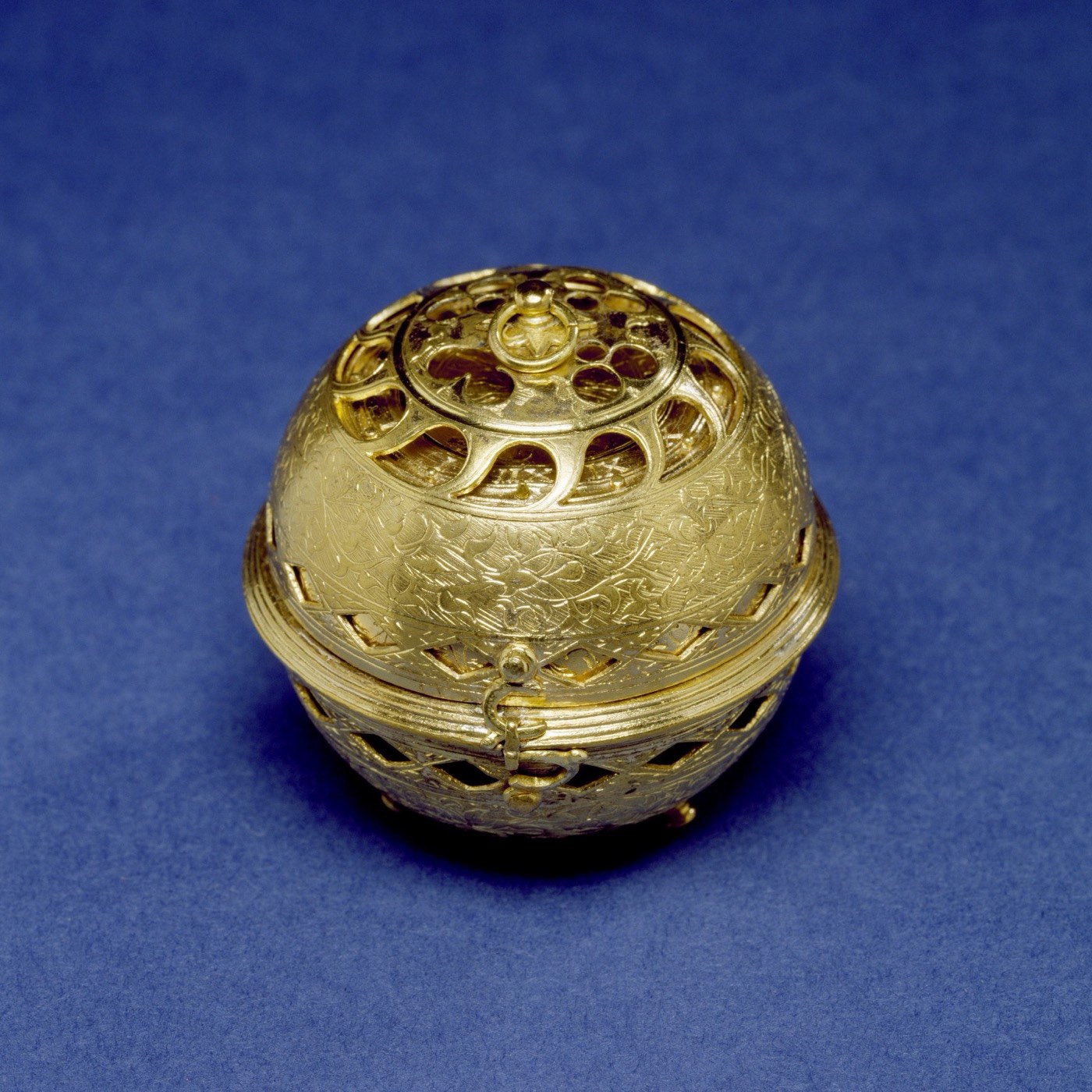
For most of history people told the time by the sun, by water or by bells rung for prayer, and from about 1300 European towns built clocks driven by falling weights. In the 1400s a coiled spring took the place of the weight, and soon after 1500 locksmiths in Nuremberg and Augsburg were making clocks small enough to hang from a neck chain or a belt. Later legend made one of them, Peter Henlein, the inventor of the watch, a claim the Nuremberg museum that studied it now rejects. For about 150 years watches were costly jewels more than timekeepers, made at the French court in Blois, in Geneva and in London, until in 1675 a spring on the balance began to make them keep time.2, 3, 6, 7, 8, 10, 12, 14, 18, 19, 20, 21
Part 1
What had to exist before the watch
Medieval Europe counted 'unequal' hours: daylight and night were each split into twelve, so a summer day hour was longer than a winter one. Clocks that strike the same hour all year needed a fixed, equal hour instead.1, 6, 22
Monasteries needed to wake and ring for prayer at set times, and by the 13th century timekeeping devices ('horologia') were standard equipment there. Historians disagree on how much this drove the invention: older accounts trace the mechanical clock to monastic bell-ringing alarms, while Gerhard Dohrn-van Rossum argues that monastic time was a sequence of offices, not a measure in equal units.1, 23
The decisive step was the mechanical escapement, which lets a weight-driven train of wheels move forward in regular steps. In Europe the verge escapement with a swinging bar, the foliot, appeared in tower clocks in the late 13th century; who devised it and where is not recorded.1, 10
Which early clock was the first truly mechanical one is uncertain, because the same Latin word, horologium, was used for water clocks too. Candidates include Dunstable Priory (1283) and a clock in Milan (1335); the 1911 Britannica lists clocks at Westminster (1288) and Canterbury (1292) without settling the question.10, 24
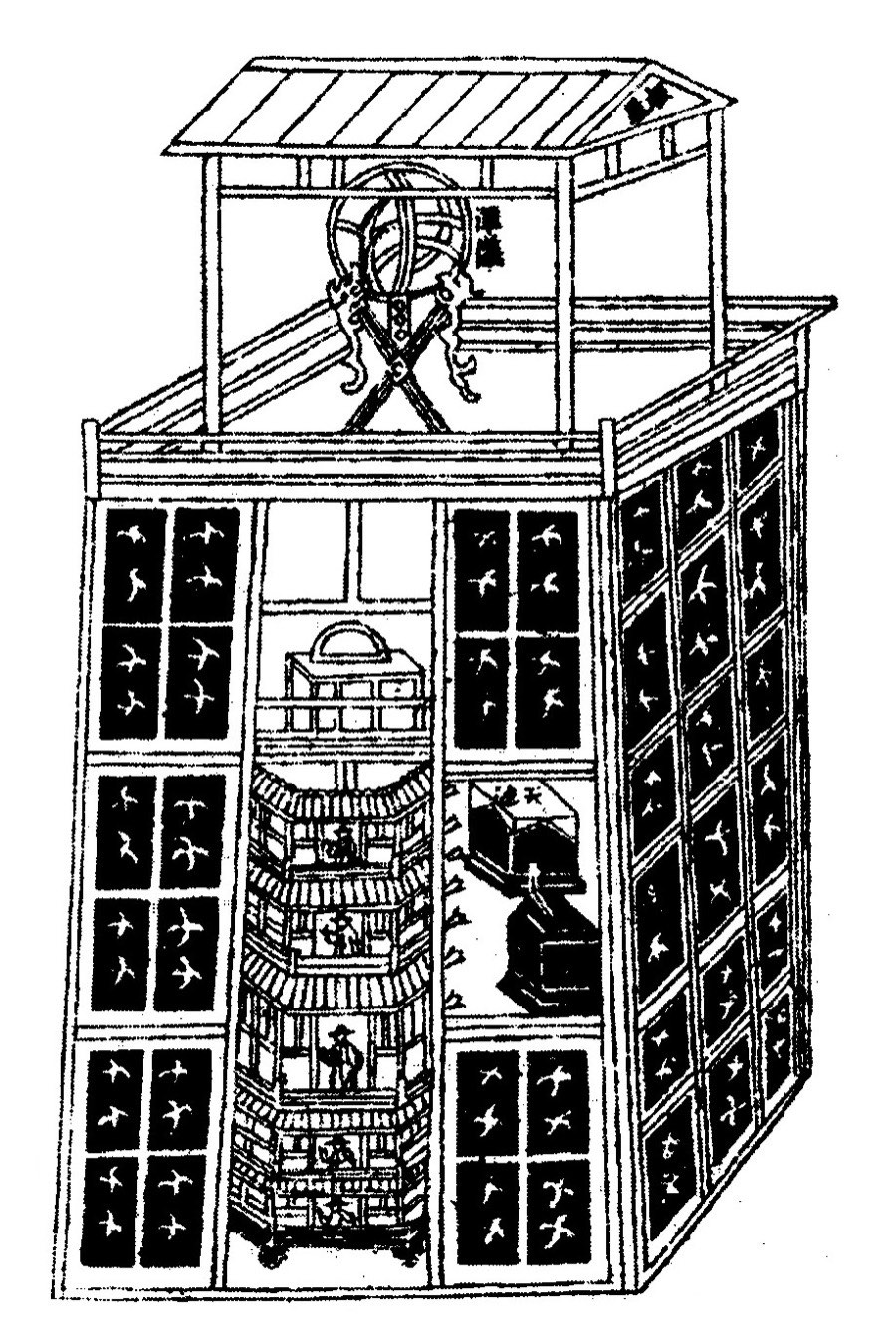
Earlier, in China, Su Song built a water-driven astronomical clock tower at Kaifeng, with a pilot model in 1088 and a treatise written in 1092, using a water-wheel escapement descended from one of 725. Whether this reached Europe is disputed: Derek de Solla Price argued the Chinese escapement spread west; Dohrn-van Rossum's review finds no evidence of how far European clocks drew on Chinese precedent, and Su Song's tower ran on water, not on a falling weight.1, 19, 26, 27
What brought clocks into everyday life was the striking public clock. From the 1330s, clocks that struck the right number of bells caused a sensation in northern Italian towns; equal hours struck by clocks are recorded in Padua in 1344, Genoa in 1353 and Bologna in 1356, and by 1400 a public clock was standard equipment for any self-respecting city.1, 28, 29
Scholars built the most ambitious early clocks: Richard of Wallingford, abbot of St Albans, described his astronomical clock in 1327, and Giovanni Dondi spent 1348 to 1364 building his astrarium in Padua. But most clockmakers of the period, more than half of those known, were smiths and locksmiths.1, 30, 31
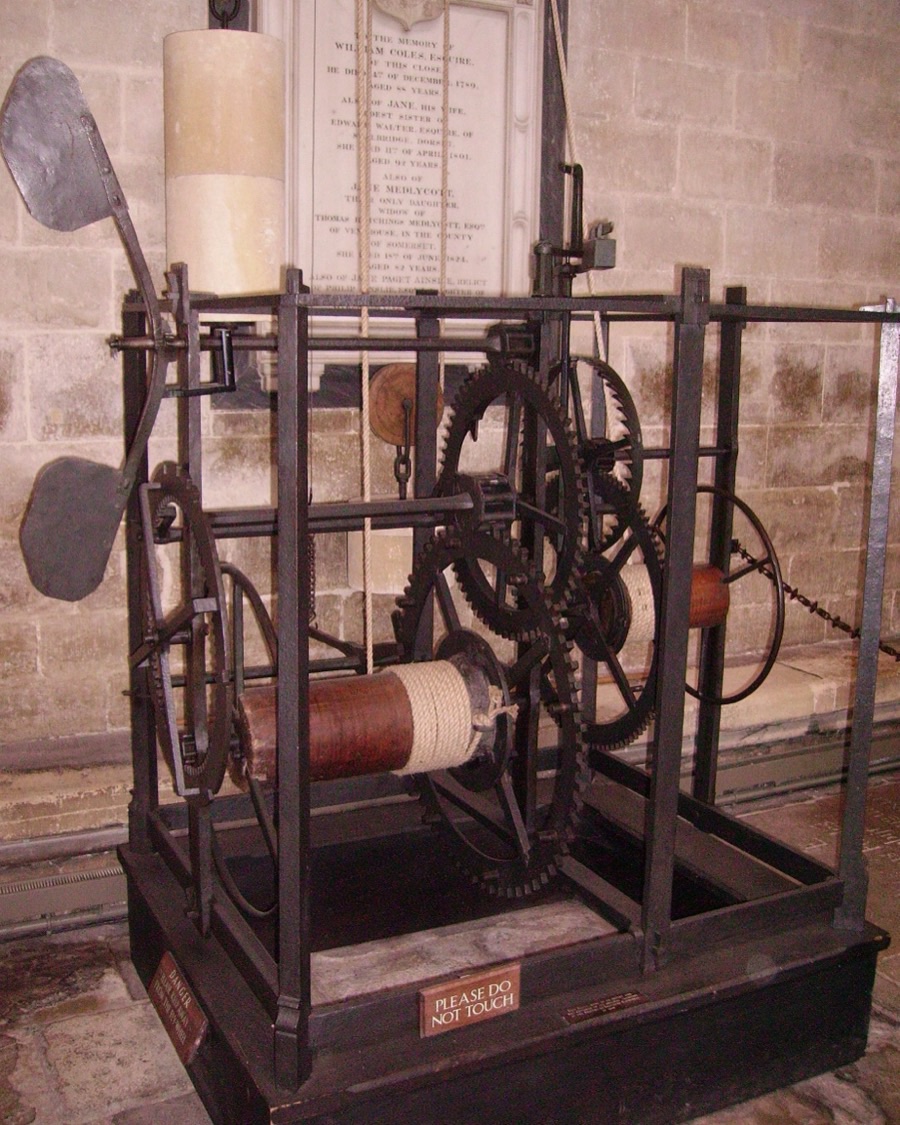
Survivors of this early age can still be seen: the dial-less iron clock at Salisbury Cathedral, thought to date from about 1386, and the Wells Cathedral mechanism of about 1386 to 1392, now running in the Science Museum in London. Both have been altered; Salisbury's verge and foliot is a 1956 reproduction.24, 32, 33
Part 2
A spring instead of a weight
A weight-driven clock must hang still. The step that made a portable clock possible was the coiled spring, already used in locks around 1400; the mainspring replaced the weight in clocks during the 15th century, and many early clockmakers were locksmiths.1, 2, 35
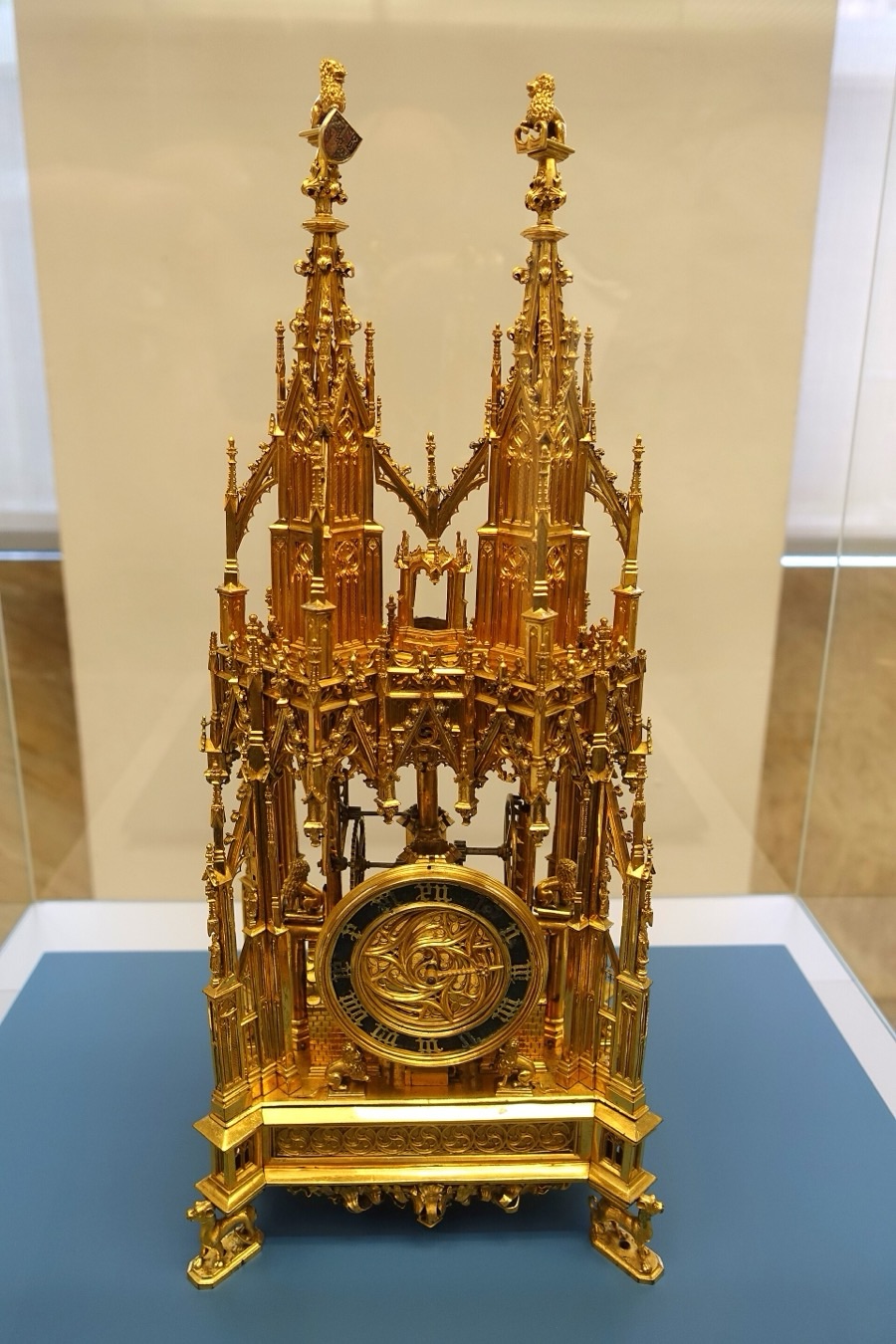
Wikipedia calls a gilt Gothic table clock in the Germanisches Nationalmuseum the oldest surviving spring-driven clock; it is dated about 1430 to 1440 by the arms of Philip the Good, Duke of Burgundy. Its maker is unknown and its history can be traced back no further than 1835, which once raised doubts about its authenticity; the museum bought it in 1943.2, 11, 37
A spring pulls hard when wound and weakly when nearly run down, and early timekeepers slowed as it unwound. Two answers appeared: the fusee, a cone-shaped pulley that evens out the pull, and the stackfreed, a spring-loaded cam used in some German clocks and watches.11, 38, 39
When the fusee arrived is disputed. The 1911 Britannica dates its invention to about 1525 to 1540, and it is often credited to Jacob Zech of Prague, whose clock of 1525 has the earliest dated fusee; modern accounts point to a crossbow windlass drawn in 1405 and to the Burgundy clock of about 1430.11, 39
Portable clocks were already wanted at court before 1500. In 1481 Louis XI of France paid the clockmaker Jean de Paris for a striking clock with a dial that the king took everywhere with him, and in 1506 a Milanese nobleman, Galeazzo di Sanseverino, ordered a clock with an alarm from Nuremberg through Willibald Pirckheimer.3
Part 3
Nuremberg and Augsburg: watches to wear
According to Wikipedia and the Walters Art Museum, the first timepieces worn on the body were made in the 16th century, in the south German cities of Nuremberg and Augsburg. They were halfway between clocks and watches in size, and hung from a chain round the neck or from the clothes rather than sitting in a pocket.20, 21, 40
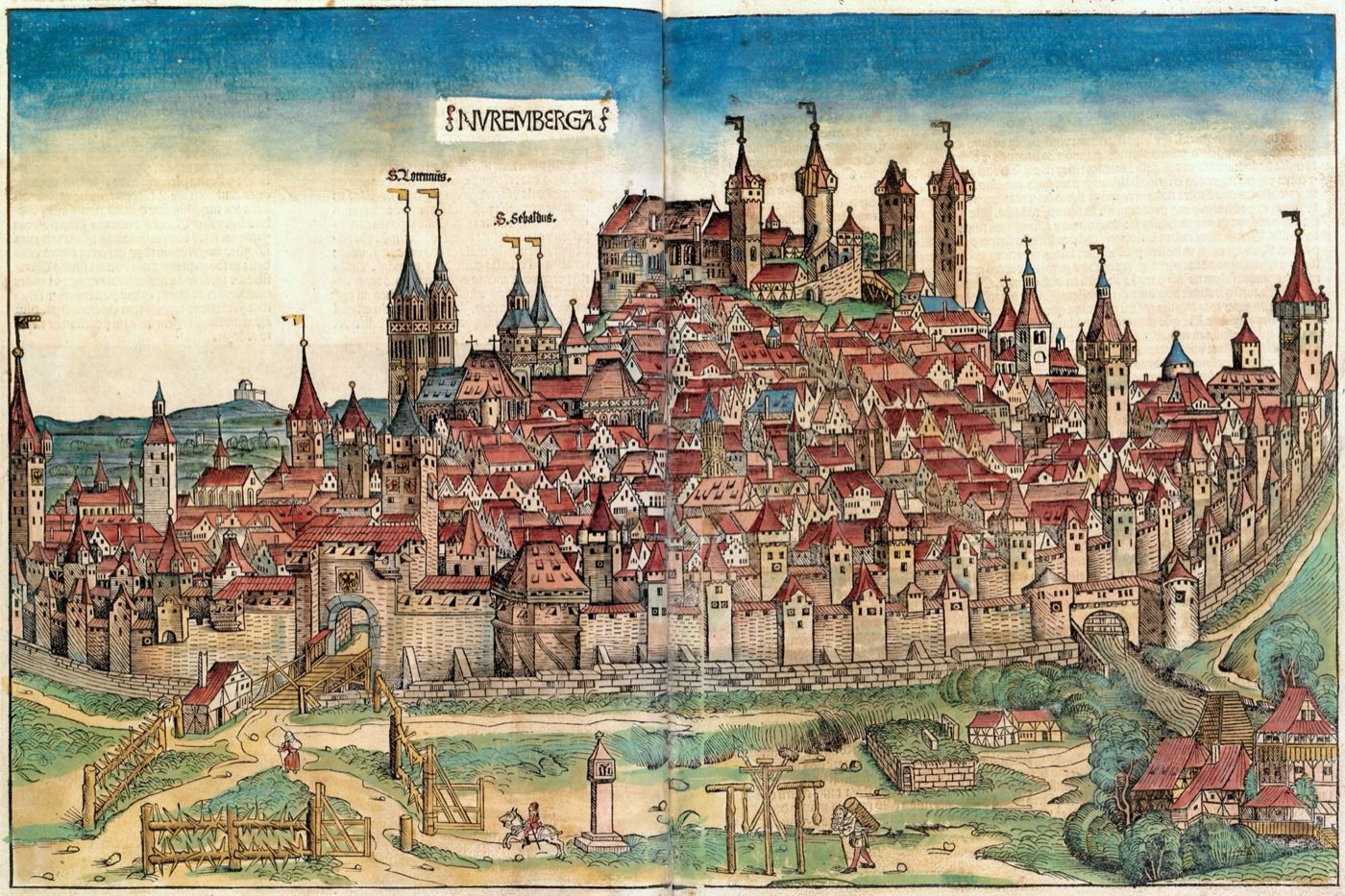
A written witness from his own time is the humanist Johannes Cochlaeus, whose praise of Nuremberg (1511, printed 1512) names the young locksmith Peter Henlein as making small iron clocks with many wheels that ran for forty hours without a weight, even when carried at the breast or in a purse.3, 12, 42
Henlein was not alone. The Germanisches Nationalmuseum names other Nuremberg makers of his time: Ludwig Gerung, a clockmaker citizen from 1469; Jörg Heuß, who built the Männleinlaufen figure clock on the Frauenkirche in 1509; Jakob Bulmann; Andreas Osterberger, who exported clocks to Königsberg; and Caspar Werner, a master from 1528 to whom a neck watch in the Patek Philippe Museum is attributed.3
The trade was slow to gain its own name: the Germanisches Nationalmuseum finds the word 'Uhrmacher' (clockmaker) in the Nuremberg register of deaths from 1542, for Henlein himself, and within about a decade the title was common.3
Augsburg made watches as early as Nuremberg. A drum watch in the Walters Art Museum from about 1520 to 1550 has an all-iron movement stamped with a pinecone, the Augsburg mark; the museum notes that it is not clear whether watches began as drums or as balls.20, 21
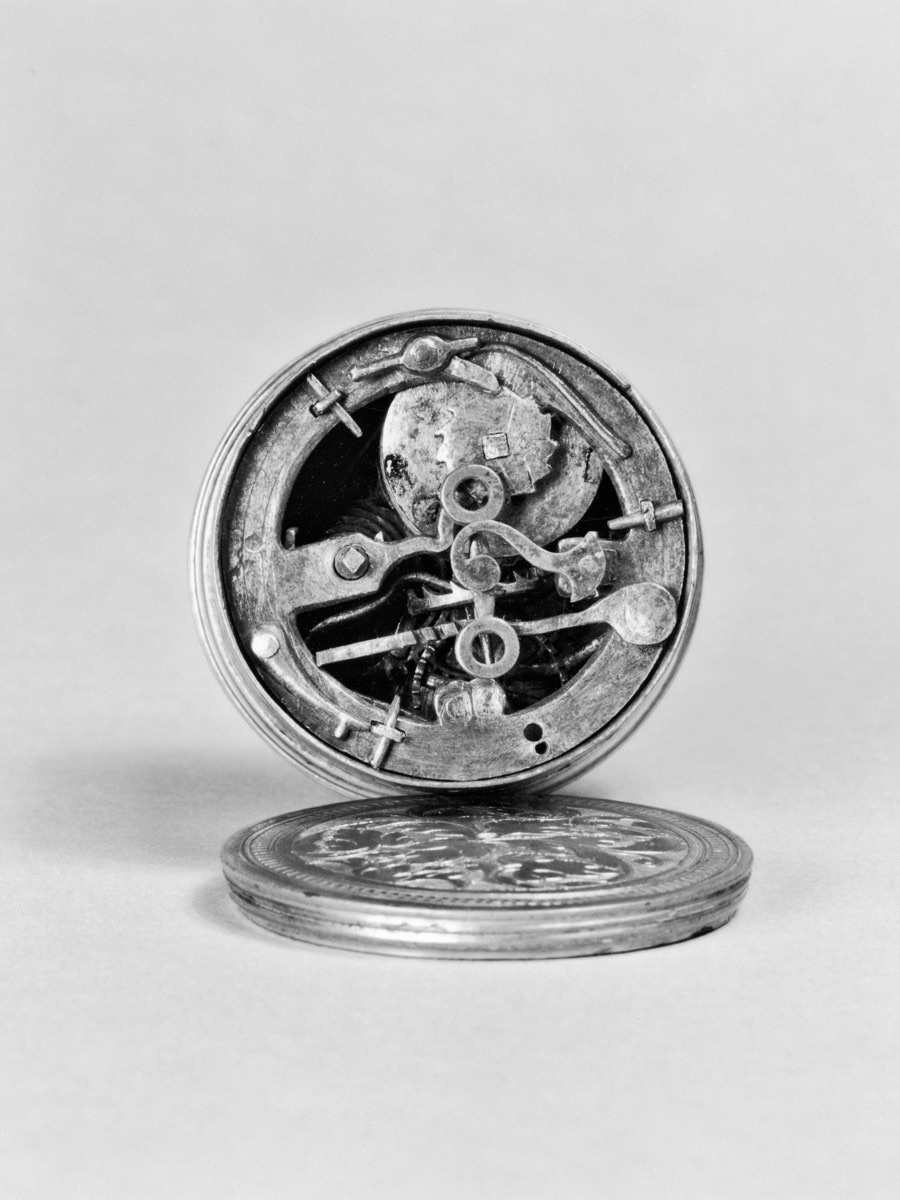
Some early watches were built into pomanders, the perforated balls in which the wealthy carried scent. Nuremberg records show Henlein paid 15 gulden on 11 January 1524 for a gilded pomander with a clock; a handful of such pomander watches survive.42, 44, 45
Within a generation small clocks were made all over Europe. The museum's historian Thomas Eser writes that by about 1530 mobile small clocks had spread across Europe, so no single city could claim to be their sole birthplace.3, 46
Part 4
Which is the oldest watch?
The earliest watch with a firm date is a gilt spherical watch engraved with the name of the reformer Philip Melanchthon and the year 1530, in the Walters Art Museum, Baltimore. The museum calls it the earliest dated watch known; it carries no maker's mark and the museum gives its origin as Augsburg with a question mark, while others attribute it to Henlein.5, 13, 45
The Germanisches Nationalmuseum's famous 'Henlein watch', a drum watch signed 'Petrus Hele me f. Norimb. 1510' and bought in 1897, was examined with CT scans in 2013 and 2014. The museum concluded that it was put together mainly in the 19th century from older and added parts: the design belongs to Henlein's time, most of the physical parts do not, and the signature is judged a later addition.3, 46, 47
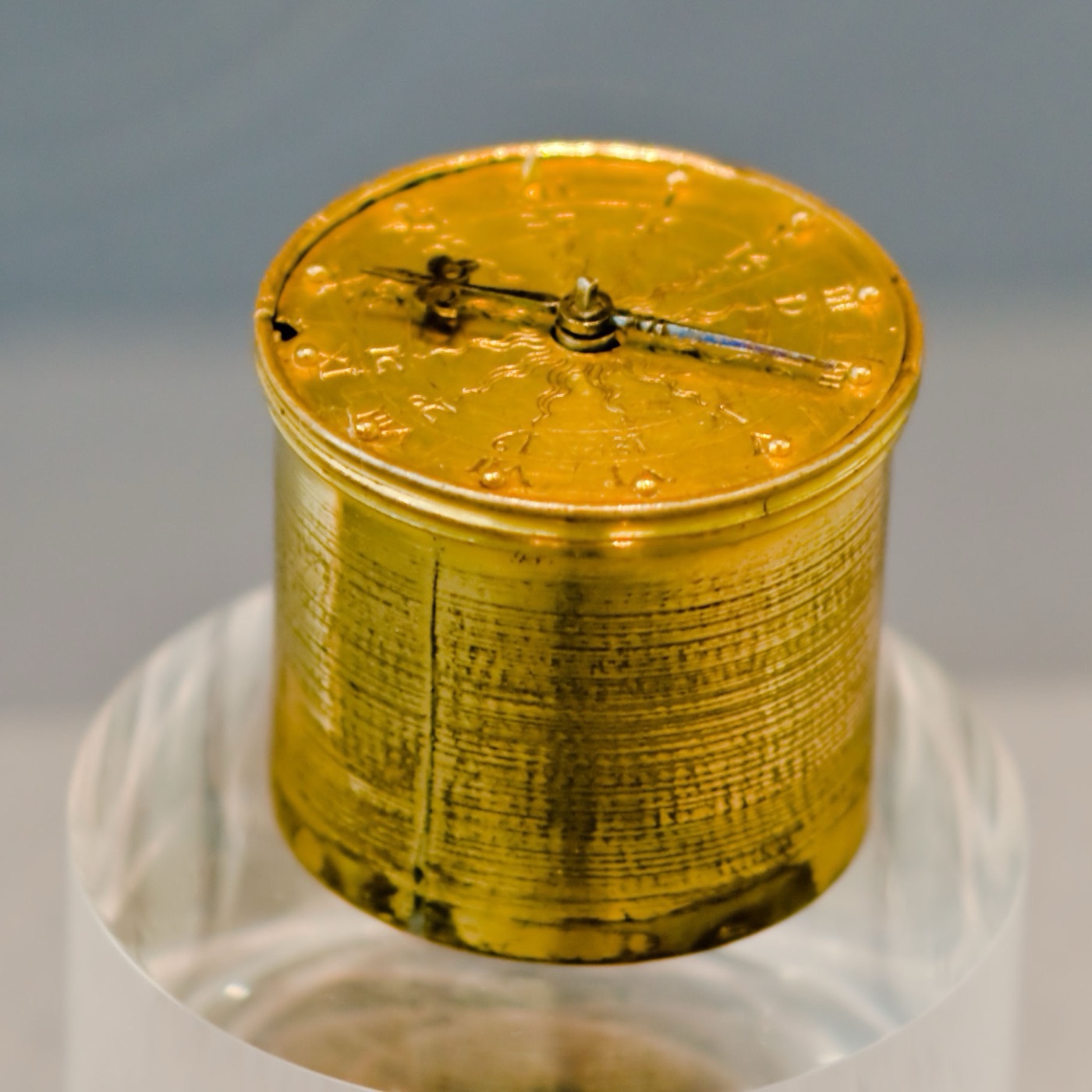
A rival claim was made for a gilt pomander watch found at a London flea market in 1987, engraved inside 'MDV PHN', which its owner's experts read as '1505, Peter Henlein Nuremberg'. They presented it in Nuremberg in December 2014 as Henlein's work of 1505, but their findings have not been generally accepted.4, 13
Henlein's fame as the inventor is largely a later creation. The Walhalla hall of fame named him 'inventor of the pocket watch' in 1842; a 19th-century novel by Karl Spindler made him a popular figure; German watchmakers raised a fountain to him in Nuremberg in 1905; and the 1939 film 'Das unsterbliche Herz' made him a national hero.3, 12, 42
The 'Nuremberg egg' is a misnomer, though accounts differ on its origin. Wikipedia derives 'Eierlein' from 'Ührlein' (little clock) through Johann Fischart's 1571 translation of Rabelais; the Germanisches Nationalmuseum calls it a mistranslation of a Rabelais passage that has nothing to do with 16th-century clock types. Oval watches became popular only from about 1580, long after Henlein's death.3, 35, 44
Part 5
Jewels that told the time
Early watches were drum-shaped brass boxes with one hand for the hours, iron movements held together by pins and wedges, and pierced lids so the time could be read without opening them; many also struck the hours or had an alarm.3, 21, 40
A 'clock-watch' struck the hours like a clock. Museum examples include a German table clock-watch by a maker signing 'A. K.' from about 1560 and a rock-crystal clock-watch of about 1590, both in the Metropolitan Museum.49, 50
Watches were luxury and display objects before they were instruments. Cases were shaped as crosses, books, shells, flowers and skulls, cut from rock crystal or enamelled, and Elizabeth I of England was given jewelled watches; one from Robert Dudley in 1571 was described as an 'armed watch' for the wrist.20, 39, 40, 51, 52
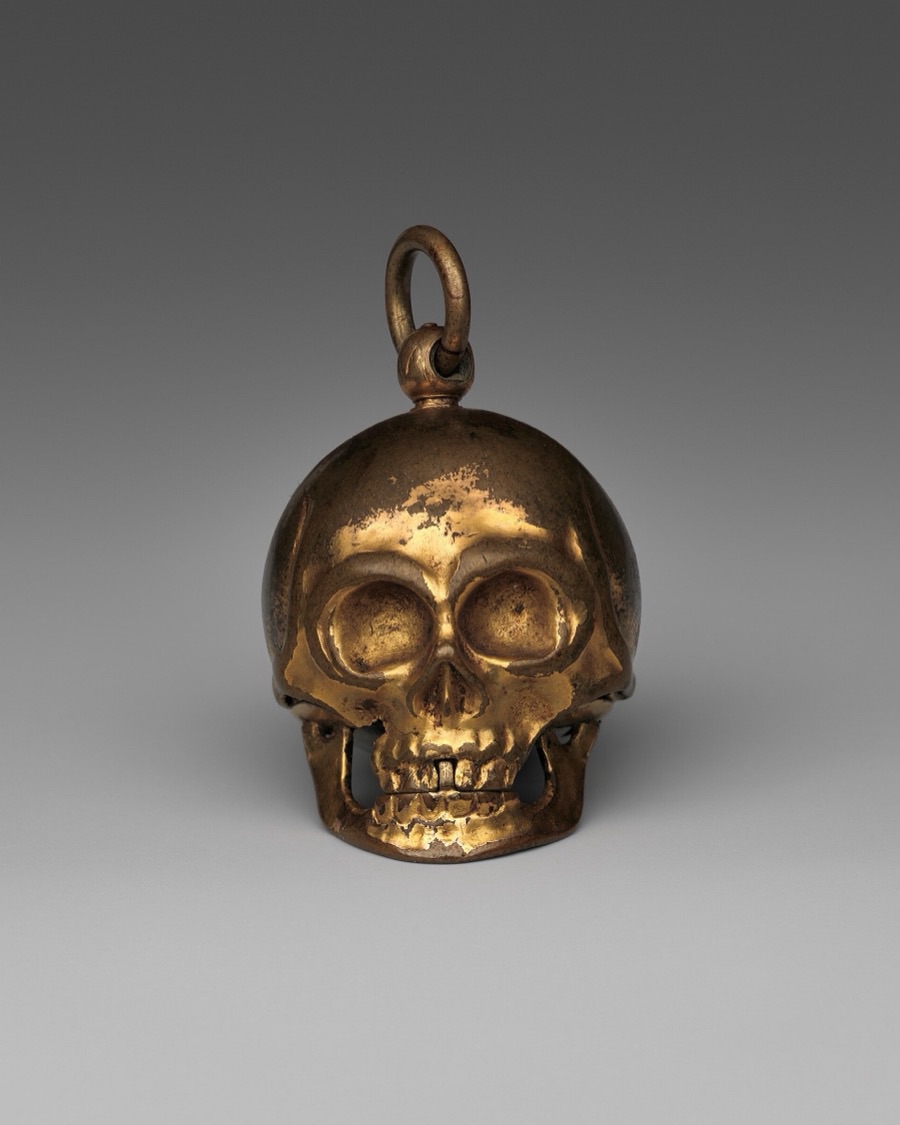
Wikipedia says watches moved slowly from neck to pocket: glass over the dial came in about 1610, and men began to carry watches in pockets after Charles II introduced the waistcoat in 1675.40
Part 6
Blois, Geneva and London
In France the court set the fashion. Blois, a royal residence under Louis XII, became a watchmaking centre whose makers had royal patronage and rivalled Paris in their movements, engraving and enamel; Nicolas Lemaindre signed a carriage watch 'A Blois' in 1630 and served the queen mother, Marie de Médicis.14, 15, 54
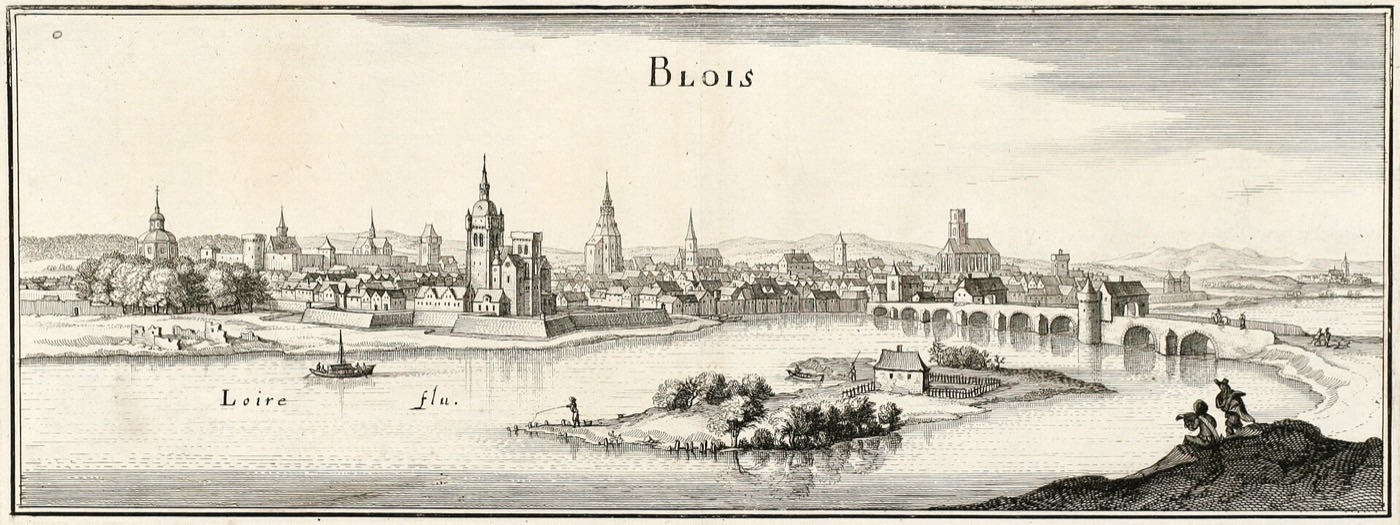
According to French Wikipedia, Blois's makers were tied to other countries: the Cuper family, Protestants who worked in Blois from 1553, descended from a German, Barthélemy Cuper; by 1637 one son worked in Constantinople and another, Josias, in London, and a daughter married a watchmaker from Geneva.56
Geneva's watch trade began with refugees. From about 1550 Huguenots fleeing France brought portable watchmaking to Geneva, where Calvin's rules against display had turned goldsmiths toward watch cases; a French 'orologeur' is recorded there in 1554, and the watchmakers formed their own guild in 1601.6, 16
In England, according to the Clockmakers' Company, smaller clocks and watches before 1600 were imported or made by immigrants in London. Henry VIII's clock 'deviser' was the Bavarian Nicholas Kratzer, and the Frenchman Nicholas Oursiau was clockmaker to Mary and Elizabeth I.7, 17, 57
Bartholomew Newsam, probably born in York, served Elizabeth I as clockmaker and seems to have been the first Englishman made royal clock-keeper; he left a 'cristall Jewell with a watch in it' in his will and died in 1593. The sources disagree on when he took office: the Dictionary of National Biography says before 1582, the Victoria County History says 1590.17, 58, 59
London makers organised against foreign competition. In 1622 a group including Robert Grinkin petitioned James I for a company of their own, and was refused; on 22 August 1631 Charles I chartered the Clockmakers' Company, with David Ramsay, former chief clockmaker to James I, as its founding Master.7, 60, 61
Part 7
Poor timekeepers, and what came next
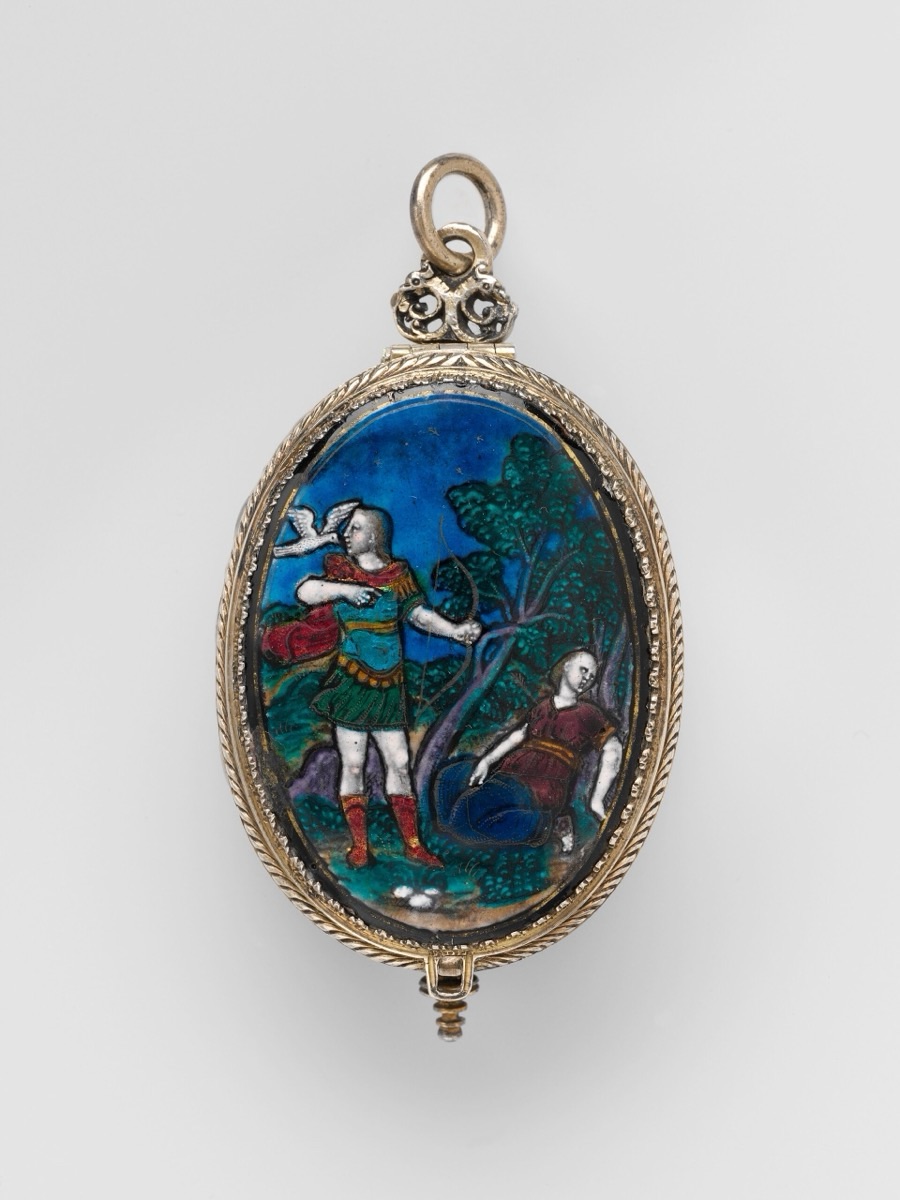
These watches were poor timekeepers. Their balance had no spring of its own, so its swing depended on the force of the mainspring. How poor is disputed: the Walters Art Museum says its 1530 watch told the time to the nearest half hour, while Wikipedia speaks of errors of several hours a day before the balance spring.5, 20, 39
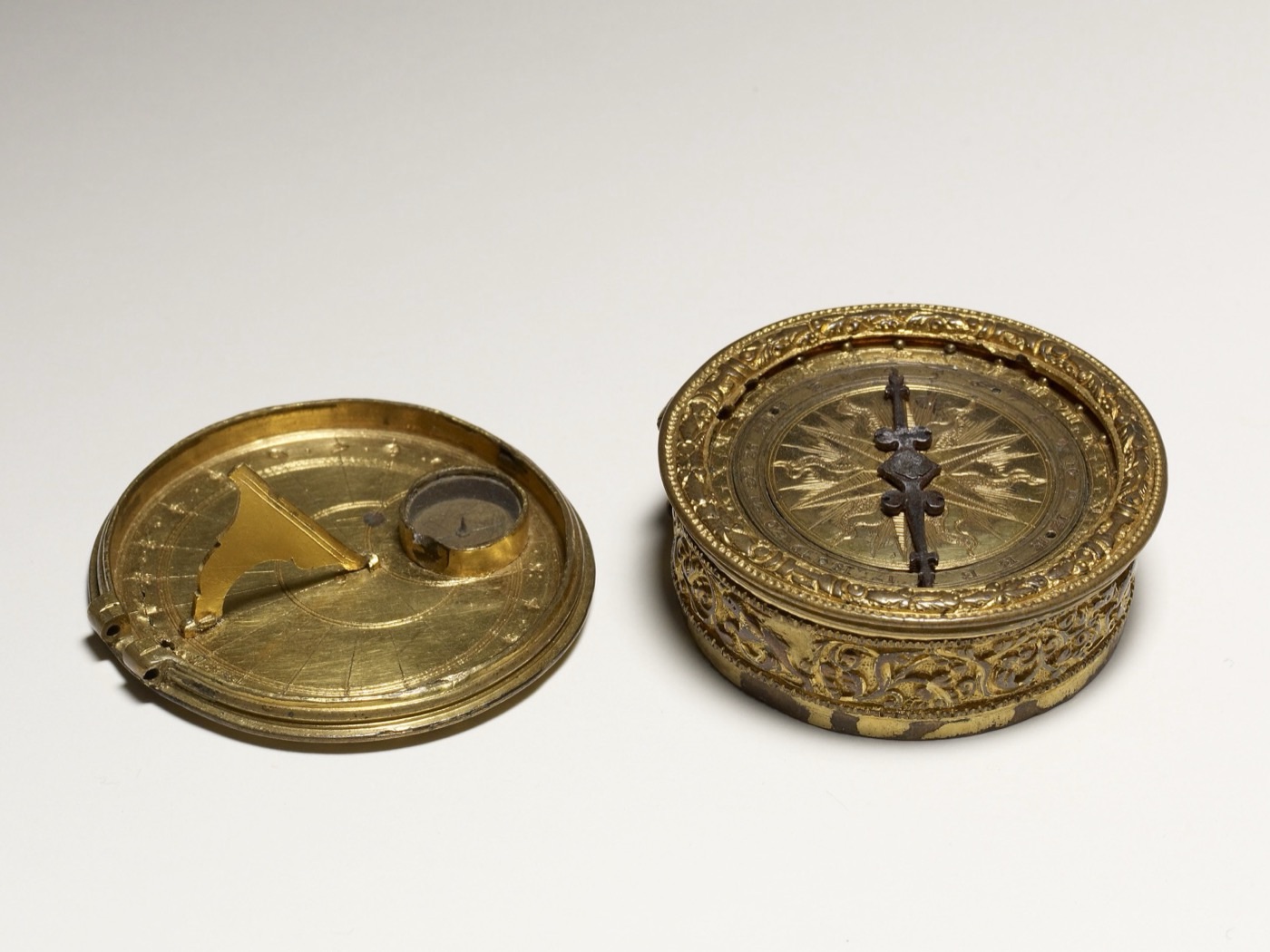
Owners reset them from the sun. A drum watch made in Augsburg by Christoph Schissler about 1550 to 1570 carries its own sundial, which the Walters Art Museum calls far more accurate and usable to reset the watch.63
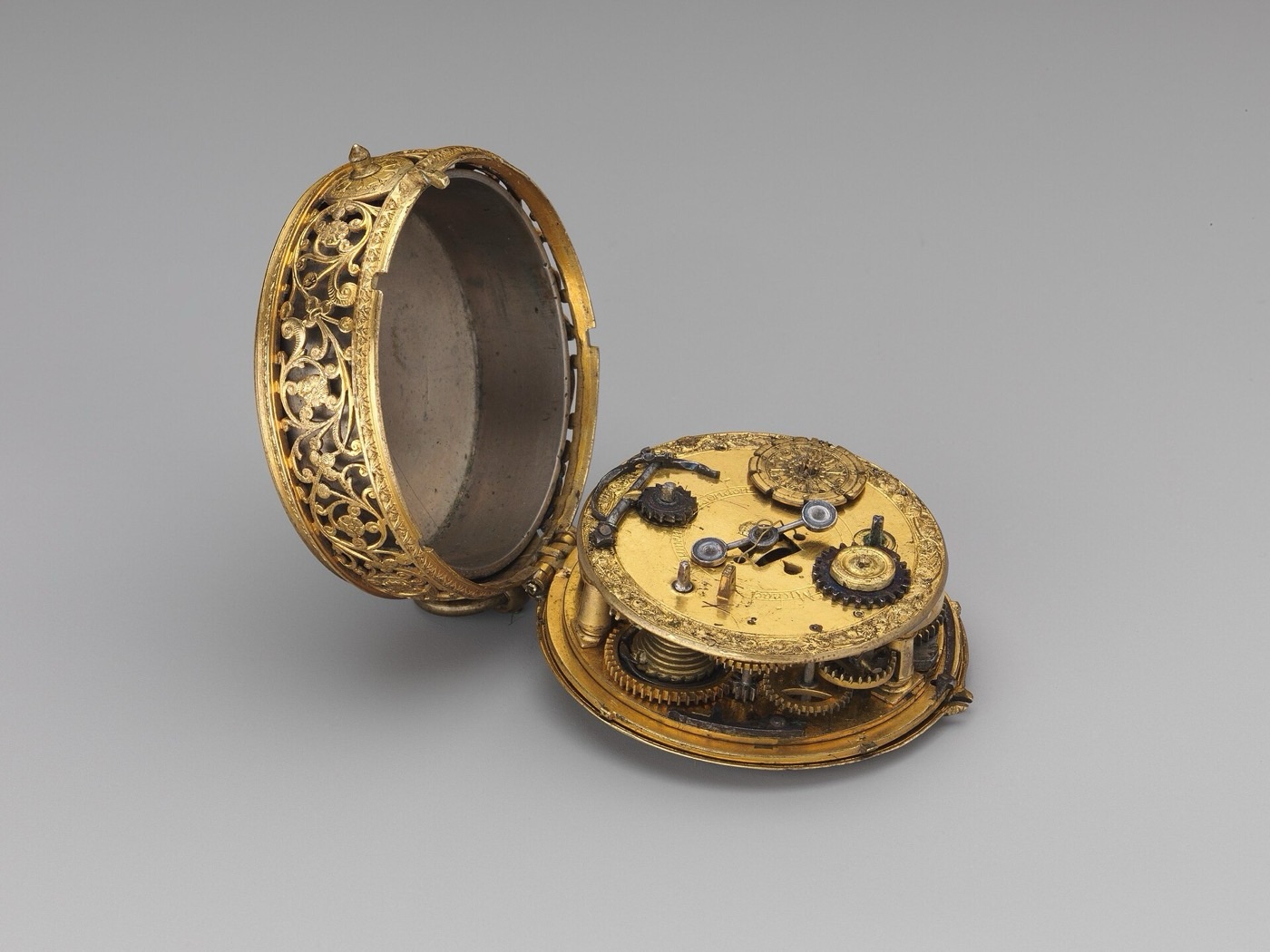
A century on, the design was much the same: London watches of about 1600-1620 by Michael Nouwen and Robert Grinkin still had a single hand, and Grinkin's has a verge escapement and a fusee driven by gut.60, 65
The change came in 1675, when a spiral spring fitted to the balance, claimed by both Christiaan Huygens and Robert Hooke, gave the watch a steady beat of its own; the National Institute of Standards and Technology puts the result at about ten minutes a day, and the minute hand followed.8, 18, 20
The centres of the trade changed places. Blois declined after the court left: it had 47 master watchmakers in 1639, 38 in 1670 and 17 in 1686, after the Revocation of the Edict of Nantes drove out Protestant families. Huguenot watchmakers of these years settled in Geneva and in Soho, London.15, 16, 17
Through this history
The companies, people, technologies, objects and events this chapter is made of, in the order the story meets them.
Technology
The verge escapementThe escapement of the tower clocks of about 1300, still beating in watches when the balance spring arrived in 1675.1, 10
Technology
The mainspring and fuseeThe coiled spring that replaced the falling weight, and the cone-shaped pulley that evened out its pull.2, 11
Person
Peter HenleinThe Nuremberg locksmith praised for portable clocks in 1511 and made a national legend centuries later.3, 12
Object
The pomander watch of 1505A watch in a scent ball, dated 1505 and claimed for Henlein by its owner's experts, a claim not generally accepted.4, 13
Object
The Melanchthon watchThe ball watch engraved 1530, which the Walters Art Museum calls the earliest dated watch known.5
Key dates
- 1088
Su Song's water-driven clock tower at Kaifeng: wooden pilot model (treatise written 1092, tower finished 1094).19, 26
- 1327
Richard of Wallingford, abbot of St Albans, describes his astronomical clock.24, 30
- 1344
Equal hours struck by a public clock recorded at Padua; Jacopo Dondi's tower clock.29, 31
- 1430
Spring-driven table clock for Philip the Good of Burgundy (c.1430-1440).2, 37
- 1481
Louis XI pays Jean de Paris for a striking clock to carry everywhere.3
- 1505
Date read on a pomander watch by its owner's experts, who attribute it to Henlein; not generally accepted.4, 13
- 1511
Cochlaeus praises Henlein's small clocks that run forty hours.3, 12
- 1530
Melanchthon's watch is engraved with this year.5, 45
- 1542
Death of Peter Henlein, called 'Uhrmacher' in Nuremberg's death register.3, 42
- 1601
Geneva's watchmakers form their guild (maîtrise).6, 16
- 1631
Charles I charters the Clockmakers' Company of London (22 August).7, 61
- 1675
A spiral spring fitted to the balance gives the watch a steady beat of its own.8, 18
Where this leads
- After, Era IIThe balance spring and the age of precision
1675 to 1800
Where Time in the pocket leads
- Led to, HistoryThe balance spring and the age of precision
The balance spring of 1675 gave the watch the steady beat that earlier watches lacked.8, 18
- In this story, PlaceAugsburg
With Nuremberg, the south German city where the first watches worn on the body were made, by the Walters Art Museum's account; its watches carry a pinecone mark.20, 21
Facts and sources
- Period
- c.1500 to 1675 (with a prologue from about 1300)1, 20
- Where
- Nuremberg and Augsburg, then Blois, Paris, Geneva and London6, 7, 14, 20
- Key techniques
- Mainspring, verge escapement with balance or foliot, fusee and stackfreed2, 39
- Earliest dated watch
- Melanchthon's watch, 1530 (Walters Art Museum); older claims (1505, 1510) disputed3, 4, 5
Sources
- 1
- 2
- 3
- 4
Is This The World's Oldest Known Watch? A Peter Henlein Mystery From 1505 (opens in a new tab)
- 5
Spherical Table Watch (Melanchthon's Watch), 1530 (Walters 58.17) (opens in a new tab)
- 6
Horlogerie (Estelle Fallet, Béatrice Veyrassat) (opens in a new tab)
- 7
- 8
A Walk Through Time - A Revolution in Timekeeping (opens in a new tab)
- 9
- 10
- 11
- 12
- 13
- 14
Carriage watch, Nicolas Lemaindre, Blois, 1630 (2366-1855) (opens in a new tab)
- 15
- 16
- 17
- 18
- 19
- 20
- 21
Portable Drum Watch, Augsburg, ca. 1520-1550 (Walters 58.68) (opens in a new tab)
- 22
- 23
- 24
Clock (Encyclopædia Britannica, 11th edition, 1911) (opens in a new tab)
- 25
- 26
- 27
- 28
History of the Hour: Clocks and Modern Temporal Orders (review) (opens in a new tab)
- 29
- 30
- 31
- 32
- 33
- 34
- 35
- 36
- 37
Standuhr Herzog Philipps des Guten von Burgund (opens in a new tab)
- 38
- 39
Watch (Encyclopaedia Britannica, 11th edition, 1911) (opens in a new tab)
- 40
- 41
Nuremberg in the Nuremberg Chronicle, printed in the city in 1493. (opens in a new tab)
- 42
- 43
- 44
- 45
- 46
- 47
Scientific instruments and the history of medicine (opens in a new tab)
- 48
- 49
Table clock-watch, 'A. K.', 16th century (17.190.1538) (opens in a new tab)
- 50
- 51
Watch, Pierre Landré, ca. 1630-40 (17.190.1574) (opens in a new tab)
- 52
Watch, Nicolaus Rugendas the Elder, ca. 1620 (17.190.1519) (opens in a new tab)
- 53
- 54
- 55
- 56
- 57
- 58
Newsam, Bartholomew (Dictionary of National Biography, vol. 40, 1894) (opens in a new tab)
- 59
- 60
Watch, Robert Grinkin, London, ca. 1610-1620 (M.3-2003) (opens in a new tab)
- 61
- 62
- 63
Portable Drum Watch, Christoph Schissler, Augsburg, 1550-1570 (Walters 58.70) (opens in a new tab)
- 64
- 65
Clock watch, Michael Nouwen, London, ca. 1600-1610 (17.190.1549) (opens in a new tab)
- 66
Sources read November 12, 2026.