The mainspring and fusee
How a coiled spring replaced the falling weight in the 15th century and made clocks small enough to carry, and how the fusee, a cone-shaped pulley, and the German stackfreed evened out its pull as it ran down.
Introduced Mainspring in clocks: 15th century (a spring-driven clock survives from about 1430); fusee: 15th century, dating disputed, Fusee into the 20th century in marine chronometers; stackfreed about 1530 to 1640
In the history Time in the pocket
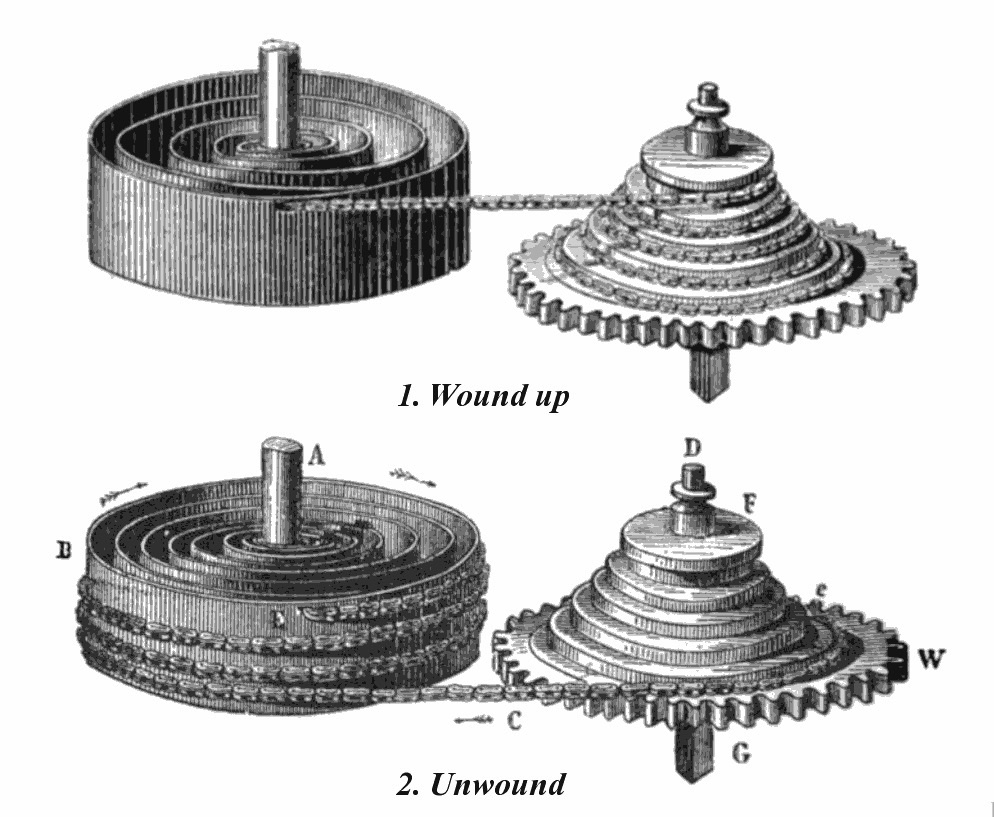
A spring instead of a weight
Before springs, clocks were driven by a weight on a cord. Coiled springs appear in locks around 1400, and clockmakers, many of them locksmiths, used them to make smaller clocks that could be moved.1, 6
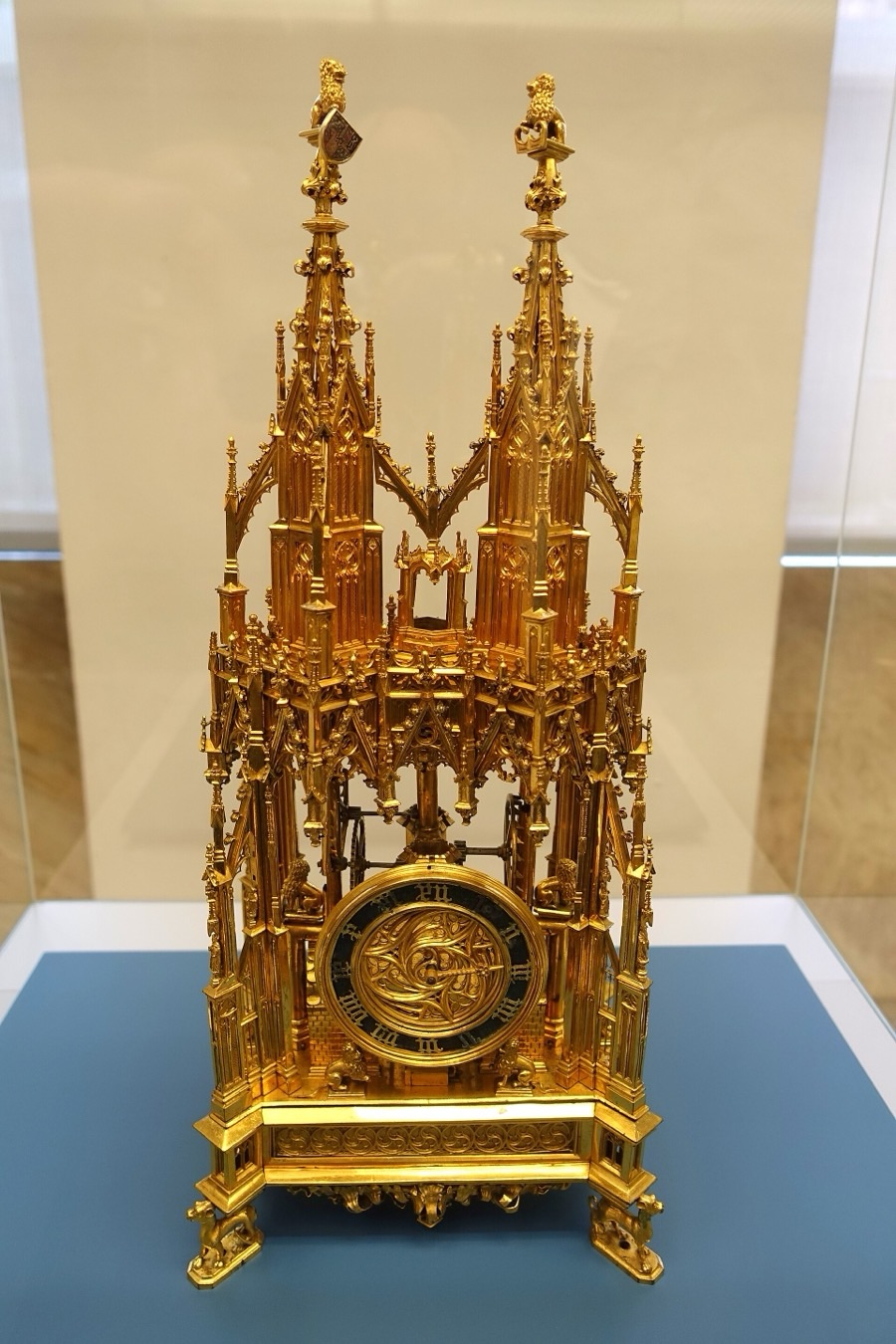
15th-century sources mention portable clocks 'without weights', and Wikipedia calls the gilt table clock made for Philip the Good of Burgundy about 1430 to 1440, now in the Germanisches Nationalmuseum, the oldest surviving spring-driven clock.1, 7
Peter Henlein is often credited with the mainspring, but springs drove clocks before he was born; what Cochlaeus praised in 1511 was his small clocks running for about forty hours.1, 9, 10
Wikipedia says early mainsprings were of untempered steel and ran for a short time; some watches had to be wound twice a day.1
The fusee
A spring's pull weakens as it unwinds, and an early clock or watch slowed with it. The fusee answers this: the spring barrel pulls a cord or chain wound on a cone-shaped pulley, and as the spring weakens the cord works on a wider part of the cone.2, 4
The fusee's origin is unknown. It appears on a crossbow windlass drawn in 1405 and in drawings by Brunelleschi and Leonardo; the Burgundy clock has one; and the earliest dated fusee clock is by Jacob Zech of Prague, 1525, though he is wrongly called its inventor. The 1911 Britannica put its invention at about 1525 to 1540.2, 4
Fusee cords were first gut; chains followed. The 1911 Britannica says chains replaced gut late in the 16th century, while Wikipedia dates the first mention of a fusee chain to about 1540 and wider use to about 1650, crediting Gruet of Geneva in 1664.2, 4
The stackfreed and stopwork
German makers also used the stackfreed, a stiff spring pressing on a snail-shaped cam that held back the mainspring when it was strongest. It was easier to make and thinner than the fusee but wasted power; surviving examples date from about 1530 to 1640.3, 4, 11
Stopwork limited the spring to the middle of its range, where its force was steadiest; it was used with both devices.1, 3
In surviving watches
Surviving watches show both systems: the Germanisches Nationalmuseum's 'Henlein watch' has a fusee and chain, a Nuremberg neck watch of the Pfinzing family (about 1550-1580) has a stackfreed, and Robert Grinkin's London watch of about 1610-1620 a gut-driven fusee.11, 12
The fusee outlived the stackfreed by centuries: it remained in spring clocks and English watches into the 19th century and in marine chronometers into the 20th; the historian G. H. Baillie wrote that perhaps no mechanical problem was ever solved so simply and so perfectly.1, 2
Where the mainspring and fusee lead
- Used by, ObjectThe pomander watch of 1505
The 1505 watch is described with a fusee and chain; all early watches were spring-driven.1, 13
- Part of, HistoryTime in the pocket
The coiled spring that replaced the falling weight, and the cone-shaped pulley that evened out its pull.1, 2
- See also, PersonPeter Henlein
Popular accounts credit Henlein with the mainspring, which drove clocks before he was born.1, 9, 10
Facts and sources
- Introduced
- Mainspring in clocks: 15th century (a spring-driven clock survives from about 1430); fusee: 15th century, dating disputed1, 2, 4, 7
- In use
- Fusee into the 20th century in marine chronometers; stackfreed about 1530 to 16401, 2, 3
Sources
- 1
- 2
- 3
- 4
Watch (Encyclopaedia Britannica, 11th edition, 1911) (opens in a new tab)
- 5
- 6
- 7
Standuhr Herzog Philipps des Guten von Burgund (opens in a new tab)
- 8
- 9
- 10
- 11
- 12
Watch, Robert Grinkin, London, ca. 1610-1620 (M.3-2003) (opens in a new tab)
- 13
Is This The World's Oldest Known Watch? A Peter Henlein Mystery From 1505 (opens in a new tab)
Sources read November 12, 2026.