Peter Henlein
A Nuremberg locksmith, born about 1479 or 1485 and dead in 1542, who made small portable clocks praised by Johannes Cochlaeus in 1511. No surviving watch can be firmly called his, and his fame as the inventor of the pocket watch was built mostly in the 19th and 20th centuries.
Born Nuremberg, about 1479 or about 1485, Died Nuremberg, summer (between 31 May and 20 September) 1542
In the history Time in the pocket
A Nuremberg locksmith
Peter Henlein (also Hele or Henle) was a Nuremberg locksmith, the son of a brass-founder, who made small clocks and watches; little about his life is certain.1, 2
In September 1504 he was involved in a brawl in which a fellow locksmith was killed, and took sanctuary in the Franciscan friary; after a long case he became a master of the locksmiths' guild on 16 November 1509.1, 2
Johannes Cochlaeus praised him in 1511 for small iron clocks with many wheels that ran forty hours without weights and could be carried at the breast or in a purse. Whether Cochlaeus's word 'pulsant' means the watches struck the hours or simply ticked is uncertain.1, 2, 3
Nuremberg's accounts record payments to him: 15 gulden on 11 January 1524 for a gilded pomander with a clock, and in January 1525 for a 'selbgeend arologium' in a silver-gilt case.1, 5
The German Wikipedia says his customers included princes: he supplied small clocks to the ducal court of Mecklenburg at Schwerin between 1526 and 1542, and Cardinal Albrecht of Brandenburg in 1529; two of his letters, one in his own hand, were found in Schwerin after the 2014 exhibition.1
He also built large clocks: in 1541 he made a tower clock for the Nuremberg castle of Lichtenau, and he advised on the church clock at Hersbruck.1, 2
Which watches were his?
No surviving watch can be firmly called his. The Germanisches Nationalmuseum's 'Henlein watch' signed 1510 was found to be largely a 19th-century assembly; the German Wikipedia says a drum watch in the British Museum can be attributed to him with high probability, and a pomander watch dated 1505 is claimed for him by its owner's experts.1, 3, 6
He did not invent the mainspring, which was in use in clocks by about 1430, decades before his birth, though popular accounts still credit him with it.2, 7, 8
The making of a legend
Two accounts of him compete. In the German tradition he is 'the inventor of the pocket watch', named so in the Walhalla in 1842; the Germanisches Nationalmuseum and the Leibniz Association now treat his role as inventor as refuted, crediting many European workshops in the 15th and 16th centuries.2, 3, 9
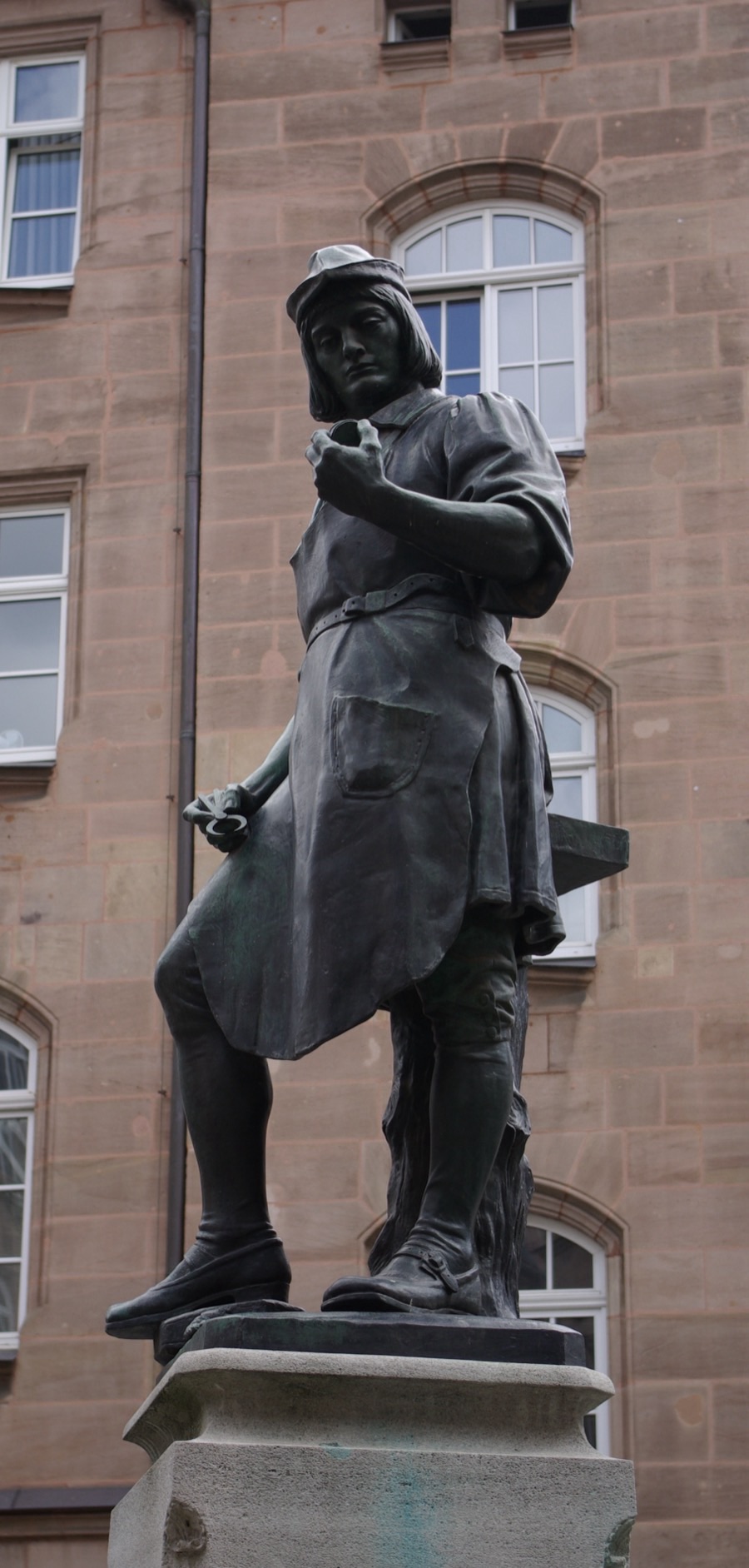
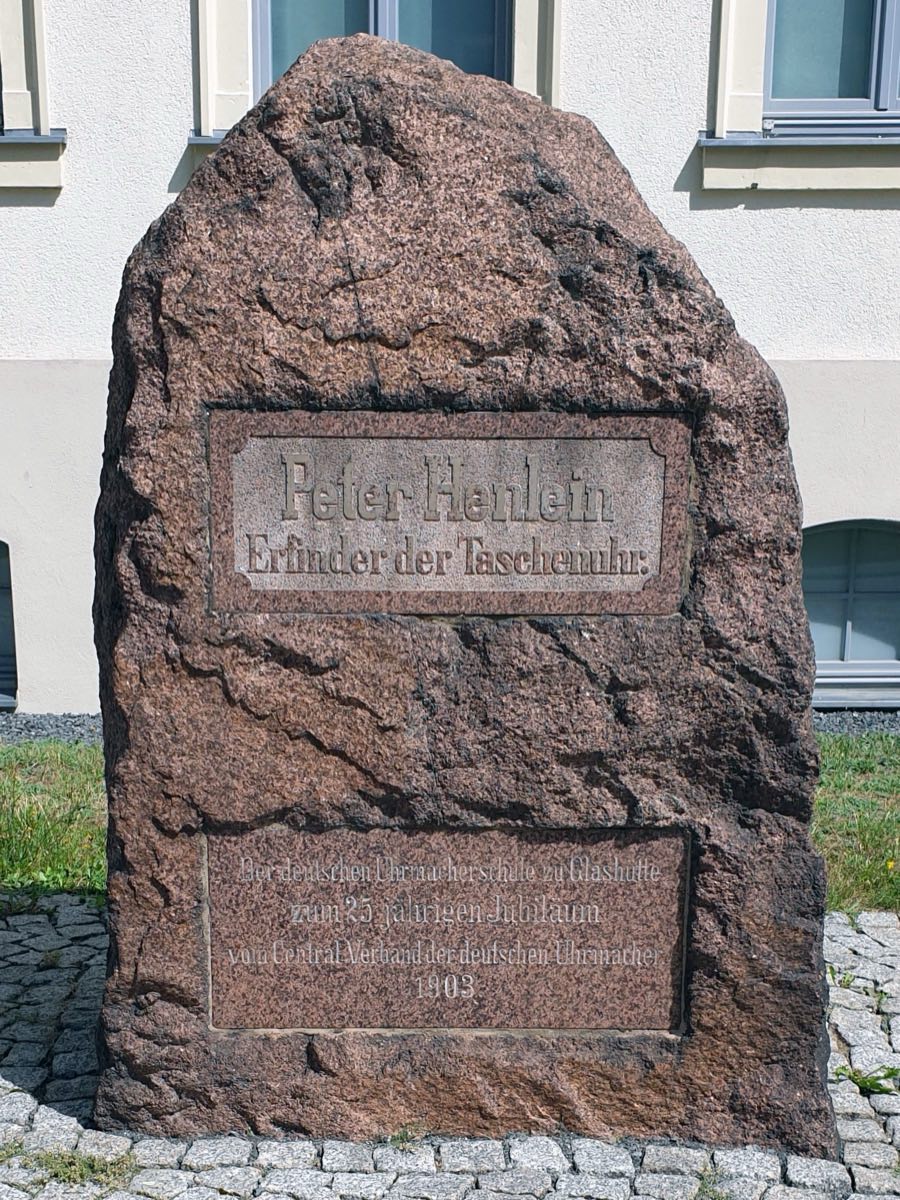
His reputation grew in the 19th century: a novel by Karl Spindler made him a hero, the engineer Franz Reuleaux called for a monument in 1898, a Henlein stone was set up before the German watchmaking school at Glashütte in 1903, and a bronze statue by Max Meißner was unveiled on a fountain in Nuremberg in 1905.1, 2, 3
The fountain statue is an imaginary portrait: no likeness of Henlein survives, which is why the Walhalla gave him an inscription and no bust.3
Under National Socialism he was used as a national figure: Veit Harlan's 1939 film 'Das unsterbliche Herz' romanticised him and Germany issued a stamp in 1942 naming him the inventor of the pocket watch.1, 2, 9
Even his birth year has been fought over: in 1979 and 1985 the Germanisches Nationalmuseum and the German watchmakers quarrelled over which anniversary to celebrate, and Jürgen Abeler of the Wuppertal clock museum published a full documentation, 'In Sachen Peter Henlein' (1980).1, 2
Key dates
- 1504
Brawl in which a locksmith is killed; Henlein takes sanctuary with the Franciscans.1, 2
- 1509
Becomes master locksmith in Nuremberg (16 November).1, 9
- 1511
Cochlaeus praises his portable clocks.2, 3
- 1524
Paid 15 gulden for a gilded pomander with a clock (11 January).1, 5
- 1541
Tower clock for Lichtenau.1, 2
- 1542
Dies in Nuremberg; recorded as 'Uhrmacher'.1, 3
- 1842
Inscription in the Walhalla as 'inventor of the pocket watch'.2, 3
- 1905
Henlein fountain unveiled in Nuremberg.1, 3
- 2014
Germanisches Nationalmuseum exhibition 'Die älteste Taschenuhr der Welt?'.3, 11
Where Peter Henlein leads
- Based in, PlaceNuremberg
Locksmith and clockmaker of Nuremberg, master from 1509.1, 9
- Part of, HistoryTime in the pocket
The Nuremberg locksmith praised for portable clocks in 1511 and made a national legend centuries later.2, 3
- See also, PlaceAugsburg
The Walters Art Museum gives Augsburg, with a question mark, as the origin of the 1530 Melanchthon watch that others attribute to Henlein.12, 13
- See also, PlaceGlashütte
A Henlein memorial stone was set up before the German watchmaking school at Glashütte in 1903.1, 3
- See also, TechnologyThe mainspring and fusee
Popular accounts credit Henlein with the mainspring, which drove clocks before he was born.2, 7, 8
- See also, ObjectThe Melanchthon watch
The Walters names no maker for the Melanchthon watch; Wikipedia says Henlein was probably commissioned to make it.12, 13
- See also, ObjectThe pomander watch of 1505
Henlein was paid for a pomander watch in 1524; the surviving pomander watch dated 1505 is attributed to him by its owner's experts.1, 6
Facts and sources
- Born
- Nuremberg, about 1479 or about 14851, 9
- Died
- Nuremberg, summer (between 31 May and 20 September) 15421, 3
Sources
- 1
- 2
- 3
- 4
- 5
- 6
Is This The World's Oldest Known Watch? A Peter Henlein Mystery From 1505 (opens in a new tab)
- 7
- 8
- 9
- 10
- 11
The Henlein pocket watch dispute (research project, March 2013 - December 2014) (opens in a new tab)
- 12
Spherical Table Watch (Melanchthon's Watch), 1530 (Walters 58.17) (opens in a new tab)
- 13
Sources read November 12, 2026.