Places

Glashütte

A small town in the eastern Ore Mountains of Saxony, south of Dresden, where watchmaking began in 1845 as a state-backed answer to the decline of mining. Its firms were merged under East Germany and refounded after 1990, and since 2022 German law has protected its name on watches.

Germany (Saxony)

Companies here A. Lange & Söhne, Glashütte Original, Moritz Grossmann, Mühle-Glashütte, Nomos Glashütte, Sinn, Tutima

In the history German watchmaking
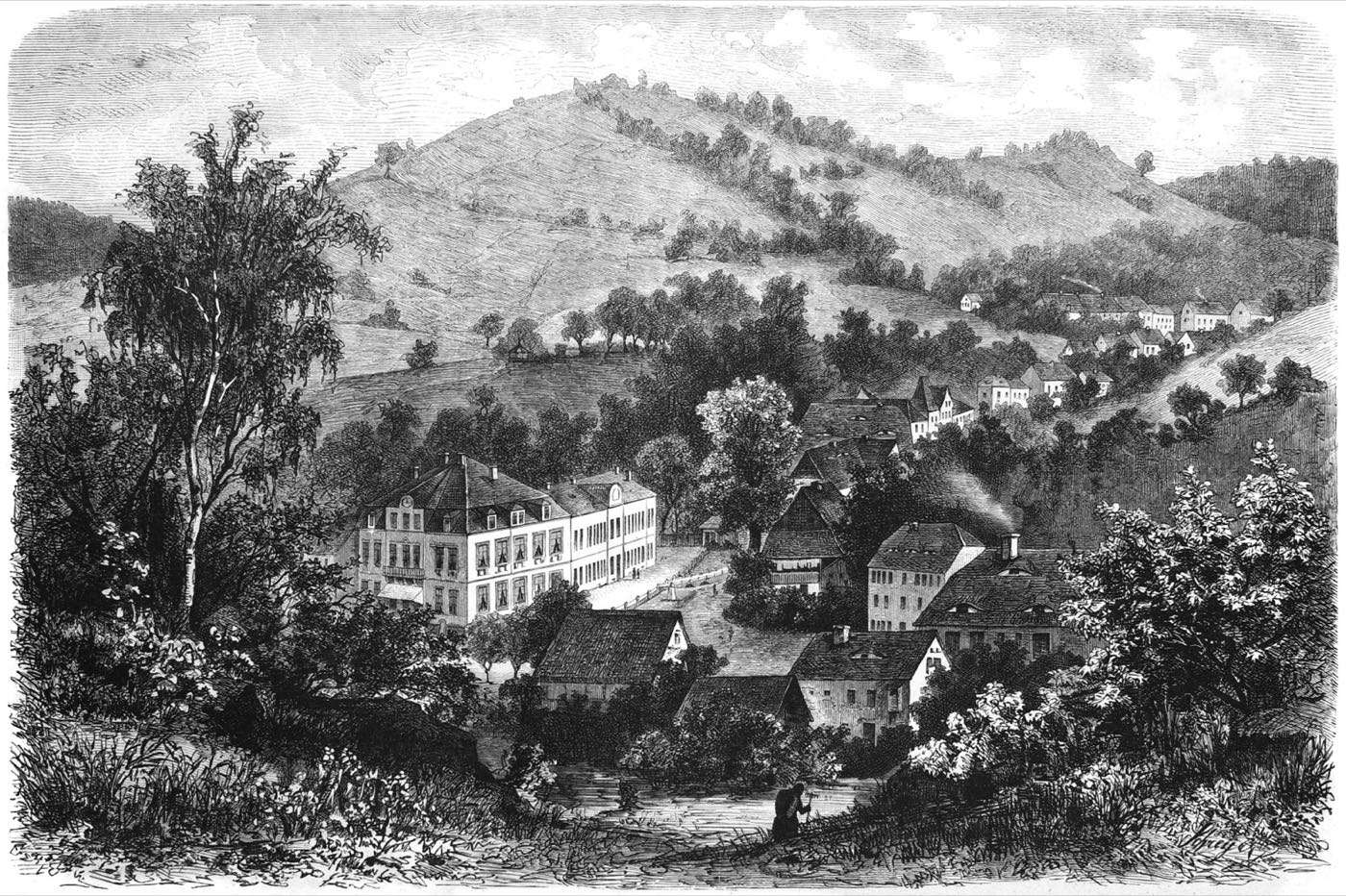
An engraving of a small town in a wooded valley: a large three-storey building with a clock gable among smaller houses and trees, a smoking chimney, and a steep hill behind with farmland on its slopes.
Glashütte in the Ore Mountains, drawn from life by Franz Schreyer and published in Die Gartenlaube in 1879.6 Engraving: Franz Schreyer, Die Gartenlaube, 1879. View full original at Wikimedia Commons (opens in a new tab) · 3,456 × 2,300 px; Public domain (opens in a new tab).

From silver mining to watchmaking

Glashütte appears in records from the middle of the fifteenth century, when silver drew people to the valley where the Müglitz and Prießnitz meet, and it received mining and town rights in 1506. As mining declined, poverty followed, and in the early 1840s the Saxon government looked for people who would bring new industry to the Ore Mountains.1, 5
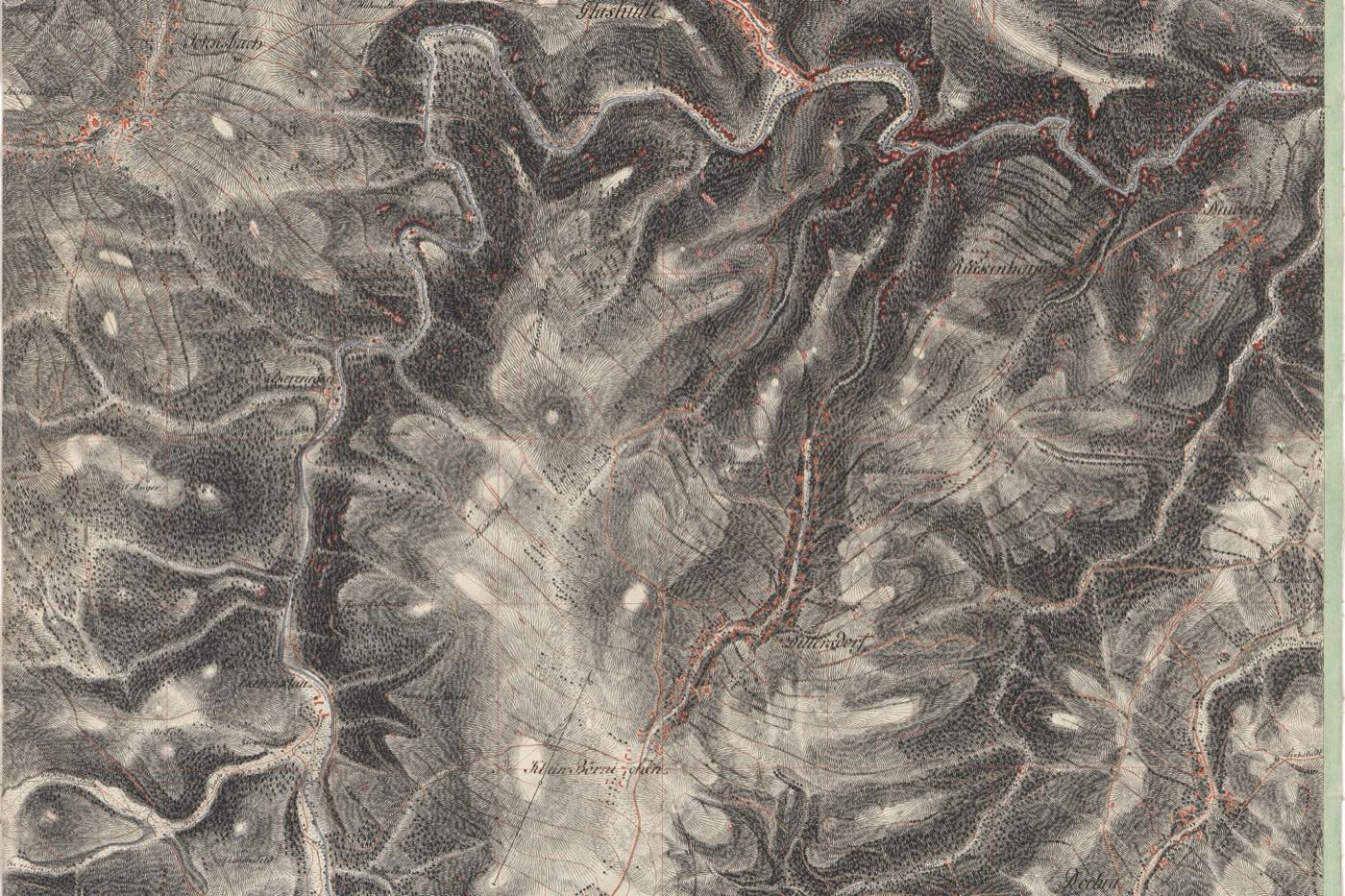
A hand-drawn survey map in grey hachures showing a river winding through steep, deeply cut valleys, with settlements marked in red and small handwritten place names.
Glashütte and the Müglitz valley on sheet 317 of the Saxon mile-sheet survey, drawn by the army engineers under Friedrich Ludwig Aster around 1784. The town lies at the river bend near the top.7 Map: Saxon engineer corps, SLUB Dresden / Deutsche Fotothek. Cropped here. View full original at Wikimedia Commons (opens in a new tab) · 9,000 × 8,990 px; Public domain (opens in a new tab).

The Dresden watchmaker Ferdinand Adolph Lange answered with a plan for watchmaking. With a state loan to train apprentices, he began making pocket watches in Glashütte with fifteen of them on December 7, 1845, the start of A. Lange & Söhne.1, 2, 3
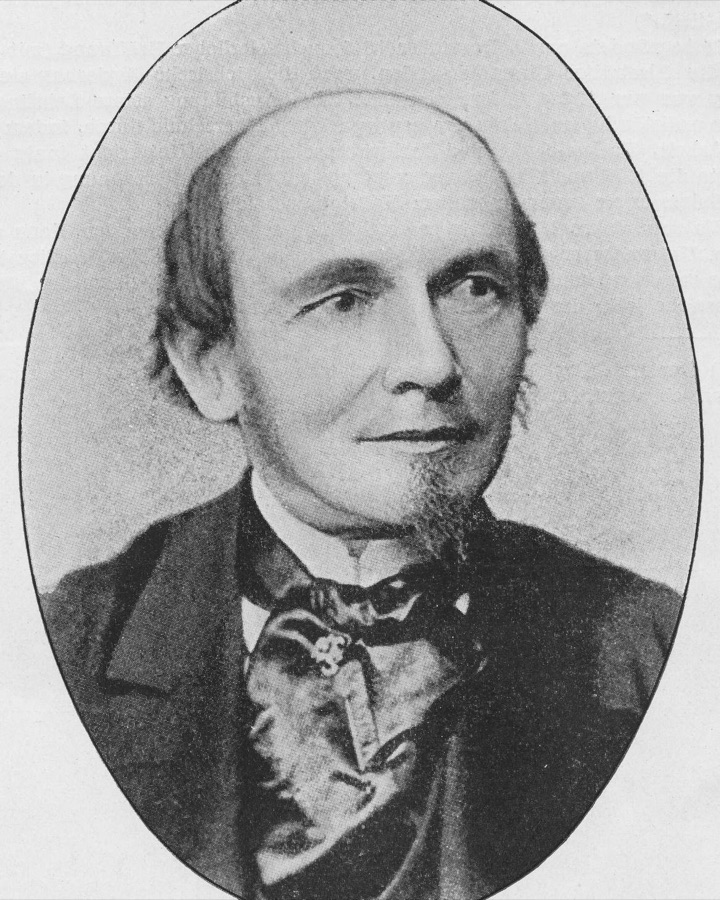
An oval photograph of a balding man with a goatee, in a dark coat and a cravat with a pin.
Ferdinand Adolph Lange, in a photograph reproduced in a book of 1910.8 Photograph: unknown, reproduced in C. Dietzschold, 1910. Cropped here. View full original at Wikimedia Commons (opens in a new tab) · 1,169 × 1,600 px; Public domain (opens in a new tab).
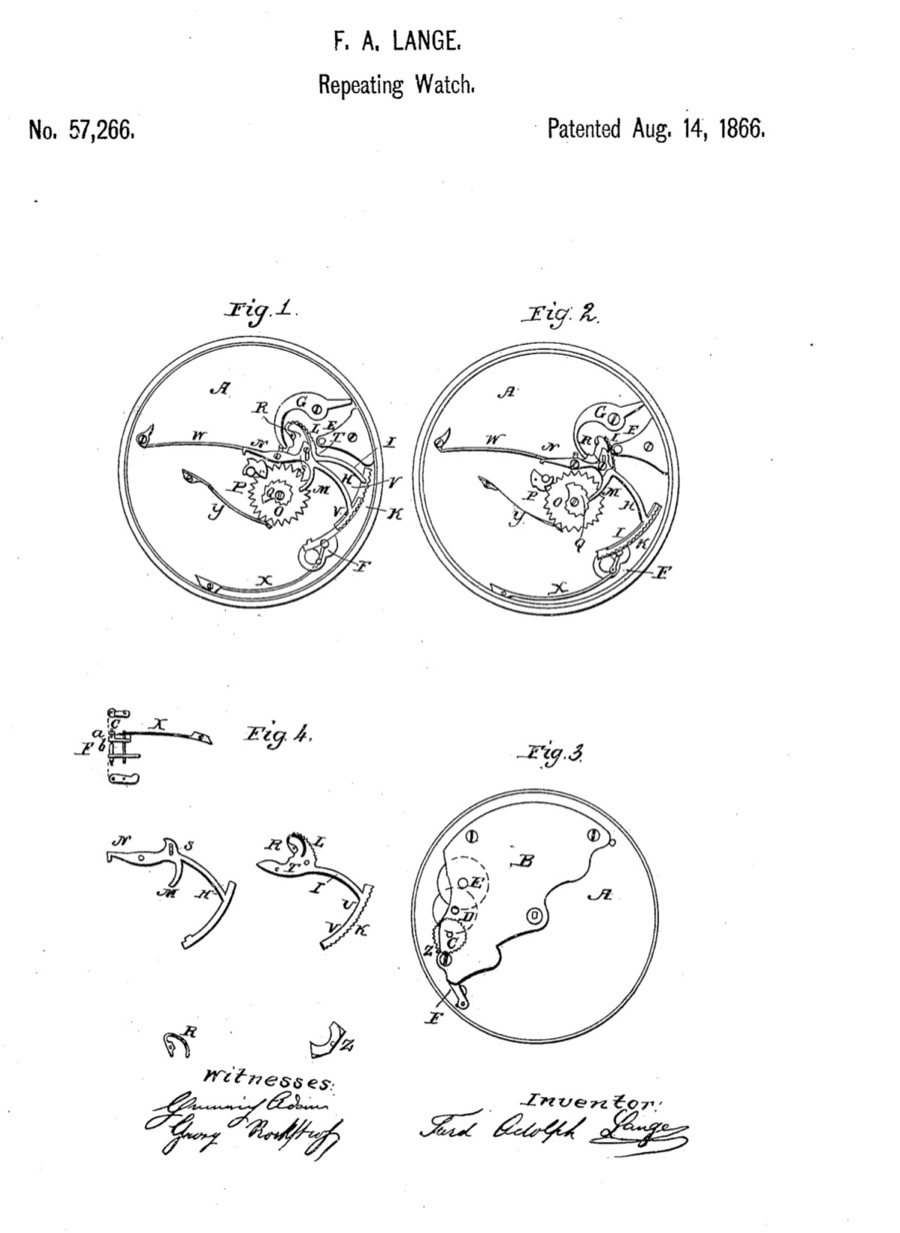
A patent drawing headed F. A. Lange, Repeating Watch: three round watch plates with levers and wheels lettered for reference, separate parts below, and the inventor’s signature at the foot.
Lange’s United States patent for a repeating watch, granted on August 14, 1866, signed by him as the inventor.9 Drawing: US patent 57,266. Original at United States Patent and Trademark Office (opens in a new tab); Public domain in the United States (opens in a new tab).

Lange divided the work among specialists and encouraged trained men to set up their own supplier firms, so a cluster of independent makers grew up around his. The town names Moritz Grossmann among the watchmakers who followed; Robert Mühle, who trained with Grossmann, went on to make the measuring instruments the industry needed, the origin of Mühle-Glashütte. The way of building movements that grew from this is described under The Glashütte tradition.1, 10, 11, 12
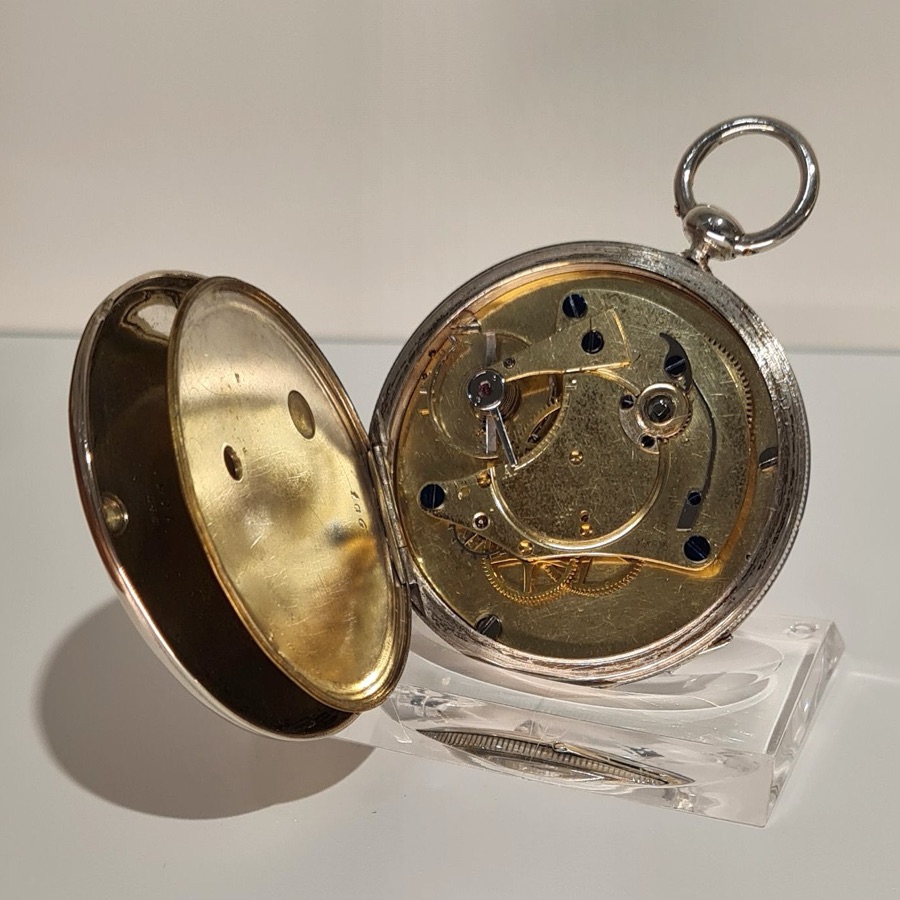
A silver pocket watch with its case open, showing a gilt movement, on a clear stand in a museum display.
A pocket watch made by A. Lange & Cie. in 1850, now in the German Watch Museum Glashütte.13 Photograph: Derbrauni. View full original at Wikimedia Commons (opens in a new tab) · 1,385 × 1,362 px; CC BY 4.0 (opens in a new tab).

The watchmaking school and the museum

The German School of Watchmaking opened on May 1, 1878, largely through Grossmann’s efforts, and moved into its own building in 1881. Under East Germany it became a technical college and, from 1957, an engineering school for precision engineering.1, 14

The museum says the engineering school closed in 1992. A foundation named after Nicolas G. Hayek was set up in 2006; with the support of the Swatch Group, Glashütte Original bought and restored the old school, and the German Watch Museum Glashütte opened there on May 22, 2008, sharing the building with Glashütte Original’s own school for watchmakers.14
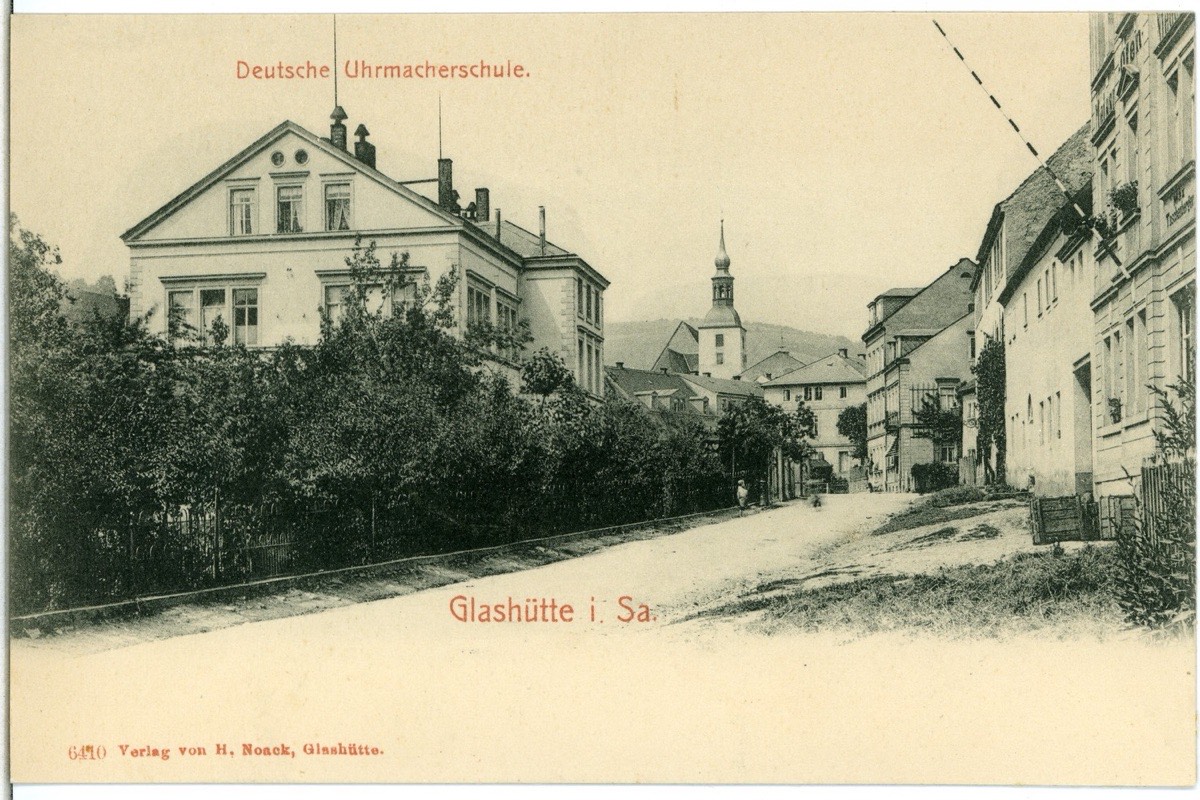
A postcard view of a street with a large gabled building behind trees on the left, a church tower and town houses on the right, captioned Deutsche Uhrmacherschule, Glashütte.
The German School of Watchmaking on a postcard of 1905.15 Postcard: H. Noack, Glashütte; Brück & Sohn Kunstverlag. View full original at Wikimedia Commons (opens in a new tab) · 1,523 × 1,000 px; CC0 (opens in a new tab).
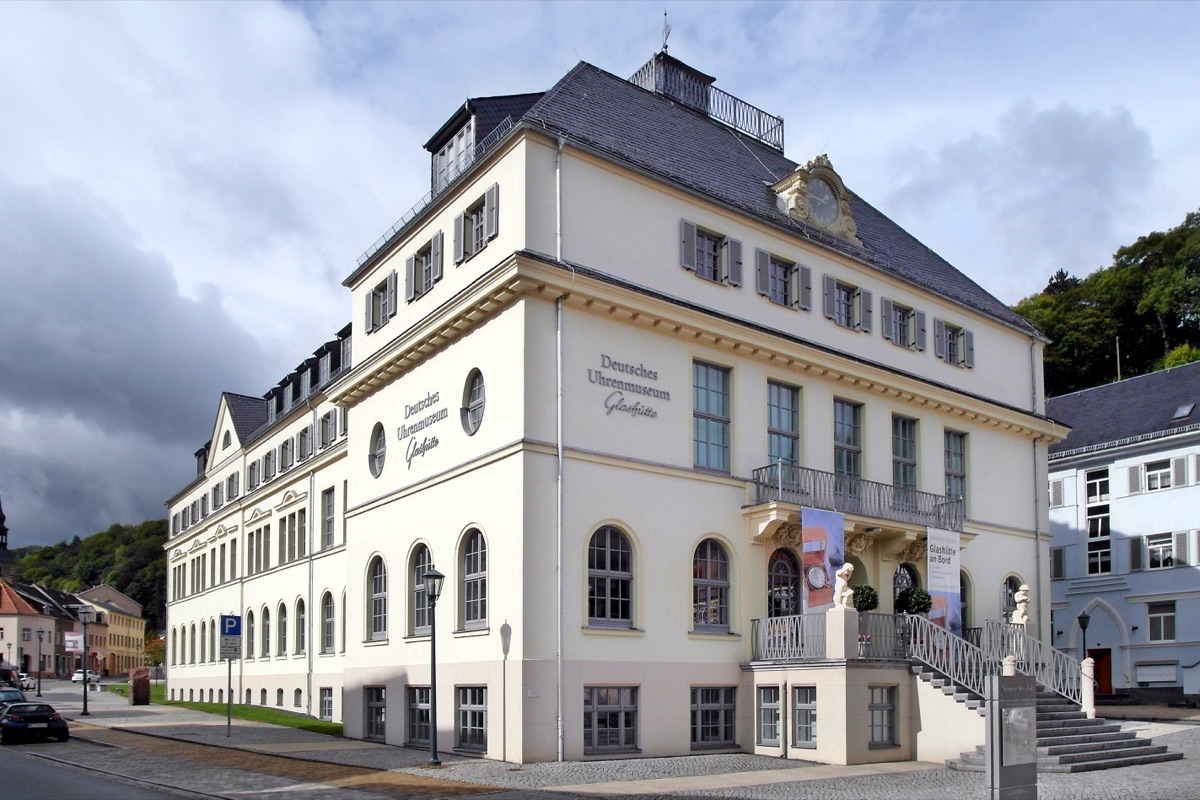
A cream-coloured building with a clock in its gable and the lettering Deutsches Uhrenmuseum Glashütte, with banners and entrance steps, under a cloudy sky.
The same building in 2016, now the German Watch Museum Glashütte.16 Photograph: Jörg Blobelt. Cropped here. View full original at Wikimedia Commons (opens in a new tab) · 2,846 × 2,171 px; CC BY-SA 4.0 (opens in a new tab). Adapted; shared alike.

Its permanent exhibition, the museum says, tells the town’s watchmaking history from 1845, through the world wars, dismantling and expropriation to reunification, with a room on the products of VEB Glashütter Uhrenbetriebe.17
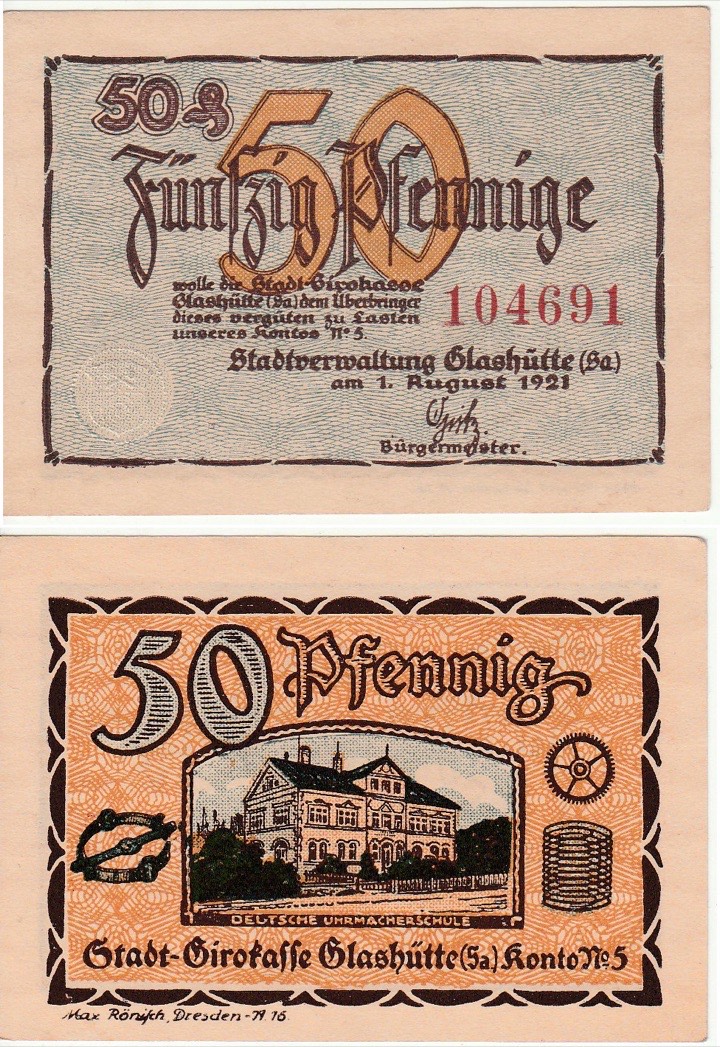
Both sides of a small paper banknote: one with the value 50 Pfennig and the town name, the other with a picture of a large building framed by a balance wheel and gear wheels.
A 50-pfennig emergency note issued by the town in 1921, with the watchmaking school framed by a balance wheel and gears.18 Banknote: Stadt Glashütte, 1921; scan by 5snake5. View full original at Wikimedia Commons (opens in a new tab) · 976 × 1,419 px; Public domain (opens in a new tab).

Merger and new beginnings

After the Second World War the town’s firms were dismantled and expropriated, and in July 1951 they were merged into one state enterprise, VEB Glashütter Uhrenbetriebe. Some left: the founder of Tutima took the business to the West, to Ganderkesee in Lower Saxony.3, 12, 19, 20
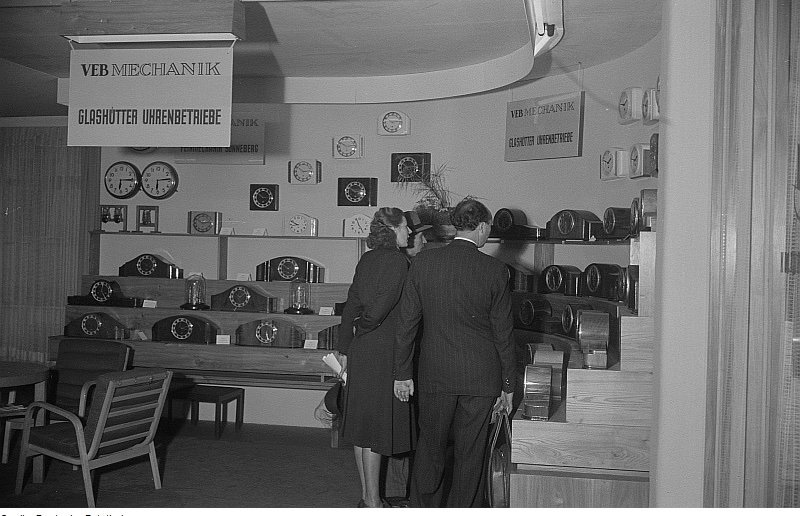
A couple in 1950s clothes looks at a trade-fair stand lined with shelves of mantel clocks, alarm clocks and wall clocks, under a sign reading VEB Mechanik Glashütter Uhrenbetriebe.
Visitors at the stand of VEB Mechanik Glashütter Uhrenbetriebe at the Leipzig autumn fair of 1952.21 Photograph: Roger and Renate Rössing, Deutsche Fotothek. Cropped here. View full original at Wikimedia Commons (opens in a new tab) · 800 × 540 px; CC BY-SA 3.0 DE (opens in a new tab). Adapted; shared alike.

Reunification brought a run of new companies, a turn told under Glashütte after reunification. In 1990 Walter Lange re-founded A. Lange & Söhne, Roland Schwertner founded NOMOS, and the state combine became Glashütter Uhrenbetrieb GmbH, later Glashütte Original. Mühle-Glashütte was re-established in 1994, Moritz Grossmann was founded in 2008, and Tutima opened a new factory in the town in the same year, as it dates it.3, 12, 22, 23, 24, 25
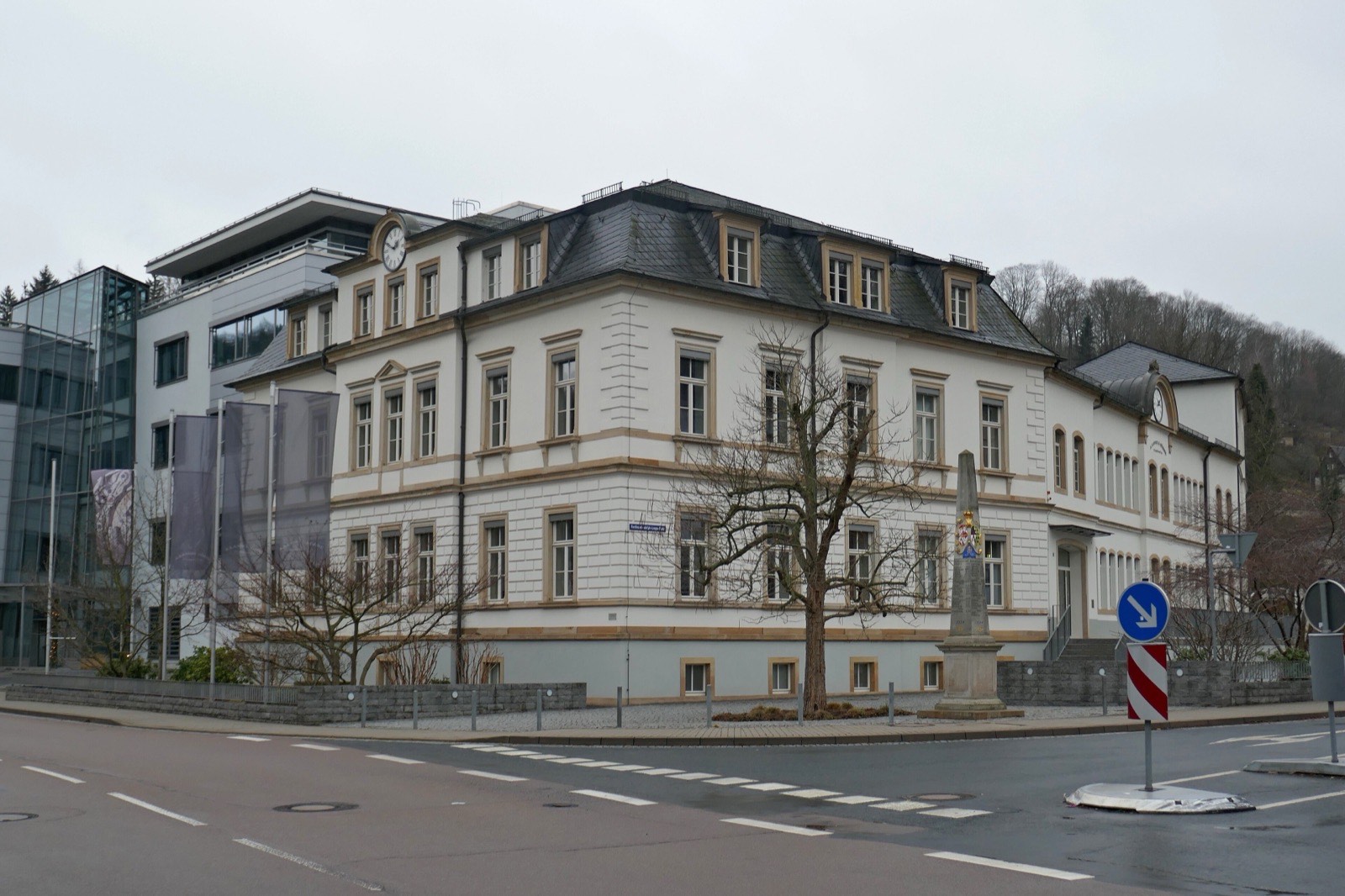
A large restored building with a clock in its central gable, a modern glass extension and banners at the left, on a grey winter day.
The A. Lange & Söhne headquarters in Glashütte in 2018.26 Photograph: © 1971markus@wikipedia.de. Cropped here. View full original at Wikimedia Commons (opens in a new tab) · 4,697 × 3,408 px; CC BY-SA 4.0 (opens in a new tab). Adapted; shared alike.

The town says nine watchmakers work there today. Sinn, based in Frankfurt, has most of its cases made by SUG, a case maker in Glashütte.1, 27
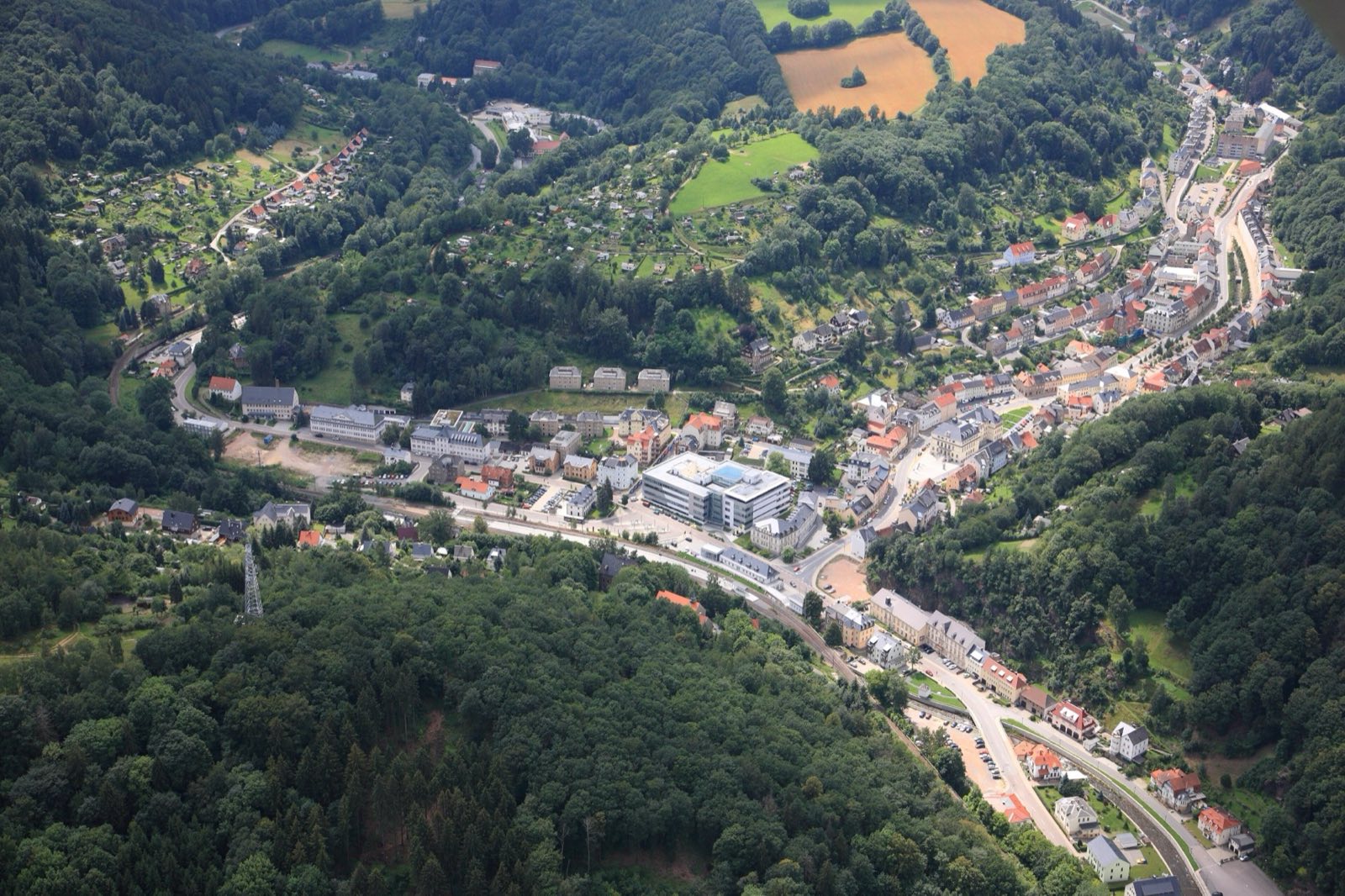
An aerial photograph of a town strung along a narrow forested valley, with factory buildings at its centre and a railway following the valley floor.
Glashütte along the Müglitz valley from the air, July 2009.28 Photograph: SG-IMBTUDD. View full original at Wikimedia Commons (opens in a new tab) · 4,368 × 2,912 px; CC BY-SA 4.0 (opens in a new tab). Adapted; shared alike.

Protecting the name

A German regulation of February 22, 2022, now reserves the name for watches made in the area of origin: the town itself, two districts of neighbouring Altenberg for supplying and finishing parts, and Dresden for certain plating steps. Assembly, casing, dial and hand fitting must take place in Glashütte, and more than half the value of the main stages must be added in the area. How such rules work elsewhere is described under Origin labels.4

A map of Glashütte, with Dresden, Leipzig for reference.
Drawn from Natural Earth map data, which is in the public domain. Town positions from Natural Earth and Wikipedia.29, 30, 31, 32

Key dates

  1. 1506

    Glashütte receives mining and town rights.1

  2. 1845

    A. Lange & Söhne Ferdinand Adolph Lange opens his workshop in Glashütte on December 7.1, 2, 10

  3. 1878

    Moritz Grossmann The German School of Watchmaking opens on May 1, founded on Grossmann’s initiative.1, 24, 33, 34

  4. 1881

    The German School of Watchmaking moves into its own building, today the watch museum.1, 14

  5. 1990

    A. Lange & Söhne Walter Lange and Günter Blümlein found Lange Uhren GmbH on December 7.10, 22, 35

  6. 1990

    Glashütte Original Glashütter Uhrenbetrieb GmbH is registered on October 16.3, 34

  7. 1990

    Nomos Glashütte Roland Schwertner founds NOMOS Glashütte.23, 36, 37

  8. 1992

    The engineering school in the former watchmaking school building closes, the museum says.14

  9. 1994

    Mühle-Glashütte Hans-Jürgen Mühle re-establishes the company on April 1.12, 38

  10. 1999

    Sinn SUG, the Glashütte case maker co-founded by Sinn’s owner, begins work.27, 39

  11. 2008

    Glashütte Original The German Watch Museum Glashütte opens in the old watchmaking school on May 22.1, 14

  12. 2008

    Moritz Grossmann Christine Hutter founds Grossmann Uhren GmbH on November 11.24, 40

  13. 2008

    Tutima A new Tutima factory in Glashütte begins work on May 14.25

  14. 2022

    A German regulation protects the name Glashütte on watches.4

Where Glashütte leads

  • Based here, CompanyA. Lange & Söhne

    The company was founded in Glashütte in 1845, re-founded there in 1990, and works from the building it moved into in 1873.2, 10, 35

  • Based here, CompanyGlashütte Original

    The company’s manufactory is in the centre of Glashütte, where it is the legal successor to most of the town’s post-war watch enterprises.3, 41

  • Based here, CompanyMoritz Grossmann

    The company was founded in Glashütte in 2008 and has had its own manufactory building there since 2013.24, 40

  • Based here, CompanyMühle-Glashütte

    The Mühle family firm has worked in Glashütte since the nineteenth century and was re-established there in 1994.12, 38

  • Based here, CompanyNomos Glashütte

    NOMOS was founded in Glashütte in 1990 and works from five buildings in the town, its headquarters in the railway station.23, 37

  • Based here, CompanyTutima

    Tutima began in Glashütte in 1927 and, after decades in Lower Saxony, came back to build a new factory there.20, 25, 42

  • Part of, HistoryGerman watchmaking

    The Saxon town where Ferdinand Adolph Lange began making fine watches in 1845.1, 2

  • See also, CompanySinn

    Sinn says most of its cases come from SUG, a case maker in Glashütte co-founded by Sinn’s owner.27, 43

  • See also, PersonFerdinand Adolph Lange

    The town he turned from a failing mining settlement into a watchmaking centre, and served as mayor.1, 2, 44

  • See also, PersonMoritz Grossmann

    Where he had his workshop, sat on the council, and has a square named after him.24, 45

  • See also, PersonNicolas G. Hayek

    The museum says the foundation behind the German Watch Museum in Glashütte, set up in 2006, carries Hayek’s name.14

  • See also, PersonPeter Henlein

    A Henlein memorial stone was set up before the German watchmaking school at Glashütte in 1903.46, 47

  • See also, PlaceMoscow

    Garratt cites a German report that twelve Glashütte workers went to Moscow in August 1930 to train workers at the new watch factory.48

  • See also, PlaceVallée de Joux

    Audemars Piguet says the 1899 “Universelle” begun at Le Brassus was finished and sold by Union Glashütte.49

  • See also, GroupThe Swatch Group

    The German Watch Museum Glashütte says the Swatch Group supported Glashütte Original in buying and restoring the former watchmaking school as the museum’s home.14

  • See also, GroupVEB Glashütter Uhrenbetriebe (GUB)

    For four decades GUB was the town’s watch industry; its successor still makes watches there.34, 50

  • See also, TraditionOrigin labels

    The Glashütteverordnung of 2022 defines the town and its neighbouring districts as the area a watch marked Glashütte must come from.4

  • See also, TraditionThe Glashütte tradition

    The town where the tradition began in 1845 and where the brands that keep it are still made.1, 2, 36

  • See also, EventGlashütte after reunification

    The town where the state works was privatised and new firms were founded.12, 23, 34

  • See also, EventThe luxury-group consolidation

    The Swatch Group bought Glashütte Original and Union Glashütte in the town in 2000, as Richemont took over Lange.51, 52, 53

Facts and sources

Country
Germany (Saxony)1, 5
Watchmaking since
18451, 2, 3

Sources

  1. 1

    Die Geschichte der Uhrenstadt Glashütte (opens in a new tab), Stadtverwaltung Glashütte, official

  2. 2

    Ferdinand Adolph Lange: early years (opens in a new tab), A. Lange & Söhne, official

  3. 3

    History (opens in a new tab), Glashütte Original, official, archived copy

  4. 4

    Glashütteverordnung (GlashütteV): Verordnung zum Schutz der geografischen Herkunftsangabe “Glashütte” (opens in a new tab), Bundesministerium der Justiz / Bundesamt für Justiz, official

  5. 5

    Glashütte (opens in a new tab), Wikipedia, independent

  6. 6

    Die Gartenlaube (1879), p. 221: Glashütte im sächsischen Erzgebirge, drawn from life by Franz Schreyer (opens in a new tab), Wikimedia Commons, public record

  7. 7

    Meilenblatt B 317: Glashütte (Saxon mile-sheet survey) (opens in a new tab), Wikimedia Commons (SLUB Dresden / Deutsche Fotothek), public record

  8. 8

    Ferdinand Adolph Lange (portrait reproduced in C. Dietzschold, Der Cornelius Nepos der Uhrmacher, 1910) (opens in a new tab), Wikimedia Commons, public record

  9. 9

    US Patent 57,266: F. A. Lange, Repeating Watch, patented August 14, 1866 (opens in a new tab), United States Patent and Trademark Office (via Google Patents), public record

  10. 10

    A. Lange & Söhne (opens in a new tab), Wikipedia, independent

  11. 11

    Glashütte in the Ore Mountains (opens in a new tab), NOMOS Glashütte, official

  12. 12

    History (opens in a new tab), Mühle-Glashütte, official

  13. 13

    Exhibit, German Watch Museum Glashütte: pocket watch by A. Lange & Cie., 1850 (opens in a new tab), Wikimedia Commons, public record

  14. 14

    Geschichte des Hauses (opens in a new tab), Deutsches Uhrenmuseum Glashütte, independent, archived copy

  15. 15

    Glashütte, 1905: Deutsche Uhrmacherschule (postcard) (opens in a new tab), Wikimedia Commons, public record

  16. 16

    Glashütte, Uhrenmuseum, October 5, 2016 (opens in a new tab), Wikimedia Commons, public record

  17. 17

    Dauerausstellung (opens in a new tab), Deutsches Uhrenmuseum Glashütte, independent, archived copy

  18. 18

    Glashütte, 50 Pfennig emergency note, 1921 (opens in a new tab), Wikimedia Commons, public record

  19. 19

    Saxony becomes Lower Saxony (opens in a new tab), Tutima Glashütte, official

  20. 20

    You are there: visiting Tutima Glashütte in Germany (opens in a new tab), Quill & Pad, independent

  21. 21

    Visitors at a fair stand with clocks of VEB Mechanik Glashütter Uhrenbetriebe, Leipzig autumn fair 1952 (opens in a new tab), Wikimedia Commons (Deutsche Fotothek), public record

  22. 22

    Homage to Walter Lange (opens in a new tab), A. Lange & Söhne, official

  23. 23

    NOMOS Glashütte: independent German watch manufacturer (opens in a new tab), NOMOS Glashütte, official

  24. 24

    Geschichte (opens in a new tab), Grossmann Uhren GmbH, official

  25. 25

    The circle begins to close (opens in a new tab), Tutima Glashütte, official

  26. 26

    A. Lange & Söhne Stammhaus, Glashütte (opens in a new tab), Wikimedia Commons, public record

  27. 27

    SUG manufacture (opens in a new tab), Sinn Spezialuhren, official, archived copy

  28. 28

    Luftbild Glashütte (Sachsen) im Juli 2009 (opens in a new tab), Wikimedia Commons, public record

  29. 29

    Admin 0: countries, 1:50m (opens in a new tab), Natural Earth, public record

  30. 30

    Terms of use (opens in a new tab), Natural Earth, official

  31. 31

    Populated places, 1:10m (opens in a new tab), Natural Earth, public record

  32. 32

    Coordinates of Glashütte, Pforzheim, La Chaux-de-Fonds, Le Locle, Saint-Imier, Le Sentier, Le Brassus and Grenchen (opens in a new tab), Wikipedia, independent

  33. 33

    Sonderausstellung Grossmann200 (opens in a new tab), Deutsches Uhrenmuseum Glashütte, independent, archived copy

  34. 34

    Ahead of its time – for 180 years (opens in a new tab), Glashütte Original, official

  35. 35

    A. Lange & Söhne is reborn (opens in a new tab), A. Lange & Söhne, official

  36. 36

    How The Wall Came Tumbling Down: Watches Made In Germany (Reprise) (opens in a new tab), Quill & Pad, independent

  37. 37

    NOMOS Glashütte (opens in a new tab), Wikipedia, independent

  38. 38

    Mühle-Glashütte (opens in a new tab), Wikipedia (German), independent

  39. 39

    About us: the company's history (opens in a new tab), Sinn Spezialuhren, official, archived copy

  40. 40

    Moritz Grossmann (opens in a new tab), Wikipedia, independent

  41. 41

    The brand Glashütte Original (opens in a new tab), Glashütte Original, official, archived copy

  42. 42

    The birth of a brand (opens in a new tab), Tutima Glashütte, official

  43. 43

    Technology glossary (opens in a new tab), Sinn Spezialuhren, official, archived copy

  44. 44

    Ferdinand Adolph Lange (opens in a new tab), Wikipedia (German), independent

  45. 45

    Karl Moritz Großmann (opens in a new tab), Wikipedia (German), independent

  46. 46

    Thomas Eser, Die älteste Taschenuhr der Welt? Der Henlein-Uhrenstreit (Kulturgeschichtliche Spaziergänge 16), 2014 - published extract (opens in a new tab), Germanisches Nationalmuseum, Nuremberg, public record

  47. 47

    Peter Henlein (opens in a new tab), Wikipedia (German), independent

  48. 48

    The Birth of Soviet Watchmaking: continuing the Hampden story (updated edition) (opens in a new tab), Alan F. Garratt, 2019, published on hampdenwatches.com, independent

  49. 49

    Before 1875 (opens in a new tab), Audemars Piguet (AP Chronicles, Heritage team, February 2025), official

  50. 50

    Glashütter Uhrenbetrieb (opens in a new tab), Wikipedia (German), independent

  51. 51

    Acquisition of Glashütter Uhrenbetrieb GmbH (opens in a new tab), The Swatch Group, official

  52. 52

    Swatch Group History (opens in a new tab), The Swatch Group, official

  53. 53

    Richemont acquires Les Manufactures Horlogères SA and the outstanding 40 per cent of Manufacture Jaeger-LeCoultre SA (opens in a new tab), Richemont, official

Sources read November 11, 2026.