The Glashütte tradition
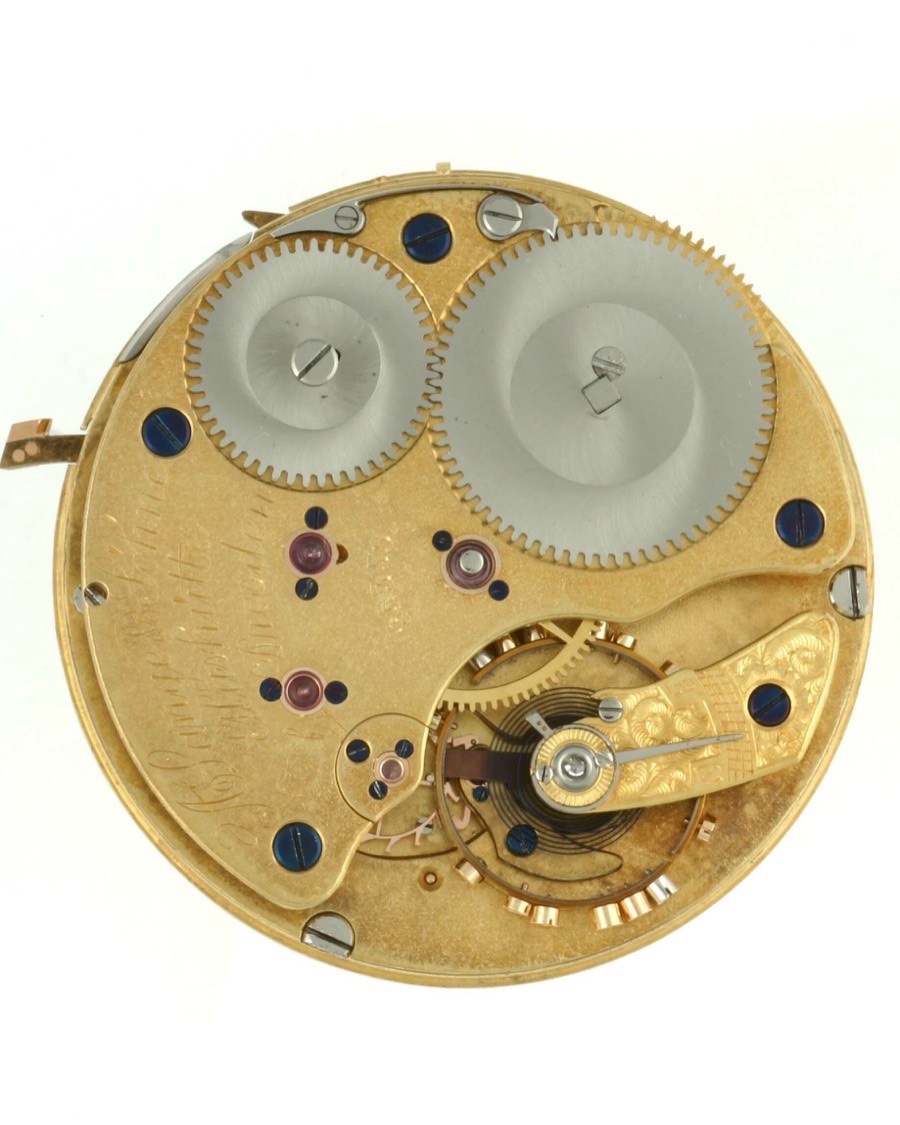
The way of building watch movements that grew up in Glashütte, Saxony, after 1845: a large upper plate covering three quarters of the movement, frames of German silver, jewels in screwed gold settings and hand-engraved balance cocks, taken up again by the town’s makers after 1990.
Companies A. Lange & Söhne, Glashütte Original, Moritz Grossmann, Nomos Glashütte

A town built around one trade
What made Glashütte’s watches distinct began as a way of organising work. Ferdinand Adolph Lange split production into specialised steps instead of having one craftsman make a whole watch, and urged skilled workers to found firms of their own. Other watchmakers settled in the town, among them Moritz Grossmann, and makers of tools and fine-mechanical parts grew up beside them.6, 7, 8, 9
From 1878 the Deutsche Uhrmacherschule, opened on Grossmann’s initiative, trained the town’s watchmakers. Its watches became known well enough to be copied: imitations were sold as “System Glashütte”, and in the 1920s an “Original Glashütte” seal set the genuine ones apart.8, 9, 11, 12
The three-quarter plate
Most pocket watches of the time held each wheel under its own bridge or cock, and lining them up against one another was slow trial and error. Lange replaced them with one upper plate holding the pivots of the main wheels, so their positions were fixed. He refined it for nearly twenty years until, in 1864, it covered three quarters of the movement with the balance left uncovered.1, 2
The plate makes a movement steadier and keeps dirt out, but fitting it over several arbors at once takes a steady hand. Quill & Pad calls it practically a synonym for Glashütte watchmaking. A two-thirds plate came before it, and Moritz Grossmann still uses one.1, 2, 4, 13
Materials and finish
The plates and bridges are traditionally German silver, an alloy of copper, nickel and zinc that Lange began using for some movement frames in the 1850s in place of gilded brass or hardened steel. It is harder than brass, resists tarnishing and needs no gilding, slowly taking on a light patina.1, 3
The plate usually carries Glashütte ribbing, a wave pattern related to the Swiss côtes de Genève but laid at a different angle. The jewel bearings sit in polished gold settings, or chatons, each held by thermally blued screws.1, 2, 4
The balance cock, the small bridge over the balance, is engraved by hand with a floral pattern, so no two are alike. Other recurring details are the swan-neck fine adjustment for regulating the rate, the screw balance, and a power-reserve display marked “Auf” and “Ab”, up and down.2, 4
Ideas from Glashütte
In 1930 Richard Lange, the founder’s son, patented a balance-spring alloy containing beryllium, an idea later marketed by others as the Nivarox spring. Glashütte Original says the flying tourbillon, held from one side only, came from the teacher Alfred Helwig and his students at the watchmaking school in 1920.4, 12, 14
Through the East German years and after
The tradition survived the war in reduced form. The wristwatch movement the town designed in October 1945, after its factories were dismantled, kept the layout of a three-quarter plate, pressed from thin sheet metal; through the East German years the town’s watches were made by the state company GUB.12
After reunification the old hallmarks came back. A. Lange & Söhne reintroduced the three-quarter plate after 1990, and most modern Glashütte movements are built around one, above all at Lange and Glashütte Original.1, 13
Key dates
- 1845
A. Lange & Söhne Ferdinand Adolph Lange opens his workshop in Glashütte on December 7.6, 8, 15
- 1854
Moritz Grossmann Moritz Grossmann sets up his workshop in Glashütte.16
- 1864
A. Lange & Söhne Lange’s upper plate reaches its final form, covering three quarters of the movement.1
- 1878
Moritz Grossmann The Deutsche Uhrmacherschule Glashütte opens on May 1, on his initiative.8, 11, 16
- 1878
Moritz Grossmann The German School of Watchmaking opens on May 1, founded on Grossmann’s initiative.8, 12, 16, 17
- 1920
Alfred Helwig and his students build a tourbillon held from one side, as Glashütte Original describes it.4, 12
- 1930
A. Lange & Söhne Richard Lange patents a beryllium alloy for balance springs.14
- 2008
Mühle-Glashütte Mühle’s own three-quarter plate arrives.18
Where the Glashütte tradition leads
- In this story, CompanyA. Lange & Söhne
Lange’s founding in 1845 began watchmaking in Glashütte, and it says the three-quarter plate its founder developed is still part of its movements.6, 15
- In this story, CompanyGlashütte Original
Glashütte Original dates its roots to the arrival of watchmaking in Glashütte in 1845.19
- In this story, CompanyMoritz Grossmann
The company takes its name from the founder of the German School of Watchmaking and says it builds its movements on the Glashütte three-quarter plate.16, 17
- In this story, CompanyNomos Glashütte
NOMOS says it uses traditional Glashütte features such as the three-quarter plate and sunburst decoration in its movements.20
- In this story, PersonFerdinand Adolph Lange
The plate, the German silver and the division of labour he introduced became the way Glashütte builds watches.1, 3, 6
- In this story, PersonMoritz Grossmann
The watchmaking school he started in 1878 trained Glashütte’s watchmakers for more than a century.8, 11, 16
- See also, PlaceGlashütte
The town where the tradition began in 1845 and where the brands that keep it are still made.6, 8, 13
- See also, GroupVEB Glashütter Uhrenbetriebe (GUB)
How the three-quarter plate and the rest survived dismantling and nationalisation, and came back after 1990.1, 12
Facts and sources
- Began
- 1845, Glashütte6, 7, 8
- Hallmarks
- Three-quarter plate, German silver, Glashütte ribbing, screwed gold chatons, hand-engraved balance cock1, 2, 4
Sources
- 1
- 2
- 3
German silver – aesthetically appealing and sophisticated (opens in a new tab)
- 4
- 5
- 6
- 7
- 8
Die Geschichte der Uhrenstadt Glashütte (opens in a new tab)
- 9
- 10
- 11
- 12
- 13
How The Wall Came Tumbling Down: Watches Made In Germany (Reprise) (opens in a new tab)
- 14
- 15
- 16
- 17
- 18
- 19
- 20
Sources read November 11, 2026.