Histories, Era III, The industrial watch
German watchmaking
1845 to today
How Germany came to make clocks and watches for the world: the Black Forest’s wooden clocks and the peddlers who carried them, factories on the American model at Schramberg and Schwenningen, Glashütte from 1845, Pforzheim’s cases and movements, Ruhla’s cheap pocket watches, fuses in two wars, two German industries after 1945, quartz and the radio-controlled watch, and the revival after reunification.

In short
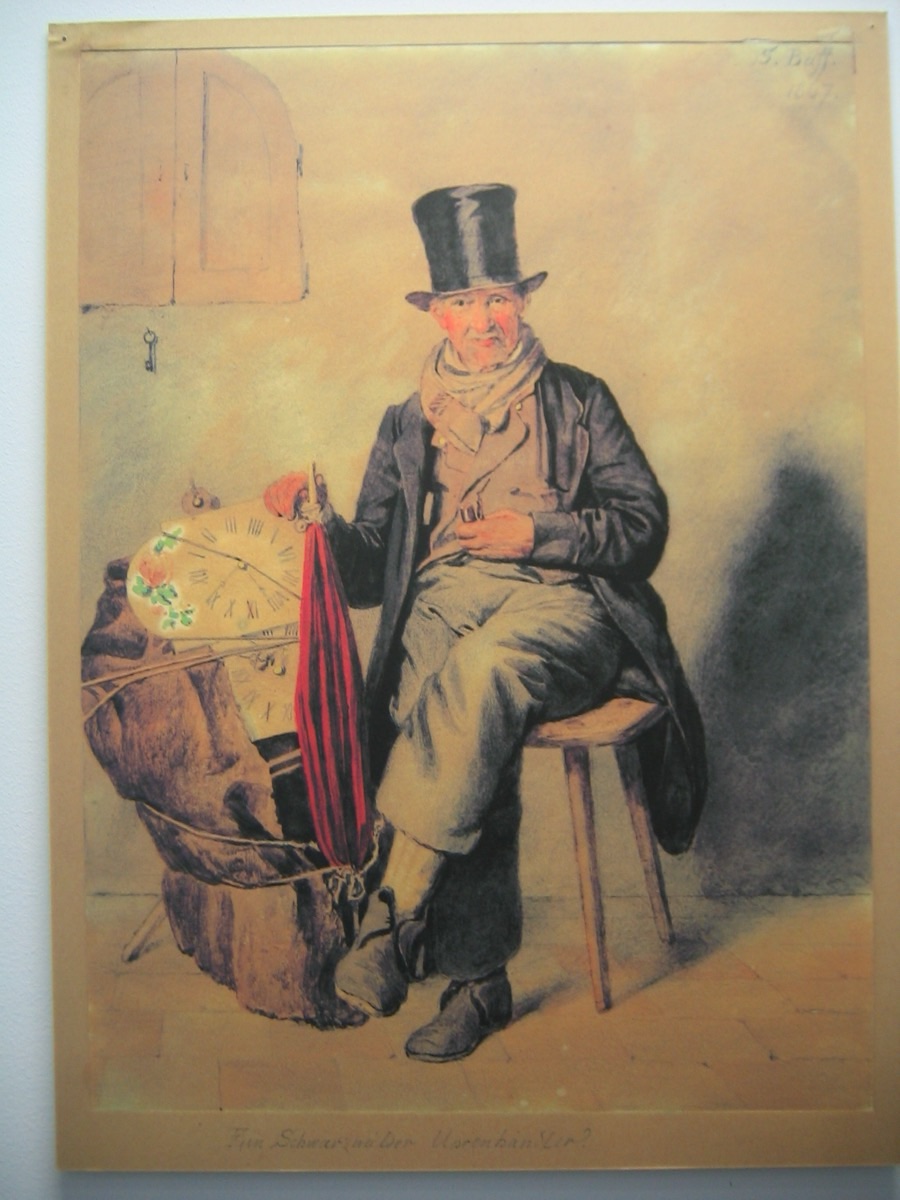
From the eighteenth century, farmers and craftsmen in the Black Forest made cheap wooden clocks, and peddlers carried them across Europe on their backs. In the late nineteenth century the region’s factories copied American methods and made alarm clocks by the million, while Glashütte made fine watches by hand, Pforzheim made cases and movements, and Ruhla in Thuringia sold pocket watches for a few marks. Two world wars turned the factories to fuses, and after 1945 the industry was split between East and West Germany. Cheap quartz watches from Asia undercut both, but the radio-controlled watch came from Schramberg, and after reunification Glashütte became a centre of fine watchmaking again.1, 2, 3, 4, 5, 6, 7, 8, 9, 10, 14, 15, 17, 22, 23, 27
Part 1
Wooden clocks from the Black Forest
Germany’s mass production of timekeepers began with clocks, not watches. In the Black Forest wooden clocks were being made in the second half of the seventeenth century, and clockmaking became a trade of its own from about 1730.1, 4
Wood mattered for a legal reason as much as a practical one. Making clocks of metal was reserved to members of the town clockmakers’ guilds, while making clocks of wood was a free trade open to anyone, so it grew up in the workshops of country woodworkers.1, 4, 30
Its success came from dividing the work. Clockmakers bought frames, cast bells and wheel blanks, chains and painted dials from specialist suppliers who built simple machines for their parts. On the eve of industrialisation some 1,000 small workshops with about 5,000 workers made clocks between Neustadt and St. Georgen.3, 4, 30
The German Wikipedia’s account puts output at about 150,000 clocks around 1800 and some 600,000 a year around 1840, a large share of the world’s production, and says a clockmaker who needed a week for one clock around 1750 made one a day thirty years later.4
Black Forest dealers formed trading companies, set up bases across Europe and walked the countryside with clocks on their backs; at home, wholesalers called Packer took the finished clocks and paid in materials and household goods. Clocks were made to suit each market: with a date for England, brightly painted for France, with black borders and bullfight scenes for Spain.2, 4, 31
Where the cuckoo clock began is disputed. The Deutsches Uhrenmuseum notes that Markus Fidelis Jäck wrote in 1810 that a Ketterer of Schönwald made cuckoo clocks in the early 1730s, while Franz Steyrer wrote in 1796 that two clock carriers brought cuckoo clocks back from a Bohemian dealer in 1742 and that Michael Dilger and Matthäus Hummel copied them. The museum says neither gave evidence; the German Wikipedia adds a third claimant, Franziskus Ketterer.32, 33
Part 2
The Black Forest learns the American system
From the 1840s cheaper factory clocks pushed Black Forest wooden clocks out of their markets, and the state of Baden answered with training. In 1850 the engineer Robert Gerwig became director of a new clockmaking school at Furtwangen, which had model movements made and commissioned case designs that local makers could use freely. It closed at the end of 1863 and reopened in 1877.30, 34, 35, 36
The Deutsches Uhrenmuseum notes that the school also tried, and failed, to build up pocket-watch making on the model of the Swiss Jura, and that most small makers kept to their wooden movements.34
Factories followed: a joint-stock company for clockmaking at Lenzkirch from 1851, L. Furtwängler Söhne at Furtwangen and others. After 1880 growth moved to Württemberg, to Schramberg, home of Junghans and the Hamburg-Amerikanische Uhrenfabrik, and to Schwenningen, home of Kienzle and Mauthe.3, 4
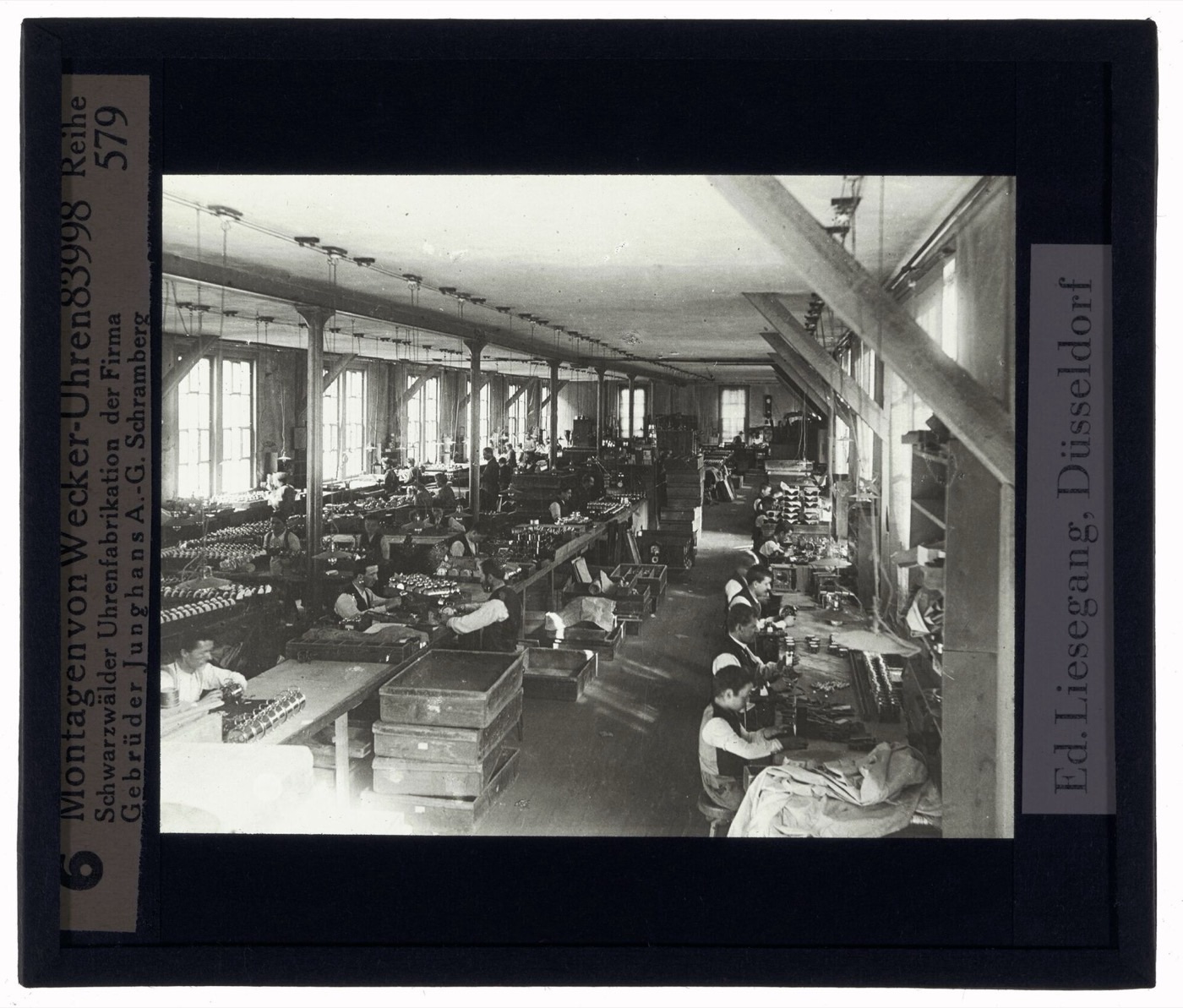
The method came from the United States. In 1872 the twenty-year-old Arthur Junghans went to work in American factories, and back in Schramberg he brought in stamped parts and simplified cases, the factory methods described under America industrializes the watch. The resulting “American” alarm clocks were built on special machines from parts designed for fast assembly, and the Junghans alarm movement W10 was copied across the region.3, 4, 12, 37
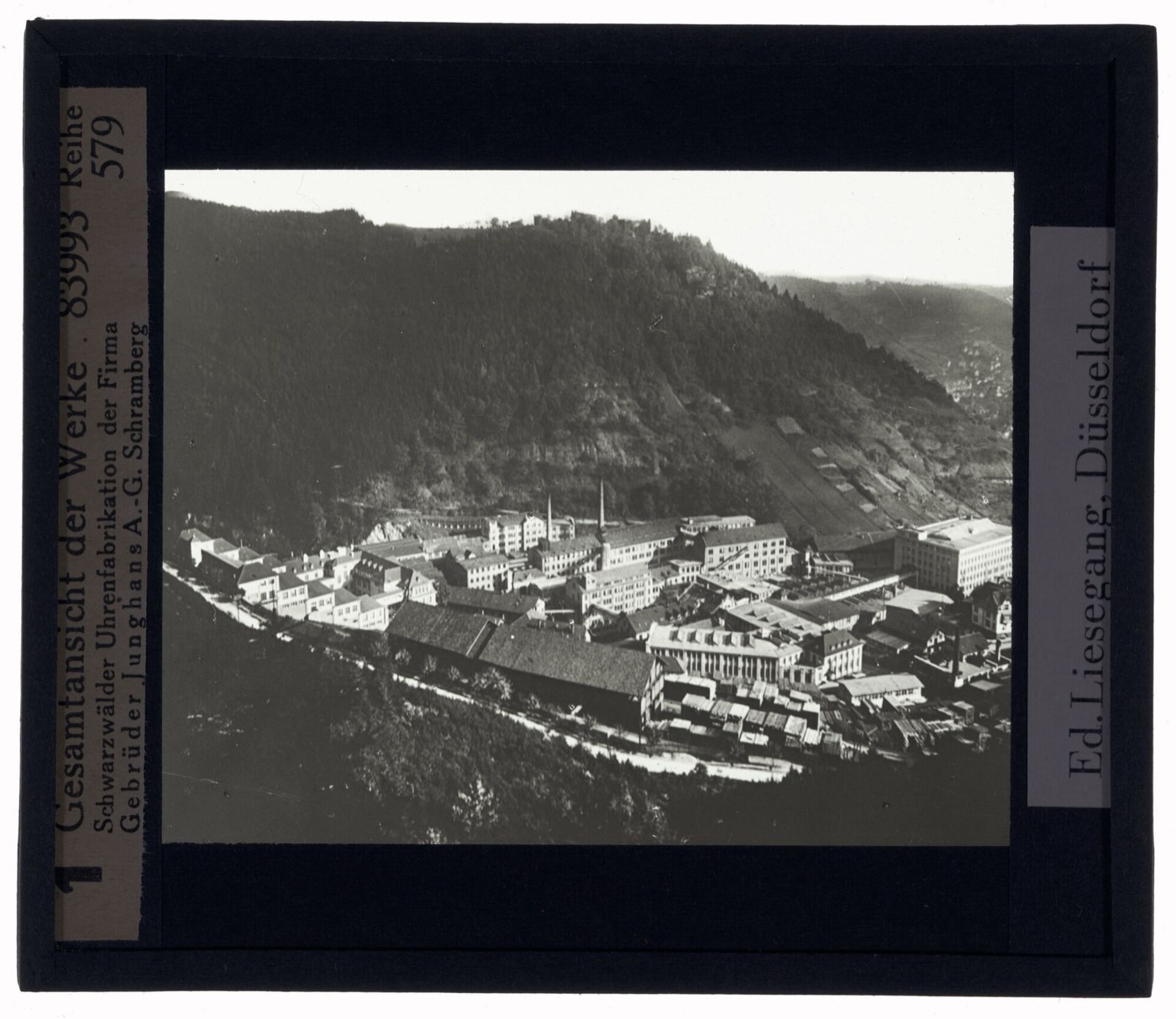
Thanks to the alarm clock, the Black Forest supplied 60 per cent of the world’s exports of clocks before the First World War.3, 4
How large Junghans became is told in superlatives. Junghans says it was the largest clock factory in the world in 1903, with 3,000 workers making more than three million timepieces a year; the Deutsches Uhrenmuseum says it was the largest in Europe, if not the world, by 1910.3, 13
A worker’s memoir shows how it was done. The museum quotes Berthold Schneider, who finished movements at Junghans from 1891 to 1898: unskilled women put the parts together in jigs, which only worked with standardised parts, and he writes that the firm’s own toolmaking put it years ahead of its rivals.40
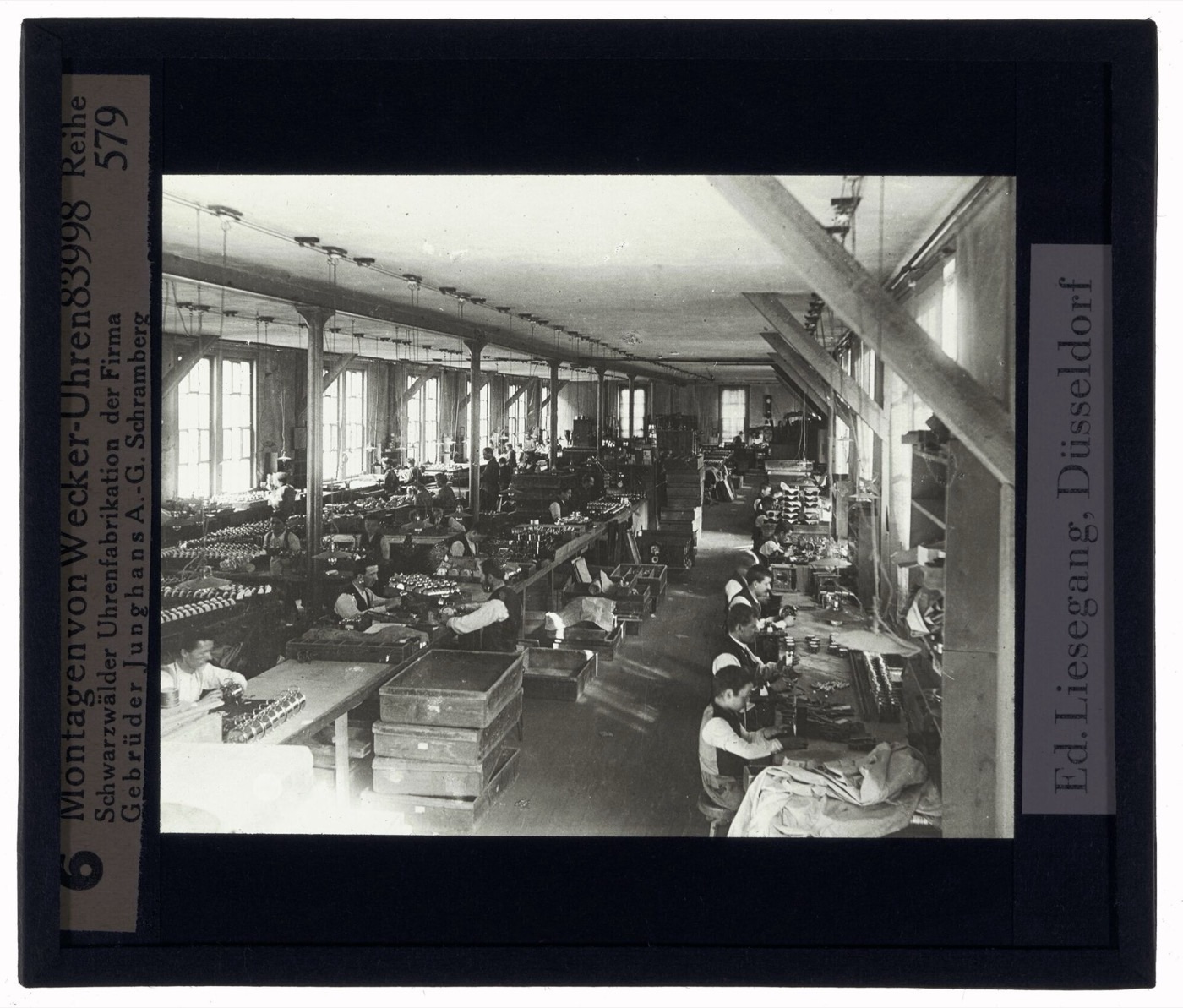
Watchmaking proper came to the region slowly. Hanhart says it moved from Diessenhofen in Switzerland to Schwenningen in 1902, made an inexpensive stopwatch from 1924 and opened a second works at Gütenbach in the Black Forest in 1934.43
Part 3
Glashütte, Pforzheim and Ruhla
Fine watches were made elsewhere. At Glashütte in Saxony, Ferdinand Adolph Lange began in 1845, with a state loan, to train apprentices as watchmakers; the town’s story and that of A. Lange & Söhne are told on their own pages.5, 14
Pforzheim, the jewellery town of Baden, made gold, silver and gold-plated cases and, with a fine division of labour among many firms, inexpensive wristwatches. After long buying movements or parts abroad, it could make complete movements from 1932.6, 15
Its movement makers supplied much of the German trade. Durowe was founded in Pforzheim in 1933 by Ludwig Hummel of Laco, and the Deutsches Uhrenmuseum’s records show movements of PUW, the Pforzheimer Uhren-Rohwerke, in an electronic watch of about 1966 and in a watch made for Helbros of New York in 1970.44, 45, 46, 47
Cheap watches came from Ruhla in the Thuringian Forest. The metalware firm Gebrüder Thiel, founded there by Christian and Georg Thiel in 1862, moved from pipe fittings and toy clocks to a machine-made pocket watch, the Fearless, in 1891 or 1892 (the town’s chronicle gives both years), sold for three marks. By 1897 it made 4,000 a day.7, 17, 48
Ruhla also came early to the wrist. The town’s chronicle says Thiel put the Darling, which it calls the first German women’s wristwatch, into series production in 1908, and the German Wikipedia says Junghans began making wristwatches in 1927 with movements bought from Thiel.7, 8
Part 4
Fuses, forced labour and the fire of Pforzheim
Clock factories made time fuses. Junghans began in 1906 and Thiel in 1909, at the suggestion of Krupp; in the First World War Thiel stopped making watches altogether, and in both wars Junghans, Kienzle and other Black Forest firms built fuses.4, 7, 8
Much of the war work was done by people forced to it. The German Wikipedia records 440 eastern workers, 332 French prisoners of war and forced labourers and 90 Polish forced labourers housed by Junghans at Schramberg in 1942; Ruhla’s chronicle counts about 10,000 people working for the Thiel firms in 1944, most of them, by the Wikipedia account, forced and eastern labourers.7, 8, 17
For the air force, Pforzheim’s Laco and Stowa built the navigator’s observation watch alongside A. Lange & Söhne; the wider story is told in Watches go to war.18, 19, 20
On the evening of 23 February 1945 a Royal Air Force raid of a little over twenty minutes destroyed Pforzheim and its industry. The city counts more than 17,600 dead, among them forced labourers, prisoners of war and men deported from La Bresse in the Vosges.6, 16, 49
Why Pforzheim was chosen is told differently. The Bomber Command War Diaries, as a squadron association summarises them, call it a communications centre and industrial target; the German Wikipedia quotes a 1944 report naming the jewellery and watch trades as likely makers of precision instruments, but adds that the fine-mechanics industry had already moved out and suggests the flammable old town was the real reason; its article on Junghans suggests fuses of Junghans design made in Pforzheim were the cause.8, 49, 50
Glashütte was bombed on the last day of the war and its industry dismantled by the Soviet occupying power, as told under VEB Glashütter Uhrenbetriebe.10, 21
Part 5
Two German watch industries
In the Soviet zone the Thiel works at Ruhla were handed in 1946 to a Soviet joint-stock company, Awtowelo, as reparations, and its branch works at Seebach, Waltershausen and Mühlhausen were dismantled. On 1 May 1952 the works passed into East German state ownership as the VEB Uhren- und Maschinenfabrik Ruhla.7, 17
Glashütte’s expropriated firms were merged in 1951 into VEB Glashütter Uhrenbetriebe. In 1967 the watch factories of Ruhla, Glashütte and Weimar were combined as the VEB Uhrenkombinat Ruhla, and from 1978 Ruhla led the watch branch of the Kombinat Mikroelektronik Erfurt.7, 10, 17, 21
Ruhla’s calibre 24, made from 1963, became East Germany’s everyday movement, but its total is given three ways: over 116 million by 1991 in the town’s chronicle, more than a hundred million between 1963 and 1991 in the German Wikipedia’s article on the works, and more than 120 million by 1987 in its article on the town.7, 17, 51
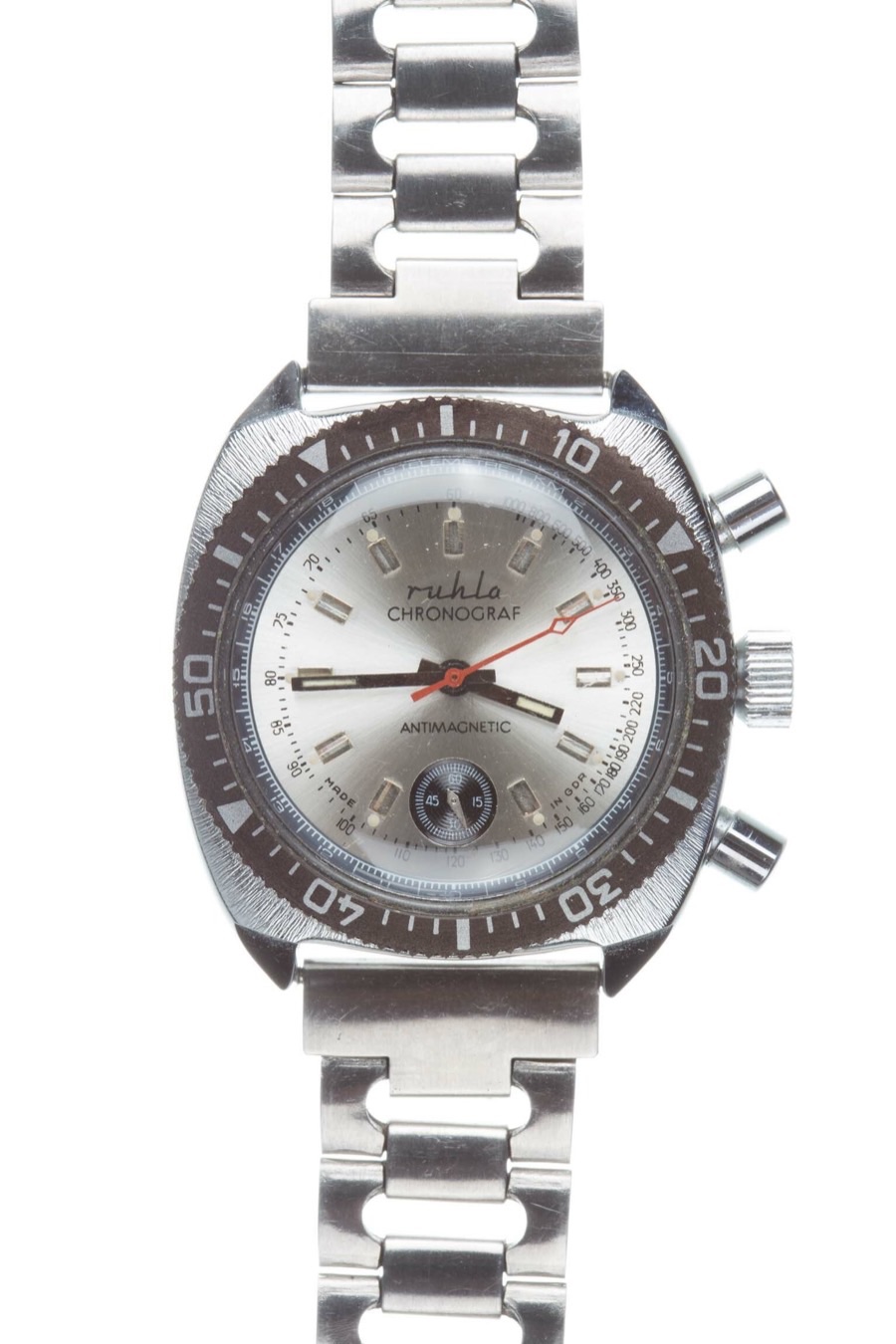
In the West, the German Wikipedia says the French occupying power took machines from Junghans and other Black Forest factories as reparations, yet the region’s clock industry was back to 85 per cent of its pre-war output by 1949.4, 8
Junghans says it was Germany’s largest maker of chronometers by 1951 and the third largest in the world by 1956, the year the Nuremberg group Diehl took control of the firm.8, 13
Smaller firms carried on beside it: Laco and its movement maker Durowe, sold to the American Timex group in 1959; Stowa, which moved its production to Rheinfelden after the Pforzheim raid; Tutima, carried on from around 1960 at Ganderkesee in Lower Saxony; and Sinn, founded in Frankfurt in 1961.25, 26, 45, 54, 55, 56, 57, 58
Part 6
Quartz, and the watch that sets itself
Junghans worked on a quartz wristwatch from 1967. It dates a pre-series of its Astro-Quartz, which it calls the first German quartz wristwatch, to 1970 and series production of its calibre to 1972; the German Wikipedia and the Junghans museum date the watch to 1971.8, 13, 59
Quartz ended most mechanical clockmaking in the Black Forest within a decade. The German Wikipedia’s account says makers that stayed with mechanics failed in the mid-1970s, that small firms at St. Georgen reached fully automatic quartz production by 1985, and that the quartz lines of EMES and Kienzle were sold to China when those firms failed; it counts about 32,000 jobs in the Black Forest clock industry in 1970 and 1,369 in 2009.4
In Pforzheim the last movement maker closed in 1993, still turning out 18,000 quartz movements a day.6, 15
Germany’s own answer was the radio-controlled clock. From 1973 the long-wave transmitter DCF77 at Mainflingen, near Frankfurt, broadcast coded time and date for the national metrology institute, the Physikalisch-Technische Bundesanstalt; the engineer Wolfgang Hilberg had patented coded radio time for clocks in 1967.9, 60, 61
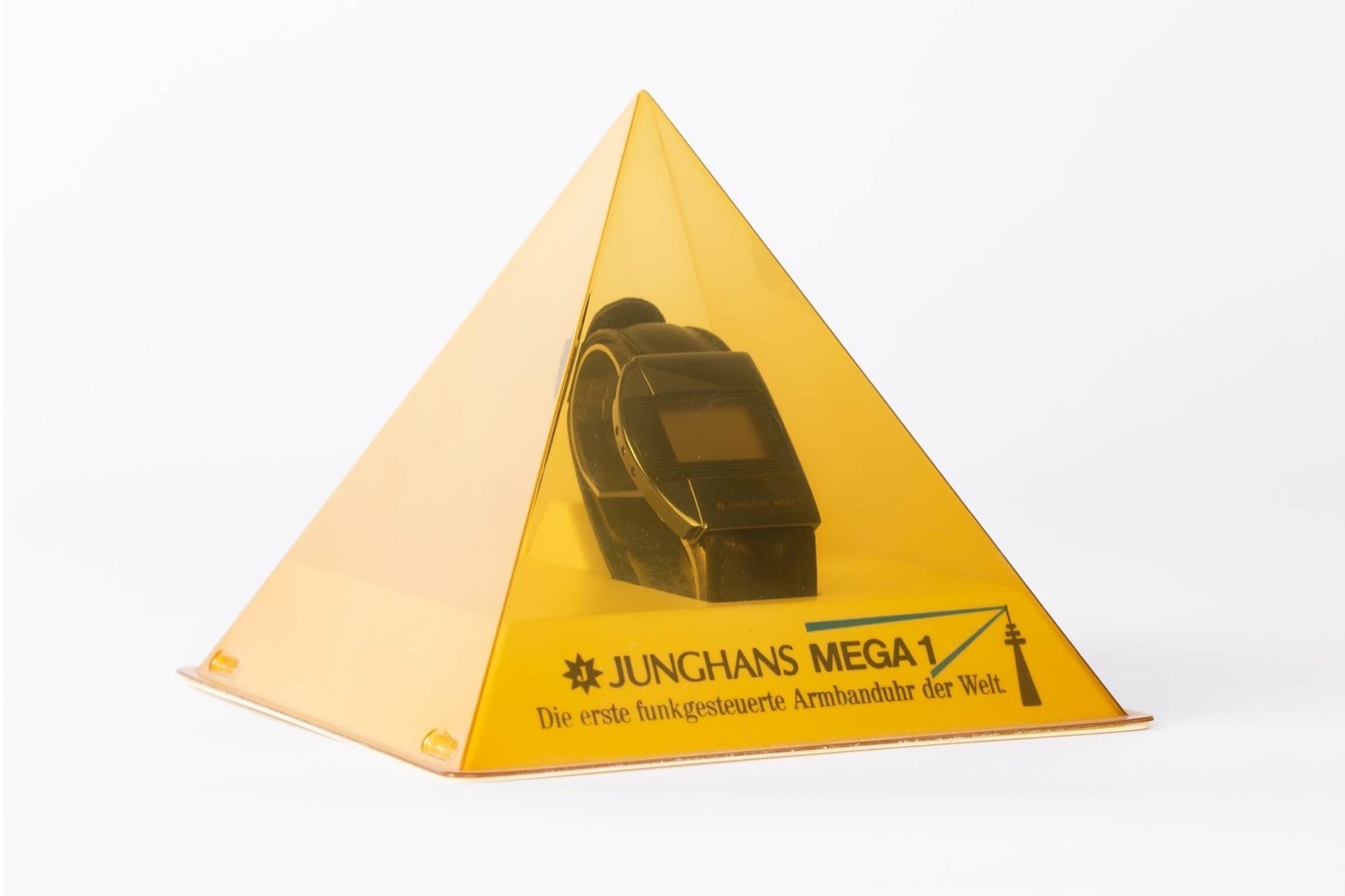
Schramberg’s town collection records that Junghans, in 1985, was the first maker to bring out a series-made radio-controlled table clock once Hilberg’s patent had lapsed, and the Deutsches Uhrenmuseum holds the Junghans MEGA 1 of 1990, whose box calls it the world’s first radio-controlled wristwatch.9, 13, 27, 61
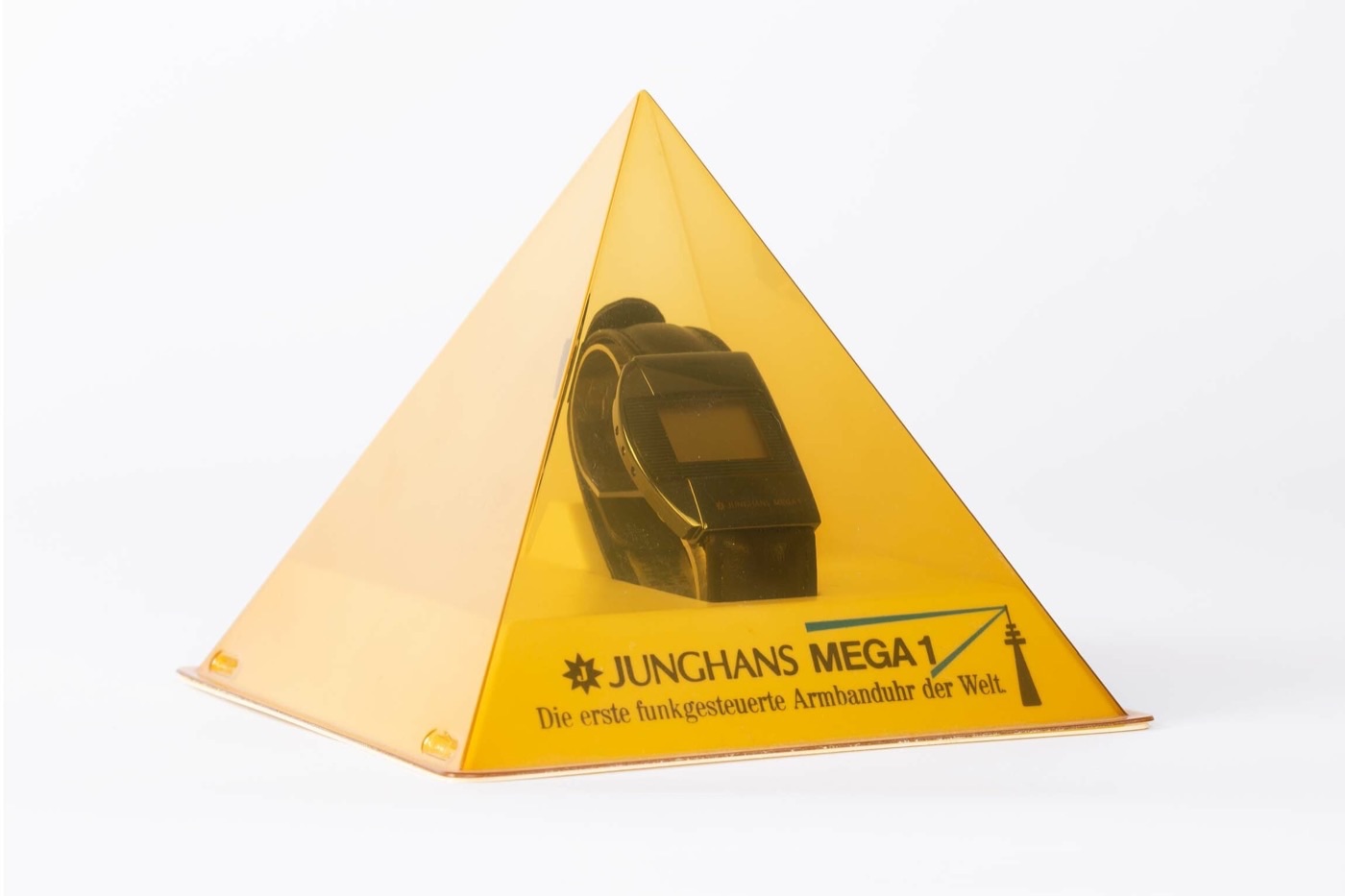
Ruhla went the same way. Its chronicle says the works put a patented radio-controlled table clock, calibre 49, into production in 1989, and that its successor Gardé showed an analogue radio-controlled wristwatch at the Basel fair in 1995.7
Part 7
Reunification and after
After 1990 the Treuhand sold off the Ruhla combine in pieces, and dozens of new firms grew from it. One of them, the watchmaker Gardé, failed in 2019; its watch assembly and museum passed to the watch company POINTtec under the old name Uhrenwerke Ruhla.7, 17
Glashütte became the centre of the revival: A. Lange & Söhne was refounded in 1990, NOMOS was founded the same year, and the former state company became Glashütte Original in 1994.10, 22, 23, 64, 65
In the Black Forest, Diehl sold the Junghans watch business to the holding company Egana Goldpfeil in 2000. After Egana ran into difficulties, Junghans filed for insolvency in 2008 and was bought in 2009 by the Schramberg entrepreneur Hans-Jochem Steim and his son.8, 13
Kienzle, by the German Wikipedia’s account, went bankrupt in 1996 and was bought by a Hong Kong group in 1997.4, 66
The history is kept in museums: the Deutsches Uhrenmuseum at Furtwangen grew from the collection Gerwig began at his school in 1852, and the Junghans Terrassenbau of 1918 opened as a museum in 2018.8, 35, 59, 67
Through this history
The companies, people, technologies, objects and events this chapter is made of, in the order the story meets them.
Place
The Black ForestWhere wooden clocks were made in cottage workshops and carried across Europe on peddlers’ backs.1, 2, 4
Group
VEB Uhrenkombinat RuhlaEast Germany’s watch combine of 1967, which joined the works of Ruhla, Glashütte and Weimar.7, 17
Specification
The B-UhrThe air force navigator’s watch made by Laco, Stowa and A. Lange & Söhne in the Second World War.18, 19, 20
Event
The Second World WarGlashütte’s makers in the armaments industry from 1938, and the town bombed in 1945.10, 21
Group
VEB Glashütter Uhrenbetriebe (GUB)The East German state company of Glashütte, joined to the Ruhla combine in 1967.7, 10, 21
Event
Glashütte after reunificationThe years 1990 to 1994, when the state works was privatised and A. Lange & Söhne, NOMOS and Mühle-Glashütte were founded or refounded.10, 22, 23, 24
Object
The Junghans MEGA 1The radio-controlled wristwatch Junghans put on sale in 1990, set by PTB’s DCF77 time signal; the Deutsches Uhrenmuseum holds two.27, 28, 29
Key dates
- 1850
The Grand Ducal Baden clockmaking school opens at Furtwangen under Robert Gerwig.30, 34, 35
- 1861
Erhard Junghans and Jakob Zeller-Tobler found Zeller & Junghans at Schramberg.8, 13
- 1862
Christian and Georg Thiel found their metalware firm at Ruhla.7, 51
- 1872
Arthur Junghans goes to work in American factories.3, 12
- 1891
Thiel’s Fearless pocket watch, sold for three marks (1891 or 1892).7, 17
- 1933
Ludwig Hummel founds the movement maker Durowe in Pforzheim.44, 45
- 1945
A Royal Air Force raid destroys Pforzheim on 23 February.6, 16
- 1952
The Ruhla works become the state-owned VEB Uhren- und Maschinenfabrik.7, 17
- 1956
The Diehl group takes control of Junghans.8, 13
- 1967
Ruhla, Glashütte and Weimar are combined as the VEB Uhrenkombinat Ruhla.7, 17
- 1973
DCF77 begins broadcasting coded time and date.9, 60
- 1985
Junghans brings out a series-made radio-controlled table clock.9, 13
- 1990
Junghans MEGA 1 radio-controlled wristwatch.13, 27
- 1993
Pforzheim’s last movement maker closes.15
Where this leads
- Before, Era IIIBritain’s watch industry
1750 to 1980
- After, Era IIIFrom the pocket to the wrist
1880 to 1930
Where German watchmaking leads
- See also, HistoryAmerica industrializes the watch
Black Forest factories built their alarm clocks on American methods from the 1870s.3, 4
- See also, HistoryThe electric and quartz revolution
Quartz ended most of the Black Forest clock industry, while Junghans brought out radio-controlled clocks from 1985.4, 9
- See also, HistoryWatches go to war
German clock and watch factories turned to fuses in both world wars, and Pforzheim and Glashütte were bombed in 1945.7, 8, 10, 16
Facts and sources
- Period
- 1845 to today (Black Forest clockmaking from about 1730)1, 4, 5
- Where
- The Black Forest (Furtwangen, Schramberg, Schwenningen), Pforzheim, Glashütte in Saxony and Ruhla in Thuringia3, 5, 6, 7, 30
Sources
- 1
Schwarzwalduhren – seit 300 Jahren ein Erfolg (opens in a new tab)
- 2
- 3
- 4
- 5
Die Geschichte der Uhrenstadt Glashütte (opens in a new tab)
- 6
Die Pforzheimer Schmuck- und Uhrenindustrie im Wandel der Zeit (opens in a new tab)
- 7
- 8
- 9
Junghans Tischfunkuhr, 1985 (Inv. 7107) (opens in a new tab)
- 10
- 11
- 12
- 13
- 14
- 15
- 16
OB-Ansprache Gedenkfeier Hauptfriedhof, 23. Februar 2020 (opens in a new tab)
- 17
- 18
- 19
The History of the Pilot Watch Part Five: B-Uhr (opens in a new tab)
- 20
Military Watches of the World: Germany Part 1 (opens in a new tab)
- 21
- 22
- 23
NOMOS Glashütte: independent German watch manufacturer (opens in a new tab)
- 24
- 25
- 26
- 27
Armbanduhr, Junghans, Schramberg, 1990 (Inv. 1995-604) (opens in a new tab)
- 28
Armbanduhr, Junghans, Schramberg, um 1990 (Inv. 1995-245) (opens in a new tab)
- 29
- 30
Themen im Museum (permanent exhibition overview) (opens in a new tab)
- 31
Uhrenträger-Krätze, Schwarzwald (Inv. 19-2037) (opens in a new tab)
- 32
Die ersten Schwarzwälder Kuckucksuhren (Teil 1) (opens in a new tab)
- 33
- 34
Zeit der Experimente – Gewerbeförderung in Furtwangen (opens in a new tab)
- 35
- 36
Musteruhr, Uhrmacherschule Furtwangen, um 1852 (Inv. 17-0134) (opens in a new tab)
- 37
Babywecker, Junghans, Schramberg, ca. 1888-1890 (Inv. 2006-124) (opens in a new tab)
- 38
- 39
- 40
Junghans in den 1890er Jahren. Ein Arbeiter berichtet (opens in a new tab)
- 41
- 42
- 43
- 44
- 45
- 46
Armbanduhrwerk, PUW, Pforzheim, um 1966 (Inv. 48-2853-E13) (opens in a new tab)
- 47
Armbanduhr Helbros Lunar Time, PUW, Pforzheim, 1970 (Inv. 2018-054) (opens in a new tab)
- 48
Taschenuhr mit Automat, Gebrüder Thiel, Ruhla, um 1900 (Inv. 2007-024) (opens in a new tab)
- 49
Luftangriff auf Pforzheim am 23. Februar 1945 (opens in a new tab)
- 50
Bomber Command summary of the raid on Pforzheim, 23/24 February 1945 (opens in a new tab)
- 51
- 52
- 53
- 54
Laco Watch Company: A Brand Highlight with a Family Perspective (opens in a new tab)
- 55
The STOWA history: mechanical watches from the Black Forest since 1927 (opens in a new tab)
- 56
- 57
- 58
You are there: visiting Tutima Glashütte in Germany (opens in a new tab)
- 59
- 60
- 61
- 62
- 63
- 64
- 65
How The Wall Came Tumbling Down: Watches Made In Germany (Reprise) (opens in a new tab)
- 66
- 67
170 Jahre Deutsches Uhrenmuseum, Teil 1: 1852-1945 (opens in a new tab)
Sources read November 12, 2026.