Ruhla
A small metalworking town in the Thuringian Forest where the Thiel brothers’ works made cheap machine-made pocket watches from the 1890s, and which led East Germany’s watch combine, making everyday watches by the million, until reunification.
Germany, Thuringia, in the Thuringian Forest near Eisenach
Companies here Junghans
In the history German watchmaking
Why here?
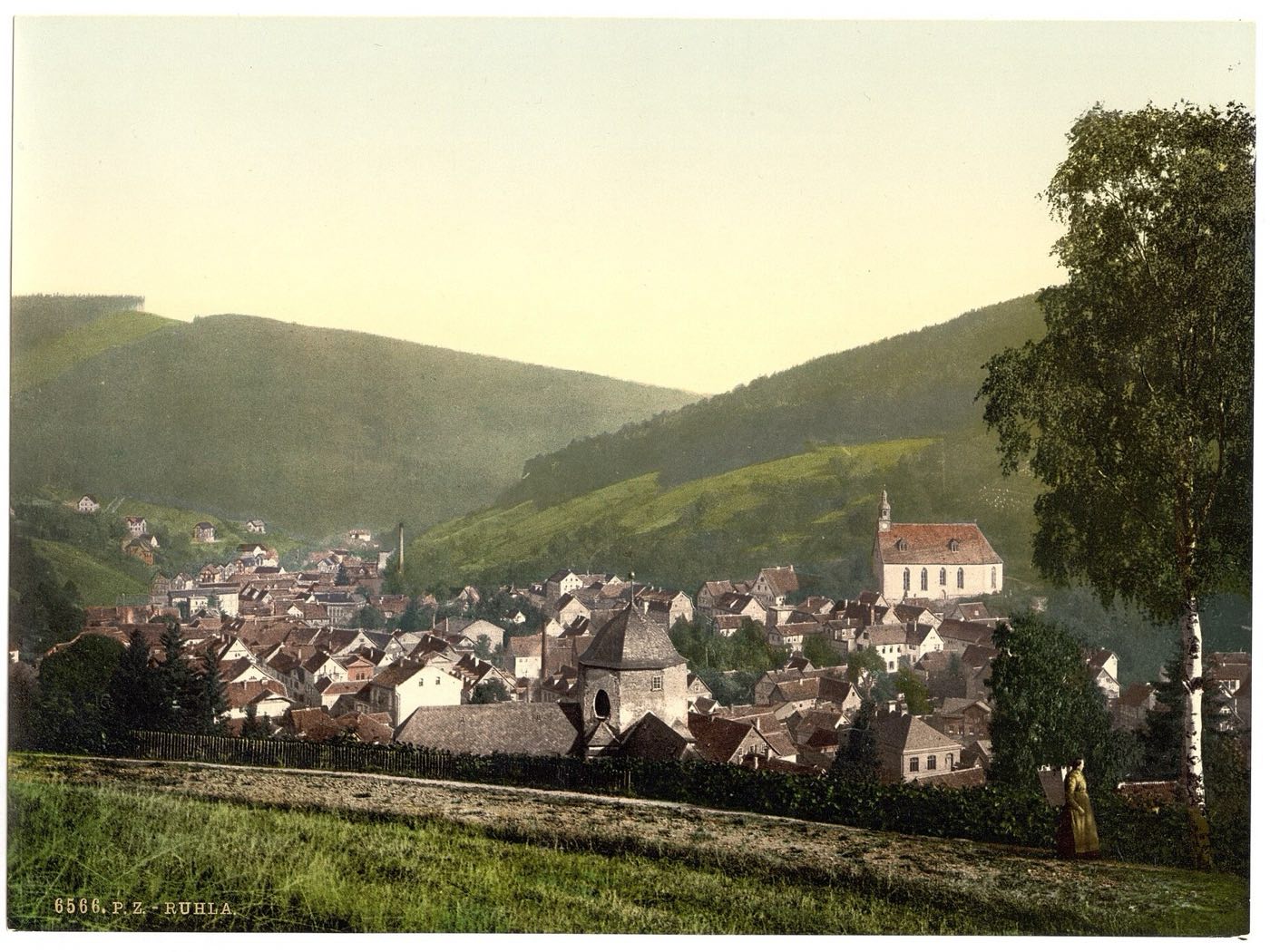
Ruhla was a metalworking town long before it made watches. It grew from forest smiths who mined, smelted and forged blades in the Middle Ages; from about 1530 its people turned to knives, and for some two hundred years cutlery was its main trade.1, 4
As the knife trade declined, Ruhla turned to fittings for tobacco pipes and then to whole pipes, including pipes of meerschaum and its imitation; in the middle of the nineteenth century it made millions of pipe bowls a year.1, 4
Water power counted: in 1873 the Thiel brothers moved their works to the site of a former felt factory in the valley because their old workshop had no stream for a water wheel.2, 3
What grew here
In 1862 the brothers Christian and Georg Thiel founded a metalware works in Ruhla making pipe fittings and other small metal goods; in 1874 it began making toy clocks, sold in large numbers to England and the United States.2, 3, 4
The town’s chronicle adds that a beer counter for innkeepers, in 1871, was the firm’s step towards clockwork, and that an American customer in 1880 wanted toy clocks that ran for an hour and cost one mark.2
In 1891 or 1892 Thiel brought out a machine-made pocket watch, the Fearless, nicknamed the “Rühler Kartoffel”, for three marks; by 1897 about 1,000 workers made 4,000 a day.2, 3, 6
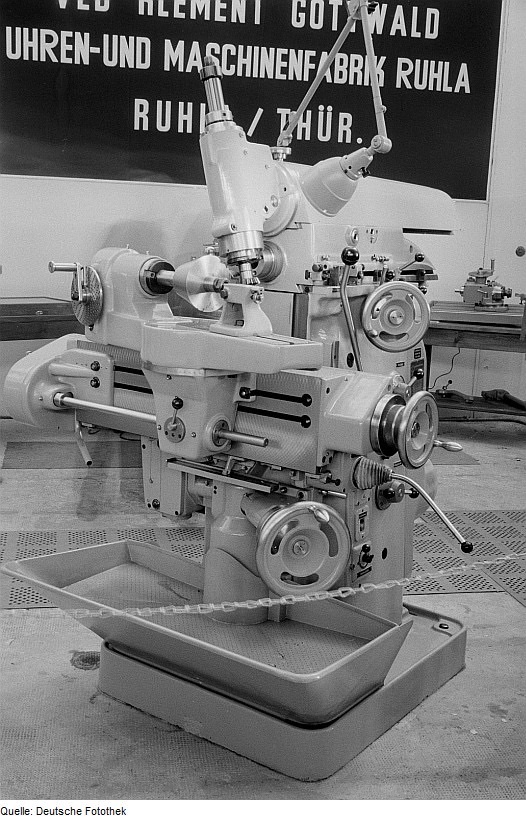
The firm built its own special machines and tools, from 1905 in a central workshop that later sold machines to other firms; machine tools stayed a second business of the Ruhla works through the East German years.2, 3
The chronicle says Thiel put the Darling, which it calls the first German women’s wristwatch, into series production in 1908, and that the Regular pocket watch of 1925 was made until 1975.2
Between 1927 and 1930 the firm put up new factory buildings and an administration building in the modern style; the building of 1929, by the Jena architects Schreiter & Schlag, still stands and houses the watch museum.2, 3
Who and what moved through
Ruhla’s cheap pocket watches sold abroad, above all, in the early years, in America.2, 4
Its movements went to the Black Forest too: the German Wikipedia says Junghans began making wristwatches in 1927 with movements bought from Thiel.9
War brought fuses. Thiel began making clockwork fuses in 1909 at the suggestion of Krupp; the chronicle says it made about 5,000 a day in 1917, and the German Wikipedia says a subsidiary at Mühlhausen was a main supplier of clockwork for anti-aircraft shell fuses in the Second World War, when most of the firm’s nearly 10,000 workers were forced and eastern labourers.2, 3, 4
In 1945 the Red Army took over the works and the branch factories at Seebach, Waltershausen and Mühlhausen were dismantled; in 1946 the Ruhla works were handed to the Soviet joint-stock company Awtowelo as reparations, and on 1 May 1952 they became the state-owned VEB Uhren- und Maschinenfabrik Ruhla.2, 3
In 1967 Ruhla became the head of the VEB Uhrenkombinat Ruhla, which joined it to the watch factories of Glashütte, then VEB Glashütter Uhrenbetriebe, and Weimar.2, 3
The chronicle says a Ruhla digital stopwatch was used for experiments on the 1978 space flight of Sigmund Jähn, East Germany’s cosmonaut.2
What changed because of it
Ruhla made East Germany’s everyday watches. Its calibre 24, made from 1963, is counted three ways: over 116 million by 1991 in the town’s chronicle, more than a hundred million in the German Wikipedia’s article on the works, and more than 120 million by 1987 in its article on the town.2, 3, 4
Quantity came at a cost. The German Wikipedia says the satirical magazine Eulenspiegel reported in 1975 that 22 per cent of Ruhla watches failed within the guarantee period.3
The chronicle says Ruhla made quartz wristwatches in series from 1976, a quartz alarm clock from 1979 and watch circuits in a new factory at Seebach from 1989, and in the same year put a radio-controlled table clock, calibre 49, into production; the museum records a Ruhla chronograph presented in 1969.2, 10
After reunification the combine was sold off in pieces and the old factory buildings were largely pulled down. The watchmaker Gardé, founded from it in 1991, opened a watch museum in 2002 and failed in 2019; its watch assembly and museum passed to POINTtec under the old name Uhrenwerke Ruhla.1, 2, 3
Key dates
- 1862
Christian and Georg Thiel found their metalware works.2, 4
- 1873
The works move to a site with water power in the valley.2, 3
- 1874
Toy clocks go into production.2, 3
- 1891
The Fearless pocket watch (1891 or 1892).2, 3
- 1897
Thiel makes 4,000 pocket watches a day.2, 3
- 1909
Clockwork fuse production begins.2
- 1946
The works are handed to the Soviet company Awtowelo as reparations.2
- 1952
The works become the VEB Uhren- und Maschinenfabrik Ruhla on 1 May.2, 3
- 1963
Calibre 24 goes into series production.2, 3
- 1967
VEB Uhrenkombinat Ruhla, with Glashütte and Weimar.2, 3
- 1991
Gardé Uhren Ruhla is founded from the combine.2, 3
- 2019
Gardé fails; POINTtec continues as Uhrenwerke Ruhla.2, 3
Where Ruhla leads
- Based here, GroupVEB Uhrenkombinat Ruhla
The combine was run from the Ruhla works, whose head became its director-general.2, 3, 11
- Part of, HistoryGerman watchmaking
The Thuringian town of cheap pocket watches and, later, East Germany’s watch combine.2, 3
- See also, CompanyJunghans
The German Wikipedia says Junghans began making wristwatches in 1927 with movements bought from Gebrüder Thiel in Ruhla.9
- See also, GroupVEB Glashütter Uhrenbetriebe (GUB)
In 1967 the Ruhla works and the Glashütte state company were joined in the VEB Uhrenkombinat Ruhla.2, 3
- See also, EventThe Second World War
Ruhla’s chronicle counts about 10,000 people working for the Thiel firms in 1944, making clockwork fuses; the German Wikipedia says most were forced and eastern labourers.2, 3
Facts and sources
Sources
- 1
- 2
- 3
- 4
- 5
- 6
Taschenuhr mit Automat, Gebrüder Thiel, Ruhla, um 1900 (Inv. 2007-024) (opens in a new tab)
- 7
- 8
- 9
- 10
Armbanduhr, VEB Uhrenkombinat Ruhla, DDR, um 1975 (Inv. 2019-052) (opens in a new tab)
- 11
Sources read November 12, 2026.