Blois
A royal town on the Loire whose watchmakers, many of them Protestant, made engraved and then enamelled watches in the 17th century, some of them for the court; the trade shrank in the later 17th century, after the death of Gaston d'Orléans in 1660 and the Revocation of 1685, as Huguenot makers left.
France, Loir-et-Cher, on the Loire (Centre-Val de Loire)
In the history Time in the pocket
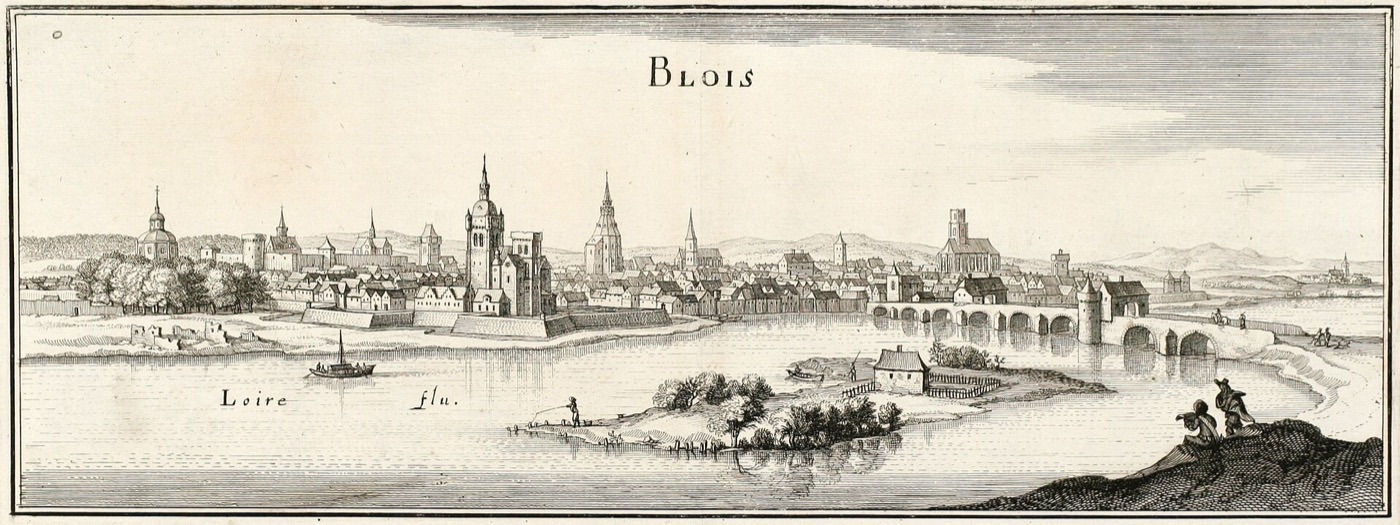
A royal town
Blois was the seat of a county that joined the royal domain in 1498, when its count, Louis d'Orléans, became Louis XII. Through the 16th century the kings stayed there often, and the town was a royal city.1, 9, 10
The V&A's record of a Lemaindre carriage watch credits Blois makers with royal patronage and puts their movements, engraving and enamelling on a level with those of Paris. The Met adds that enamel painting in Blois flourished under the protection of Gaston d'Orléans, and in 1682 the town's historian Jean Bernier wrote that its watchmaking was "esteemed by all Europe".4, 11, 12
Many of the makers were Protestants. The V&A describes the town's trade in silver, watches and jewellery as dominated by Huguenots, and the Met writes that a large number of 17th-century French clock- and watchmakers were Protestants.3, 7
In the Wars of Religion armies of both sides fell on the town, in 1562 and again in 1567-1568. Bergevin and Dupré, the town's historians of 1846, put those troubles down to party leaders from outside and wrote that the two faiths otherwise lived on fair terms in Blois.1, 10
Makers and families
On 20 June 1600 the Blois watchmakers were made a sworn trade on the model of the Paris statutes, by an act that Alfred Bourgeois printed in 1892 among the town's trade records. It names Paul Cuper the elder and the younger, Simon Gribolin, Charles Poiras, Marc Gyrard, Salomon Chesnon and Nicolas le Maindre, and among them Abraham de la Garde, watchmaker and valet de chambre to the king.5
Some families stayed for generations: the Met records the Cuper clockmakers in Blois from the mid-16th century until the late 19th. Others came from abroad. Philippe Verdier wrote in 1963 that many who engraved Blois watchcases in the 17th century were from the Netherlands, Marc Girard among them.5, 7, 13
The V&A holds a carriage watch signed 'A Blois Nicolas Lemaindre 1630'. Its record makes Nicolas I Lemaindre horloger to the queen mother, Marie de Médicis, who was for a time exiled to Blois, and his nephew Nicolas II horloger to Gaston d'Orléans, the brother of Louis XIII; it does not say which of the two made this watch.4, 14
Engraving and enamel
Engraved cases came before enamelled ones. A watch in the V&A signed 'Gribelin A Blois' and dated 1614 has a dial engraved with Abraham about to sacrifice Isaac, and the museum holds an engraved silver watch of about 1615 made in Blois by Charles Perras, signed 'Charles Barras A Bloys'. The Met dates Pierre Landré's Blois watch to about 1630-1640.3, 15, 16, 17
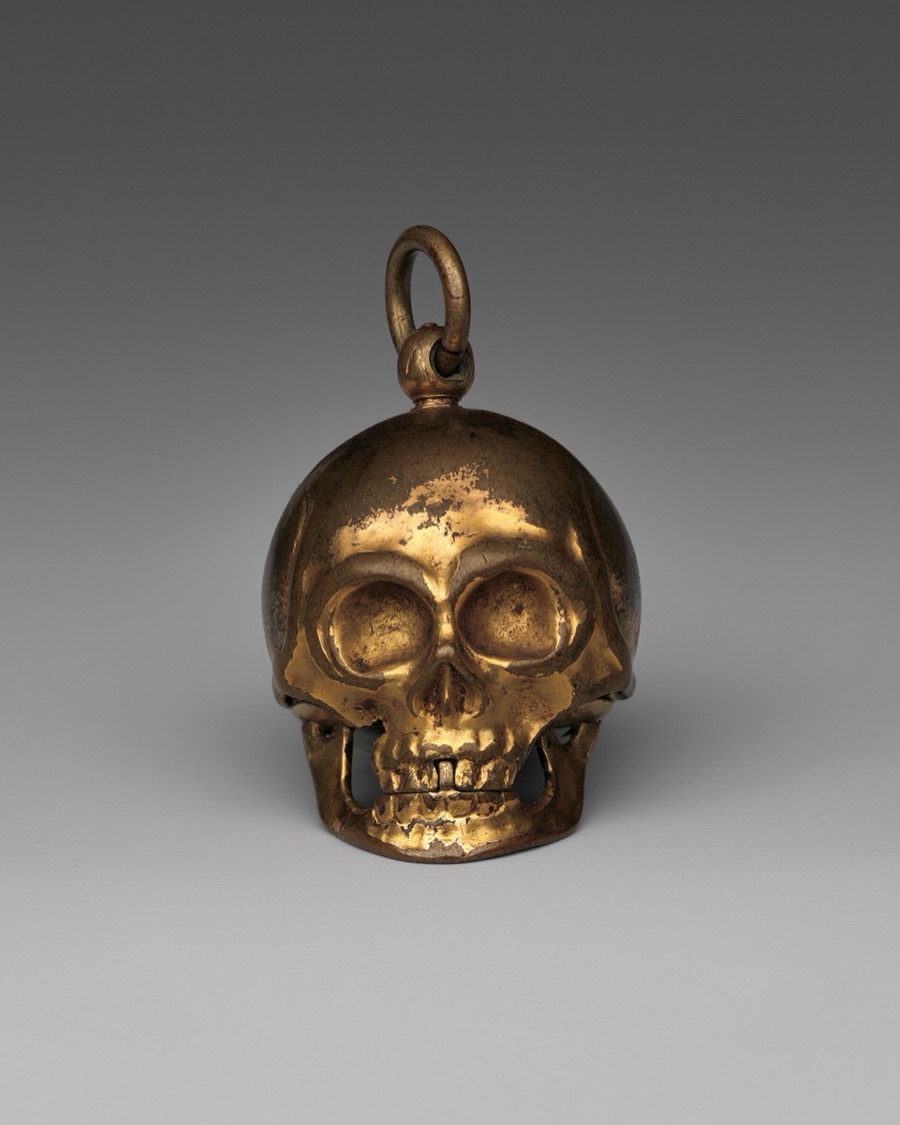
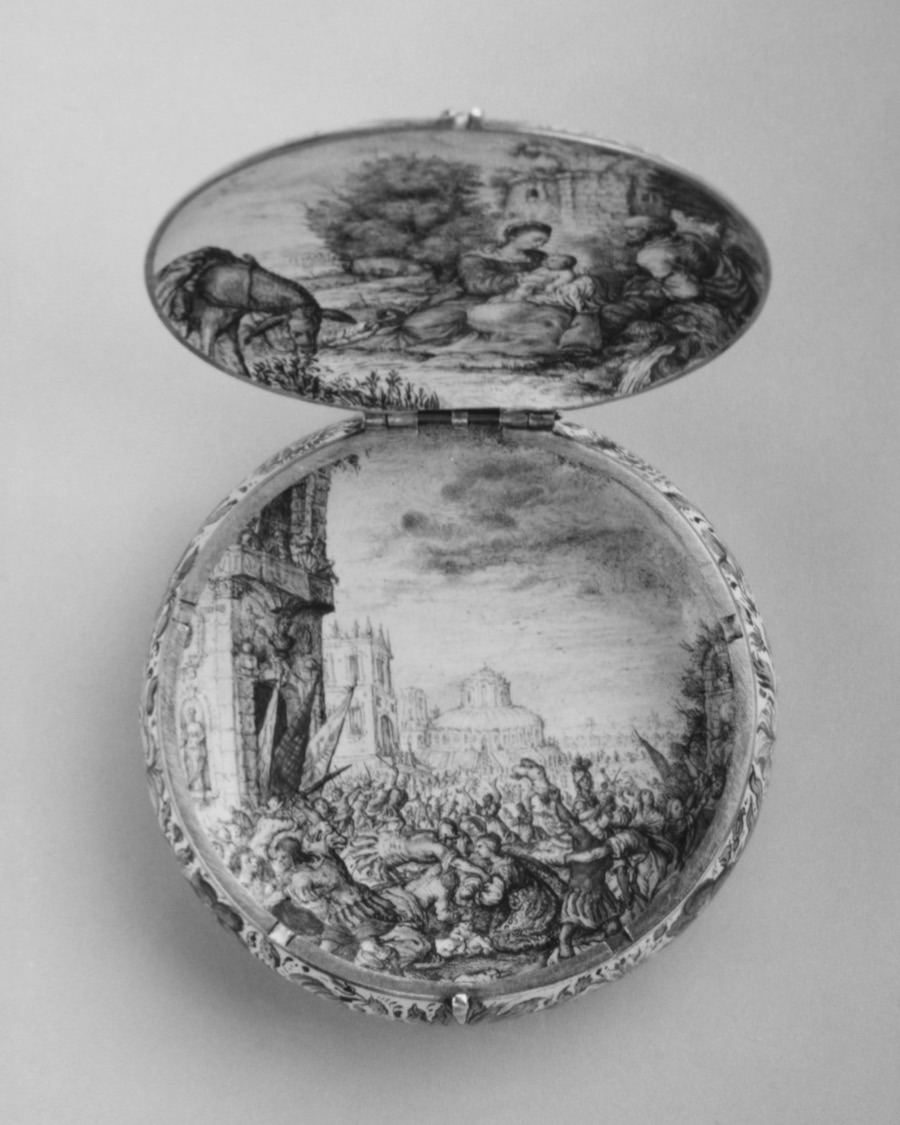
From the early 17th century enamelled cases came into fashion, and in Blois, as in Châteaudun and Paris, watches and jewellery were often painted with allegorical figures in enamel. Bernier wrote that the enameller Christophe Morlière lived in Blois without being a native, and that his pupil Robert Vauquer was born there; Verdier called Morlière the most successful case enameller in the town. The Met dates a case enamelled by Morlière to about 1645-1650, and the Louvre holds a Blois case enamelled by Vauquer, dated 1640-1660.3, 12, 13, 19, 20, 21
Decline
Accounts of Gaston d'Orléans's years at Blois differ. The château's own history has him driven from court again in 1634 and staying often at Blois, with a last exile there from 1652; the town council minutes printed by Bergevin and Dupré celebrate his return in October 1634; Touchard-Lafosse has him exiled to Blois several times and retiring there in 1636. He died at Blois on 2 February 1660.6, 9, 10
Touchard-Lafosse wrote in 1841 that after Gaston's death nearly all the nobles, scholars and artists of his circle left for Saint-Germain, and that the town's industry and trade fell quickly into decline. For watchmaking he counted 38 masters in 1670 and 17 in 1686, the year after the Revocation of the Edict of Nantes, and gave no figure for Gaston's time.6
After the Revocation, several Blois families with useful trades left the kingdom to practise their religion, while others, the Cupers among them, abjured and stayed, as Bergevin and Dupré record; La Saussaye wrote in 1867 that the Revocation destroyed most of the town's industrial workshops. The Met's catalogue adds that Blois had begun to lose Huguenot clockmakers before 1685.2, 7, 10
In the V&A's reading, the town's watchmakers and goldsmiths of the 17th century stayed closely tied to Geneva, London and Paris. The Met records Pierre II Cuper, born in 1604, as active in Constantinople in 1634, and Nicolas Massy, born in Blois, as in London by 1682, where the Clockmakers' Company minutes call him a French Protestant and where he was naturalised in 1685; the engraver Simon Gribelin (1661-1733), another émigré from Blois, joined the same company in 1687.3, 7
Blois work survives in the Louvre, the British Museum, the V&A and the Metropolitan Museum of Art.4, 14, 17, 21, 23
Where Blois leads
- Part of, HistoryTime in the pocket
The French court town whose makers engraved and enamelled watches for royal patrons.3, 4, 11
- See also, PlaceGeneva
The V&A records close links between 17th-century Blois watchmakers and Geneva.3
- See also, PlaceLondon
Nicolas Massy, born in Blois, was a watchmaker in London by 1682; Huguenot watchmakers settled in Soho after 1685.7, 24
- See also, PlaceParis
The V&A credits Blois makers with work that rivalled Paris under royal patronage.4
Facts and sources
- Country
- France25, 26, 27
- Region
- Loir-et-Cher, on the Loire (Centre-Val de Loire)2, 3, 25, 26
Sources
- 1
- 2
Blois et ses environs: guide artistique et historique (L. de La Saussaye, 1867) (opens in a new tab)
- 3
- 4
Carriage watch, Nicolas Lemaindre, Blois, 1630 (2366-1855) (opens in a new tab)
- 5
Les métiers de Blois, tome I (Alfred Bourgeois, 1892) (opens in a new tab)
- 6
Histoire de Blois et de son territoire (G. Touchard-Lafosse, 1841) (opens in a new tab)
- 7
- 8
- 9
- 10
Histoire de Blois (L. Bergevin & A. Dupré, 1846), tome I (opens in a new tab)
- 11
Watch, Nicolas Gribelin (the Younger?), case ca. 1650-60 (17.190.1559) (opens in a new tab)
- 12
- 13
- 14
Watch; watch-case, Nicholas Lemaindre, 1610-1620 (1888,1201.183) (opens in a new tab)
- 15
Watch, Simon Gribelin, 1614 (1066-1853) (opens in a new tab)
- 16
Watch, Charles Perras, Blois, about 1615 (394-1888) (opens in a new tab)
- 17
Watch, Pierre Landré, ca. 1630-40 (17.190.1574) (opens in a new tab)
- 18
- 19
Locket pendant, enamel on gold, about 1630-1640 (Gilbert collection) (opens in a new tab)
- 20
Watch case, Christophe Morlière, ca. 1645-50 (17.190.1583) (opens in a new tab)
- 21
Boîtier de montre, Robert Vauquer, 1640-1660 (OA 10077) (opens in a new tab)
- 22
- 23
Watch; watch-case, Blaise Foucher, 1645-1655 (1888,1201.218) (opens in a new tab)
- 24
- 25
API Découpage administratif: commune 41018 (Blois) (opens in a new tab)
- 26
Code officiel géographique: Blois (41018) (opens in a new tab)
- 27
Watch, movement by N. Lemaindre, Blois, 1620-1630 (M.132-1923) (opens in a new tab)
Sources read November 12, 2026.