The tourbillon
A regulator that carries the balance and escapement in a turning cage to average out the errors of a watch held upright, patented by Abraham-Louis Breguet in 1801 and revived in the wristwatch since the 1980s.
Introduced 7 Messidor Year IX (26 June 1801), by Abraham-Louis Breguet
Companies Lip
Developed by Abraham-Louis Breguet
In the histories France and the science of horology, The mechanical revival and the independents
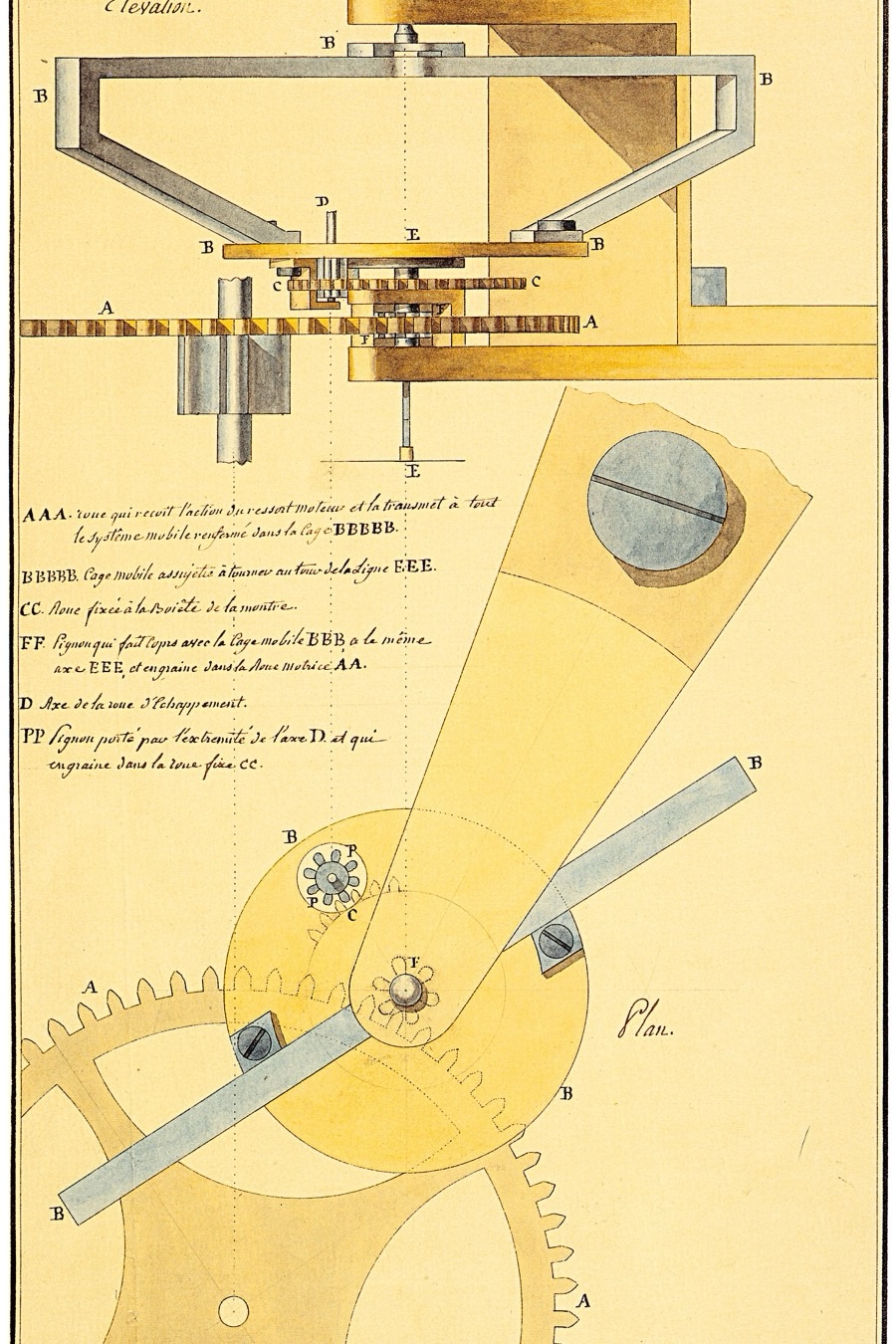
How it works
A tourbillon carries the balance and escapement in a cage that turns continuously, so that the errors a watch makes in each vertical position are averaged out.1, 2
It was meant for the pocket watch, which hung upright in a waistcoat for most of the day, where gravity distorted the hairspring's behaviour.1, 2
Breguet’s patent
Breguet’s history records that the patent of 26 June 1801 ran for ten years.1
Wikipedia says the idea was conceived by John Arnold and developed by Breguet; Breguet himself gave Arnold's son in 1808 an early Arnold chronometer rebuilt with a tourbillon, its plate calling it his first tourbillon regulator joined to one of Arnold's first works.2, 4
Breguet's own records count 35 tourbillons sold between 1805 and 1823, with two experimental pieces before.1
Breguet says that at the 1806 national exhibition it was described as keeping the same rate whatever the watch’s position.1
From the pocket to the wrist
Wikipedia counts fewer than a thousand made between 1801 and 1945, many for observatory chronometer trials.2
Wikipedia says the first wristwatch tourbillons appeared in the mid-twentieth century, in small numbers, from Patek Philippe, Lip and Omega.2
Wikipedia credits Audemars Piguet’s calibre 2870 of 1986, an automatic tourbillon wristwatch, with starting the modern revival.2
Wikipedia lists the variants that followed: double-axis (Anthony Randall, 1977), flying tourbillons supported from one side only (Alfred Helwig, 1920) and multi-axis designs since the 2000s.2
Does it help?
Wikipedia notes that whether a tourbillon ever made watches more accurate is debated among horologists; a modern wristwatch, which changes position constantly, does not need one to keep good time, and it is valued chiefly as a display of skill.2
Where the tourbillon leads
- Developed by, PersonAbraham-Louis Breguet
Granted the tourbillon patent on 26 June 1801.1, 2
- Part of, HistoryFrance and the science of horology
Breguet’s turning regulator, patented in 1801.1, 2
- Part of, HistoryThe mechanical revival and the independents
Breguet’s regulator, revived in the wristwatch from the 1980s, Wikipedia says.2
- See also, CompanyLip
Wikipedia names Lip among the makers of the first wristwatch tourbillons, in the mid-twentieth century.2
Facts and sources
- Patented
- 7 Messidor Year IX (26 June 1801), by Abraham-Louis Breguet1, 2, 5
Sources
- 1
Patent granted for a completely new type of regulator called the "Tourbillon" (opens in a new tab)
- 2
- 3
Breguet's drawing for his 1801 tourbillon patent. (opens in a new tab)
- 4
- 5
Sources read November 11, 2026.