Jean-Antoine Lépine
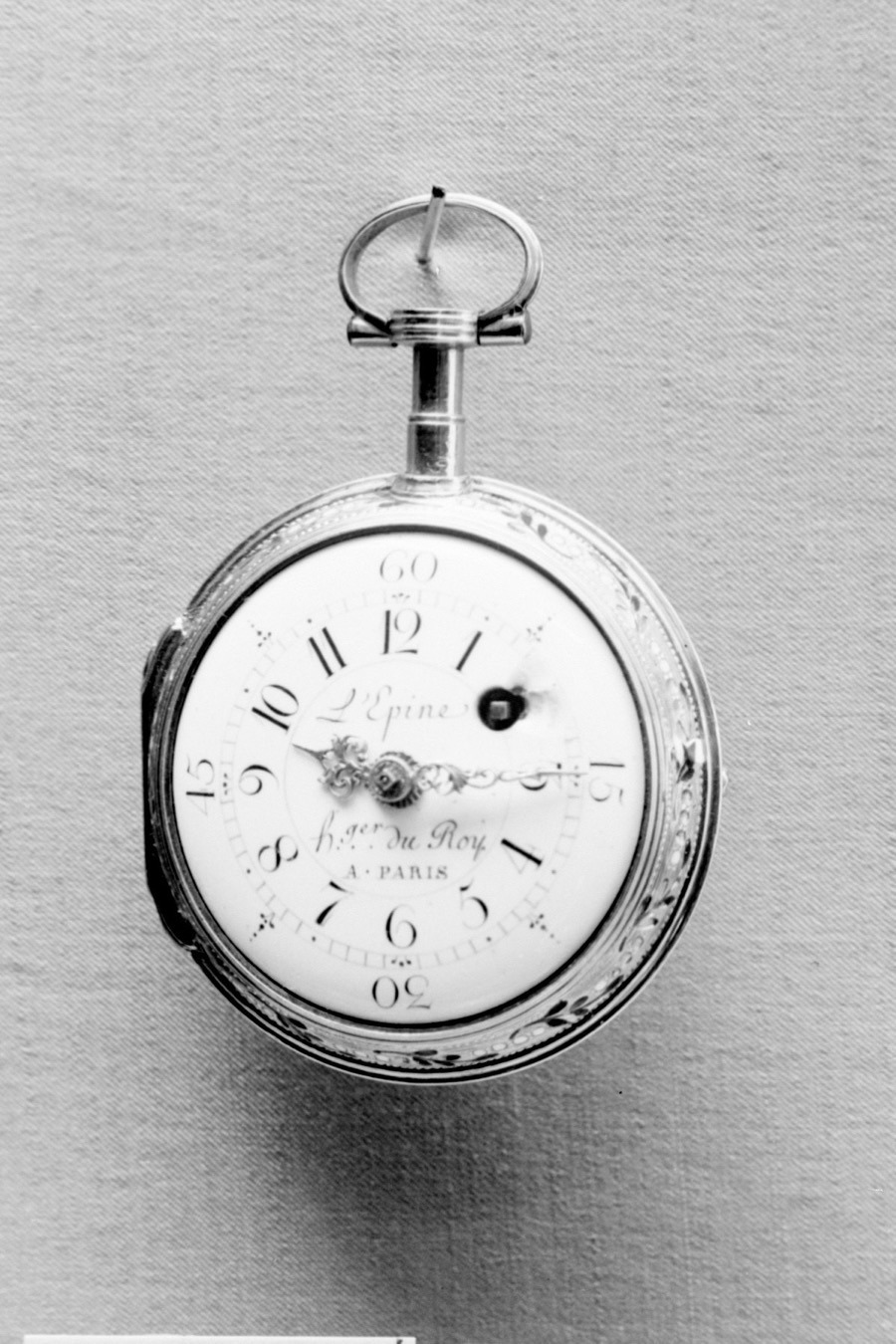
Paris watchmaker and clockmaker to the King from about 1766, whose calibre of separate bridges without a fusee made much thinner watches possible, and who supplied many watches to Abraham-Louis Breguet.
Born 18 November 1720, Challex (Pays de Gex), in the Louvre's record; the French Wikipedia gives 28 November, Died 31 May 1814, Paris
In the history France and the science of horology

From Challex to Caron’s workshop
He was born at Challex in the Pays de Gex, west of Geneva, learned the trade with a watchmaker named Decrose at Saconnex near Geneva, and moved to Paris in 1744.2, 7, 9, 12
In Paris he worked for André-Charles Caron, clockmaker to the King, married his daughter in 1756 and was his partner until 1769; his wife was a sister of Caron's son Pierre-Augustin, the future Beaumarchais.2, 11, 12, 13
Europa Star and the Instituto Português de Relojoaria make him a master on 12 March 1762, and Augarde and Ronfort give 1762; Artcurial and the French Wikipedia give 1765. The Metropolitan Museum dates his appointment as clockmaker to the King to “probably about the end of 1765 or the beginning of 1766”.1, 3, 7, 8, 9, 11
The Lépine calibre
His calibre replaced the top plate and its pillars with separate bridges and did away with the fusee, which made much thinner watches possible.2, 3, 15
Its date is not settled. Boettcher puts it around 1764, the Fondation de la Haute Horlogerie and Artcurial about 1770, and the Franche-Comté heritage inventory at the end of the eighteenth century or the start of the nineteenth.2, 4, 7, 15, 16
The name passed into the trade. Boettcher explains that Lépine's watches had no hunter lid, so any open-faced watch came to be called a Lépine, as opposed to the lidded savonnette, and that bridge movements are still called Lépine calibres.4, 8, 16
Who invented the virgule escapement is disputed. The Fondation de la Haute Horlogerie says Lépine claimed it late in life, against Beaumarchais and Jean-André Lepaute, and dates his perfecting of Lepaute's virgule to about 1780; Augarde and Ronfort call him its inventor.2, 3, 7, 11
He devised a new repeating mechanism; Artcurial dates it to 1763 and says the Académie des sciences published it in 1766.3, 7, 11, 16
Workshop and clients
He worked with Voltaire's watch manufacture at Ferney. Boettcher says it appears that most of his ébauches were made there between 1778 and 1782; his role is disputed: Augarde and Ronfort and the Fondation de la Haute Horlogerie call him its (technical) director, while Boettcher says his involvement is not fully known and Artcurial that his exact role is not known.2, 3, 4, 7
His tie to Breguet is not fully documented: the Louvre's Breguet exhibition says the young Breguet probably frequented his workshop, Boettcher says Breguet's archive records many watches supplied by Lépine, and Augarde and Ronfort call Lépine Breguet's master, though Boettcher holds that an apprenticeship is unproven.3, 4, 5, 11
He served as clockmaker to Louis XV and, according to the Fondation de la Haute Horlogerie, kept a royal title under Louis XVI and Napoleon. In 1789 Gouverneur Morris, judging him the leading watchmaker in Paris, ordered two identical watches from him, one for George Washington, and collected them that April.1, 2, 17, 18, 19
His daughter Pauline married his workman Claude-Pierre Raguet in 1782, and the two became partners in 1792. When Lépine gave up the business is disputed: 1783 according to the Fondation de la Haute Horlogerie, 1784 in one note by Augarde and Ronfort, but shortly after 1792, aged 73, in their note on Raguet (Artcurial gives about 1793). The firm then passed through a series of owners; Augarde and Ronfort record its sale by Ferdinand Verger in 1914.2, 3, 7, 8, 12, 20
Where Jean-Antoine Lépine leads
- Based in, PlaceParis
Worked in Paris from 1744 to 1814.9, 16
- Supplied, PersonAbraham-Louis Breguet
Breguet’s archive records many watches supplied by Lépine, and Breguet built most of his watches on modified Lépine calibres.5, 16
- Part of, HistoryFrance and the science of horology
The royal watchmaker whose bridge calibre made the thin watch possible.9, 16
Facts and sources
- Born
- 18 November 1720, Challex (Pays de Gex), in the Louvre's record; the French Wikipedia gives 28 November6, 7, 8, 9, 10
- Died
- 31 May 1814, Paris6, 7, 9, 10, 11
- Worked in
- Paris, from 17442, 7, 8, 12
Sources
- 1
Watch, Jean Antoine Lépine, ca. 1766 (89.2.69) (opens in a new tab)
- 2
- 3
Jean Antoine Lépine, régulateur de bureau à poids en acajou (notice) (opens in a new tab)
- 4
- 5
Breguet: history (exhibition 'Breguet, un apogée de l'horlogerie européenne') (opens in a new tab)
- 6
Montre ronde (OA 8550), Lépine, Jean-Antoine (opens in a new tab)
- 7
- 8
The 18th Century, the Century of the Great Watchmakers (Part 7) (opens in a new tab)
- 9
- 10
Lépine, Jean-Antoine (1720-1814): notice de personne (opens in a new tab)
- 11
Who fired first, the French or the English? (opens in a new tab)
- 12
- 13
- 14
- 15
L'horlogerie du Pays de Montbéliard (dossier IA25001992) (opens in a new tab)
- 16
- 17
Gouverneur Morris to George Washington, 23 February 1789 (opens in a new tab)
- 18
From George Washington to Gouverneur Morris, 28 November 1788 (opens in a new tab)
- 19
To George Washington from Gouverneur Morris, 29 April 1789 (opens in a new tab)
- 20
Claude Pierre Raguet-Lépine, table regulator (notice) (opens in a new tab)
Sources read November 12, 2026.