Automatic winding
Winding a watch by the wearer’s movement: a weight that swings or turns inside the case winds the mainspring. Made for pocket watches from the 1770s, it stayed rare until the wristwatch revived it in the 1920s.
Introduced 1770s in pocket watches; 1920s in wristwatches
Companies Rolex
Developed by John Harwood, Rolex
In the history From the pocket to the wrist
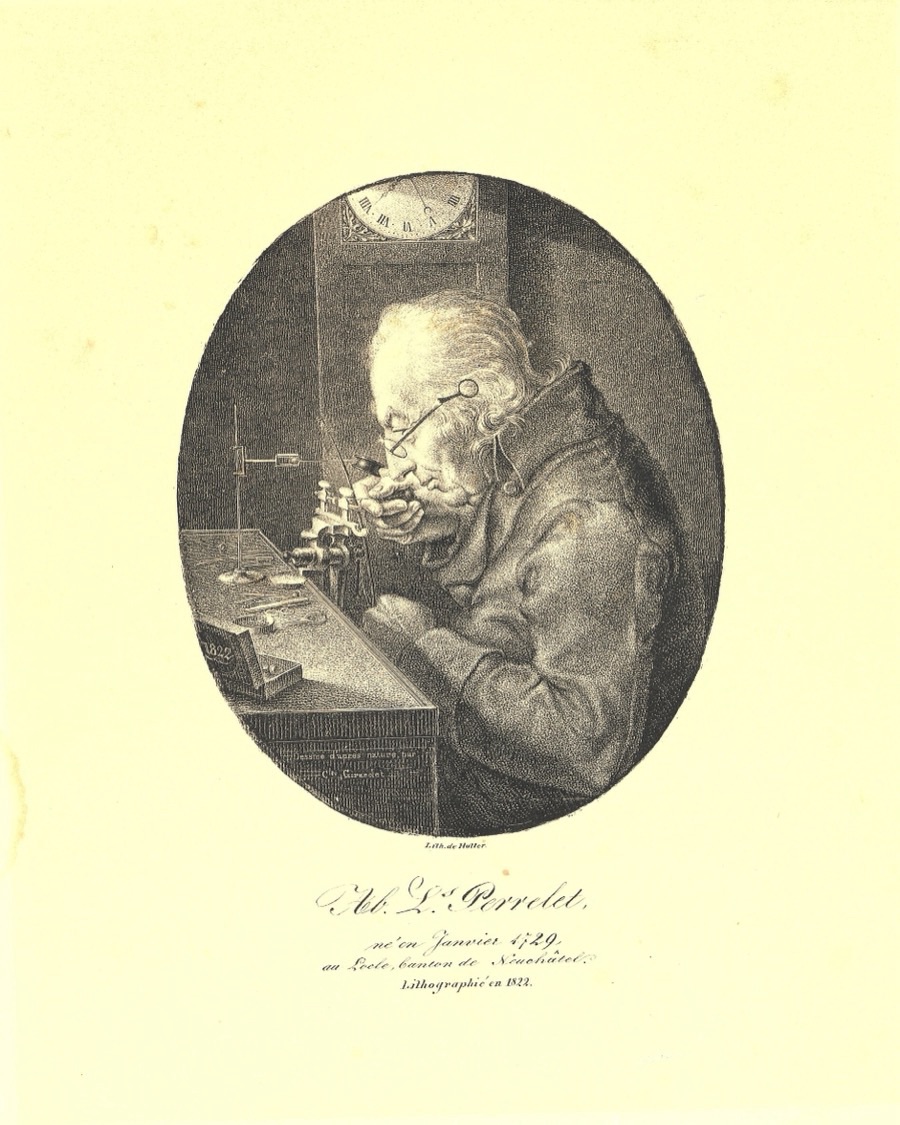
Perrelet, Sarton and Breguet
An automatic or self-winding watch winds its mainspring from the wearer's movements, by a weight that swings or turns inside the case and drives the winding gears through a ratchet.1, 6
Richard Watkins's study of 1773 to 1779 concludes that Abraham-Louis Perrelet of Le Locle made the first practical self-winding watch, with a side weight, at the end of 1775 or early 1776; Wikipedia, following the Geneva Society of Arts report of 1777, says fifteen minutes' walking wound it for eight days.1, 2, 7
The full rotor came from Hubert Sarton of Liège, who sent a watch to the Paris Académie in 1778. Watkins calls the idea that Perrelet invented the rotor 'the Perrelet myth', repeated since Chapuis and Jaquet's book of 1952.1, 2
Names get confused in the record: the Swiss historical dictionary notes that the watchmaker Jacques-Frédéric Houriet was apprenticed to Abraham Louis Perret, 'not Perrelet'.8
Abraham-Louis Breguet in Paris took up the side-weight design about 1779 and sold his perpétuelles from 1780.2, 9
For more than a century afterwards self-winding watches were rare luxuries, Watkins and Wikipedia agree, until the wristwatch gave them a purpose; in the meantime Coviot patented the rotor afresh in 1893.1, 2
On the wrist
In the 1920s the wristwatch revived the idea: Léon Leroy with a side weight in 1922, John Harwood with a centre weight swinging between buffers, patented from 1923 and made by Fortis from 1926.1, 3, 4
Harwood's point was sealing as much as convenience: with no winding stem through the case, his patent says, the case becomes 'practically dust and waterproof', linking self-winding to water resistance.6, 11
Around 1930 the field crowded. Swiss patents of 1929 to 1931 for self-winding wristwatches were filed by the Harwood company, Bulova, the Perpetual Self-Winding Watch Co., Léon Hatot (whose 'Rolls' moved the whole movement), Wyler and others.1, 12
Wikipedia says Glycine's founder Eugène Meylan designed a self-winding module for almost any 8.75-ligne movement as Harwood's patent neared its end; Glycine fitted it from October 1930.13, 14
The rotor
Rolex says it invented and patented the Perpetual rotor in 1931, a weight turning a full 360 degrees; Wikipedia says it gave up to 35 hours' reserve. The Swiss dictionary dates Rolex's rotor watch to 1930.1, 15, 16
Watkins reports that Hans Wilsdorf sponsored Chapuis and Jaquet's history of self-winding watches, and Rolex printed copies of its English edition; he suggests Wilsdorf wanted the rotor to be seen as a Swiss invention.2
Later refinements: Eterna's ball-bearing rotor of 1948, by both the Swiss dictionary and Wikipedia, and bidirectional winding. Adrien Philippe's slipping mainspring bridle of 1863 prevented overwinding.1, 17
Key dates
- 1776
Perrelet's side-weight self-winding watch (end of 1775 or early 1776, by Watkins).2, 7
- 1778
Sarton's rotor watch reported to the Paris Académie.1, 2
- 1780
Breguet sells his perpétuelles from 1780.2, 9
- 1893
Coviot patents the rotor afresh.1, 2
- 1923
Harwood's British patent.1, 3
- 1926
Harwood automatics made by Fortis at Grenchen.4, 18
- 1930
Glycine's Meylan module; Hatot's Rolls.12, 13
- 1931
Rolex's Perpetual rotor, by Rolex (1930 by the Swiss dictionary).15, 16
- 1948
Eterna's ball-bearing rotor.1, 17
Where Automatic winding leads
- Developed by, CompanyRolex
Rolex's Perpetual rotor of 1930 or 1931.15, 16
- Developed by, PersonJohn Harwood
Harwood patented a self-winding wristwatch in 1923 and 1924.3, 6
- Part of, HistoryFrom the pocket to the wrist
The eighteenth-century self-winding watch, revived for the wrist in the 1920s.1, 2
- See also, HistoryFrance and the science of horology
Perrelet, Sarton and Breguet's perpétuelle belong to the 1770s and 1780s.2, 9
- See also, PersonAbraham-Louis Breguet
Breguet made side-weight perpétuelles from about 1780.2, 9
- See also, PlaceGrenchen
The Historical Dictionary dates series production of self-winding watches in Grenchen to 1926.18, 19
- See also, ObjectThe Harwood self-winding watch
A weight swung by the wearer’s movement winds the Harwood, as its British patent describes.3, 20
Facts and sources
- Introduced
- 1770s in pocket watches; 1920s in wristwatches1, 2, 3
Sources
- 1
- 2
The Origins of Self-Winding Watches 1773-1779 (opens in a new tab)
- 3
GB 218,487: Improvements relating to wrist watches (Harwood, J., and Cutts, H.) (opens in a new tab)
- 4
100 Years of Automatic Watchmaking: Fortis Harwood Automatic 1926 (opens in a new tab)
- 5
- 6
CH 106583: Montre à remontage automatique (Harwood John; Cutts Harry) (opens in a new tab)
- 7
- 8
- 9
Appearance of the first automatic watches (opens in a new tab)
- 10
- 11
US 1,576,120: Wrist watch and other watch (John Harwood, Baldrine, Isle of Man) (opens in a new tab)
- 12
- 13
- 14
- 15
Rolex history, 1926 to 1945: milestones in watchmaking (opens in a new tab)
- 16
- 17
- 18
- 19
- 20
Self-winding wristwatch by John Harwood (opens in a new tab)
Sources read November 11, 2026.