The Harwood self-winding watch
The crownless self-winding wristwatch John Harwood patented in 1923–24 and Fortis began making in Grenchen in 1926, which Fortis and the Deutsches Uhrenmuseum describe as the first automatic wristwatch made in series: the object that brought automatic winding to the wrist.
Made Patented 1923–24; made from 1926, By John Harwood; made by Fortis, Grenchen, and under licence by Blancpain, Now at Science Museum, London (1958-263); the Clockmakers’ Museum (L2015-3403); Deutsches Uhrenmuseum, Furtwangen (47-3543)
Companies Blancpain
In the history From the pocket to the wrist
The watch
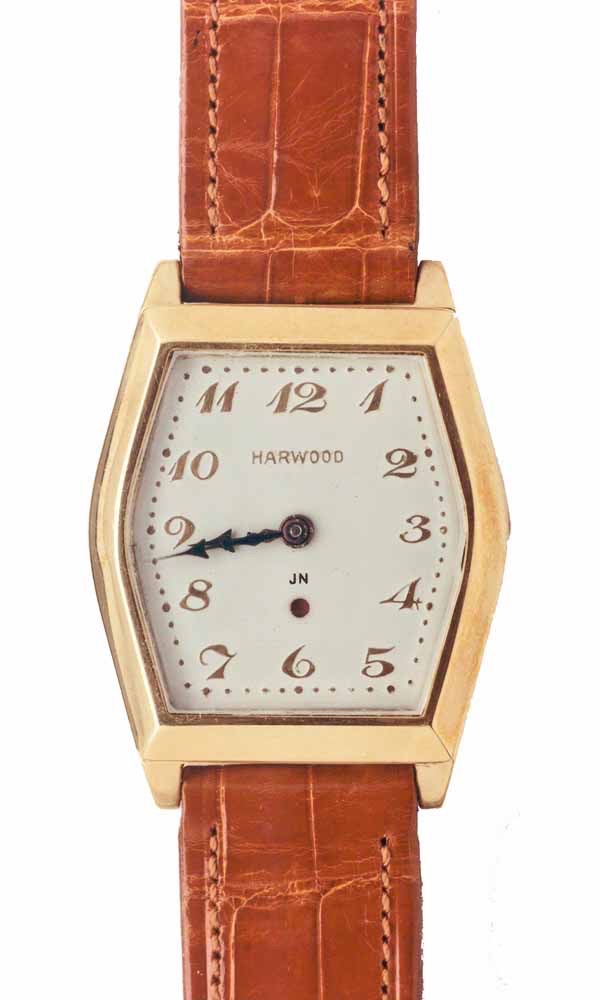
A wristwatch with no winding crown: a weight swung by the wearer’s movement winds it, and the hands are set by turning the bezel, as Harwood’s British patent describes.1, 5
The Science Museum’s example, of about 1930, has a gold case with a glass back and a white dial with green Arabic numerals marked Harwood. Its weight is marked HARWOOD BLANCPAIN FAB SUISSE with the number of Harwood’s French patent, 580247, and the museum records it as made for Harwood by Blancpain.2, 6
The Clockmakers’ example, of about 1928, has a silver case with a glazed back and a chequered silvered dial; its movement is marked Patent No 106583, the number of the Swiss patent.2, 5
The Deutsches Uhrenmuseum in Furtwangen dates its Harwood from 1929 and describes it as the first wristwatch with automatic winding made in series.4
What it changed
Its patents, British 218,487, filed with Harry Cutts on 7 July 1923, and Swiss 106583, published on 1 September 1924, claim a case with no opening, so that winding by the wearer’s movement also closed the watch against dust and water and tied it to water resistance.1, 2, 8
It marks the point at which automatic winding, made for pocket watches since the 1770s and rare for a century and a half, became a wristwatch mechanism made in quantity.3, 9, 10
Fortis and the Deutsches Uhrenmuseum call it the first automatic wristwatch made in series; Wikipedia records Léon Leroy’s side-weight wrist system of 1922 before it, and the wider dispute over who came first is told under John Harwood.3, 4, 9
Made and sold
Fortis says its first Harwood automatics left the Grenchen factory on 13 July 1926; Wikipedia says the watches were shown at the Basel fair that year, with the movement maker A. Schild involved.3, 11
Blancpain made it under licence: Wikipedia dates the licence, for France, to 1928, and the Science Museum’s example is recorded as made for Harwood by Blancpain.6, 11
In America it was sold as the ‘Perpetual’, the Bolton clockmakers’ directory says, through the Perpetual Self-Winding Watch Company that Wikipedia names as the North American licensee.11, 12
Harwood’s own company sold it in Britain from 1928 until it failed in 1931; Wikipedia and Fortis put the number made at about 30,000.3, 9, 11
Key dates
- 1923
Harwood and Harry Cutts file British patent 218,487 (7 July).1
- 1924
Swiss patent 106583 published (1 September).2
- 1926
Fortis begins making the watch at Grenchen, by Fortis’s account; its first watches leave the factory on 13 July.3, 13
- 1928
The Harwood Self-Winding Watch Company is set up to sell it in Britain.9, 11
- 1931
The Harwood company fails.9, 11
Where the Harwood self-winding watch leads
- Made by, CompanyBlancpain
The Science Museum records its Harwood of about 1930 as made for Harwood by Blancpain.6
- Made by, PersonJohn Harwood
Harwood filed the British patent for the watch with Harry Cutts on 7 July 1923.1
- Part of, HistoryFrom the pocket to the wrist
The crownless self-winding wristwatch patented in 1923 that Fortis says it began making in Grenchen in 1926.1, 3
- See also, TechnologyAutomatic winding
A weight swung by the wearer’s movement winds the Harwood, as its British patent describes.1, 5
- See also, TechnologyWater resistance
Harwood’s American patent says that without a winding stem the case becomes practically dust and waterproof.8
Facts and sources
- Made
- Patented 1923–24; made from 19261, 2, 3, 13
- Maker
- John Harwood; made by Fortis, Grenchen, and under licence by Blancpain3, 6, 11
- Held by
- Science Museum, London (1958-263); the Clockmakers’ Museum (L2015-3403); Deutsches Uhrenmuseum, Furtwangen (47-3543)4, 5, 6
Sources
- 1
GB 218,487: Improvements relating to wrist watches (Harwood, J., and Cutts, H.) (opens in a new tab)
- 2
CH 106583: Montre à remontage automatique (Harwood John; Cutts Harry) (opens in a new tab)
- 3
100 Years of Automatic Watchmaking: Fortis Harwood Automatic 1926 (opens in a new tab)
- 4
Harwood automatic wristwatch, Deutsches Uhrenmuseum Inv. 47-3543 (opens in a new tab)
- 5
Self-winding wristwatch by John Harwood (opens in a new tab)
- 6
Harwood self-winding wrist-watch of about 1930 (1958-263) (opens in a new tab)
- 7
- 8
US 1,576,120: Wrist watch and other watch (John Harwood, Baldrine, Isle of Man) (opens in a new tab)
- 9
- 10
The Origins of Self-Winding Watches 1773-1779 (opens in a new tab)
- 11
- 12
- 13
Sources read November 12, 2026.