John Harwood
The Bolton-born watch repairer of the Isle of Man who patented a self-winding wristwatch with Harry Cutts in 1923; Fortis of Grenchen made it from 1926, and his own company sold it in Britain until 1931.
Born 1893, Bolton, Lancashire, Died 1964
In the history From the pocket to the wrist

Bolton and the Isle of Man
John Harwood was born in Bolton, Lancashire; his family home was a pork butcher's shop on Blackburn Road.1, 7
In the First World War he served as an armoury staff sergeant, where he worked on an automatic pistol and an impact screwdriver.1, 7
After the war he served a watchmaking apprenticeship with Hirst Brothers and Co. of Oldham, and in 1922 moved to the Isle of Man to open a watch repair business.1, 7
The patent
With his backer Harry Cutts he filed British patent 218,487 on 7 July 1923, 'Improvements relating to wrist watches': an automatic weight swung by the wearer's movement winds the mainspring, with spring buffers and a friction clutch to prevent overwinding.2, 8
The Swiss patent, no. 106583, was filed on 16 October 1923 and published on 1 September 1924; its claim is a case 'whose walls have no opening' holding an oscillating weight.1, 4, 9
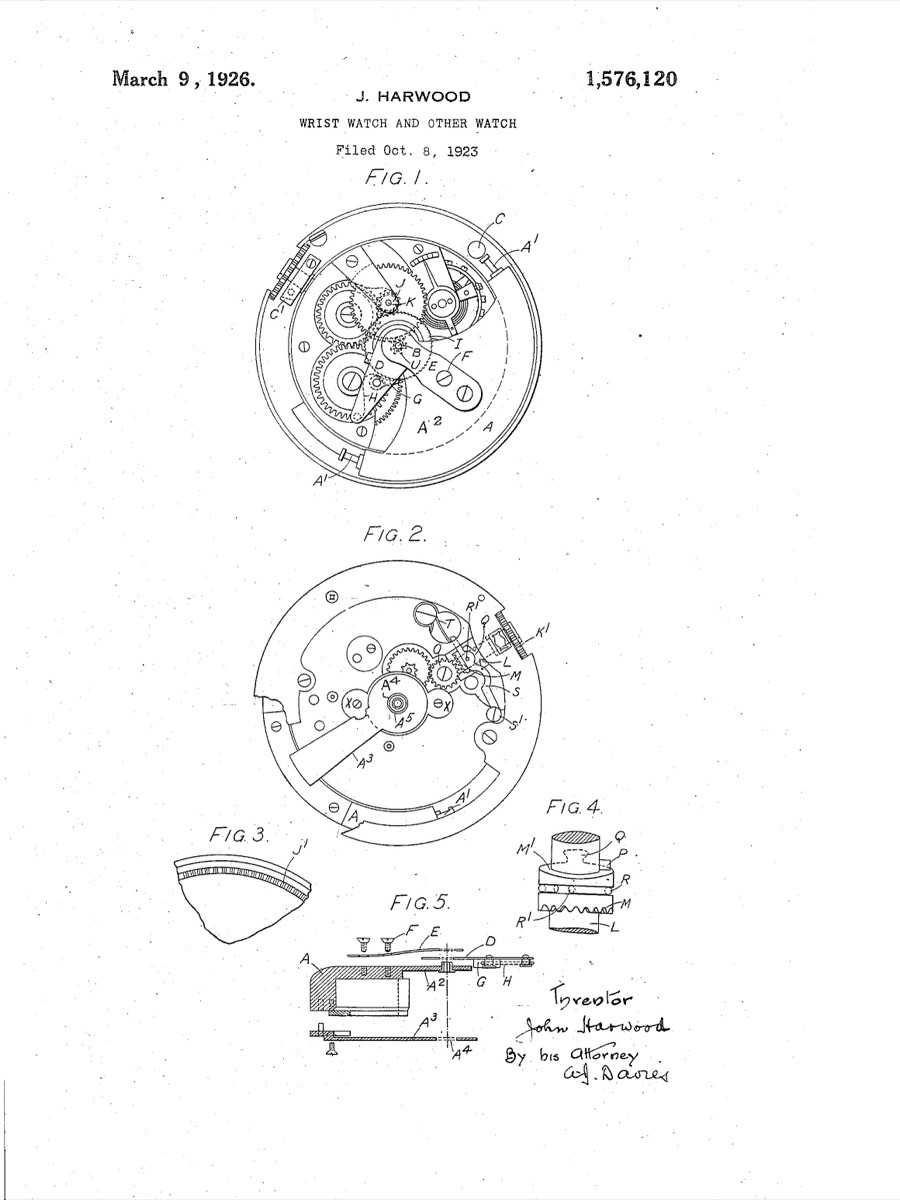
His American patent, granted on 9 March 1926 to 'John Harwood, of Baldrine, Lonan, Isle of Man', explains the aim: with no winding stem through the case, the case becomes 'practically dust and waterproof'.3
Without a crown, the hands were set by turning the bezel, and a red dot in the dial showed when the setting gear was engaged; a Harwood of about 1928 in the Clockmakers' collection shows both.2, 10
Harwood's weight swung through a limited arc between spring buffers, the type now called a 'bumper' or 'hammer' automatic; Wikipedia gives about 12 hours of reserve, and the US patent says the spring would run 'say 9 to 12 hours'.3, 4, 8
Made in Switzerland
Swiss industry made it. Fortis says Walter Vogt took up the invention and that the first Fortis Harwood automatics left the factory on 13 July 1926; Wikipedia adds that the movement maker A. Schild was involved and that the watches were shown at the Basel Fair in 1926; the Swiss dictionary records an automatic calibre made at Grenchen in 1926.1, 4, 5
Wikipedia says Blancpain made the watches under licence for France from 1928 and the Perpetual Self-Winding Watch Company for North America; the Bolton directory says they were sold in the US as 'Perpetual'. A patent of 1929 in the name of the Perpetual Self Winding Watch Co. appears in the Swiss register.1, 7, 11
He set up the Harwood Self-Winding Watch Company in 1928 to sell in Britain; it failed in 1931 in the Depression. Wikipedia and Fortis put production at about 30,000 watches; the Clockmakers' example of about 1928 has 'Harwood Self Winding Watch Co. Ltd' on its weight.1, 4, 8, 10
Credit and recognition
Who made the first automatic wristwatch is disputed. Fortis calls the Harwood the first serially produced; Rolex calls its 1931 Perpetual rotor the world's first self-winding mechanism with a Perpetual rotor; Glycine's Meylan module of 1930 is called the first widely produced; Léon Leroy is credited with a side-weight wrist system in 1922.4, 8, 12, 13
Harwood disputed Rolex's claim to be first, and Rolex published a correction, in the Sunday Express in 1956 by Fortis's account; the Bolton directory also records an apology.4, 7
Whether Harwood knew the eighteenth-century self-winding watches is not known, Wikipedia notes.8
In 1957 the British Horological Institute awarded him its Gold Medal.1, 7
Key dates
- 1893
Born in Bolton.1, 7
- 1922
Moves to the Isle of Man.1, 7
- 1923
British patent with Harry Cutts filed 7 July; Swiss and US filings follow.2, 3, 9
- 1924
Swiss patent 106583 published 1 September.1, 9
- 1926
Fortis begins production; US patent granted 9 March.3, 4
- 1928
Harwood Self-Winding Watch Co. founded.1, 8
- 1931
The company fails.1, 8
- 1957
Gold Medal of the British Horological Institute.1, 7
Where John Harwood leads
- Developed, TechnologyAutomatic winding
Harwood patented a self-winding wristwatch in 1923 and 1924.2, 9
- Made, ObjectThe Harwood self-winding watch
Harwood filed the British patent for the watch with Harry Cutts on 7 July 1923.2
- Part of, HistoryFrom the pocket to the wrist
The Isle of Man watch repairer whose self-winding wristwatch was patented in 1923 and made in Grenchen from 1926.1, 2, 5
- See also, TechnologyWater resistance
His crownless self-winding case was meant to be dust- and waterproof.3
Facts and sources
Sources
- 1
- 2
GB 218,487: Improvements relating to wrist watches (Harwood, J., and Cutts, H.) (opens in a new tab)
- 3
US 1,576,120: Wrist watch and other watch (John Harwood, Baldrine, Isle of Man) (opens in a new tab)
- 4
100 Years of Automatic Watchmaking: Fortis Harwood Automatic 1926 (opens in a new tab)
- 5
- 6
- 7
- 8
- 9
CH 106583: Montre à remontage automatique (Harwood John; Cutts Harry) (opens in a new tab)
- 10
Self-winding wristwatch by John Harwood (opens in a new tab)
- 11
- 12
Rolex history, 1926 to 1945: milestones in watchmaking (opens in a new tab)
- 13
Sources read November 11, 2026.