The co-axial escapement
A watch escapement devised by George Daniels and patented in 1980, which changes the lever escapement to reduce sliding friction and the need for oil, and which Omega has made in series since 1999.
Introduced Patented by George Daniels in 1980; its design is dated from 1974 to 1976, By Omega since 1999
Companies Omega
Came after The lever escapement
Developed by George Daniels
In the history The mechanical revival and the independents
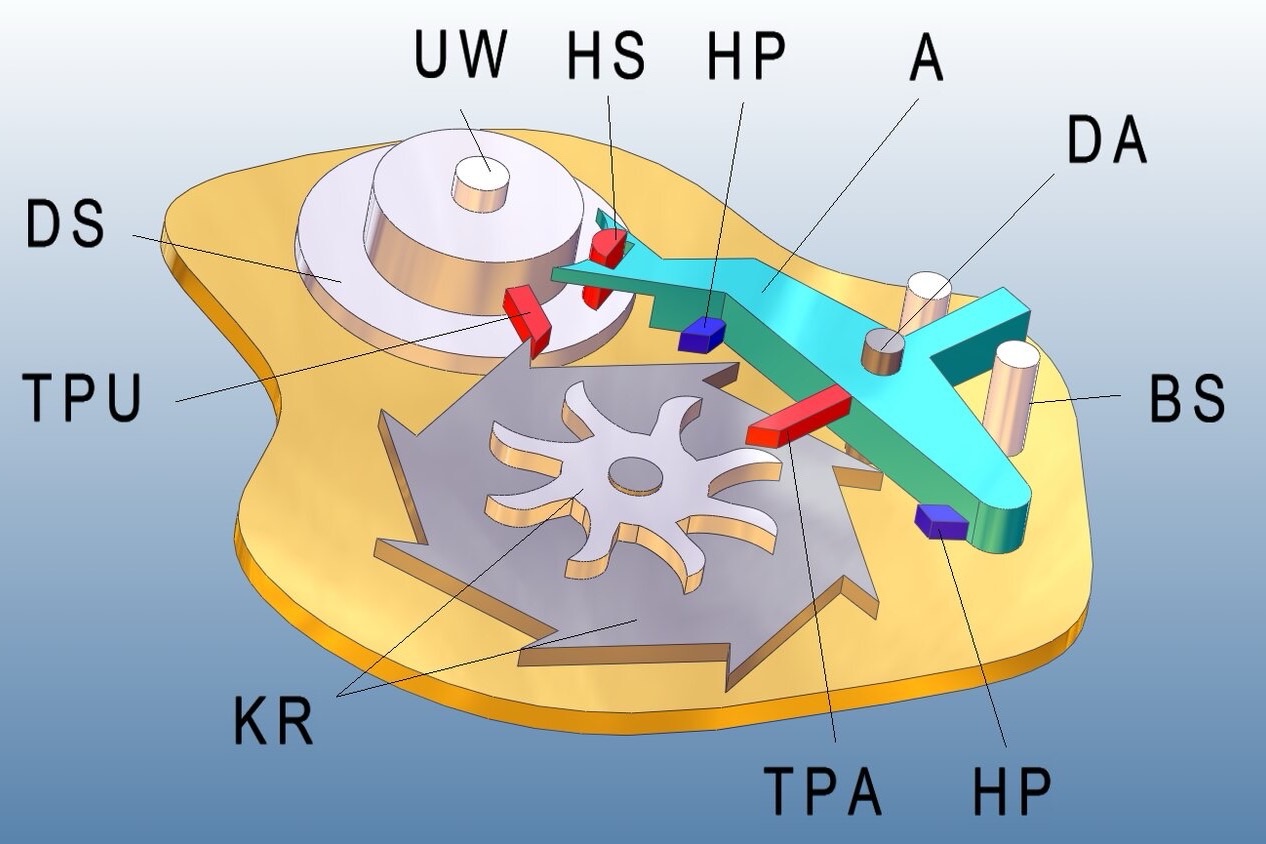
How it works
An escapement lets a watch’s train of wheels advance in steps under the control of the balance. Wikipedia says almost every mechanical watch since about 1900 has used the lever escapement that Thomas Mudge devised.7, 8
Wikipedia describes the co-axial as a modification of the lever with some features of the detent escapement, using three pallets to separate the locking of the escape wheel from the impulse given to the balance.1
The aim is less friction. The Science Museum Group’s record of Daniels’s model says the escapement suffers virtually no sliding friction and so needs minimal lubrication; Omega says its smaller contact surfaces reduce friction and the need for lubrication.3, 4
Wikipedia adds that oiling the pallets is unnecessary in theory, but that a little oil is used on the pallet stones in practice, reportedly to limit corrosion where they strike.1
Before Daniels
Wikipedia names two older designs as its forerunners: Charles Fasoldt’s escapement patented in 1865, a co-axial duplex with a three-pallet lever, and Breguet’s natural escapement, whose two escape wheels Daniels separated into two independent trains.1
Wikipedia also says that Daniels’s friend Derek Pratt contributed to the design, and that a commission from the American collector Seth G. Atwood, for a watch completed in 1976, was the occasion for it.1
From Daniels to Omega
When George Daniels devised it is told differently. Wikipedia’s article gives 1976 in its opening and 1974 in its history; the AHCI says it was unveiled in 1976; Roger W. Smith’s company dates the invention to 1974, marking its 35th anniversary in 2009. The patent is dated 1980.1, 9, 10
Daniels converted a Patek Philippe Nautilus to the escapement at Patek Philippe’s request in 1981, and built an electrically driven working model on the Isle of Man around 1985 to capture the attention of the Swiss industry; both are in the Clockmakers’ Museum.3, 11
Omega introduced it on 12 April 1999 and calls it the first practical new watch escapement in some 250 years. Wikipedia names the movement Calibre 2500, made at first at 28,800 beats an hour and later at 25,200, and notes Daniels’s warning that faster movements raise the speed and pressure at the sliding surfaces.1, 4
Omega says it introduced its own Co-Axial calibre, built around the escapement, in 2007, and that with very few exceptions all its mechanical watches now have Co-Axial movements.12
Wikipedia says it is the only escapement other than the Swiss lever made on an industrial scale.1
Outside Omega
Daniels used it in his own watches, and so did his successor on the Isle of Man: Roger W. Smith’s company says its Series Two of 2005 had an in-house movement with the co-axial escapement, and that from 2009 Smith developed a single-wheel version for the Daniels Anniversary watch.5, 10
Key dates
- 1981
Daniels converts a Patek Philippe Nautilus to the escapement at the firm’s request.11
- 1985
Daniels builds a working model to show the Swiss industry, about this year.3
- 1999
Omega introduces the Co-Axial escapement on 12 April.4, 5
- 2009
Roger W. Smith begins the Daniels Anniversary watch, with a single-wheel co-axial escapement.10
Where the co-axial escapement leads
- Developed by, PersonGeorge Daniels
Daniels devised the escapement and patented it in 1980; Omega credits him as its inventor.1, 4, 9
- Came after, TechnologyThe lever escapement
Wikipedia describes the co-axial as a modification of the lever escapement with features of the detent.1
- Used by, CompanyOmega
Omega introduced the escapement on 12 April 1999 and has made it in series since.4, 5, 12
- Part of, HistoryThe mechanical revival and the independents
Daniels’s escapement of 1980, in production at Omega since 1999.4, 5
- See also, PersonAbraham-Louis Breguet
Wikipedia names Breguet’s natural escapement among the forerunners of the co-axial.1
Facts and sources
- Introduced
- Patented by George Daniels in 1980; its design is dated from 1974 to 19761, 9, 10
- In production
- By Omega since 19994, 5, 12
Sources
- 1
- 2
- 3
Working model of the co-axial escapement built by George Daniels (opens in a new tab)
- 4
- 5
‘Millenium’ co-axial wristwatch by George Daniels (opens in a new tab)
- 6
- 7
- 8
- 9
- 10
- 11
- 12
Sources read November 12, 2026.