Harrison’s H4
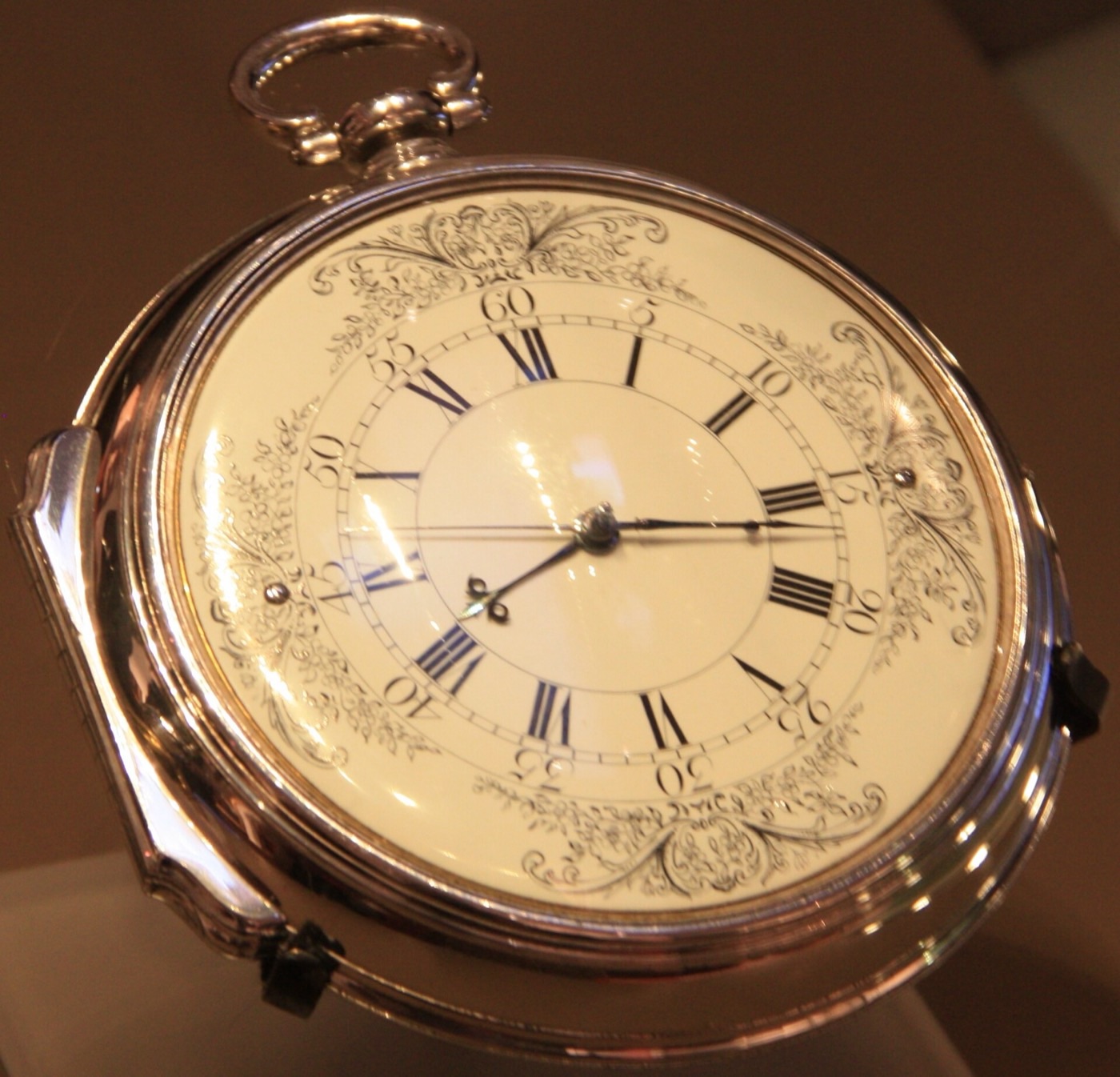
John Harrison’s large watch of 1759, the timekeeper that kept time within the Longitude Act’s strictest limit on the 1764 trial to Barbados. Its copy, K1, went round the world with Cook; H4 itself is in the collection of the National Maritime Museum, Greenwich.
Made 1759, By John Harrison, Now at National Maritime Museum, Greenwich (ZAA0037)
In the history Longitude and the marine chronometer
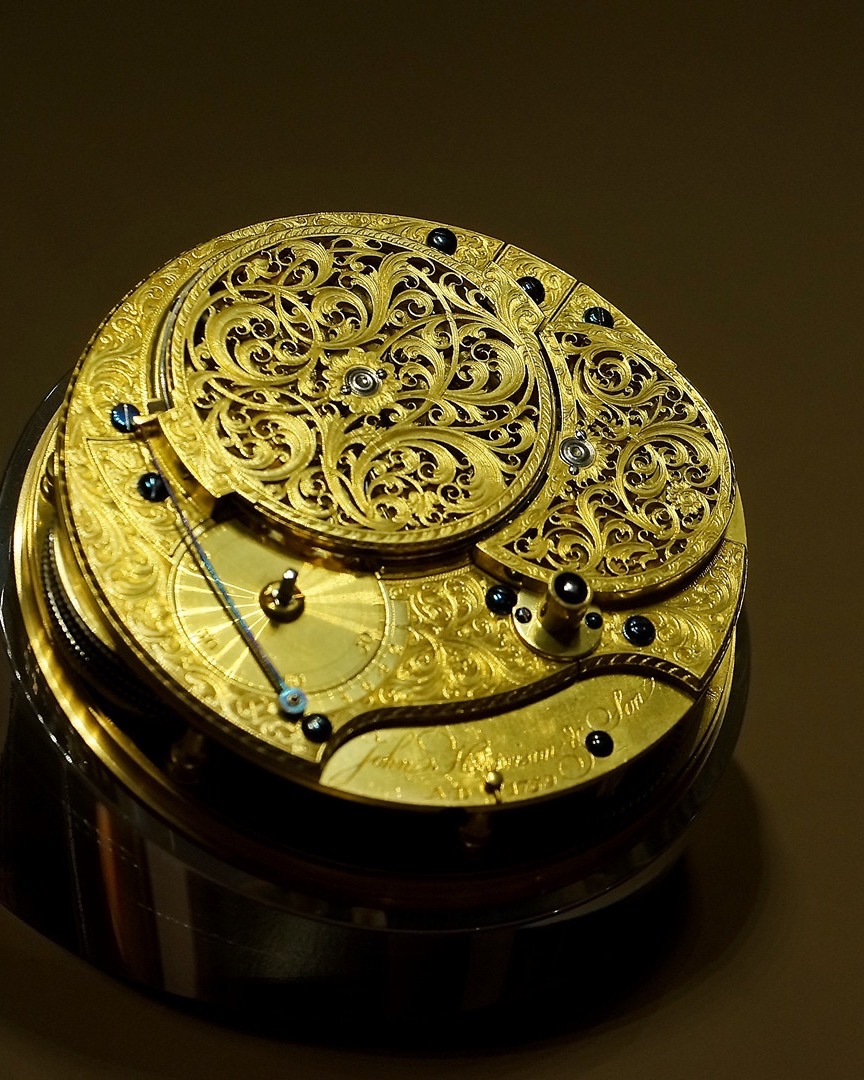
The watch
H4 is a watch-sized marine timekeeper, about 13 centimetres across in silver pair cases; the museum’s record calls it Harrison’s prize-winning longitude watch.1, 2
It began with a pocket watch made to Harrison’s design by John Jefferys in 1753. The museum’s catalogue dates the start of work on H4 to 1755; another of its accounts says around 1751–52.1, 2
Its dial plate is inscribed John Harrison and Son A.D 1759. It beats five times a second, and its escapement is a modified verge with diamond pallets.1, 2, 5
At sea
William Harrison carried H4 on HMS Deptford from November 1761. At Kingston, Jamaica it was about five seconds slow, roughly one nautical mile of longitude, but the Commissioners judged the trial insufficient.2, 5, 6, 7
On the trial to Barbados in 1764 its error was well inside the Act’s limit: 39 seconds by Wikipedia’s account, 34.4 seconds over seven weeks by the Captain Cook Society’s.5, 7
In February 1765 the Board found it had performed within the strictest limit of the 1714 Act.2, 5
Opened, tested and copied
In August 1765 Harrison explained H4 to six experts chosen by the Board, among them the watchmaker Larcum Kendall.3, 8
On 5 May 1766 it was handed, sealed in a box, to the Astronomer Royal Nevil Maskelyne and tested at the Royal Observatory for ten months. It did not perform well, and how Maskelyne treated its rate was disputed.2, 5
The Board published a description of its principles in 1767, and Kendall’s copy, K1, finished in 1769, let others test it at sea, above all on Cook’s second voyage.3, 9
Since
Rupert Gould cleaned H4 a second time in 1935, as part of his restoration of the Harrison timekeepers.11
Wikipedia’s account says that, unlike H1 to H3, it needs oil to run, so it is kept stopped.5
Where it can be seen changes: in November 2026 the museum’s record listed it as not on display, while the Royal Observatory, where Harrison’s timekeepers are usually shown, was closed for refurbishment.1, 12
Key dates
- 1753
John Jefferys makes a watch to Harrison’s design.1
- 1755
Work on H4 begins, by the museum’s record.1
- 1759
H4 completed.1
- 1761
Sails for Jamaica on HMS Deptford.5, 6
- 1764
The trial to Barbados.2, 5
- 1765
The Board finds it within the Act’s limits.2, 5
- 1766
Handed to Maskelyne for ten months of testing.2, 5
- 1769
Kendall completes his copy, K1.3
- 1935
Cleaned a second time by Rupert Gould.11
Where Harrison’s H4 leads
- Made by, PersonJohn Harrison
Harrison completed H4 in 1759.1
- Led to, TechnologyThe marine chronometer
Kendall’s copy of H4 proved the timekeeper at sea; Arnold and Earnshaw then made cheaper ones.3, 13
- Part of, HistoryLongitude and the marine chronometer
H4 kept time within the Act’s strictest limit on the 1764 trial.1, 2
- See also, PlaceGreenwich
Maskelyne tested H4 at the Observatory for ten months from May 1766.2, 5
- See also, EventThe Longitude Act
H4 was tried under the Act and in 1765 judged within its strictest limit.1, 2
Facts and sources
- Made
- 17591
- Maker
- John Harrison1
- Held by
- National Maritime Museum, Greenwich (ZAA0037)1
Sources
- 1
- 2
Longitude found: the story of Harrison's timekeepers (opens in a new tab)
- 3
- 4
- 5
- 6
- 7
- 8
- 9
- 10
- 11
Gould, Rupert Thomas, Lieutenant Commander, 1890-1948 (opens in a new tab)
- 12
- 13
Time machines: chronometers from the collection (opens in a new tab)
Sources read November 11, 2026.