Schaffhausen
A Rhine town in northern Switzerland, outside the Jura watch country, where Heinrich Moser’s dam of 1866 gave power to industry and the American Florentine Ariosto Jones founded the International Watch Company in 1868.
Switzerland, Capital of the canton of Schaffhausen, on the High Rhine
Companies here IWC Schaffhausen
Why Schaffhausen?
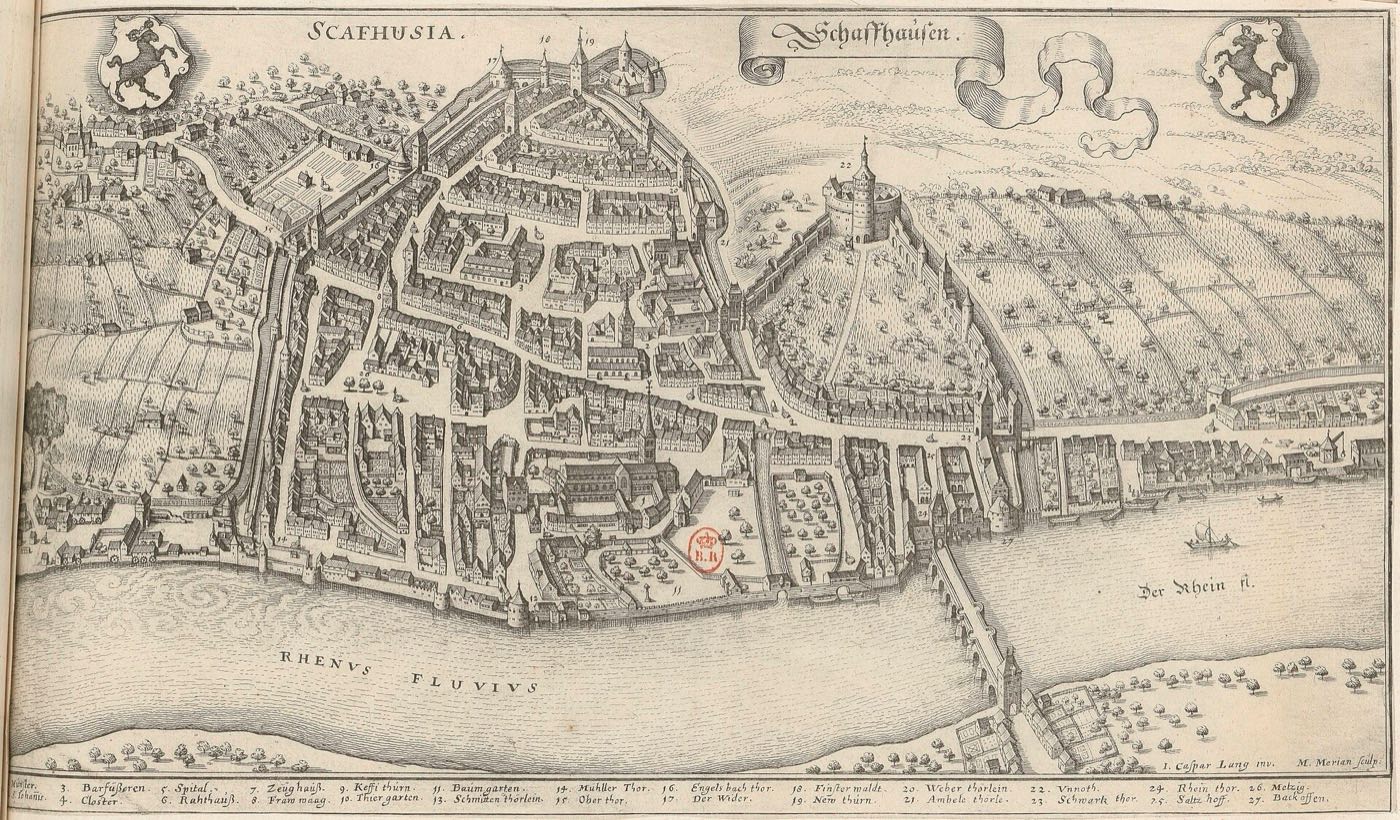
Schaffhausen grew where the Rhine stopped being navigable: the German Wikipedia describes boats from Lake Constance unloading above the rapids and the Rhine Falls, with goods carried round by land. The same falling water later drove its industry.6
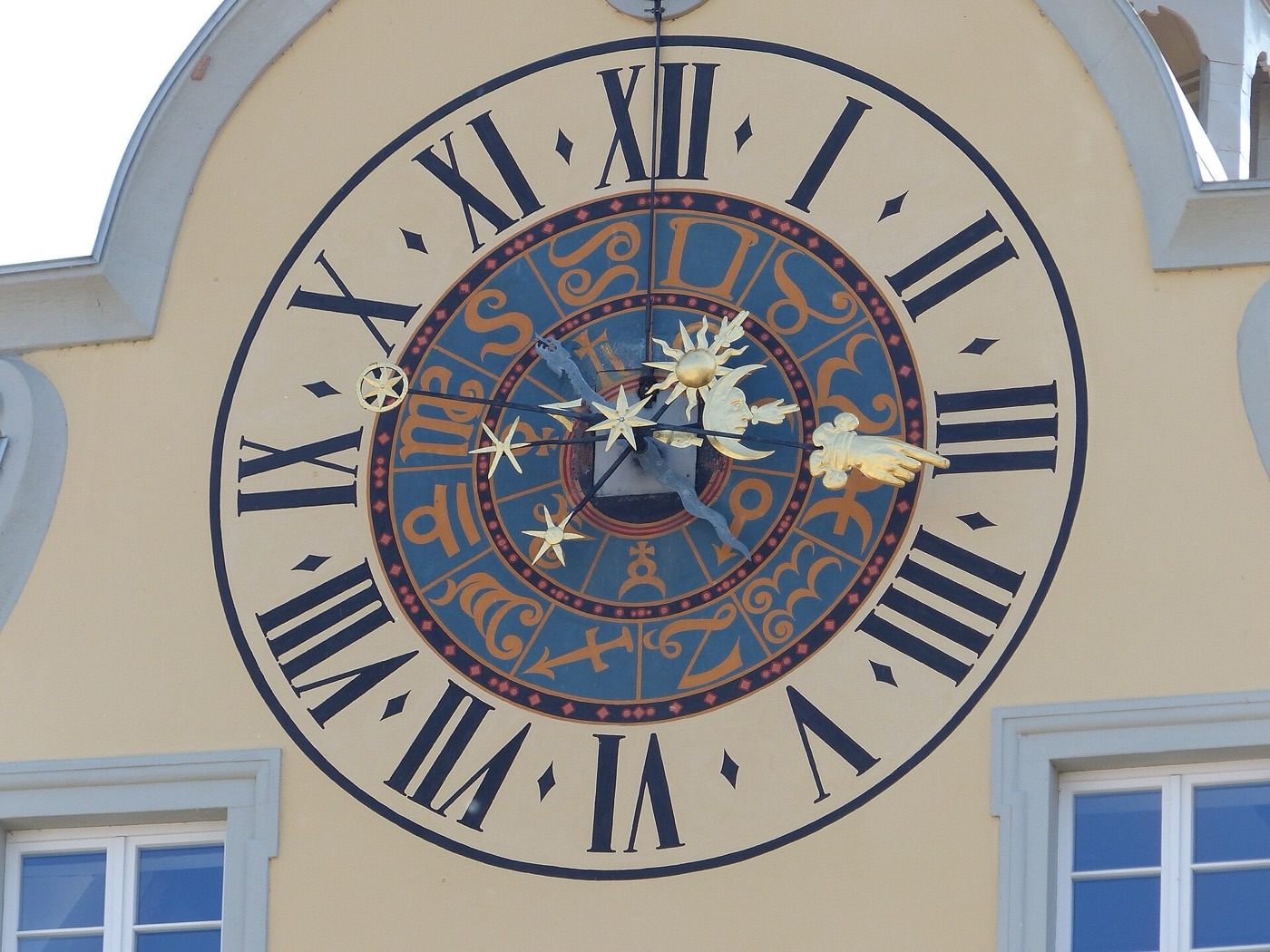
The town had clockmakers three centuries before it had a watch factory. Joachim Habrecht built the astronomical clock on the Fronwagturm in 1564, and his son Isaac signed an iron astronomical wall clock at Schaffhausen in 1568, now in the Historical Museum in Basel.7, 8
Heinrich Moser, born in Schaffhausen in 1805, learned the trade from his father, a watchmaker, and finished his training in Le Locle in the Jura from 1824 to 1827.1, 10
SRF reports that the town turned the young Moser down for the post of town clockmaker. He went to Russia, opened a sales house in St Petersburg in 1828 and came home a rich man in 1848.1, 10, 11
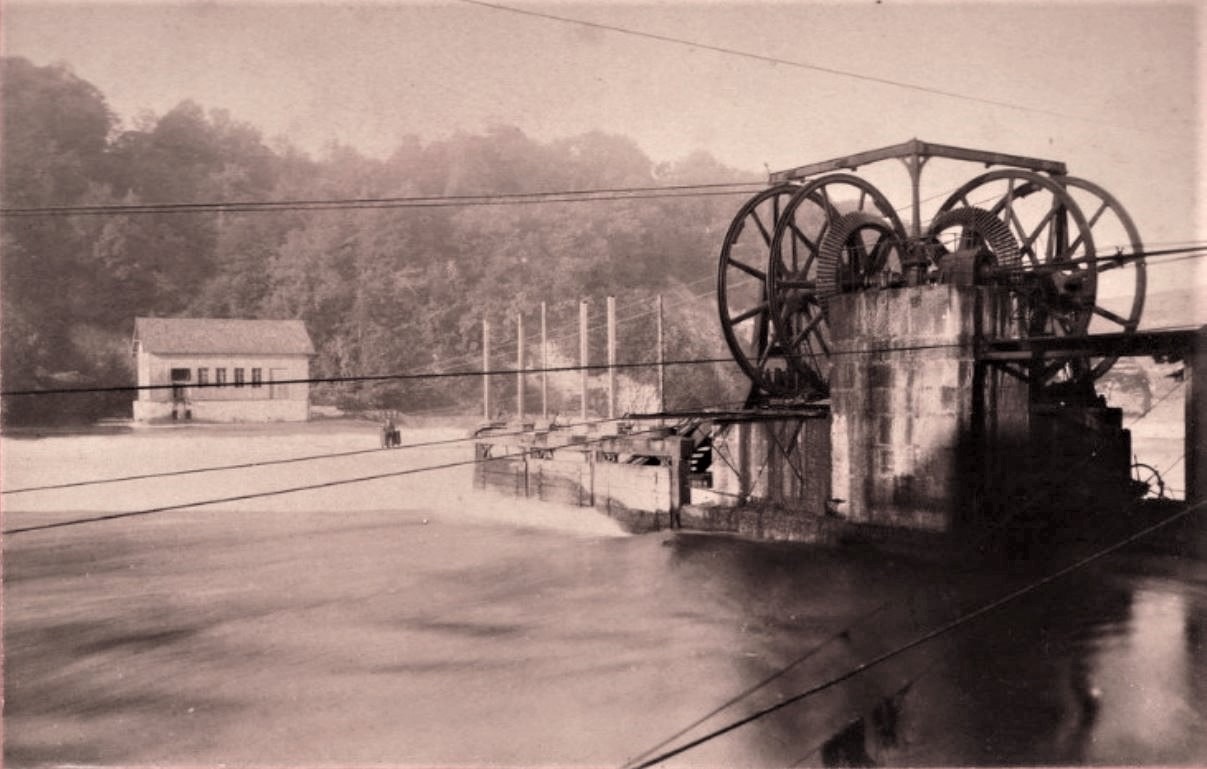
Moser then dammed the Rhine. Built from 1863 and handed over on 9 April 1866, his works drove turbines of about 600 horsepower whose power ran along the bank on wire ropes and gearing to the workshops beside it, before electricity could carry it. The Neue Deutsche Biographie calls it the condition that let industry settle in the town.1, 2, 11, 12
IWC's own history says that Florentine Ariosto Jones planned to pair Swiss craftsmen with American machinery, and that when watchmakers in western Switzerland met the idea with suspicion he settled in the north instead, where the Rhine could drive the machines.3, 4
What grew here: an American factory on the Rhine
Jones, who had run the E. Howard company in Boston, founded the International Watch Company in Schaffhausen in 1868. IWC's timeline describes the aim as top-quality pocket-watch movements for the American market, made with Swiss workers, machine tools and Rhine water power.3, 4, 14
The company began in rented rooms in a building of Moser's on the Rheinstrasse in 1869, by Wikipedia's account, and built its own factory beside the river between the summer of 1874 and March 1875, on land bought from Moser's water company.3, 14
IWC's timeline says the early Jones calibres were built in grades on a common plan, with Pattern H at the top, and that the works was laid out for more than 10,000 movements a year, exported to American retailers.3
The venture did not meet its shareholders' hopes, and Jones went back to America in 1875. In 1880 the Rauschenbach family, Schaffhausen machine makers, took the factory over and began selling its watches worldwide.3, 4, 14
The power changed with the century. A second turbine house of 1887 to 1889 turned the dam's turbines over to electricity, and Wikipedia's IWC article says Rauschenbach ran a power line to the factory in 1888, with its machines converted to electric drive shortly before 1900.2, 14
The watch factory was one of several the dam made possible. Moser also co-founded the Swiss Wagon Factory at Neuhausen in 1853, the later SIG, and promoted the Rhine Falls railway that joined Schaffhausen to the Swiss network in 1857.1, 10
Who and what moved through
Schaffhausen's clockmakers travelled. Isaac Habrecht and his brother Josias worked for years in Strasbourg, where the Basel museum credits Isaac with completing the second astronomical clock of the cathedral in 1574.8
Moser's own business ran the other way, from the Jura to Russia: watches made at his works in Le Locle, opened in 1829, were sold through St Petersburg and branches in Moscow, Kiev and Nizhny Novgorod, and his Russian firms kept his name until they were taken over in 1918.1, 10
IWC brought American factory methods to the Rhine: Jones came from Boston's watch industry, and IWC's timeline records that the shareholders replaced him with another American, Frederick Francis Seeland.3, 4
In the Second World War the factory worked for both sides' specifications: it was one of the five makers of the German air force's observation watch, and Wikipedia lists it among the twelve Swiss suppliers of the British army's W.W.W. wristwatch; its Mark 11 navigator's watch followed in 1948. The story is told in Watches go to war.14, 15, 16
Neutrality did not keep the war away. On 1 April 1944 American bombers hit Schaffhausen by a navigation error, killing 40 people, the German Wikipedia records; the English article adds that a bomb struck the watch factory and failed to explode.6, 14
What changed because of it
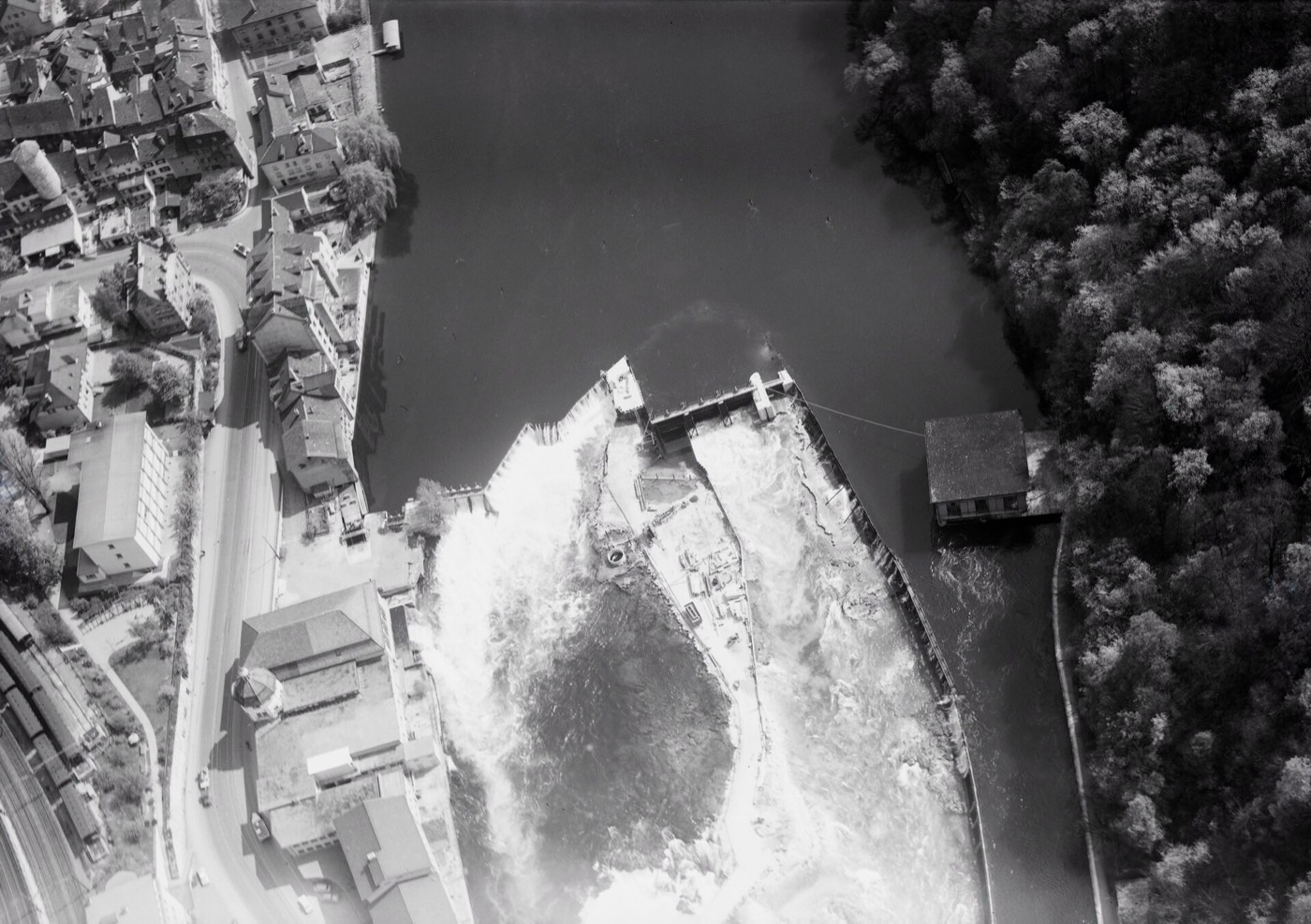
The dam that started it lasted almost a century, but accounts differ on its end: SRF says it was blown up in 1959, the German Wikipedia's article on the dam dates its demolition to 1961 and its replacement plant to 1963, and the article on the town dates the new power station to 1967.2, 6, 11
A working model of the dam, built for the Swiss national exhibition of 1939, is kept in the Museum zu Allerheiligen in Schaffhausen.2, 11
The factory on the Rhine outlasted its founders. IWC passed to the German instrument maker VDO in 1978, then into Les Manufactures Horlogères, and has belonged to Richemont since 2000.3, 4, 18
IWC keeps a museum of its own history in the town, with about 230 objects by the German Wikipedia's count.6
Moser's name came back to his home town: Wikipedia records that Moser Schaffhausen AG was founded in 2002 and that the H. Moser & Cie brand was relaunched in 2005 with a new manufacture in Schaffhausen.10
Key dates
- 1568
Isaac Habrecht signs an astronomical wall clock at Schaffhausen.8
- 1574
Isaac Habrecht completes the Strasbourg cathedral clock.8
- 1828
Heinrich Moser opens his sales house in St Petersburg.1, 10
- 1866
Moser's Rhine dam goes into service on 9 April.2, 12
- 1868
Florentine Ariosto Jones founds the International Watch Company.3, 14
- 1875
The factory on the Rhine is finished; Jones returns to America.3, 14
- 1880
The Rauschenbach family takes over the watch factory.3, 14
- 2000
Richemont buys Les Manufactures Horlogères, owner of IWC.4, 18
Where Schaffhausen leads
- Based here, CompanyIWC Schaffhausen
IWC has made watches in Schaffhausen since its founding in 1868.3, 14
- Part of, HistoryAmerica industrializes the watch
Where a Boston watchmaker, Florentine Ariosto Jones, set up a factory in 1868 to make movements for the American market.3, 4, 14
- Part of, HistoryCrisis, consolidation and the groups
IWC was bought by VDO in 1978 and passed with Les Manufactures Horlogères to Richemont in 2000.3, 18
- Part of, HistorySwitzerland’s network of specialists
A watch town outside the Jura: IWC's founder came north to the Rhine after western Swiss watchmakers distrusted his plan, by IWC's own account.3, 4
- Part of, HistoryWatches go to war
IWC in Schaffhausen was one of the five makers of the German air force's observation watch.15, 16
- See also, PlaceThe Jura Arc
Heinrich Moser trained in Le Locle and made his watches there from 1829 before building the Rhine dam at home.1, 10
- See also, TechnologyInterchangeable parts
Jones's plan, by IWC's account, was to make Swiss watches with American machinery.4
- See also, SpecificationThe B-Uhr
One of the five B-Uhr makers worked here: IWC, with its calibre 52 T.S.C.15, 16
- See also, GroupRichemont
Richemont has owned the Schaffhausen watch factory, IWC, since 2000.4, 18
Facts and sources
- Country
- Switzerland3, 14
- Where
- Capital of the canton of Schaffhausen, on the High Rhine1, 6
- Watchmaking
- Clockmakers from the 16th century; watch factory since 18683, 8
Sources
- 1
- 2
- 3
- 4
- 5
- 6
- 7
Schaffhausen: astronomical clock of the Fronwagturm (opens in a new tab)
- 8
- 9
- 10
- 11
- 12
- 13
- 14
- 15
- 16
Military Watches of the World: Germany Part 1 (opens in a new tab)
- 17
- 18
Acquisition of Les Manufactures Horlogères SA completed (opens in a new tab)
Sources read November 12, 2026.