Waltham, Massachusetts
A mill town on the Charles River west of Boston, already home to a large textile corporation, where the watch factory built on the empty South Side in 1854 laid out streets, housed and employed much of the town, earned it the name Watch City, and left a factory that still stands.
United States, Middlesex County, Massachusetts, on the Charles River west of Boston
Companies here Waltham
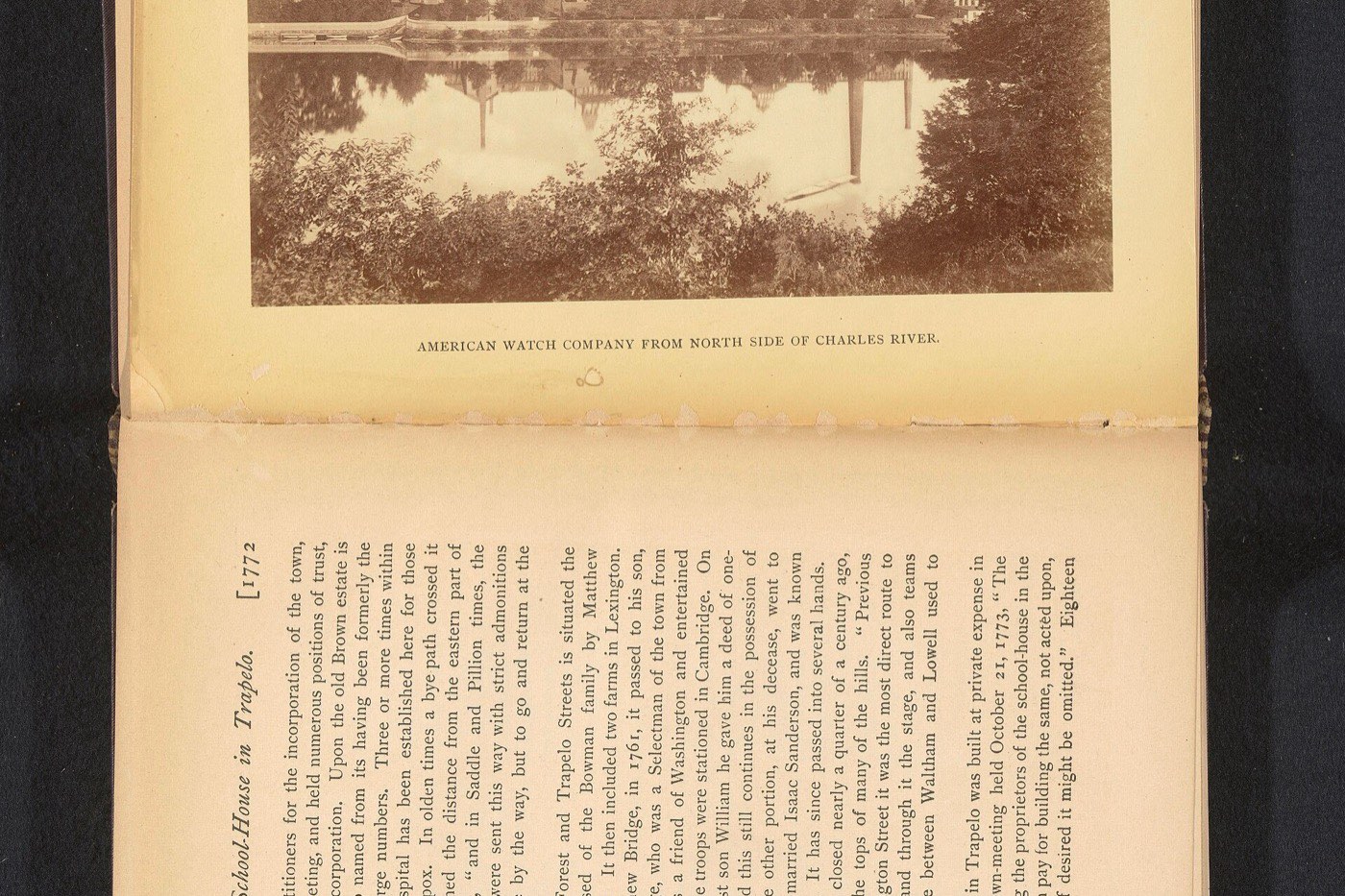
Why Waltham? A mill town on the Charles
Waltham was an industrial town before it made watches. In 1813 Francis Cabot Lowell, Nathan Appleton, Patrick Tracy Jackson and their partners organised the Boston Manufacturing Company on a mill site on the Charles River, and from the following year it wove cloth by machine, every stage from raw cotton to finished cloth under one management in one mill.1, 3, 5
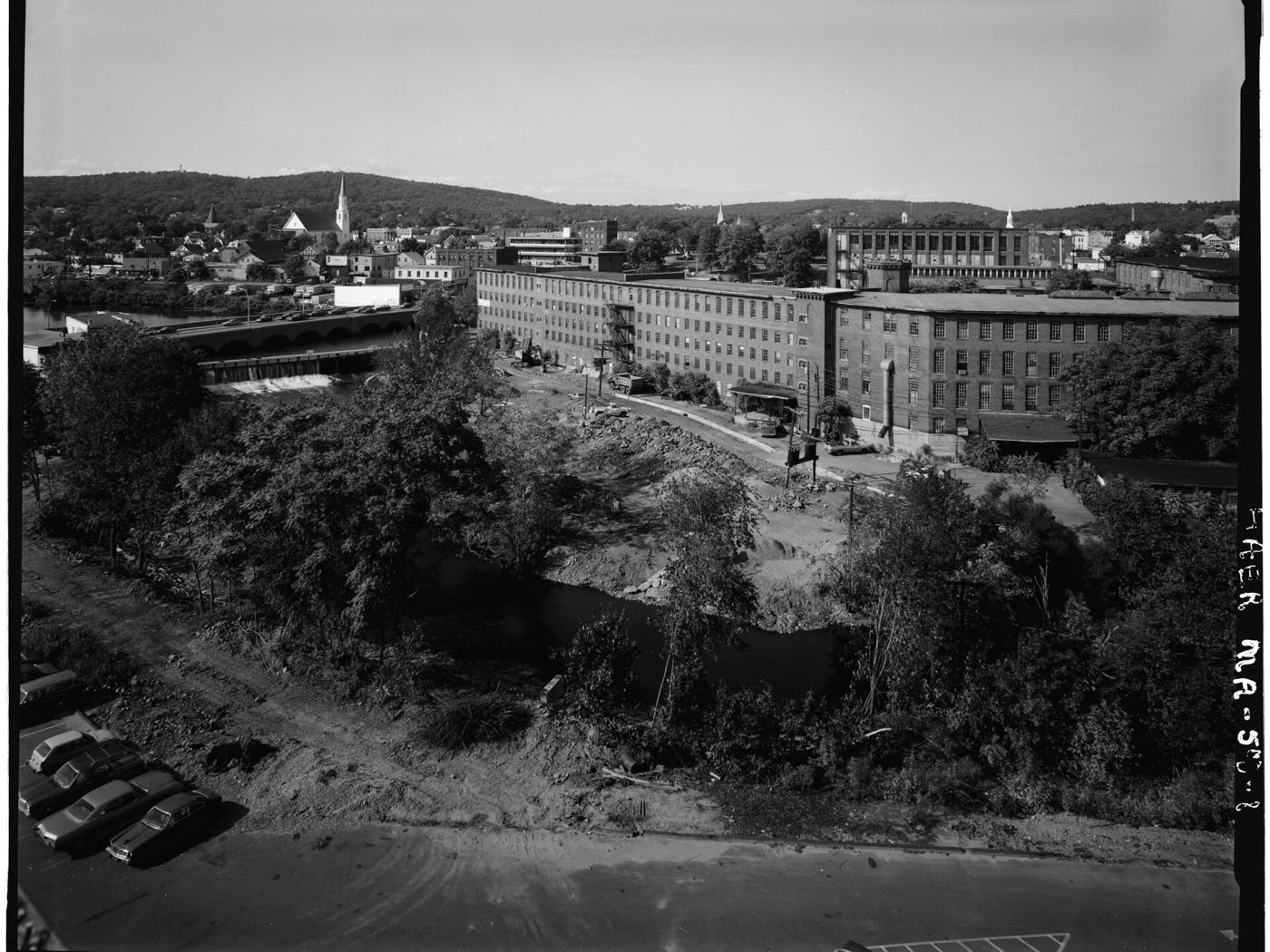
The Historic American Engineering Record calls the Boston Manufacturing Company the first major industrial corporation in the United States and credits it with starting large-scale industrialisation there; the National Register survey of Waltham adds that its mill of 1816 became the model for the mills of the Boston textile corporations for some forty years.1, 3
The town then reached across the river. The Fitchburg Railroad came through in 1843, run past the mills at the company’s urging; the Moody Street Bridge followed in 1847; and in 1849 Waltham bought 600 acres south of the Charles from Newton for $1,000. The new South Side then had about 170 people and thirty-five buildings.1, 7
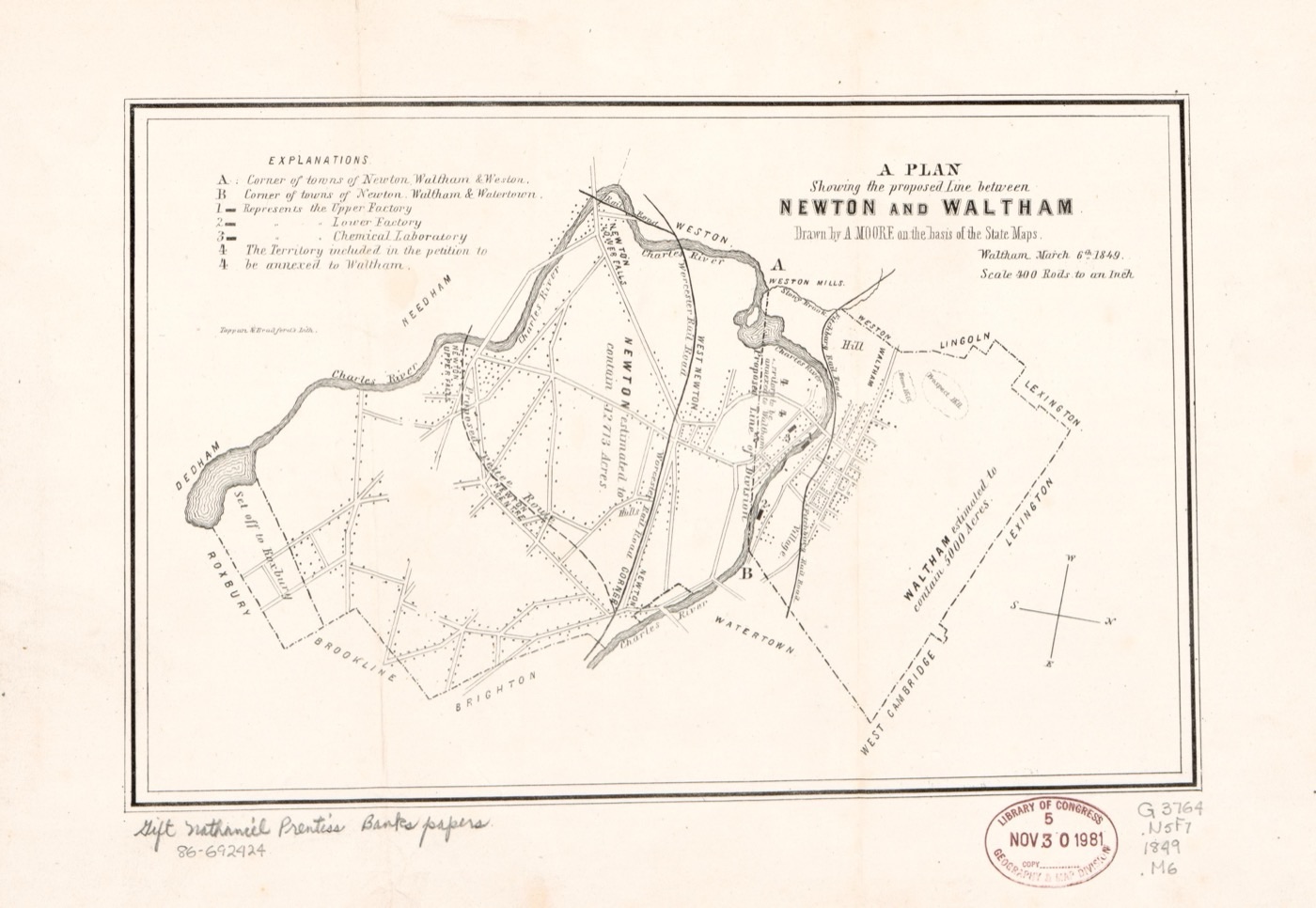
That empty South Side is where the watch factory went. The National Register nomination says Aaron Dennison initially considered a site on Stony Brook in Weston before choosing the 160-acre Bemis farm, and quotes the historian Howard Gitelman: Waltham was near Boston, had large tracts of cheap land, and its town fathers were willing to invest to attract industry. The nomination and the Library of Congress survey both add the reason a watchmaker cared about most, a place free of the dust and vibration of the city.2, 9
The river gave the site, not the power. Unlike the textile mills before it, the watch factory that opened in 1854 at Crescent and Prospect Streets, beside the Prospect Street Bridge, ran on steam.1, 2
What grew here: “the Watch” and its neighbourhood
The factory came with a plan for a town. The Waltham Improvement Company, incorporated in March 1854 with $100,000 of capital, bought most of the Bemis farm and laid out a grid of several hundred house lots over 160 acres between Moody Street and the curve of Crescent Street, with shade trees and gas lights. In the early 1860s Robbins and Crescent Parks were laid out across the street from the factory, both as ornaments and as a buffer against dust.1, 2
The neighbourhood was not open to all. For several decades the company hired Protestant and native-born workers alone, and until the 1880s the deeds of the Improvement Company’s lots kept out the foreign-born along with any “noisy, nauseous and offensive trade”. Under Royal E. Robbins the company offered its employees house lots and cheap loans, so that the streets of “the Watch” neighbourhood filled with houses built for skilled watch workers.1, 2
The factory became the town’s largest employer. It had more than 600 workers by 1865 and about 2,500 by the turn of the century, making 1,250 movements a day; when it made its last expansion, in 1910, it employed 4,200. Its many related firms gave Waltham the name “Watch City”.1
The present brick factory went up on the old site between the late 1870s and 1913, a complex nearly 1,000 feet long beside the river. By 1888 it had 3,300 windows, about five acres of floor and 1,600 automatic sprinklers, with rooms for recreation, emergency care and child day care; that year the writer John Swinton described it as a model factory in a model city.1, 2
Tool and parts makers grew around it. The survey of Waltham lists the American Watch Tool Company (1877), the O’Hara Waltham Dial Company (1897), the Waltham Watch Tool Company, the Waltham Machine Works, Waltham Screw and the Waltham Emery Wheel Company, and the same precision trades fed the Orient bicycles of the Waltham Manufacturing Company from 1894 and Charles Metz’s motor cars from 1909.1
Who and what moved through
The National Register nomination says the Boston Watch Company brought about fifty workers with it to Waltham, among them men recruited from the English watch trade, and that for many years “the Watch” was the main home source of skilled watch workers, many of whom rose to senior posts at rival firms.2
Its people built the industry in the west. The nomination calls Waltham the mother factory of several American watch companies, Elgin among them; in 1864 the founders of the National Watch Company of Chicago contracted Waltham men to run their new works at Elgin, and Bill Briska counts at least fifteen who had left Waltham for Elgin by 1867.2, 10, 11
Capital and management came from the import trade. Royal E. Robbins, born in Connecticut in 1824, had worked from 1841 to 1846 for his uncle’s Birmingham firm, which bought English goods including watches, and then imported English watches in New York; he took over the failed works for the Philadelphia case makers Tracy & Appleton and ran the company as treasurer and general manager for forty-five years. Dennison left for Europe in 1862.2
Workers came from abroad despite the company’s hiring rules. By 1865 about 21 per cent of Waltham’s people had been born in Ireland, and the Irish remained the largest group, joined by French Canadians and Sicilians by 1900. The town grew from 9,065 people in 1870 to nearly 12,000 in 1880, enough to become a city on 2 June 1884, and to 30,047 by 1915.1
By the late 1880s, the nomination says, watch company employees ran the town: they included three directors of the public library, the fire chief, the postmaster, half the aldermen and the mayor.2
What changed because of it
The nomination describes the Boston Watch Company as the first in the world to make a complete watch under one roof, and the Waltham historian Nathan Warren wrote that watchmaking by machinery had done more than any other enterprise to advance Waltham and spread its name. The method is told on the Waltham company and interchangeable parts pages.1, 2
In 1924 the watch industry still employed more than half of the city’s workers. But Robbins’s death in 1902 had brought a struggle for control: in the First World War it made time fuses, speedometers and blood-pressure gauges, the banks took over its management after the slump of 1921, and it went into receivership in 1923.1, 2
The Charles River Museum of Industry records a strike at the watch factory from 11 August 1924 to 8 January 1925, when about 2,800 employees stopped work against wage cuts.12
The factory shut in February 1950, leaving 1,200 people out of work; from 1952 the company mostly cased imported Swiss movements, and the old company was gone by 1957. Other industries had already moved into Waltham’s mills: Raytheon took over a River Street button factory in 1933 to make radio tubes and later rented space in both the textile mill and the watch factory.1, 10, 13
The watch factory still stands on the river. It was listed on the National Register on 28 September 1989 as the American Waltham Watch Company Historic District, about 8.2 acres, then housing small businesses; Wikipedia’s account says it has since been turned to mixed residential and commercial use.2, 14
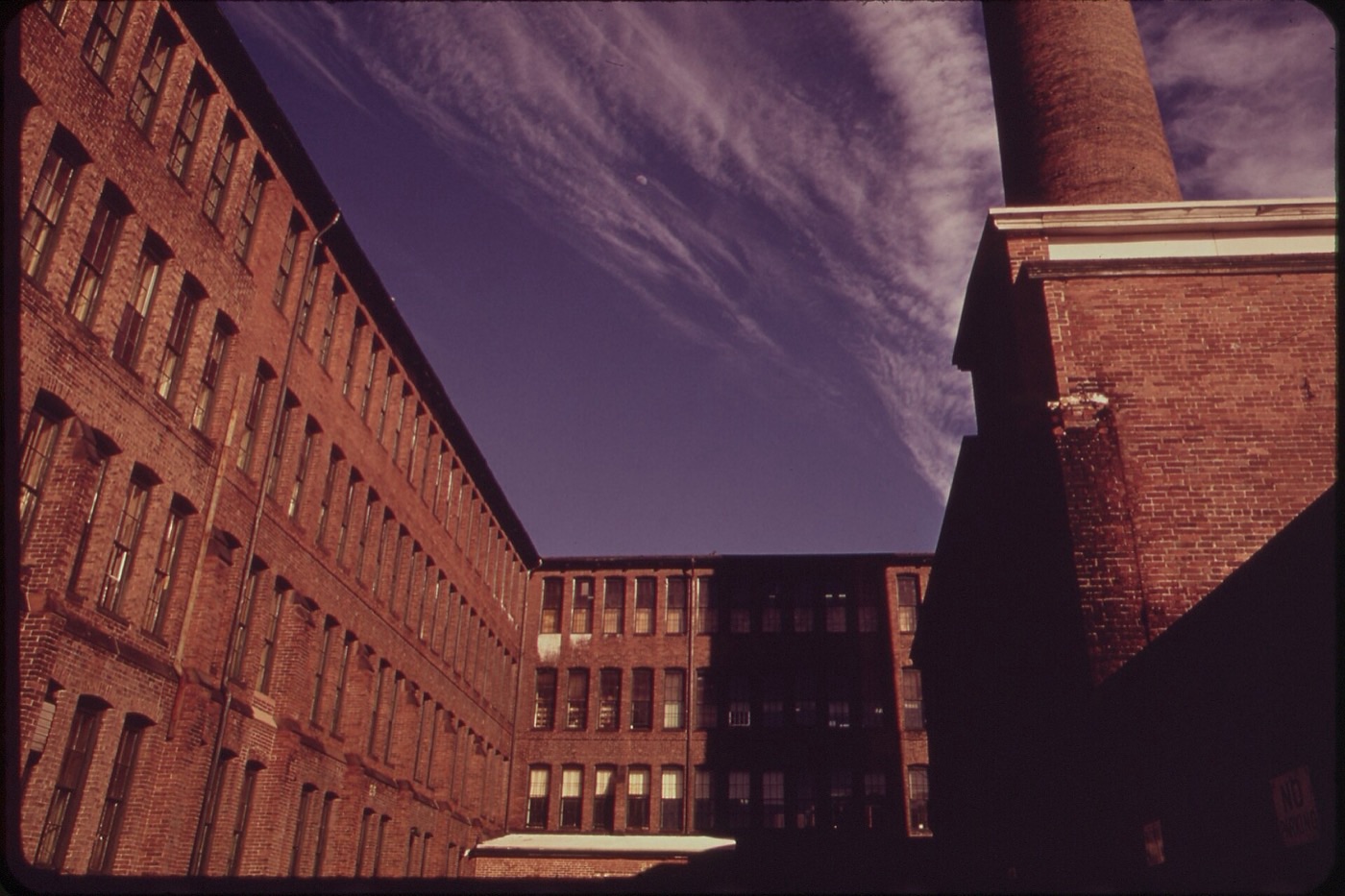
The textile mill where industrial Waltham began houses the Charles River Museum of Industry & Innovation, which says it was incorporated in 1980 and opened in 1988 in the Francis Cabot Lowell Mill, on the site where the Boston Manufacturing Company was founded.5
Key dates
- 1813
The Boston Manufacturing Company is organised on the Charles River at Waltham.1, 3
- 1849
Waltham buys 600 acres south of the river from Newton: the South Side.1
- 1854
The watch factory opens on the South Side; the Waltham Improvement Company lays out house lots.1, 2
- 1884
Waltham becomes a city, on 2 June.1
- 1888
John Swinton’s study presents the watch factory as a model factory in a model city.1, 2
- 1910
The watch factory’s last expansion; it employs 4,200.1
- 1950
The watch factory shuts in February; 1,200 lose their jobs.10, 13
- 1989
The American Waltham Watch Company Historic District is listed on the National Register.2, 14
Where Waltham, Massachusetts leads
- Based here, CompanyWaltham
The company built its factory on Waltham’s South Side in 1854 and made watches there until 1950.2, 9, 10
- Part of, HistoryAmerica industrializes the watch
The mill town where America’s watch factory was built and its workers housed, the source of skilled men for Elgin.1, 2, 11
- Part of, HistoryWatches go to war
In the First World War the Waltham factory turned to time fuses, speedometers and gauges.2, 13
- See also, PersonAaron Lufkin Dennison
Dennison chose the Bemis farm on Waltham’s South Side for the watch factory in 1854.2, 9
- See also, PlaceElgin, Illinois
Elgin’s founding superintendent and foremen were men recruited from the Waltham factory in 1864.2, 10, 11
- See also, PlaceWaterbury, Connecticut
Abbott says the Waterbury Watch factory was designed by H. W. Hartwell, the architect of the Waltham and Elgin factories.11
- See also, TechnologyInterchangeable parts
The Library of Congress survey says the Waltham factory introduced interchangeable parts to a civilian industry and spurred other watch and tool firms around the town.9
- See also, EventThe First World War
The Waltham factory made time fuses, speedometers and blood-pressure gauges in the First World War.2
Facts and sources
- Country
- United States1, 16
- Where
- Middlesex County, Massachusetts, on the Charles River west of Boston1, 16
- Watchmaking
- The watch factory from 1854; it shut in 1950 and the old company was gone by 19571, 10, 13
Sources
- 1
Waltham Multiple Resource Area, National Register nomination (opens in a new tab)
- 2
- 3
- 4
- 5
About the Charles River Museum of Industry & Innovation (opens in a new tab)
- 6
- 7
A plan showing the proposed line between Newton and Waltham (1849) (opens in a new tab)
- 8
- 9
- 10
- 11
- 12
- 13
- 14
American Waltham Watch Company Historic District (opens in a new tab)
- 15
- 16
Sources read November 12, 2026.