Waterbury, Connecticut
Connecticut’s Brass City, where button and brass makers on the Mad and Naugatuck rivers turned to clocks and cheap watches: the Waterbury watch, the Ingersoll dollar watch and the company that, after leaving the city in 1944, made the Timex.
United States, New Haven County, Connecticut, on the Naugatuck and Mad rivers
Why Waterbury? Buttons, brass and rivers
Settlers from Farmington came to Mattatuck in the 1670s, and the place was renamed Waterbury in 1686. The Historic American Engineering Record explains its turn to industry: the soil was poor and rocky, the Mad and Naugatuck rivers gave enough power for the mills of the time, wood for melting metal was plentiful, and small goods such as buttons cost almost nothing to carry to market.1
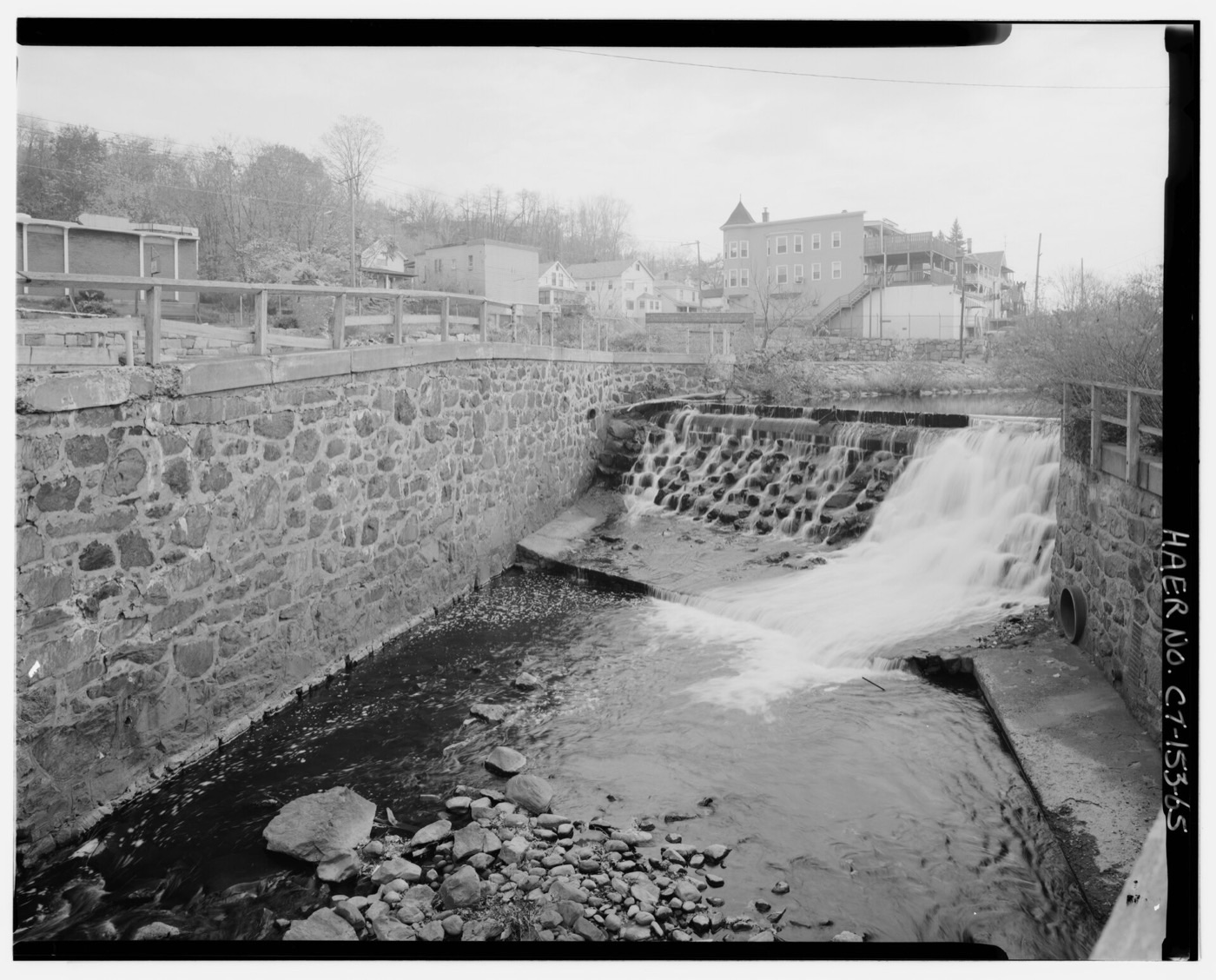
Brass began with buttons. In 1802 the button makers Abel Porter, Silas Grilley and their partners set up Abel Porter & Company, soon using the water power of the old Hopkins mill on the Mad River: the firm that became the Scovill Manufacturing Company. Fine metal buttons had until then mostly been imported, many of them from Birmingham in England.1
The National Register nomination for the clock factory dates the first casting of brass in the United States to 1806, in Abel Porter’s shop, and says the city was known internationally as “the Brass City” by 1896.2
Clocks followed the brass. Connecticut was already the country’s clockmaking state, and Chauncey Jerome’s cheap 30-hour brass clock of 1837 made brass movements the norm. Benedict & Burnham, one of Waterbury’s largest brass mills, began making clocks about 1850 after failing to win a contract to supply brass to Jerome, and the Waterbury Clock Company was incorporated separately on 27 March 1857 with $60,000 of capital.2, 7
By 1880 Waterbury firms supplied most of the brass, steel and copper punchings used by the American clock industry.2
What grew here: clocks by the million, watches for a dollar
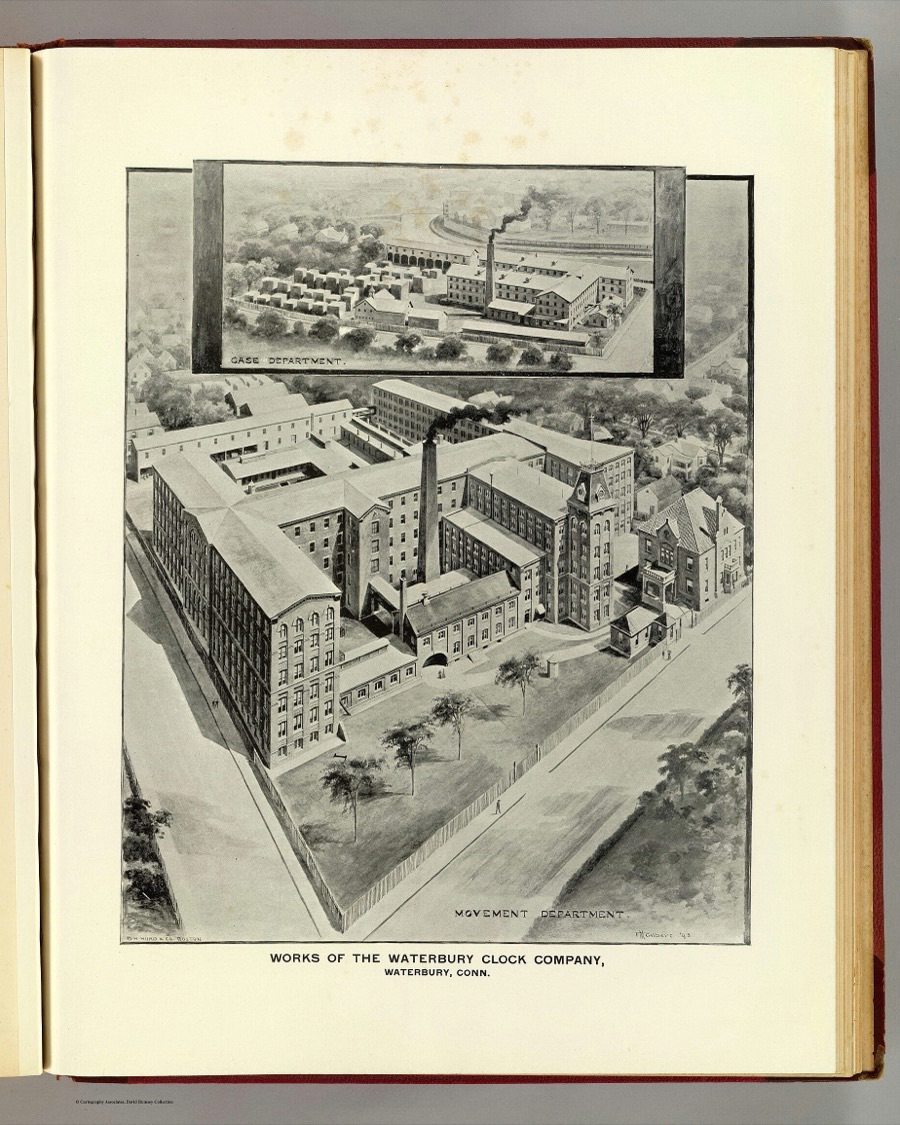
In March 1873 the clock company left Benedict & Burnham’s works for a former woollen mill on the Great Brook at North Elm Street, the nucleus of its Movement Shop. In 1870 its 142 workers had made 82,000 clocks; it employed about 300 people in 1887 and 700 in 1896, with salesrooms in New York, Chicago and Glasgow.2
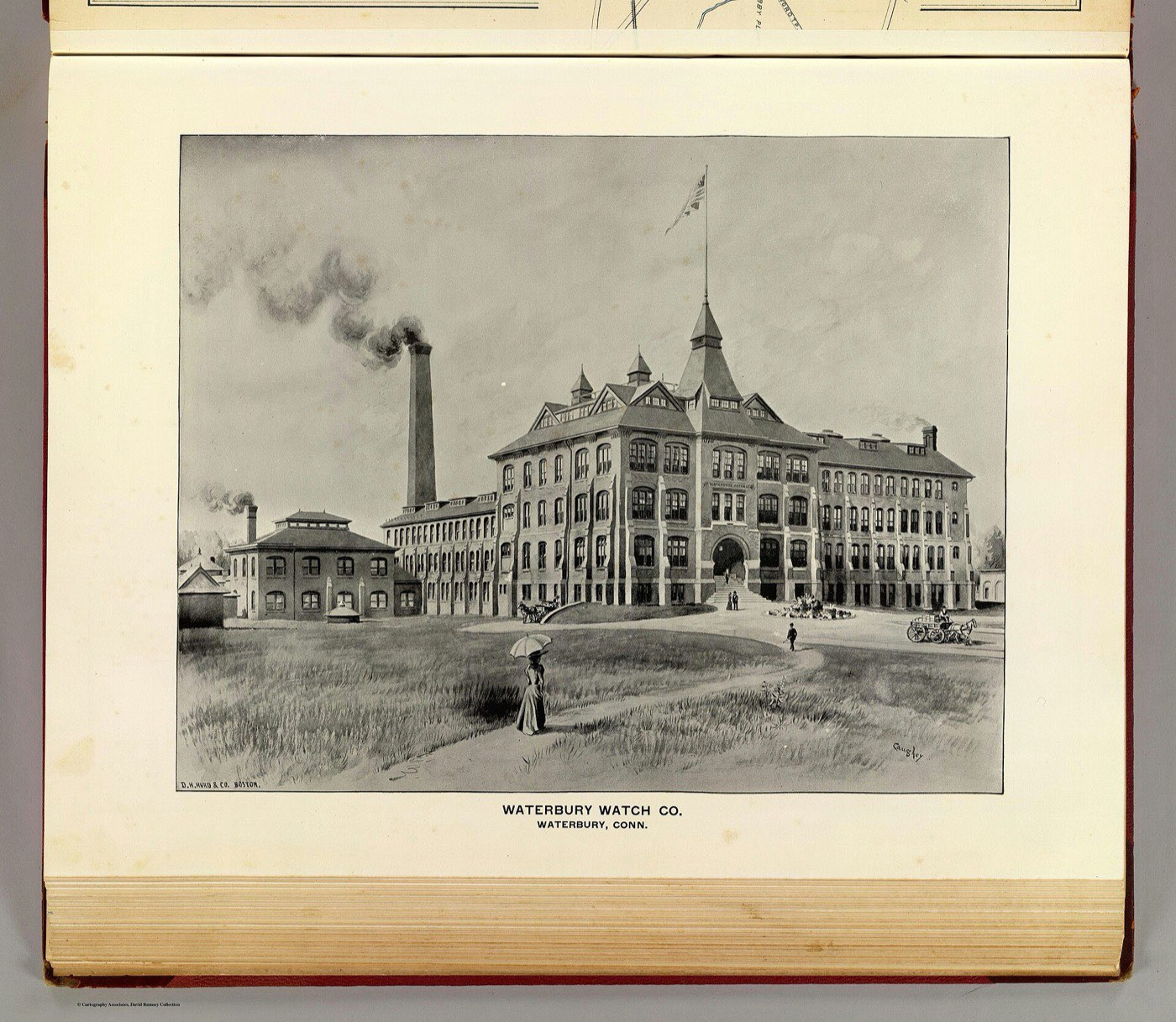
Abbott’s history of 1888 says the Waterbury watch was designed to reach the millions who could not afford even a cheap Waltham or Elgin: D. A. Buck of Worcester made a model with only fifty-eight parts and no jewels, Charles Benedict of Benedict & Burnham took it up in 1878, and the Waterbury Watch Company built a new factory for it. The long-wind watch sold for $3.50 by 1880, and Abbott puts the factory at 300 workers and 1,500 watches a day.3, 8, 9
The clock company went the same way. The National Register nomination says it brought out the “Jumbo”, a clock movement in a watch case small enough for an overcoat pocket, in 1889 for $1.50; Robert H. Ingersoll, a New York novelty merchant, ordered 180,000 improved Jumbos in 1893 and 300,000 the next year, and Wikipedia’s accounts date the Ingersoll Yankee, sold for one dollar, to 1896.2, 4, 7, 8
By 1907 the Waterbury Clock Company was counted the world’s largest clock maker, with 510,000 square feet of floor. In 1917 it employed more than 3,000 people and turned out about 23,000 clocks, watches and other items a day, 12,000 of them Ingersoll dollar watches; when the war cut off German and Swiss supplies it began making watch crystals too.2
Women did much of the work. The nomination records that, having entered industry in the button shops, women cut, drilled, polished and gilded parts and assembled movements in the watch and clock factories.2
Who and what moved through
Skill was smuggled in from England. In 1821 the firm that became Scovill sent the metalworker James Croft to England for machinery and men, and in the 1820s Israel Holmes made several trips to bring out English brass workers, then forbidden by law to emigrate; on one he brought twenty, three of them hidden in wine casks.1
Immigrants filled the mills. More than a quarter of the city’s people were foreign-born in 1850, and by 1890 seven in ten were immigrants or their children: at the start Irish, English and Germans, then French Canadians, Italians, Russians and Lithuanians. Swedes organised a Lutheran church on Cherry Street, almost inside the clock factory, in 1891, and Russian Jews and Poles settled nearby.1, 2
Abbott says the Waterbury Watch Company’s factory, which cost nearly half a million dollars, was designed by H. W. Hartwell of Boston, the architect of the Waltham and Elgin factories.3
Waterbury-made watches went round the world under the Ingersoll name. In 1901 Ingersoll sold a million of them to Symonds’ stores in London, and in 1922, when Robert H. Ingersoll & Bro. failed, the Waterbury Clock Company took over its business and bought the New England Watch Company, the former Waterbury Watch Company, as well.2, 4, 7
War and new owners moved the company out. Before 1941 it contracted to make 300,000 fuses for the British government, and in the Second World War it stopped nearly all clock and watch work for time fuses, gauges and torpedo gyroscopes. Wikipedia’s account says the Norwegian shipowner Thomas Olsen, who had fled Norway in 1940, and Joakim Lehmkuhl bought control in 1941. A new plant was built at Middlebury in 1942, and on 1 January 1944 the company became the United States Time Corporation.2, 11
What changed because of it
The National Register nomination credits the Waterbury Clock Company with helping earn Waterbury the title of “Watch Capital of America” by 1880. Bill Briska notes that the makers of jewelled watches never entered the dollar-watch market and could not foresee that its sales would grow for six decades until they dwarfed their own.2, 12
In 1933 the company contracted with Walt Disney to put Disney characters on its watches, and more than four million Mickey Mouse watches were sold before the Second World War.2, 7
On 8 November 1944 U.S. Time left the Waterbury site it had used for seventy-one years; the Benrus Watch Company bought the plant and in 1949 divided it among small firms. The sources differ on when the company’s cheap new watch appeared: the nomination dates the Timex to 1952, while Briska and Wikipedia’s account give 1950.2, 11, 12
Brass declined in turn. Scovill, which had 12,000 employees after the Second World War, diversified away from brass, left Waterbury by 1976 and sold its brass works; the complex was recorded from 1994 ahead of its demolition for a planned shopping centre.1
The clock company’s Movement Shop, more than twenty brick buildings on North Elm and Cherry Streets, was listed on the National Register in 1982; the nomination counts it as one of just two large nineteenth-century factory complexes left nearly intact in the city.2, 13
Key dates
- 1802
Abel Porter & Company, the forerunner of Scovill, begins making buttons on the Mad River.1
- 1857
The Waterbury Clock Company is incorporated, 27 March.2, 7
- 1873
The clock company moves to its own works on North Elm Street.2
- 1880
The Waterbury Watch Company’s long-wind watch sells for $3.50.3, 8, 9
- 1893
Robert H. Ingersoll orders 180,000 improved “Jumbo” watches.2
- 1922
The Waterbury Clock Company takes over the failed Ingersoll business.2, 7
- 1933
A contract with Walt Disney leads to the Mickey Mouse watch.2
- 1944
The company becomes the United States Time Corporation and leaves its Waterbury works.2
- 1976
Scovill has left Waterbury and sold its brass works.1
- 1982
The Movement Shop is listed on the National Register.2, 13
Where Waterbury, Connecticut leads
- Part of, HistoryAmerica industrializes the watch
The brass town that made the cheap Waterbury watch and the Ingersoll dollar watch.2, 3, 4
- See also, PlaceWaltham, Massachusetts
Abbott says the Waterbury Watch factory was designed by H. W. Hartwell, the architect of the Waltham and Elgin factories.3
- See also, ObjectThe Ingersoll Yankee
The Waterbury Clock Company made the Ingersoll dollar watches, about 12,000 a day in 1917.2
- See also, EventThe Second World War
The Waterbury Clock Company stopped nearly all clock and watch work for time fuses, gauges and torpedo gyroscopes.2
Facts and sources
- Country
- United States1, 2
- Where
- New Haven County, Connecticut, on the Naugatuck and Mad rivers1, 2
- Clocks and watches
- Waterbury Clock Company 1857 to 1944; Waterbury Watch Company from 18802, 7, 11
Sources
- 1
- 2
Waterbury Clock Company (Movement Shop), National Register nomination (opens in a new tab)
- 3
- 4
- 5
- 6
- 7
- 8
- 9
- 10
- 11
- 12
- 13
Sources read November 12, 2026.