The Ingersoll Yankee
The Yankee, a pocket watch made by the Waterbury Clock Company for Robt. H. Ingersoll & Bro. of New York and sold from 1896 for one dollar: the dollar watch, which Wikipedia’s accounts say set that price, and through which millions of people came to own a watch.
Made From 1896, By Waterbury Clock Company, Waterbury, Connecticut, for Robt. H. Ingersoll & Bro., New York, Now at Examples in the Deutsches Uhrenmuseum, Furtwangen (2004-044), and other collections
In the history America industrializes the watch
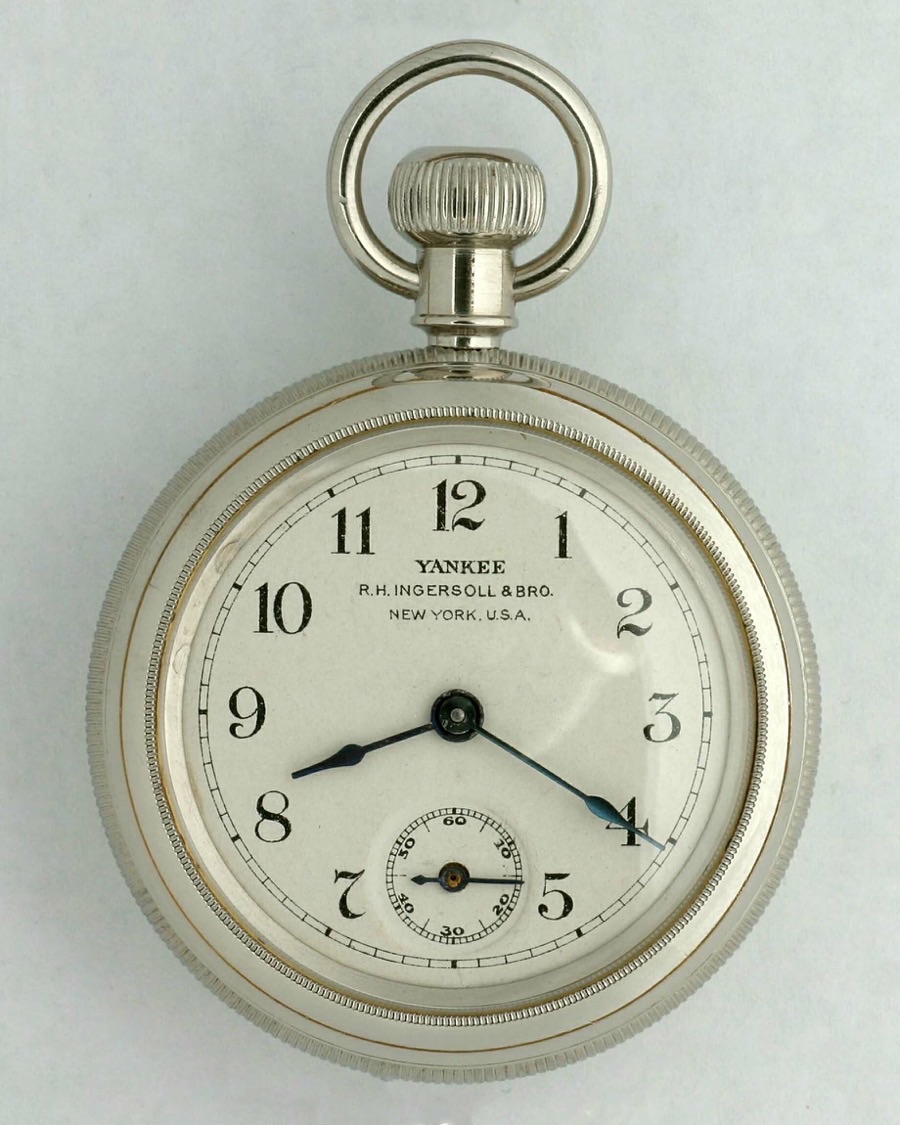
The watch
The Deutsches Uhrenmuseum in Furtwangen holds a Yankee pocket watch of R. H. Ingersoll & Bro., which it dates to about 1900: movement No. 5220258, 5.3 centimetres across, still with its watch paper.4
Its dial is lettered Yankee, R. H. Ingersoll & Bro., New York, U.S.A., and the paper in its case back is a printed guarantee from Ingersoll, “makers”, of Washington Street, New York: the watch would keep good time for a year, or be repaired free for five cents’ return postage.4
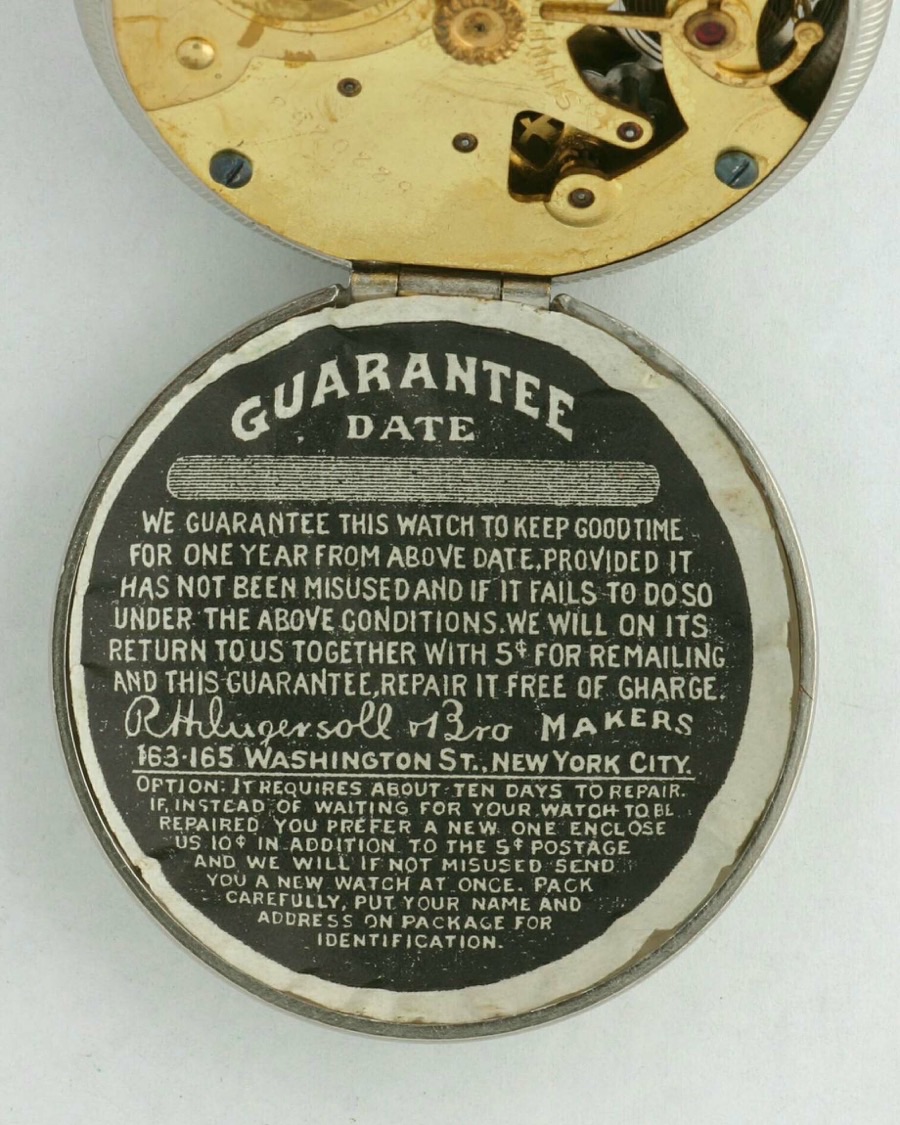
Wikipedia’s account says it was mass-produced cheaply from stamped parts and without jewels, so that anyone could afford it.1
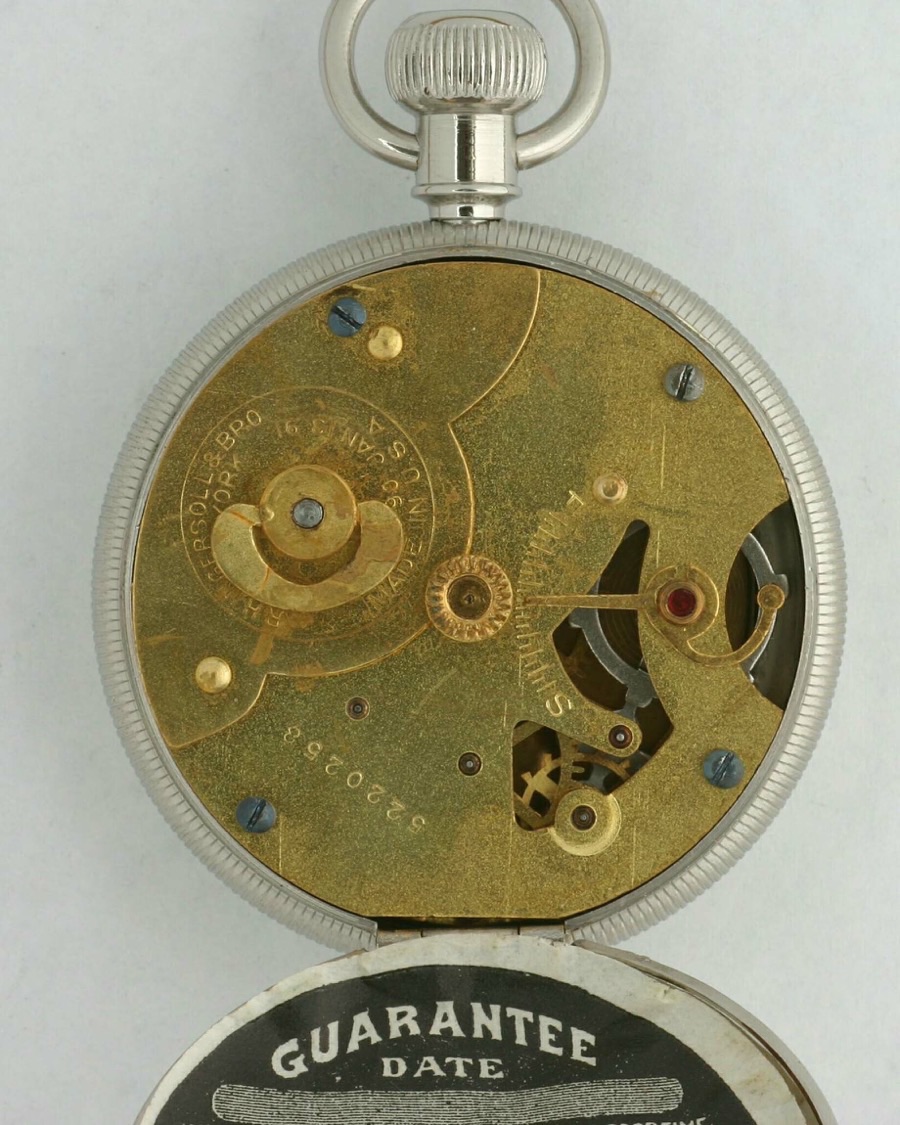
The Ingersolls did not make it. The Waterbury Clock Company of Waterbury, Connecticut, made their watches, and the Ingersoll firm became the sole distributor of its watches and clocks.1, 3
What changed
A cheap watch had been tried before. The Waterbury Watch Company could sell its long-wind watch for $3.50 by 1880, and Abbott wrote in 1888 that it was designed to reach the millions who could not afford even a cheap Waltham or Elgin.2, 9, 10
The Waterbury Clock Company brought out the “Jumbo” in 1889, a clock movement in a watch case small enough for an overcoat pocket, at $1.50; Robert H. Ingersoll, a New York novelty merchant, ordered 180,000 improved Jumbos in 1893 and 300,000 the next year.3, 11
The sources date Ingersoll’s start in watches differently: Wikipedia’s account gives the Universal of 1892, a small clock in a watch case, while the National Register nomination puts the opening order in 1893.1, 3
Wikipedia’s accounts say the Yankee of 1896 set the price at one dollar, the cheapest watch then available, and call it the first watch priced at a dollar.1, 2
Bill Briska notes that the makers of jewelled watches never entered the dollar-watch market and could not foresee that its sales would grow for six decades until they dwarfed their own.12
Selling it
An Ingersoll advertisement of December 1903 sells it as the Ingersoll Dollar Watch and draws a dial marked Yankee.5
Wikipedia’s account says the Waterbury Clock Company was making 8,000 a day for Ingersoll by 1899, that Ingersoll advertised 10,000 dealers, and that output reached 3.5 million dollar watches a year by 1910.1
In 1901 Ingersoll sold a million of the watches to Symonds’ stores in London, and in 1917 the clock company turned out about 12,000 Ingersoll dollar watches a day among 23,000 clocks, watches and other items.3
Wikipedia’s account credits Ingersoll with the slogan “The watch that made the dollar famous” and counts nearly 40 million dollar watches sold in twenty years. Other makers followed, Westclox from 1899 among them.1, 2
Key dates
- 1880
The Waterbury Watch Company’s long-wind watch sells for $3.50.2, 9, 10
- 1889
The Waterbury Clock Company brings out the “Jumbo” at $1.50.3
- 1893
Robert H. Ingersoll orders 180,000 improved Jumbos.3
- 1896
The Yankee goes on sale for one dollar.1, 2, 5
- 1901
Ingersoll sells a million watches to Symonds’ stores in London.3
- 1903
Advertised as the Ingersoll Dollar Watch.5
- 1922
The Waterbury Clock Company takes over the failed Ingersoll business.3, 11
Where the Ingersoll Yankee leads
- Part of, HistoryAmerica industrializes the watch
The dollar watch of 1896, made at Waterbury for the Ingersoll brothers.1, 2, 3
- See also, PlaceWaterbury, Connecticut
The Waterbury Clock Company made the Ingersoll dollar watches, about 12,000 a day in 1917.3
Facts and sources
- Made
- From 18961, 2
- Maker
- Waterbury Clock Company, Waterbury, Connecticut, for Robt. H. Ingersoll & Bro., New York1, 3, 4
- Held by
- Examples in the Deutsches Uhrenmuseum, Furtwangen (2004-044), and other collections4
Sources
- 1
- 2
- 3
Waterbury Clock Company (Movement Shop), National Register nomination (opens in a new tab)
- 4
Taschenuhr, R. H. Ingersoll und Bro., USA, um 1900 (inv. 2004-044) (opens in a new tab)
- 5
Ingersoll Dollar Watch advertisement, Everybody's Magazine, December 1903 (opens in a new tab)
- 6
- 7
- 8
The movement of the Furtwangen Yankee, No. 5220258. (opens in a new tab)
- 9
- 10
- 11
- 12
- 13
Sources read November 12, 2026.