The Rolex Oyster
The sealed wristwatch case that Rolex introduced in 1926: a screw-down crown patented by Paul Perregaux and Georges Perret and a screwed case patented by Hans Wilsdorf, launched in 1927 with Mercedes Gleitze’s Channel swim.
Made From 1926, By Rolex, Geneva; movements from Aegler, Biel
Companies Rolex
In the history From the pocket to the wrist
Patents and making
The Oyster is the sealed wristwatch case that Rolex introduced in 1926 and named for its tight closure; Rolex says it gave the movement 'optimal protection'.1, 2, 5
Its key part, the screw-down crown, was patented by Paul Perregaux and Georges Perret (Swiss application 30 October 1925); Wilsdorf held the British patent as their assignee, and Wikipedia says Rolex bought the patent.3, 6, 8
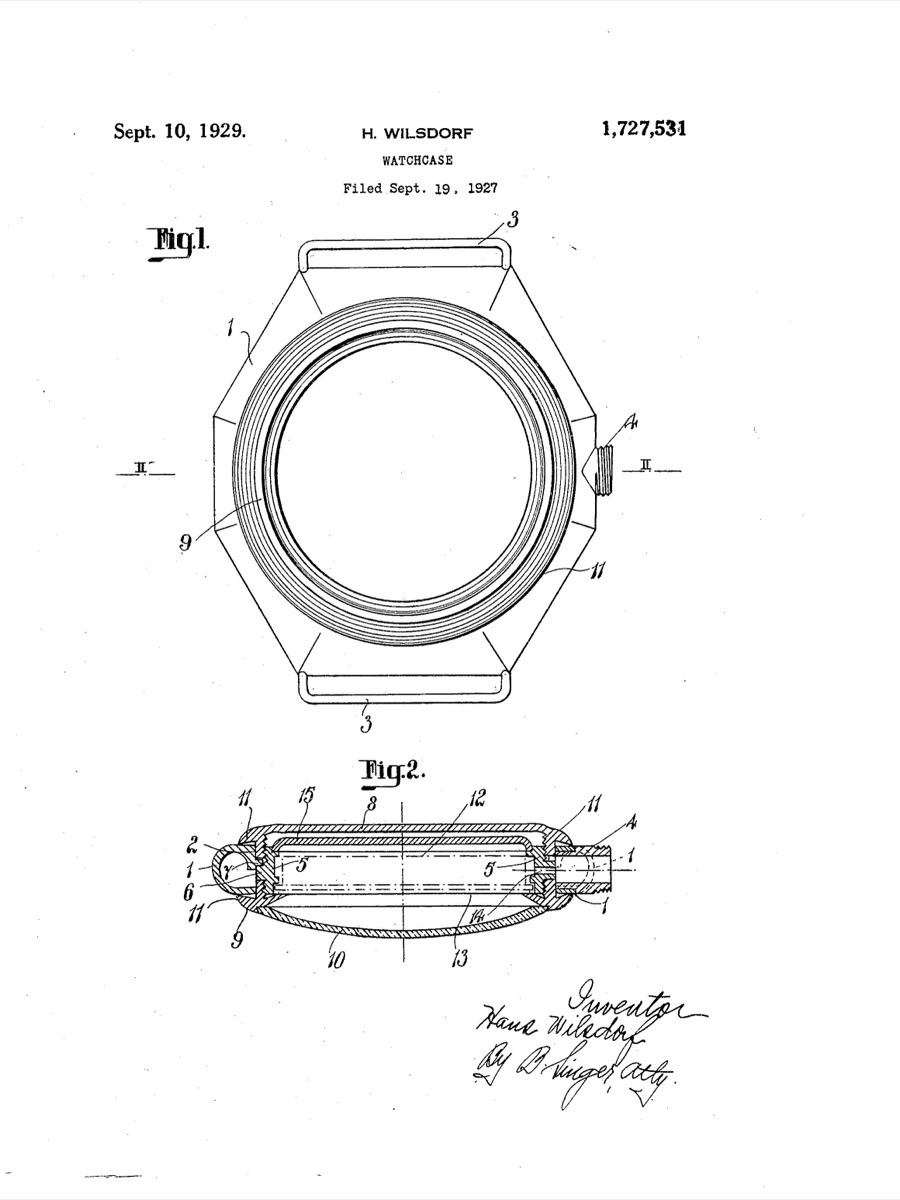
Wilsdorf's own Swiss patents of September and October 1926 add a crown that slides on the stem and screws down onto a tube in the case, and a shaped case closed by a screwed back and bezel; the US version, granted in 1929, shows an octagonal case.4, 9, 10
Donzé dates Rolex's patent application for a hermetically sealed case to 1926; Wikipedia says the original cases were made for Rolex by an outside casemaker.5, 6
The movements came from the Aegler factory in Biel, Rolex's sole movement supplier, which, Donzé shows, raised the share of its movements earning a rating certificate with distinction from 10.8 per cent in 1926-27 to an average of 63.1 per cent in 1932-37 and hired the adjuster Jean Matile in 1927.2, 5
Further patents kept the design moving: a winding and setting device for hermetic watches (1929), a hermetic watch (1933) and a tightness-testing apparatus (1934), all in Wilsdorf's name.11
The 1927 launch
The launch advertisement filled the front page of the Daily Mail on 24 November 1927. It calls the Oyster 'the greatest Triumph in Watch-making ... the Wonder Watch that Defies the Elements', for men or women, and carries Mercedes Gleitze's picture.5, 6, 12
Rolex dates its 'Testimonee' idea, the use of famous wearers, to that advertisement.1
Which swim the watch survived is told differently: Rolex says it crossed the Channel with Gleitze; Wikipedia, citing John E. Brozek, says she wore it on the failed second attempt of 21 October 1927, hung round her neck, and The Times reported it had kept good time.1, 6, 13
Rolex displayed Oysters submerged in aquariums in the windows of its retailers, Wikipedia says.6
Donzé records that on 7 December 1927 Wilsdorf warned 'any counterfeiter or imitator' in La Fédération horlogère suisse that he owned the patents and the trademarks Oyster, Aqua and Submarine.5
Claims and successors
Rolex calls it 'the first waterproof and dustproof wristwatch'; Watkins (Dennison patents of 1872 and 1915) and Wikipedia (Depollier) point to earlier sealed cases.1, 6, 14
With the self-winding rotor of 1930 or 1931 it became the Oyster Perpetual, an automatic, and the sealed case led to the diving watches of the 1950s.1, 2, 6
Key dates
- 1925
Perregaux and Perret apply for the screw-down crown patent (30 October).3, 8
- 1926
Wilsdorf's case and crown patents; the Oyster introduced.1, 4, 9
- 1927
Gleitze's swim; Daily Mail front page (24 November); warning notice (7 December).5, 6
- 1929
US patent for the shaped Oyster case granted.10
- 1931
The rotor makes it the Oyster Perpetual (1930 by the Swiss dictionary).1, 2
- 1934
Patent for a case tightness-testing apparatus filed.11
Where the Rolex Oyster leads
- Developed by, PersonHans Wilsdorf
Wilsdorf held the crown patent as assignee and patented the case himself in 1926.4, 8, 9
- Made by, CompanyRolex
Rolex introduced the Oyster case in 1926.1, 2
- Part of, HistoryFrom the pocket to the wrist
The sealed case with a screw-down crown that Rolex introduced in 1926.1, 2, 4
- See also, TechnologyWater resistance
The Oyster’s screw-down crown and screwed case sealed a wristwatch against water and dust.1, 4
Facts and sources
- Made
- From 19261, 2, 5
Sources
- 1
Rolex history, 1926 to 1945: milestones in watchmaking (opens in a new tab)
- 2
- 3
CH 114948: Montre à remontoir (Paul Perregaux; Georges Perret) (opens in a new tab)
- 4
CH 120848: Montre à remontoir (Wilsdorf Hans) (opens in a new tab)
- 5
Watchmaking in 1927: major structural changes (opens in a new tab)
- 6
- 7
- 8
- 9
CH 120851: Boîte de montre de forme (Wilsdorf Hans) (opens in a new tab)
- 10
US 1,727,531: Watchcase (Hans Wilsdorf, London) (opens in a new tab)
- 11
Google Patents search: assignee Wilsdorf, priority before 1935 (opens in a new tab)
- 12
- 13
- 14
The Origins of Self-Winding Watches 1773-1779 (opens in a new tab)
Sources read November 11, 2026.