The American Watch Company prototype
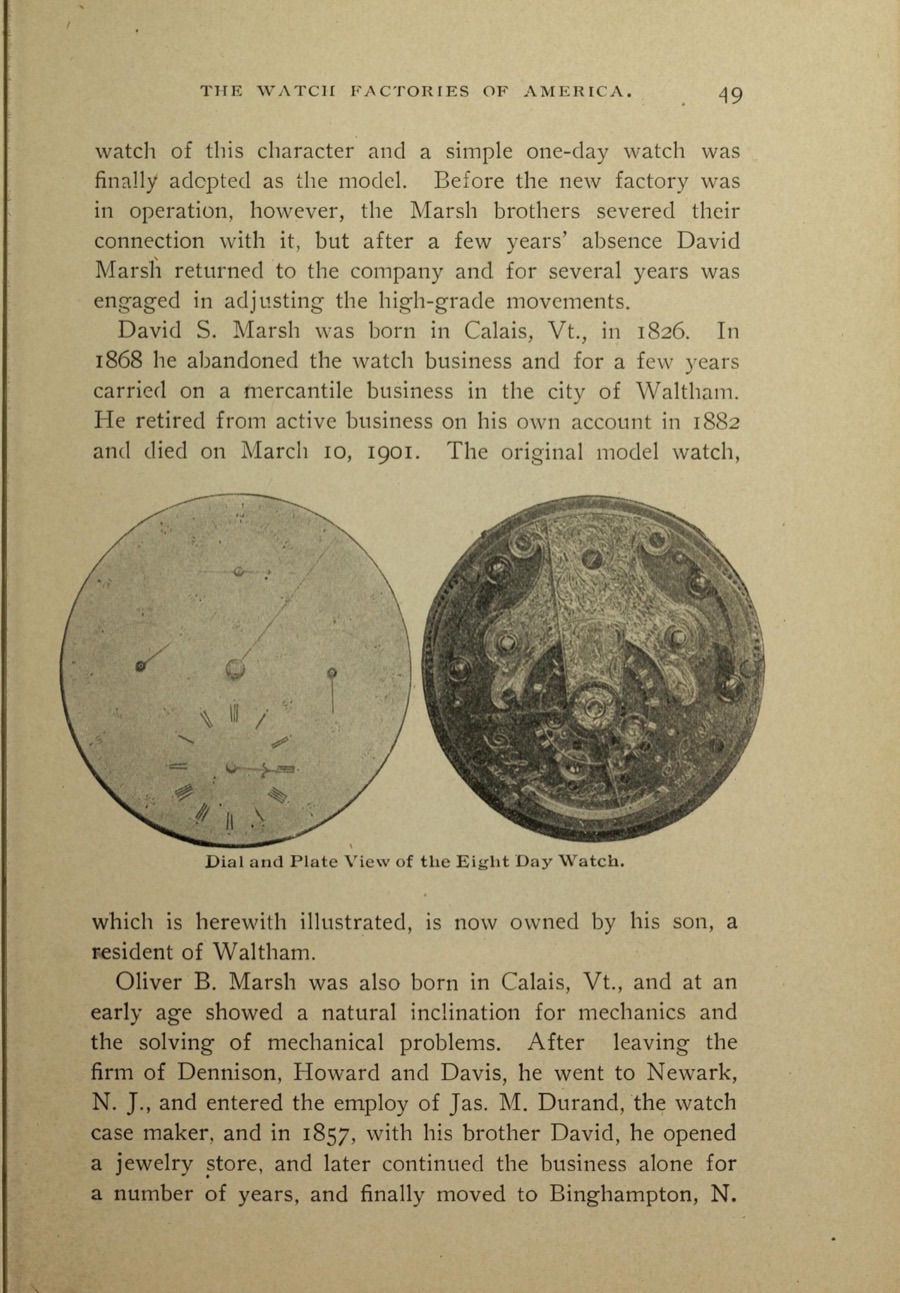
A gold pocket watch with an eight-day movement, made about 1850–52 by Oliver B. Marsh as a prototype for the Roxbury venture that became the American Watch Company of Waltham: one of the seventeen watches, still made largely by hand, that came before the factory’s machine-made watches built from parts checked against gauges. It is in the National Museum of American History.
Made About 1850–52, at Roxbury, Boston (the museum gives 1849–1851 and about 1852), By Oliver B. Marsh, for the venture that became the American Watch Company of Waltham, Now at National Museum of American History, Washington (ME.334625)
Companies Waltham
In the history America industrializes the watch
The watch
The National Museum of American History holds a gold pocket watch that Oliver B. Marsh, a watchmaker with the firm from its beginnings, designed and made as a prototype for the American Watch Company of Massachusetts.1
It is large for a pocket watch of its day, about 7.9 by 5.9 centimetres in an 18-carat gold case. Its white enamel dial shows minutes round the rim and four smaller dials: hours at six, seconds at twelve, the day of the week at nine and the date at three.1
The museum gives its date as 1849–1851 and as about 1852, and its place of making as Roxbury, near Boston. It was a gift of Mr. and Mrs. Joseph W. E. Bourgeois.1
Henry Abbott’s history of the Waltham company, published in 1905, says Aaron Dennison did not feel equal to making the model watch himself and entrusted it to two brothers from Calais, Vermont, Oliver and David Marsh, who worked in a small room partitioned off in the Howard and Davis factory and produced two models designed to run seven to eight days at a winding.2
What changed
The venture began in 1849 in a corner of the Howard & Davis clock factory at Roxbury, where Edward Howard and Aaron Dennison worked on new designs of watch and the machines to make them; it became the Waltham company.1, 4
Its makers redesigned the watch so that the movement could be assembled from parts made on special machines. Dennison took from the Springfield Armory a system based on models: they made a model watch and a master set of gauges, and every part made afterwards was measured against the matching part of the model, the method told under interchangeable parts.1
The Smithsonian describes these as the world’s first machine-made watches; Abbott’s history of 1888 gives that title, for America, to the Pitkin brothers’ watch of 1838.1, 4
The prototypes themselves were still handwork. By late in 1852 Howard and Dennison had seventeen watches, made mostly by hand by the brothers Oliver and David Marsh, and this one, by Oliver, survives.1
From prototype to product
The eight-day design, with two mainsprings, gave way to a simpler watch that ran a little more than a day on one mainspring in a going barrel, without the fusee and chain of English watches: fewer parts to make.1, 4
Abbott says the change came after the makers talked to the jewellery trade, which judged it unwise to enter the market with an eight-day watch.2
The next hundred watches, on the new model, took until the autumn of 1853, and a batch of nine hundred that followed sold for $40 each, cased, about half the price of an imported movement of the same quality.1
Abbott’s history of 1888 records that the opening hundred bore the name of the Warren Manufacturing Company and the next six or seven hundred that of Samuel Curtis, the venture’s backer.4
The firm moved to Waltham in 1854, failed in 1857 and carried on under Royal E. Robbins as the American Watch Company, the name under which the museum records the prototype.1, 4, 5, 6, 7
Key dates
- 1849
Howard and Dennison begin their watch venture at Roxbury.1, 4
- 1850
Abbott’s history of 1888 dates the completed model of the eight-day watch to the summer of 1850.4
- 1852
Seventeen watches, the prototypes among them, are finished, mostly by hand.1
- 1853
The next hundred, on a simpler one-day model, are finished.1
- 1854
The firm moves to its new factory at Waltham.4, 5, 6
- 1857
The company fails; Royal E. Robbins buys the works.4, 6
Where the American Watch Company prototype leads
- Made by, CompanyWaltham
Oliver B. Marsh made the prototype for the venture that became the American Watch Company of Waltham.1
- Part of, HistoryAmerica industrializes the watch
One of the seventeen hand-made watches of 1852 with which the Roxbury venture began.1
- See also, PersonAaron Lufkin Dennison
Abbott says Dennison entrusted the model watch to Oliver and David Marsh.2
- See also, TechnologyInterchangeable parts
Made while the firm built its model watch and master gauges, against which every later part was measured.1
Facts and sources
- Made
- About 1850–52, at Roxbury, Boston (the museum gives 1849–1851 and about 1852)1
- Maker
- Oliver B. Marsh, for the venture that became the American Watch Company of Waltham1, 2
- Held by
- National Museum of American History, Washington (ME.334625)1
Sources
- 1
American Watch Company Prototype (NMAH 1204764) (opens in a new tab)
- 2
History of the American Waltham Watch Company of Waltham, Mass. (opens in a new tab)
- 3
- 4
- 5
- 6
- 7
Works of the American Watch Company, Waltham, Mass. (opens in a new tab)
Sources read November 12, 2026.