The original Swatch
The plastic quartz watch shown in Zurich on 1 March 1983: 51 parts, a moulded case closed by ultrasonic welding, assembly by machine and a design by the ETA engineers Elmar Mock and Jacques Müller under Ernst Thomke. It is the watch on which the Swiss industry rebuilt its volume after the quartz crisis.
Made 1983; prototypes 1981–82, By ETA, Grenchen, for Swatch, Now at Centre Pompidou, Paris (six prototypes of 1981–82, AM 1993-1-415 and others; a 1983 model, AM 1993-1-418)
In the histories The electric and quartz revolution, Crisis, consolidation and the groups
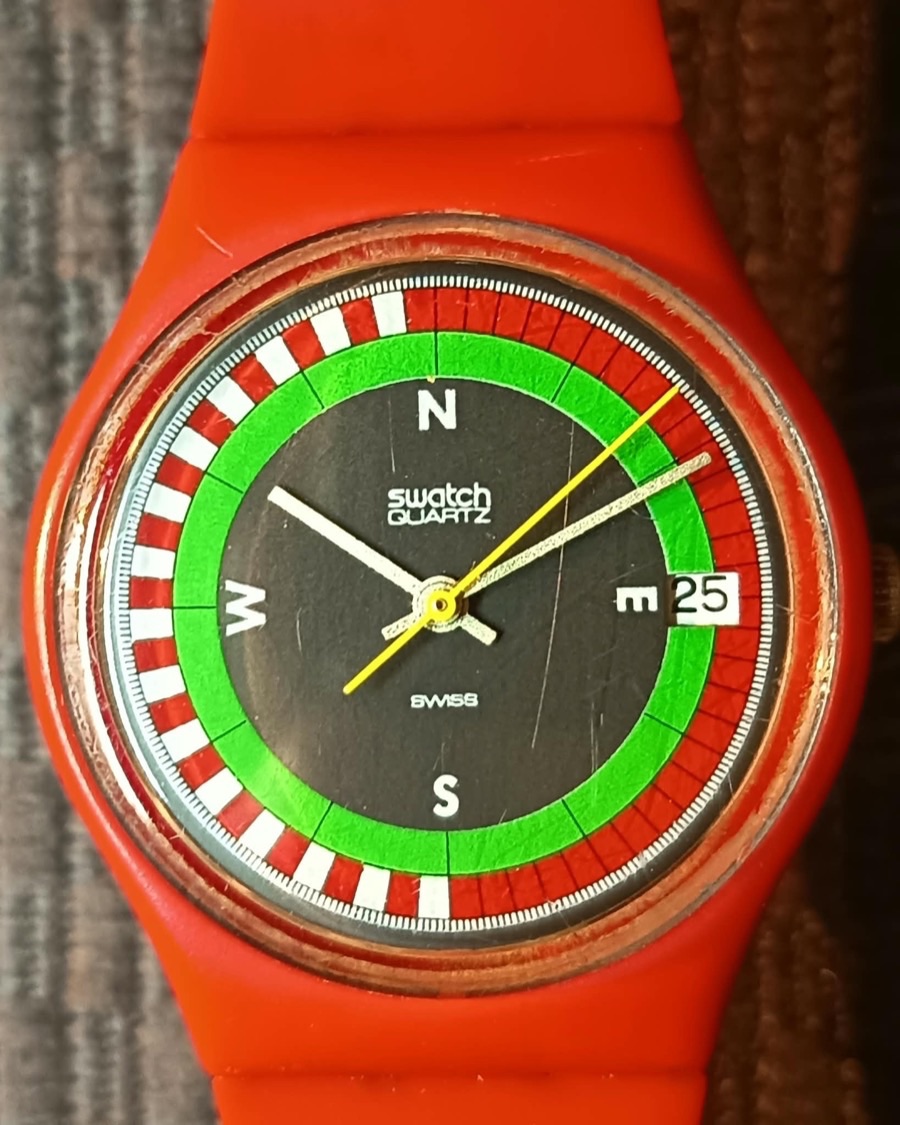
The watch
The first collection of twelve Swatch models was shown in Zurich on 1 March 1983; Europa Star records that Ernst Thomke, the head of ETA, introduced it at a press conference.1, 6, 7
It was a quartz watch with hands in a case moulded from plastic: the Centre Pompidou records its model of 1983 as injection-moulded ABS with a strap of flexible PVC.10
The Swatch Group says it was made from just 51 components and assembled on automated production lines around a Swiss Made movement. The European Patent Office compares the 51 with 91 in a standard watch; swissinfo puts the earlier figure at 100.2, 5, 7
The case was part of the movement. In the patent Jacques Müller and Elmar Mock filed in Switzerland on 26 February and 6 March 1981, the motor’s stator carries the rotor, hand spindles and gear train, the circuit is heat-sealed to the plastic case bottom, and the cell sits in a chamber in the case bottom.3
Later patents closed it up: one with a Swiss priority of 12 August 1982 seals the crystal to the plastic case by ultrasonic welding, and one of June 1982, by Mock and Alphonse Bron, hinges the strap to lugs moulded in one piece with the case.4, 11
What changed
Europa Star writes that Mock, working on plastic insulators, saw that injection moulding could make a watch case, that he and Müller drew the first sketch, and that Thomke, head of ETA from 1978, saw what it meant for mass production.6, 12
The European Patent Office credits Mock with bringing ultrasonic welding into watchmaking, for parts inside the case and for the crystal; Watchonista, reporting the citation of the Gaïa Prize, adds that the design set out to avoid repairs, which made the watch cheaper to make.5, 12
swissinfo reports that the design drew on prototypes of fully integrated watches developed inside ASUAG since 1978, and that a low-cost, high-tech watch was what Nicolas Hayek recommended to ASUAG and SSIH in 1983.7
The result was a Swiss watch at a mass-market price: twelve models at 39 to 50 francs, by swissinfo’s account, at a time when cheap quartz watches from Japan and Hong Kong had taken the market from the Swiss.7, 13
Launched and copied
Europa Star records that ETA registered the Swatch name in July 1982, planned a test launch in Texas that autumn, and sold about 400,000 in the first half-year in Switzerland, Britain and the United States.6
swissinfo counts a million sold within twelve months and some 3.5 million by the end of 1984; the Historical Dictionary of Switzerland counts 10 million by 1985.7, 8
It was sold as a fashion accessory, with new models every six months, swissinfo reports, and Europa Star credits Franz Sprecher with the idea of selling it as a “second watch”. Mondaine’s M-Watch and Fortis’s ID-Watch followed it in plastic in 1983, Europa Star notes.6, 7
Since
The Centre Pompidou in Paris holds a set of six Swatch prototypes of 1981–82 and a model of 1983, all given by Swatch in 1992; the Swatch Group says the Museum of Modern Art in New York holds a GB100 of 1983.10, 14, 15
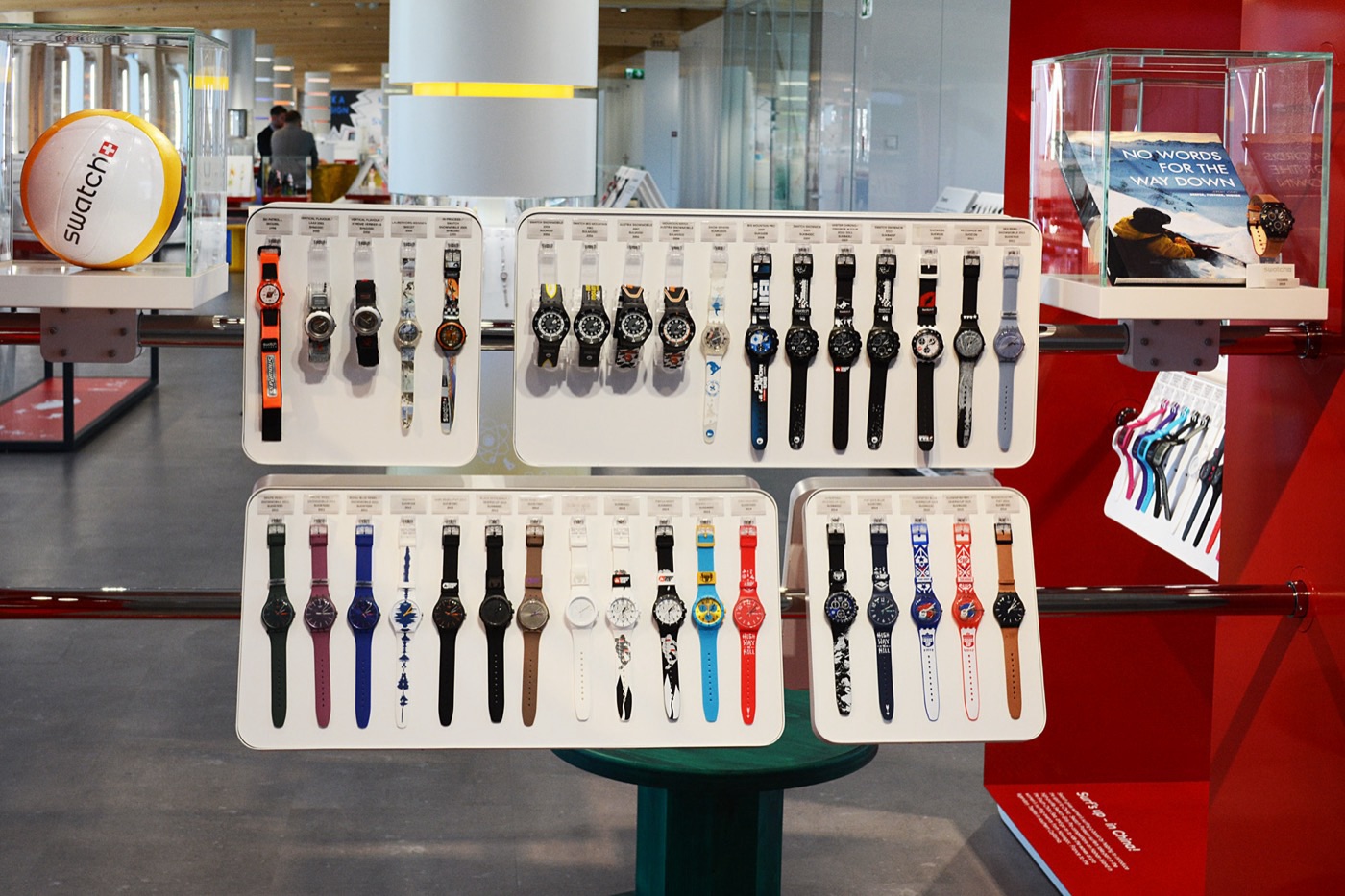
Mock and Müller received the Gaïa Prize of the Musée international d’horlogerie in La Chaux-de-Fonds in 2010 as the inventors named in three Swatch patents, and the European Patent Office named Mock a finalist for its European Inventor Award in 2017.5, 12
Key dates
- 1981
Müller and Mock file Swiss patents for a plastic electronic watch.3
- 1982
ETA files the patent for welding the crystal to the case by ultrasound.4
- 1983
Twelve Swatch models are shown in Zurich, 1 March.1, 7
- 1984
swissinfo counts some 3.5 million Swatches sold by the end of the year.7
- 1992
Swatch gives prototypes and early models to the Centre Pompidou.10, 14
- 2010
Watchonista reports the Gaïa Prize for Mock and Müller.12
- 2017
Mock is a finalist for the European Inventor Award.5
Where the original Swatch leads
- Made by, CompanySwatch
Made by ETA in Grenchen and sold under the Swatch name from 1983.1, 2
- Part of, HistoryCrisis, consolidation and the groups
The Swatch Group says this 51-part plastic watch of 1983, assembled by machine, gave the initial spark to the industry’s upswing.2, 7
- Part of, HistoryThe electric and quartz revolution
The plastic quartz watch of 51 parts shown in Zurich on 1 March 1983 and assembled by machine.1, 2
- See also, CompanyETA
ETA’s engineers designed the Swatch and filed its patents in 1981 and 1982.3, 4
- See also, TechnologyThe quartz watch
A quartz watch with hands whose movement is built into its plastic case.3, 10
Facts and sources
- Made
- 1983; prototypes 1981–821, 14
- Held by
- Centre Pompidou, Paris (six prototypes of 1981–82, AM 1993-1-415 and others; a 1983 model, AM 1993-1-418)10, 14
Sources
- 1
- 2
- 3
- 4
EP 0101663: Method of producing a watch and watch obtained by this method (opens in a new tab)
- 5
- 6
From the archives: our first look at the Swatch (opens in a new tab)
- 7
The Swatch celebrates its 20th birthday (opens in a new tab)
- 8
- 9
A Swatch Compas, model GB105, of 1983, by its record. (opens in a new tab)
- 10
Montre Tennis Grid, 1983 (AM 1993-1-418) (opens in a new tab)
- 11
EP 0098239: Wrist watch with a strap hinged to the case (opens in a new tab)
- 12
Prix Gaïa 2010: Jacques Muller and Elmar Mock, Craftsmanship-Creation category (opens in a new tab)
- 13
- 14
Montre Swatch, 1981-1982 (AM 1993-1-415) (opens in a new tab)
- 15
Swatch and MoMA collaborate to launch special edition watches (opens in a new tab)
- 16
Sources read November 12, 2026.