The quartz watch
The watch that keeps time by counting the vibrations of a quartz crystal: from the room-sized quartz clocks of the 1920s to Seiko’s Astron of 1969 and the Swiss Beta 21, then digital displays, cheap chips and the watch most people wear.
Introduced 1969 (Seiko Quartz Astron), 1969 onwards
Companies Casio, Citizen, Hamilton, Longines, Omega, Seiko, Titan
Came after The electric watch
Developed by Seiko, Hamilton, Citizen, Casio
In the history The electric and quartz revolution
How it works
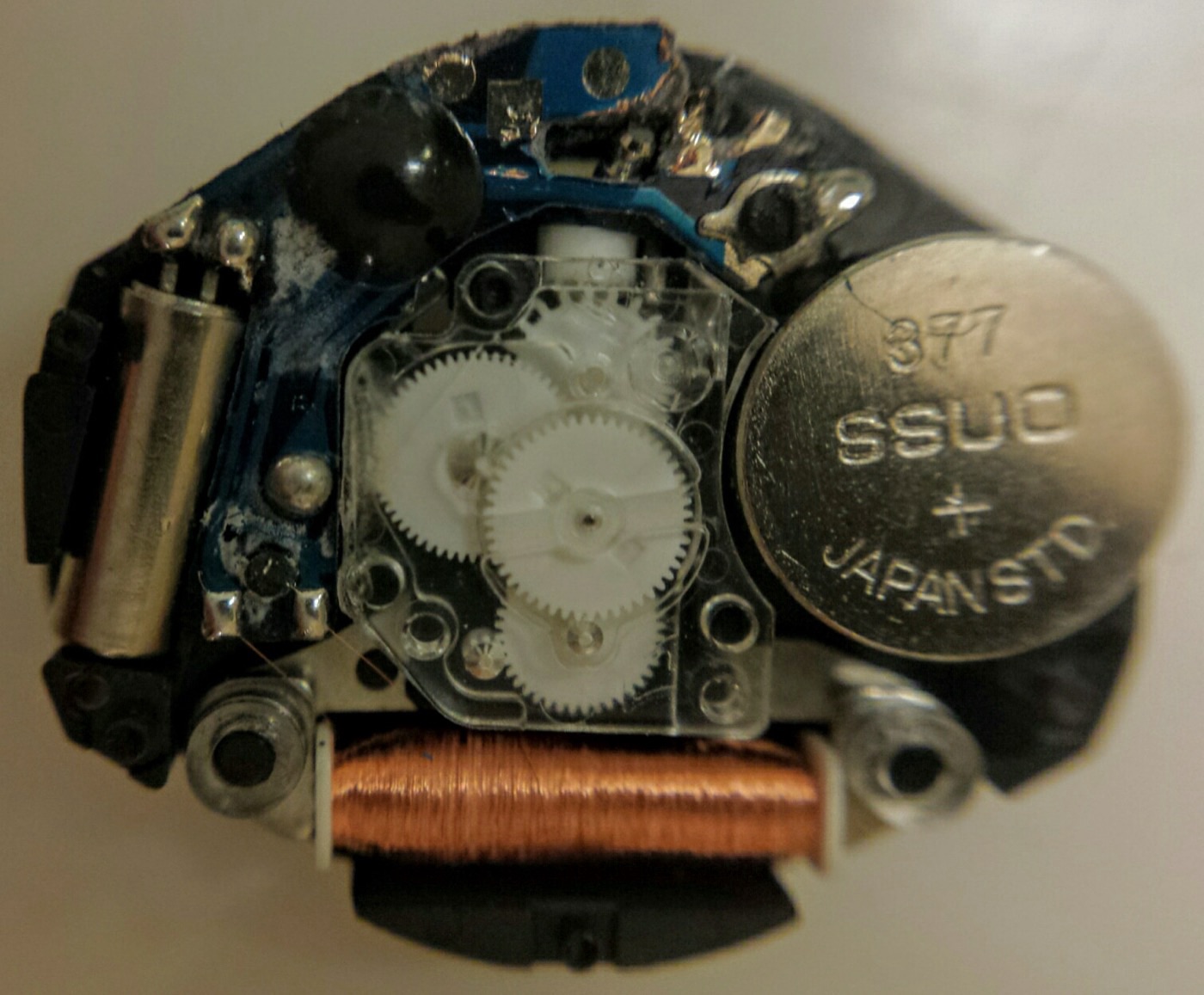
A quartz watch counts the vibrations of a quartz crystal driven by a battery, divides them down electronically, and uses the result to step the hands or change a digital display.1, 2
Most quartz watches today use a crystal at 32,768 vibrations a second, which Wikipedia’s account dates to Girard-Perregaux’s calibre 350 of 1971.1, 6
From clocks to the wrist
Warren Marrison built a quartz clock at Bell Telephone Laboratories in 1927, driving a synchronous motor through a frequency divider, and time laboratories went on to use quartz until atomic clocks replaced it.1, 7, 8
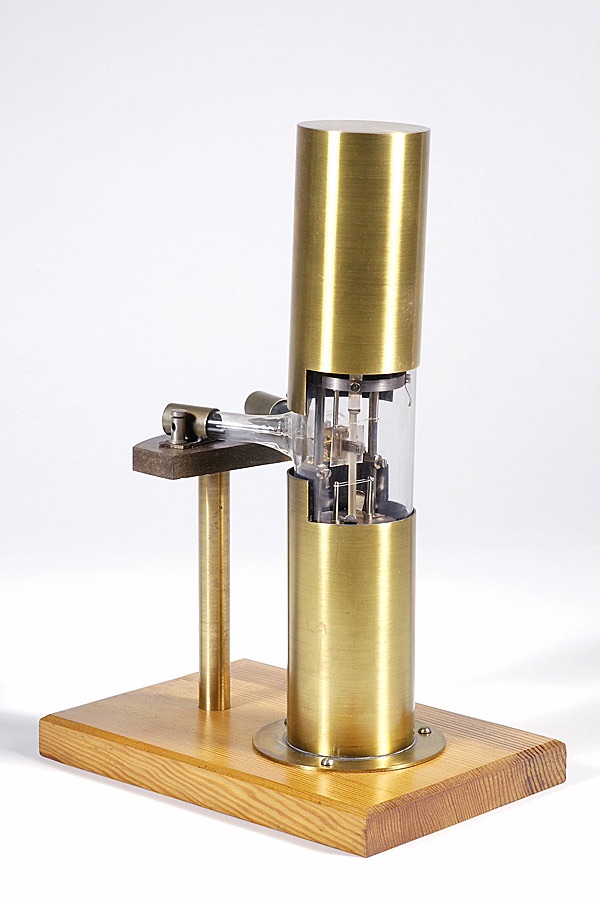
Such clocks filled cabinets. Seiko’s, built in 1958 for a Nagoya broadcaster, was the size of a filing cabinet.2, 10
According to Wikipedia’s account, what made a wristwatch possible was cheap integrated circuits from the 1960s, and later low-power MOS chips that let a coin cell run a watch for about a year.1
The prototypes
The Swiss Centre Electronique Horloger, founded in Neuchâtel in 1962, began its quartz wristwatch project in 1965 and made its own integrated circuits.3, 11, 12
A CEH researcher records that its Beta 1 prototype of July 1967 used an 8,192 Hz crystal, a fourteen-stage divider and a stepping motor, and that Beta 2 used a vibrating motor driven at 256 Hz.11, 12
CEH prototypes set new records at the 1967 Neuchâtel Observatory competition, where Seiko also entered quartz wristwatches.2, 3
On sale
Seiko and the IEEE say Seiko sold the first quartz wristwatch, the Quartz Astron, on 25 December 1969; it used an 8,192 Hz crystal and a stepping motor.1, 2, 10
The Swiss Beta 21 followed on 10 April 1970, sold under many Swiss brands.3, 11
Digital displays came next: Hamilton’s Pulsar with red LEDs, announced in 1970 and sold from 1972, then liquid-crystal displays from 1972 and 1973, which needed far less power.4, 12, 13, 14
Semiconductor firms such as Texas Instruments, Fairchild and National Semiconductor mass-produced digital quartz watches, and prices fell from $2,100 for the gold Pulsar to under $20 for a Texas Instruments LCD watch in 1976.4, 6, 12, 14
Seiko says it disclosed many of its quartz patents and that other makers adopted its method, and that its twin-quartz temperature correction of 1978 cut the annual error to five seconds.10
Quartz watches overtook mechanical ones in popularity by about 1978 to 1980, and by the 1980s quartz dominated the wristwatch market.1, 6, 12, 15
Key dates
- 1927
Marrison builds a quartz clock at Bell Telephone Laboratories.1, 7
- 1958
Seiko’s quartz clock for a Nagoya broadcaster.2, 10
- 1962
The CEH is founded in Neuchâtel.3, 15
- 1967
Quartz wristwatch prototypes at the Neuchâtel Observatory.2, 3
- 1969
The Seiko Quartz Astron goes on sale.2, 10
- 1970
The Beta 21 goes on sale; the Pulsar is announced.3, 13
- 1973
Seiko’s six-digit LCD quartz watch.10, 14
Where the quartz watch leads
- Developed by, CompanyCasio
Casio’s Casiotron of 1974 was a digital quartz watch built on its calculator chips.12, 16
- Developed by, CompanyCitizen
Citizen made a quartz wristwatch in 1973 and a light-powered one in 1976.17, 18
- Developed by, CompanyHamilton
Hamilton and Electro-Data developed the Pulsar LED watch, announced in 1970.13, 19
- Developed by, CompanySeiko
Seiko’s Suwa Seikosha worked on quartz timekeeping from 1959.2, 10
- Came after, TechnologyThe electric watch
Quartz overtook the balance-wheel and tuning-fork electric watches.6, 12
- Used, CompanyOmega
Omega was among the Swiss brands that sold the Beta 21 quartz watch in 1970.3, 20
- Part of, HistoryThe electric and quartz revolution
The quartz wristwatch is the technology at the centre of this history.2, 3
- See also, HistoryMaking watches today
Swiss exports of electronic watches fell from 20.3 million in 2015 to 9.4 million in 2025, by the FH’s figures.21
- See also, CompanyLongines
Longines showed a quartz pocket-watch prototype in 1966.6, 20
- See also, CompanyTitan
Titan made quartz analogue watches at Hosur from 1987, with movements from its collaboration with France Ebauches.22, 23
- See also, PlaceHong Kong
Donzé dates Hong Kong’s assembly of analogue quartz watches to 1975 and of digital watches to the year after.24
- See also, PlaceNeuchâtel
The Beta 21, developed from CEH prototypes, went on sale under Swiss brand names in 1970.3, 25
- See also, PlaceSuwa
Suwa Seikosha worked on quartz timekeeping from 1959.2, 10
- See also, ObjectThe Bulova Accutron
Seiko says the Accutron set off a race for electronic accuracy that ended in its quartz watch.10
- See also, ObjectThe Junghans MEGA 1
A quartz watch corrected by radio: without the DCF77 signal the MEGA 1 runs as an ordinary quartz watch.26, 27
- See also, ObjectThe original Swatch
A quartz watch with hands whose movement is built into its plastic case.28, 29
- See also, ObjectThe Seiko Astron
According to Seiko and the IEEE, the Astron is the first quartz wristwatch to be sold.2, 10
- See also, EventThe quartz crisis
The technology whose falling price turned a research race into an industrial crisis.4, 24
Facts and sources
Sources
- 1
- 2
Milestones: Electronic Quartz Wristwatch, 1969 (opens in a new tab)
- 3
Milestones: Pioneering Work on the Quartz Electronic Wristwatch, 1962-1967 (opens in a new tab)
- 4
1974: Digital Watch is First System-On-Chip Integrated Circuit (opens in a new tab)
- 5
- 6
- 7
- 8
- 9
- 10
History of Seiko and its products, stage 3 (1960s to 1980s) (opens in a new tab)
- 11
First-Hand: The First Quartz Wrist Watch (opens in a new tab)
- 12
- 13
- 14
It's About Time: The Computer on Your Wrist (Chris Garcia, 12 Nov 2014) (opens in a new tab)
- 15
- 16
- 17
- 18
- 19
- 20
- 21
Exports of Swiss watches, electronic and mechanical (historical table) (opens in a new tab)
- 22
- 23
- 24
- 25
- 26
Junghans ‘Mega 1’ radio-controlled wristwatch, 1990 (opens in a new tab)
- 27
- 28
- 29
Montre Tennis Grid, 1983 (AM 1993-1-418) (opens in a new tab)
Sources read November 12, 2026.