The Seiko Astron
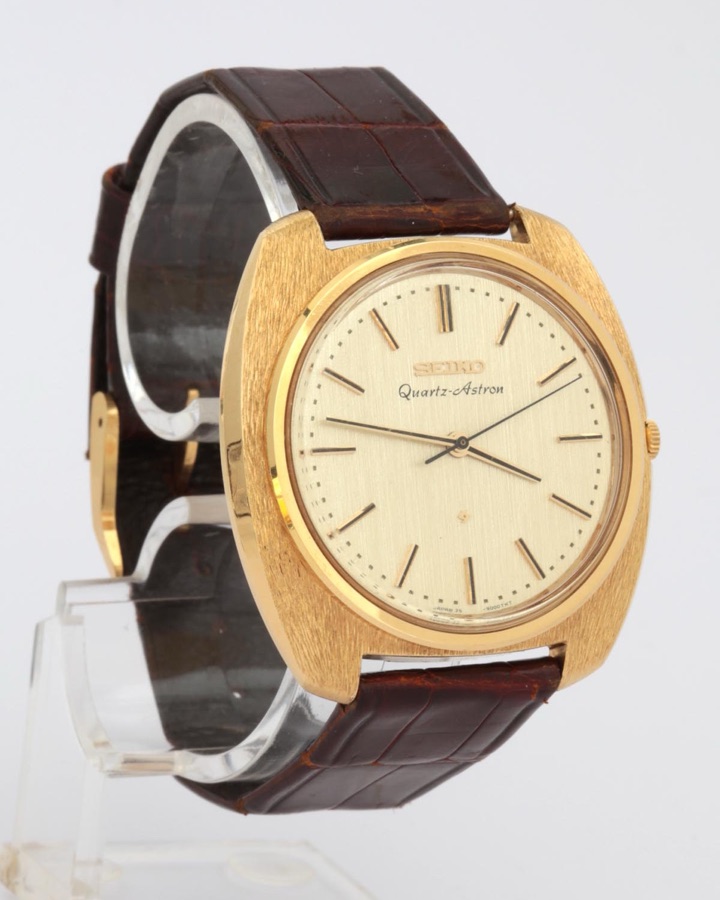
The Seiko Quartz Astron 35SQ, put on sale in Tokyo on 25 December 1969: the quartz wristwatch Seiko and the IEEE describe as the first, the result of ten years’ work at Suwa Seikosha, and now an IEEE Milestone and a designated piece of Japan’s mechanical engineering heritage.
Made 1969, By Suwa Seikosha, for Seiko, Now at Seiko Museum Ginza; examples in the Deutsches Uhrenmuseum, Furtwangen
Companies Seiko
In the history The electric and quartz revolution
Ten years
The Astron came out of about ten years of work at Suwa Seikosha, the Seiko company now called Seiko Epson, which began its 59A project in 1959.1, 5, 6
The way ran through larger quartz machines: a broadcasting clock in 1958, a marine chronometer entered at Neuchâtel in 1963, the timers of the 1964 Tokyo Olympics, and a wristwatch prototype entered at Neuchâtel in 1967.1, 2
The watch
It went on sale in Tokyo on 25 December 1969 as the Seiko Quartz-Astron 35SQ, by Seiko’s and the IEEE’s dates; a CEH researcher’s memoir gives 26 December.1, 2, 7
Seiko and the IEEE describe it as the first quartz wristwatch, and the Japan Society of Mechanical Engineers as the first quartz-type wristwatch; Swiss prototypes had run in 1967, so the claim rests on its being the first sold.1, 2, 3, 8
It kept time with a quartz crystal vibrating 8,192 times a second, divided down by an electronic circuit to drive a small stepping motor that turned the hands.1, 9, 10
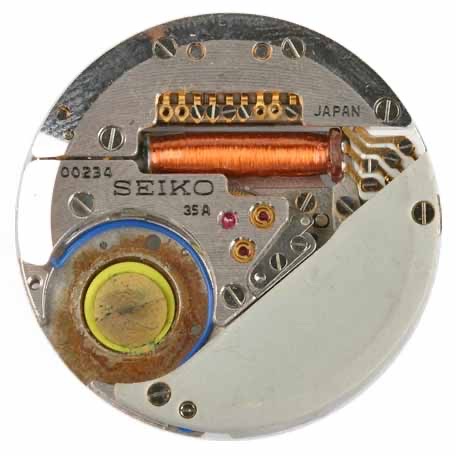
Sources describe the crystal and circuit differently: the IEEE and the Deutsches Uhrenmuseum record an XY-cut crystal and a hybrid integrated circuit, while Seiko’s museum describes a tuning-fork crystal in a vacuum capsule and a CMOS chip of its own.1, 6, 9
Seiko gives its accuracy as within five seconds a month, about a minute a year, with a battery lasting more than a year.1, 12
It was priced at 450,000 yen, and the IEEE records that a hundred of the 18-carat gold watches sold in the first week. The Deutsches Uhrenmuseum’s record says only a hundred were sold, so how many were made is not settled here.1, 2, 4, 12
Seiko says it disclosed much of the patent portfolio built up for the Astron, and that its competitors then adopted the Seiko method.2
Recognition
The IEEE gave it an Innovation Recognition Award in 2002 and named it an IEEE Milestone in 2004; the plaque was dedicated on 25 November 2004 at the Seiko Institute of Horology in Tokyo.1, 2
On 7 August 2014 the Japan Society of Mechanical Engineers designated it, with Seiko’s Laurel of 1913 and an early Grand Seiko, as Mechanical Engineering Heritage No. 66.3, 6
The Seiko Museum Ginza exhibits the designated Astron, and the Deutsches Uhrenmuseum in Furtwangen holds a watch and a 35A movement, No. 00234.3, 4, 9
Wikipedia’s account says Seiko reused the Astron name in 2012 for a solar watch that sets itself from GPS satellites.12
Where the Seiko Astron leads
- Made by, CompanySeiko
Suwa Seikosha, a Seiko company, developed and made the Astron.1, 6
- Part of, HistoryJapan builds a watch industry
Suwa Seikosha’s quartz wristwatch of 1969.1, 2
- Part of, HistoryThe electric and quartz revolution
Seiko and the IEEE describe the Astron as the first quartz wristwatch sold.1, 2
- See also, PlaceNeuchâtel
The IEEE records that Suwa Seikosha entered a quartz wristwatch prototype at Neuchâtel in 1967.1
- See also, PlaceSuwa
Developed and made at Suwa Seikosha.1, 6
- See also, TechnologyThe quartz watch
According to Seiko and the IEEE, the Astron is the first quartz wristwatch to be sold.1, 2
- See also, ObjectThe Seiko Laurel
Designated together as Mechanical Engineering Heritage No. 66 in 2014.3, 6
- See also, EventThe quartz crisis
The Astron, on sale in Tokyo in December 1969, is where the crisis begins: quartz in the shops.1, 2
Facts and sources
Sources
- 1
Milestones: Electronic Quartz Wristwatch, 1969 (opens in a new tab)
- 2
History of Seiko and its products, stage 3 (1960s to 1980s) (opens in a new tab)
- 3
- 4
Quartz wristwatch Astron, Seiko, Japan, 1969 (Deutsches Uhrenmuseum) (opens in a new tab)
- 5
- 6
- 7
First-Hand: The First Quartz Wrist Watch (opens in a new tab)
- 8
- 9
Seiko caliber 35A, No. 00234, 1969 (Deutsches Uhrenmuseum, Inv. 2010-006) (opens in a new tab)
- 10
- 11
- 12
Sources read November 11, 2026.