The electric watch
The battery-powered watch of the 1950s and 1960s, the step between the mechanical watch and quartz: at the start a balance wheel driven by a battery, as in Hamilton’s Electric 500 of 1957, then Bulova’s tuning-fork Accutron of 1960.
Introduced 1957 (balance-wheel); 1960 (tuning fork), 1952 to the 1970s
Led to The quartz watch
In the history The electric and quartz revolution
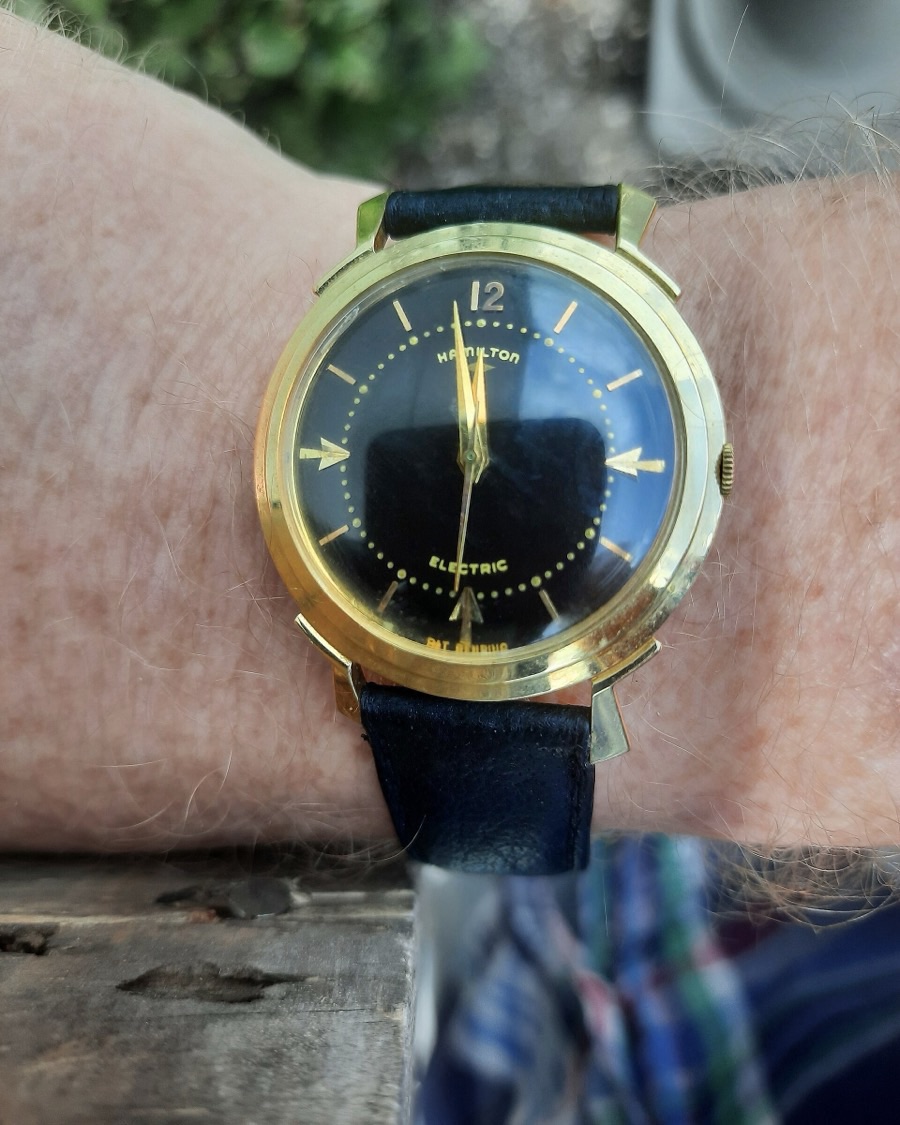
A battery and a balance wheel
An electric watch replaces the mainspring with a battery. In the earlier type the battery drives a balance wheel and hairspring through a coil, so the watch still keeps time mechanically.1, 2
Elgin and Lip showed electric wristwatches in public on the same day, 19 March 1952, and the Swiss historical dictionary dates Swiss electric models to 1952 too.2, 5, 6, 7
Wikipedia and the NAWCC Bulletin say Hamilton was the first to produce and sell one, the Electric 500, in 1957. The day is given as 3 January in some accounts and 4 January in others.2, 5, 8, 9
The Science Museum in London holds a Hamilton electric watch made in Lancaster, Pennsylvania, in 1957, with its spare battery, and names Richard Arbib as its designer.9
Arbib’s triangular Ventura case became Hamilton’s best-known design; Hamilton calls it its most iconic watch.10, 11
Citizen’s X8 of 1966 was the earliest electronic wristwatch made in Japan, according to Wikipedia and Citizen.12, 13
The tuning fork
The second type did away with the balance. Bulova’s Accutron, sold from the autumn of 1960, used a tuning fork vibrating 360 times a second, kept going by a transistor circuit, to drive the hands.3, 8, 14, 15
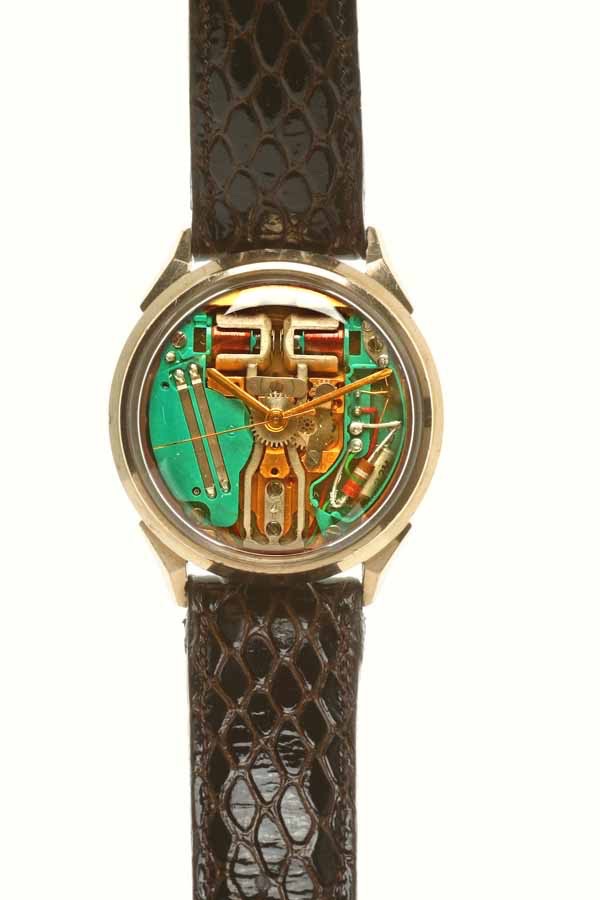
Its designer was Max Hetzel, a Swiss engineer who worked on Bulova’s electronic watch from the early 1950s.3, 14, 15
Bulova guaranteed accuracy within a minute a month and says the Accutron was the first tuning-fork electronic watch.3, 17
More than four million Accutrons had been sold by 1973, and the NAWCC Bulletin puts the total above five million by the end of production in 1977.3, 15
Accutron movements went into timers for NASA: a flight-qualified backup Bulova timer from the Skylab programme of 1973 and 1974 is in the National Air and Space Museum.18
Overtaken
Seiko says the Accutron shocked the industry, and that from 1959 it studied balance, tuning-fork and quartz designs before choosing quartz.1
Quartz overtook both kinds. Hamilton itself moved on to the all-electronic Pulsar, announced in 1970, and quartz watches had overtaken mechanical ones in popularity by about 1978.15, 19, 20
Where the electric watch leads
- Developed by, CompanyHamilton
Hamilton put its Electric 500 on sale in 1957.2, 9
- Developed by, CompanyLip
Presented an electric watch on 19 March 1952 after work with Elgin.21
- Led to, TechnologyThe quartz watch
Quartz overtook the balance-wheel and tuning-fork electric watches.15, 20
- Part of, HistoryThe electric and quartz revolution
Battery and tuning-fork watches were the opening stage of the change.1, 2
- See also, PlaceSuwa
Kusama says Suwa dropped its tuning-fork watch because Bulova held the patents.22
- See also, ObjectThe Bulova Accutron
The tuning-fork type of electric watch, patented for Bulova from 1953.14, 23, 24
- See also, ObjectThe Hamilton Electric 500
The balance-wheel type of electric watch: a coil on the balance, impulsed from a battery, under Hamilton’s patent of 1954.9, 25
Facts and sources
Sources
- 1
History of Seiko and its products, stage 3 (1960s to 1980s) (opens in a new tab)
- 2
- 3
- 4
- 5
- 6
- 7
US 2,865,163: Electrically-powered time device (opens in a new tab)
- 8
- 9
Hamilton Electric Wrist-Watch, 1957 (object 1958-248) (opens in a new tab)
- 10
- 11
- 12
- 13
- 14
Bulova 'Accutron' electronic wristwatch, c. 1963 (object 1963-306) (opens in a new tab)
- 15
- 16
- 17
- 18
Timer, Skylab (National Air and Space Museum, via DPLA) (opens in a new tab)
- 19
- 20
- 21
- 22
- 23
- 24
US 2,971,323: Electronically-controlled timepiece (opens in a new tab)
- 25
Sources read November 11, 2026.